

Multi-Lane Sachet Packaging Machines
A multi-lane sachet packing machine fills several sachets per cycle. Here is how lanes, film width, dosing balance and downstream equipment limit the output.
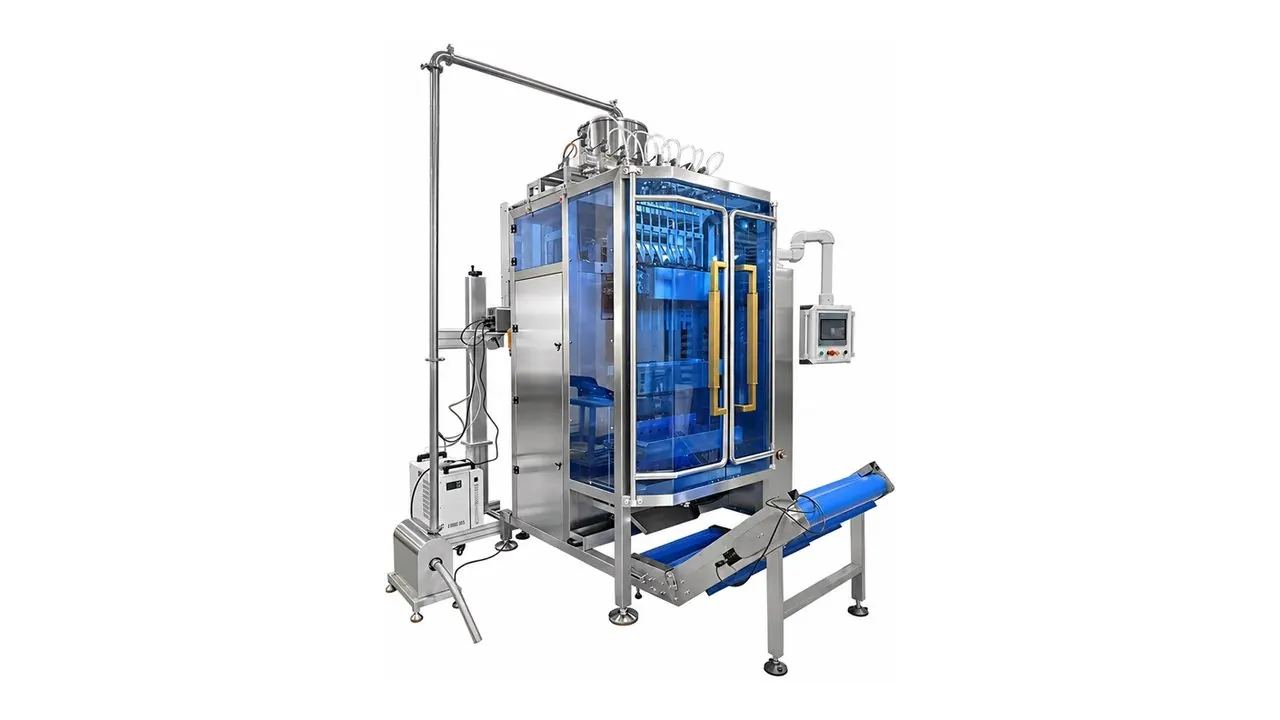
A multi-lane sachet machine forms and fills several sachets side by side in every cycle, so output goes up with the number of lanes. How many lanes you can actually run depends on sachet width, film width, how evenly the lanes dose and what sits downstream. If your main question is sachet shape rather than output, read the 4-side seal page.
How do lanes and cycles set output?
When each lane makes one sachet per cycle, theoretical output is lanes × cycles per minute. Take 6 lanes at 50 cycles per minute: that is 300 sachets per minute on paper. It is only arithmetic to show the formula, not a speed we claim for any machine.
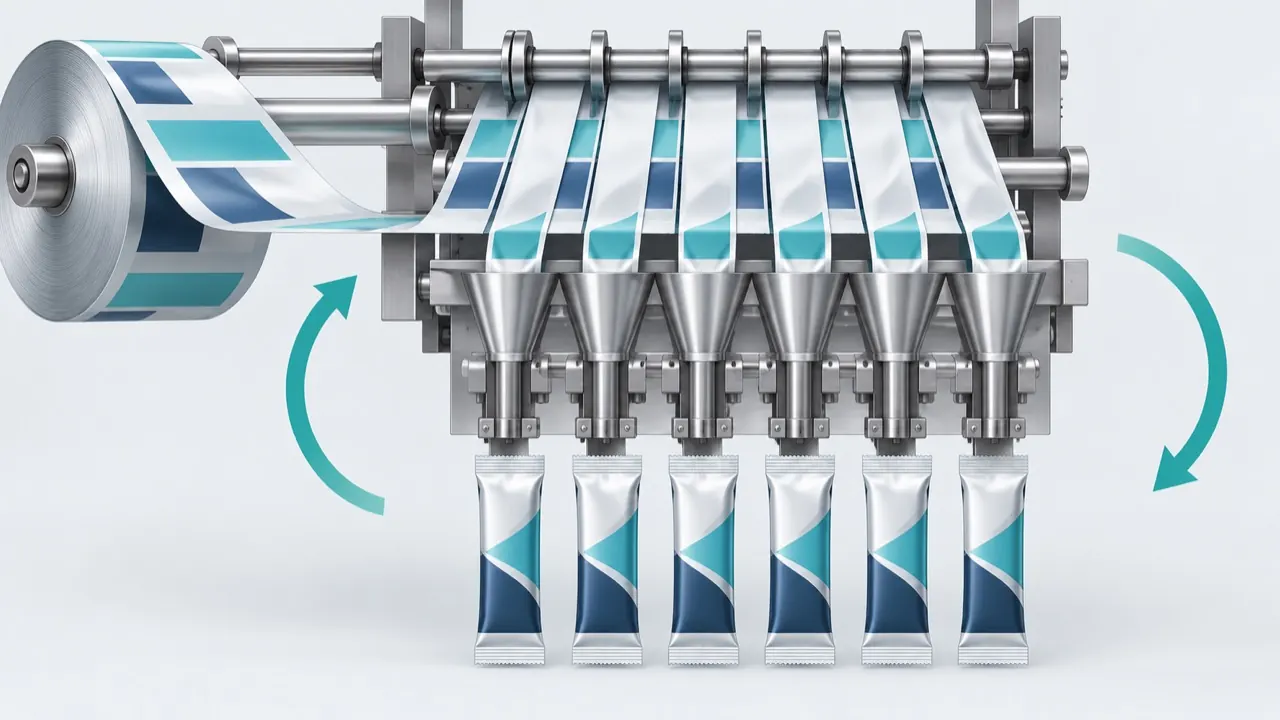
Illustration: each cycle produces one sachet per lane, so lanes and cycles multiply.
Enquiries tend to mix up four different numbers, so keep them apart.
- Per-lane speed is how many sachets one lane completes per minute, which equals the cycle rate.
- Total speed is that figure multiplied by the number of active lanes.
- Theoretical output is the formula above, before any losses.
- Verified output is the count of good sachets you actually get from a run with your product and film.
The gap between the last two depends on the product, the film, the fill portion, the sachet size, seal quality and the equipment after the machine. We do not quote speeds on this page. Your own product sets them, and we only put a number in writing once we have seen it run.
What limits the number of lanes?
All lanes share one film web, so the film has to carry every sachet plus the margins between them. Each lane needs the sachet width, a seal area on both sides and a gap or cutting allowance to its neighbour. Fix the sachet width before you argue about lane count: a wider sachet or a bigger seal margin removes lanes quickly.
Illustration: sachet width, seal margins and lane gaps all add up across the film web.
Per-lane speed, total speed, theoretical and verified output
These terms are often mixed up in enquiries, so keep them separate:
- Per-lane speed is how many sachets one lane completes per minute, which equals the cycle rate.
- Total speed is per-lane speed multiplied by the number of active lanes.
- Theoretical output is the formula above, before any losses.
- Verified output is the count of acceptable sachets actually produced with your product and film during a run.
The gap between theoretical and verified output depends on the product, film, fill portion, sachet size, seal quality and downstream equipment. We do not state speeds on this page. Speed is confirmed for your product in a trial or in the written quotation.
What limits the number of lanes?
Lanes share one film web, so the film must carry every sachet plus the margins between them. Each lane needs the sachet width, a seal area on both sides, and a gap or cutting allowance to the next lane. Wider sachets or larger seal margins mean fewer lanes fit on a given film width.
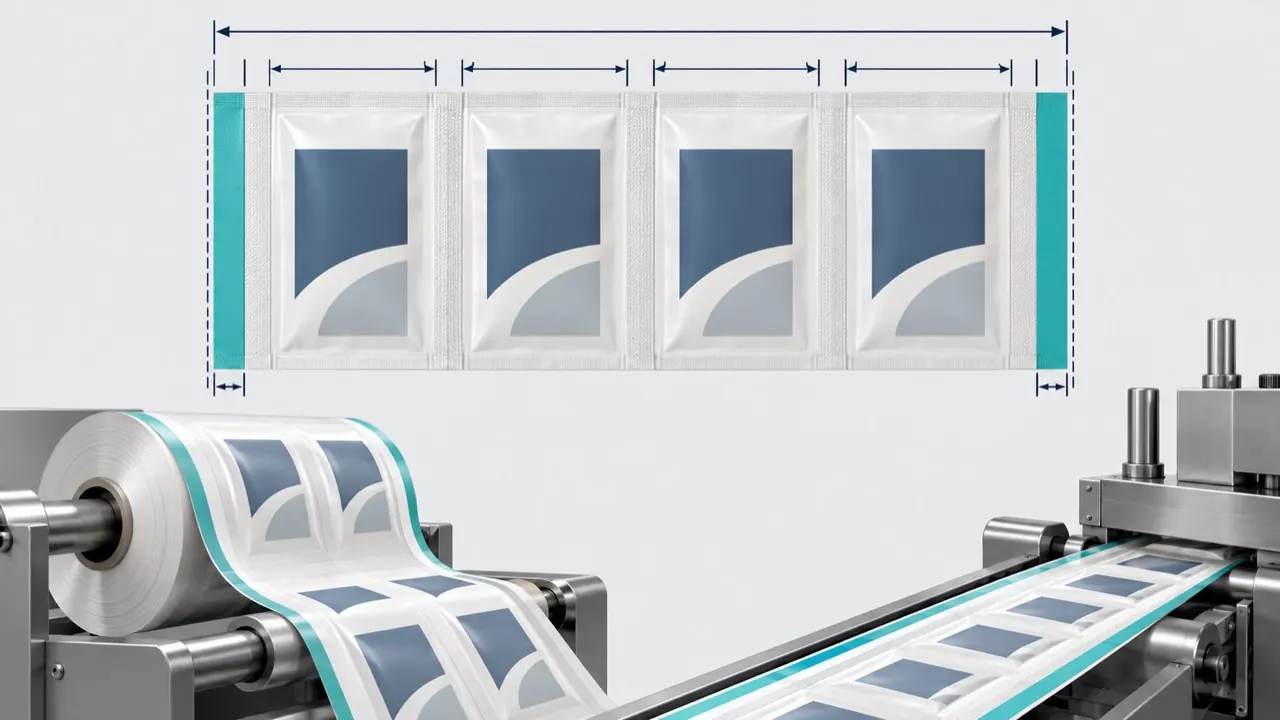
Illustration: sachet width, seal margins and lane gaps all add up across the film web.
Adding lanes also makes the machine harder to run well.
- A wider web has to track and hold tension evenly across every lane.
- Heat and pressure must be even across the whole sealing width, or the outer lanes seal differently from the inner ones.
- On printed film, every lane needs the same registration.
- More lanes mean more contact parts to clean and set at each changeover.
How is dosing handled across lanes?
Each lane gets its own dose, and the lanes have to stay close to each other. The method follows the product: an auger or volumetric cup for dry materials, a piston or pump for liquids and pastes. Our category pages cover the options for powders, liquids and pastes and granules.
The average fill weight across lanes can look fine while one lane runs light and another runs heavy, so check lane by lane. Sample every lane during a run, outer ones included. Look at how product reaches all the lanes too. Powder that bridges in the hopper, a blend that segregates or an uneven product level will all show up as lane-to-lane differences. Cleaning between products or batches matters as well, since every lane has its own dosing parts. We do not promise a fixed accuracy, because what you can hold depends on the product.
What about counting, cartoning and other downstream steps?
A fast filling section only helps if the next step can take what it delivers. A multi-lane machine puts out sachets as several parallel strips or as cut singles, and the line after it has to match.
Strips and singles count and stack differently, so decide early which you want. Check that the counter can follow total speed, not per-lane speed. The carton or case packer needs the right feed rate and sachet orientation. If you use metal detection or vision inspection, it must handle the full rate too. A filler that outruns the cartoner only builds a queue, so size the line as a whole.
Which lane configuration should we discuss?
Lane counts of 4, 6, 8 and 10 are configurations to talk about, not a promise that each is available for every product or sachet size. The table shows what limits each one and what to check.
| Lanes | What mainly limits it | What to verify |
|---|---|---|
| 4 | Usually the easiest to balance and clean; output may fall short of a high target | Whether total output meets the target without extra lanes |
| 6 | Film width and sachet width start to matter | Film width, seal margin and lane-to-lane dose balance |
| 8 | Even sealing and tension across a wide web; feeding all lanes | Seal consistency in outer lanes, feed method, downstream capacity |
| 10 | Film width, dosing uniformity, downstream handling and cleaning access | All of the above, plus whether the sachet size and product allow it at all |
When is a single-lane machine the better choice?
More lanes are not always better. A single lane is often the sensible choice in these cases.
- Volumes are small or products change often, so changeover and cleaning time dominate.
- The product is hard to dose consistently, such as sticky, lumpy or highly variable material.
- The sachet is large, so few lanes would fit the film anyway.
- You are running a first trial or a pilot batch.
- Budget or floor space is tight and the target output is modest.
If you are unsure, our selection guide for sachet machines walks through the decision, and the price guide explains which choices move the cost.
What do we need for a multi-lane quote?
Send us the following and we can suggest a lane count.
- Product name and form (powder, liquid, paste, granule), plus anything about stickiness, flow, particle size or foaming.
- Fill portion per sachet and the sachet size you have in mind.
- Film type, and film width if you already have a supplier.
- Target output, and whether it is a theoretical figure or must be a verified rate.
- Strip or single-sachet output, and the downstream equipment you plan to use.
- Your hygiene and cleaning requirements.
You can ask about a trial run with your film to see real output, or go straight to a quotation request on WhatsApp.
Questions about multi-lane sachet machines
How many lanes do I need?
Start from your target output and the cycle rate your product can take, then test the lane count against film width and sachet width. Lanes × cycles per minute gives the theoretical figure, and a run with your product shows what you really get.
Is theoretical output the same as real output?
No. Theoretical output ignores stoppages, rejects and product-dependent limits. Verified output counts only good sachets from a run with your product and film.
Can I run different products on the same multi-lane machine?
Sometimes, but the dosing method, cleaning routine and film must suit every product. Send us the full product list and we will say whether one configuration is realistic.
Why not simply add more lanes?
A wider film needs even sealing, balanced dosing and a downstream step that can keep up. Past a certain point the extra complexity costs more than the extra output brings.
Not sure which configuration fits your product?
Send your product and pack details, or ask for a trial on your own material before you decide.