

Pharmaceutical Powder & Granule Sachet Packaging Machines: 316L Contact Parts, Foil Laminates & Dose Checks
Published by the LINEVO sachet equipment team. Technical questions and corrections
Specify pharmaceutical granules sachet packaging machines and powder lines: compare contact materials, auger vs cup dosing, foil laminate sealing and checks.
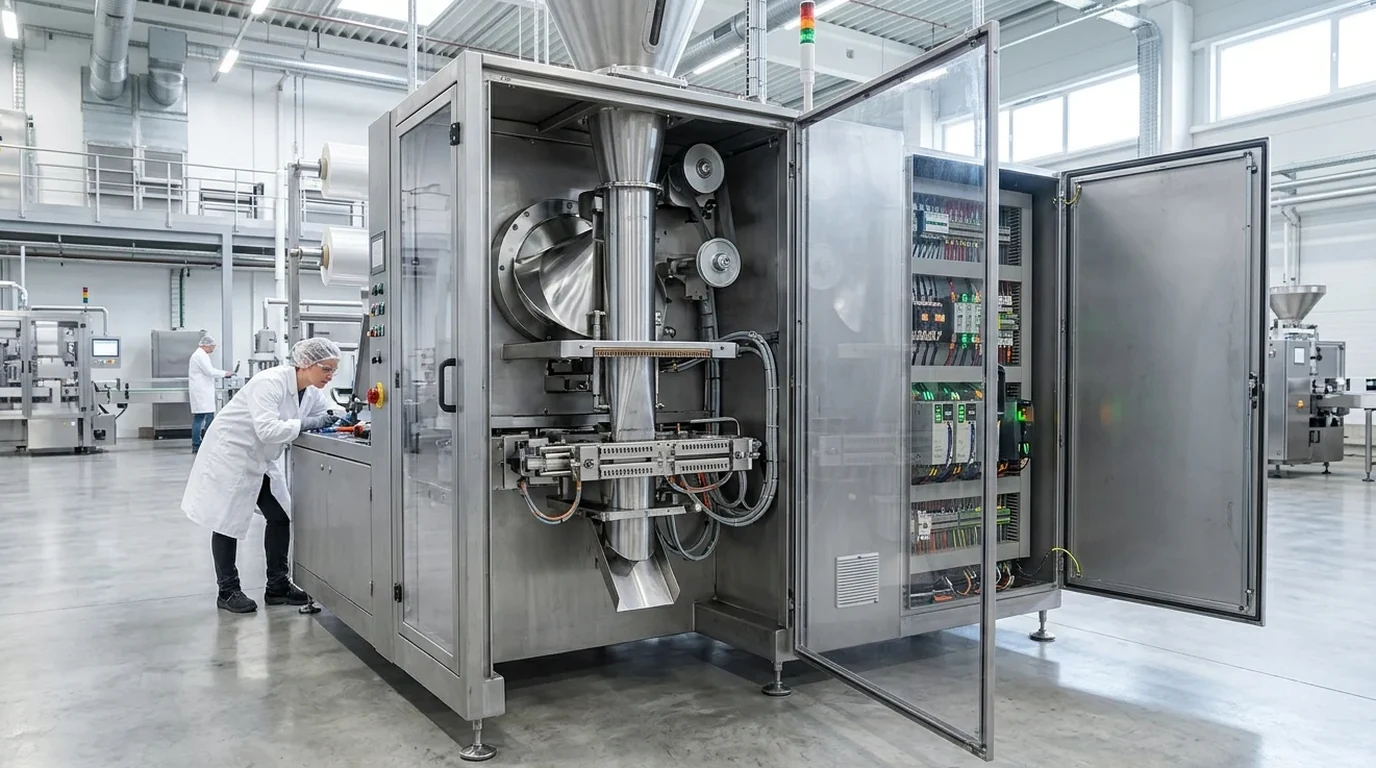
Specifying pharmaceutical granules sachet packaging machines, pharmaceutical powder sachet packaging machines, a pharmaceutical granule packing machine, or an oral rehydration salts sachet machine requires defining product-contact metallurgy, dosing geometry, high-barrier foil laminate sealing windows, and inline verification controls before requesting a formal quotation. Use this engineering specification guide alongside our granule sachet packaging machine overview, our powder sachet packaging machine overview, our sachet packaging technical guides, and our guide on how to choose a sachet packaging machine to align your user requirement specification with factory acceptance checks.
| Specification domain | Equipment elements to define | Engineering verification focus |
|---|---|---|
| Contact materials and hygiene | 316L contact hopper, dosing screw/cups, forming tube, PTFE seals, tool-free latches | XRF alloy check (Cr/Ni/Mo), FTIR polymer check, and 21 CFR § 211.67 cleaning disassembly |
| Dosing head and flow control | Over-flight or parallel auger, spinner cut-off disc, vented hopper, volumetric cups (4–4916 ml), or weigh filler | Cohesive vs friable granule handling and bulk-density drift compensation |
| Barrier laminate and sealing jaws | PET/AL/PE foil laminate, jaw serration profile, carbon/NCR impression strip, and peel/leak rigs | Narrowed thermal seal window on thick foil and 3-to-4-layer seam overlaps |
| Batch coding and inline checks | Thermal/laser coder, 100% camera vision, OIML R 51-1 checkweigher, reject sensor, and lockable bin | 21 CFR § 211.68 calibration logs, lot-code legibility, and verified reject reconciliation |
Contact materials, sanitary construction and alloy verification
Start the mechanical specification at the product-contact hopper, dosing assembly, and vertical forming tube, and compare frame and contact surface boundaries across our powder sachet machine configurations and granule sachet machine configurations.
Under 21 CFR § 211.65(a), equipment shall be constructed so that surfaces that contact components, in-process materials, or drug products shall not be reactive, additive, or absorptive so as to alter the safety, identity, strength, quality, or purity of the drug product beyond the official or other established requirements.
Under current good manufacturing practice for finished pharmaceuticals, any substances required for operation, such as lubricants or coolants, shall not come into contact with components, drug product containers, closures, in-process materials, or drug products so as to alter the safety, identity, strength, quality, or purity of the drug product beyond the official or other established requirements.
The presence of molybdenum (Mo) in the alloy differentiates 316-series stainless steel from 304, as molybdenum contributes to improved resistance in certain corrosive environments where 316-series stainless steel is frequently considered for demanding product-contact applications.
In the distinction between 316 and 316L stainless steel, the L indicates lower carbon content, which becomes particularly relevant for welded components because lower carbon content can reduce the risk of certain forms of corrosion associated with welding.
On a pharmaceutical packaging machine, a product-contact hopper may use 316L stainless steel, while the machine frame may use 304 stainless steel.
Using an XRF spectrometer, manufacturers can analyze elements such as Chromium (Cr), Nickel (Ni), and Molybdenum (Mo), where the presence and relative amount of molybdenum are particularly useful when distinguishing 316-series stainless steel from 304.
To identify polymer composition through infrared spectroscopy, a practical identification method to verify PTFE is FTIR, or Fourier Transform Infrared Spectroscopy.
Cleaning disassembly and micro-filler enclosure examples
Evaluate how quickly operators can strip down the dosing head between batches without introducing hidden powder traps.
Written pharmaceutical equipment cleaning procedures must describe the methods of disassembling and reassembling equipment as necessary to assure proper cleaning and maintenance.
Written pharmaceutical equipment cleaning procedures must also include removal or obliteration of previous batch identification, protection of clean equipment from contamination prior to use, and inspection of equipment for cleanliness immediately before use.
On All-Fill's pharmaceutical micro-filler, every surface that contacts the product is constructed from 316L grade stainless steel, complete with available material and welding certificates for full regulatory compliance.
All-Fill's pharmaceutical micro-filler uses a dustproof stainless-steel enclosure, IP65 rating, and standard tool-free disassembly to make cleaning and changeovers fast, safe, and compliant with pharmaceutical hygiene standards.
One Italian OEM's pharmaceutical granule sachet machines provide optimal accessibility, easy handling, modular design, and quick cleaning thanks to swivel-mounted dosing units where no tools are required for disassembling.
Auger dosing, volumetric cups, weigh-filling and bulk density control
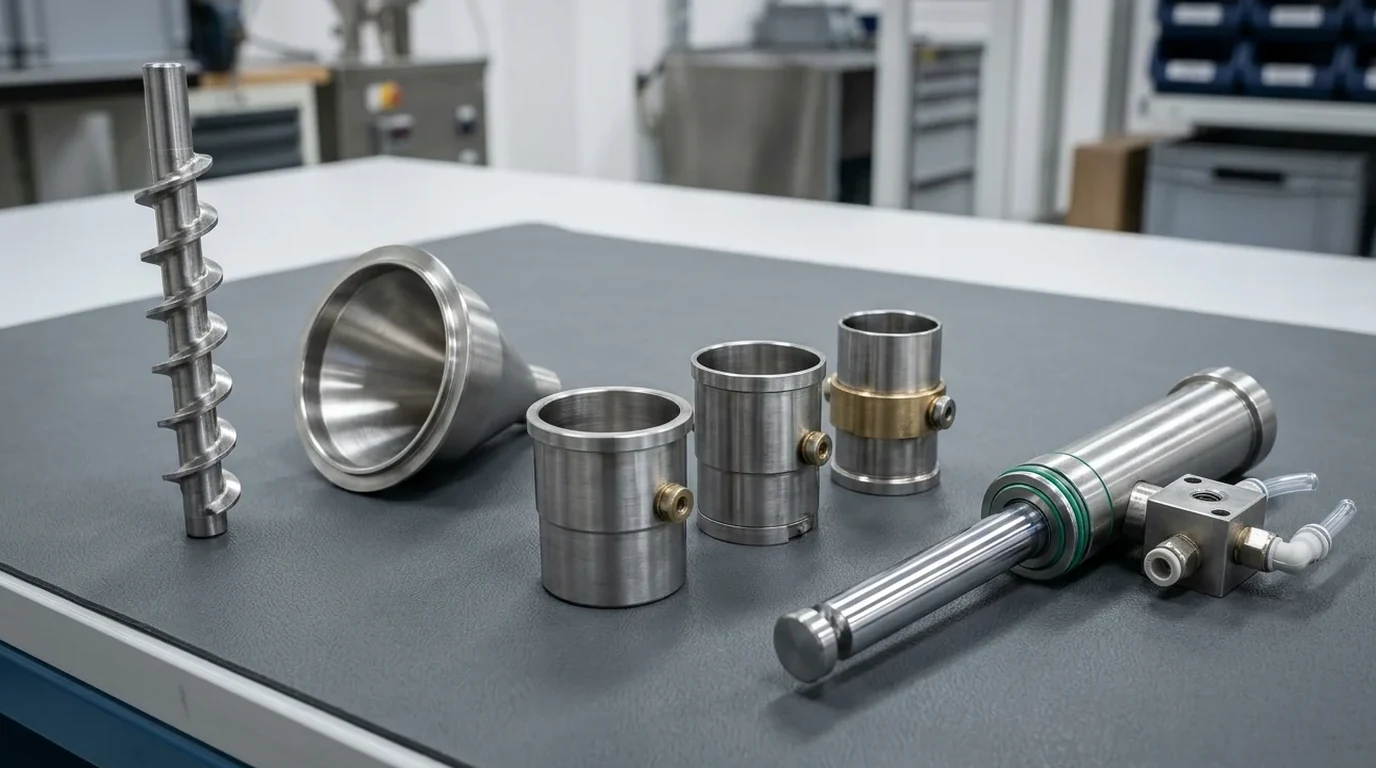
Match the dosing mechanism to particle size, cohesiveness, friability, and bulk-density stability using our auger versus volumetric cup filling guide and our sachet sizes and fill capacity guide.
In All-Fill's non-free-flowing auger tooling setup, the auger is flush with the bottom of the funnel, the agitation blade extends into the throat of the funnel, and the auger features larger diameter over-flights in the hopper section.
Because a delicate or granular product might be damaged if large diameter compressive auger over-flights are used within the hopper section, an auger with parallel flights would be selected.
When free-flowing (granular) products are being filled with an auger, a method of cutting off the powder flow is required, and the usual method is to use a spinner disc—a saucer-shaped disc attached to the end of the protruding auger, designed to retain the product flow.
An unvented infeed system can additionally be a source of accuracy problems by building up air pressure in the hopper of the filler, and venting the hopper back through the infeed system is often the simplest method to eliminate this problem.
In volumetric cup fillers, cup volume sizes can vary greatly from .25 in³ (4ml) to 300 in³ (4916ml), with options that include multi-dump, dual discharge, and servo drive ability.
Where factors such as variations in bulk density and particle size/distribution, high cost, or criticality of dose demand closer tolerances, weigh-filling technology can be employed.
To verify volumetric fill mass, operators weigh each filled sachet and subtract the measured empty-pack tare to record net product mass, keeping the gross reading, tare method, and net result together.
Oral rehydration salts packet formula and volumetric dosing math
Compare fixed-volume cup dosing against multi-component formulation weights and sachet pocket geometry before locking tooling dimensions.
The WHO and UNICEF Oral Rehydration Salts packet formula for 1 liter of clean water consists of 2.6 grams of salt, 2.9 grams of trisodium citrate dihydrate, 1.5 grams potassium chloride, and 13.5 grams anhydrous glucose (a sugar).
Summing those Oral Rehydration Salts packet ingredients (2.6 g, 2.9 g, 1.5 g, and 13.5 g) gives a combined dry fill weight of 20.5 g per packet.
In a volumetric cup worked example with assumed inputs of a 4 g sugar portion and a bulk density of 0.8 g/ml, the required volume is 4 ÷ 0.8 = 5 ml, and since the LV-350X lists a fill range of 1 to 50 g, 4 g sits inside it.
Because a volumetric cup set to 5 ml delivers 4 g only at that density, if a lot packs at an assumed 0.75 g/ml, the same cup gives 5 × 0.75 = 3.75 g.
With assumed seal widths of 5 mm on each long edge and 6 mm at each end, a 4-side seal sachet 40 mm wide and 60 mm long has an internal cavity 40 − 5 − 5 = 30 mm wide and 60 − 6 − 6 = 48 mm long.
High-barrier foil laminates, heat-seal windows and seal integrity testing
Specify the barrier laminate structure, jaw serration profile, and quality-control test methods alongside our four-side seal sachet machine overview and our sachet sealing problems troubleshooting guide.
One powder sachet machine builder's documentation states its machine is compatible with most common laminated packaging films including BOPP/PE, NY/PE, PET/AL/PE (aluminium foil laminate), and kraft paper composites.
In flexible packaging laminates with the same sealant layer (type and thickness), usually a doubling of the base film thickness almost doubles the seal strength, however the thicker the material, the narrower the temperature sealing range under normal sealing conditions.
The effective seal range narrows as machine speed is increased and dwell time is reduced, so machine speed is limited by the need to keep normal temperature cycles within the effective seal range.
Assuming a thickness deviation of ±10%, with a standard thickness of 80 µm, the composite film thickness would range from 72 µm to 88 µm, with a maximum deviation of 16 µm.
Insufficient resin fusion is commonly seen at the four-layer section of the back seal or at the overlap between the side seal and top seal, where the heat-sealed area is separated by three layers of laminated film.
Jaw impression diagnostics and empty-sachet split testing
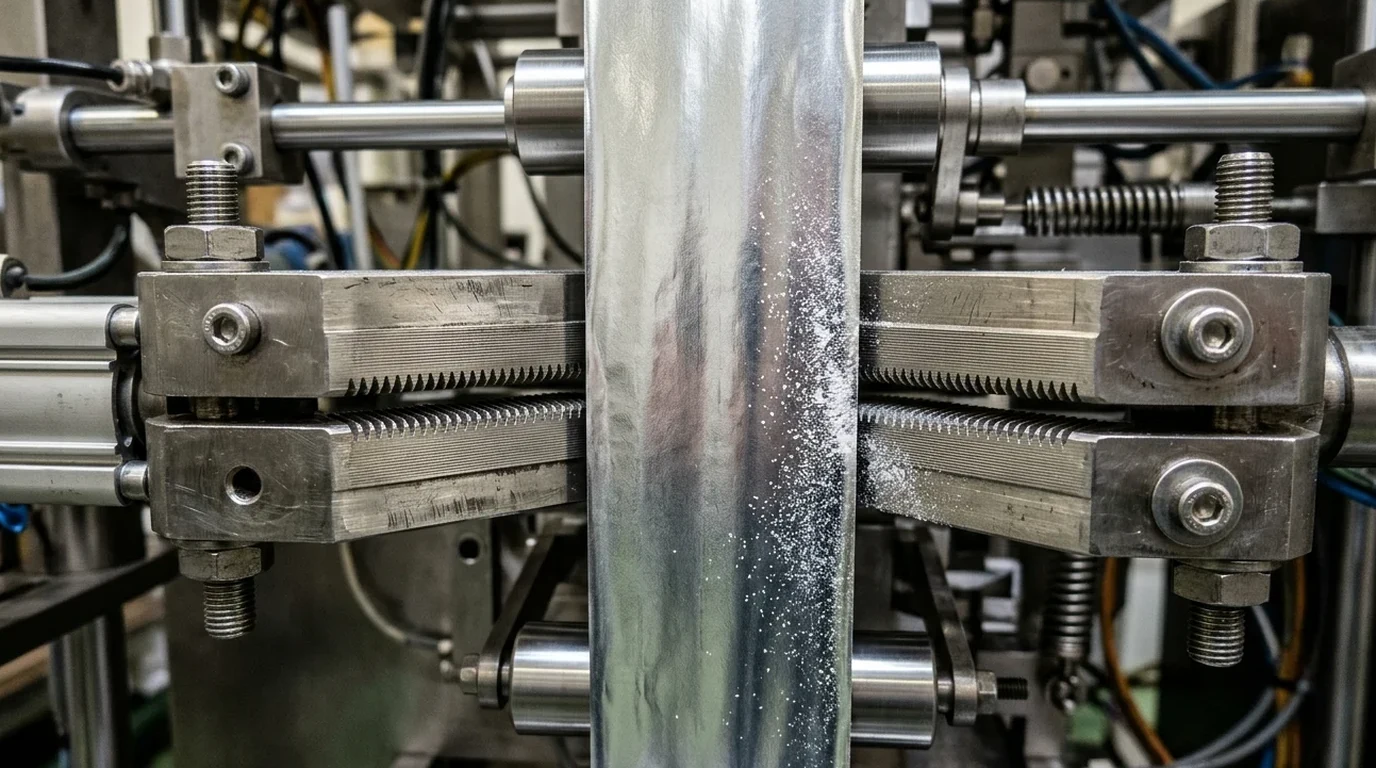
Verify mechanical jaw nip uniformity before attributing leakers to powder contamination in the seal zone.
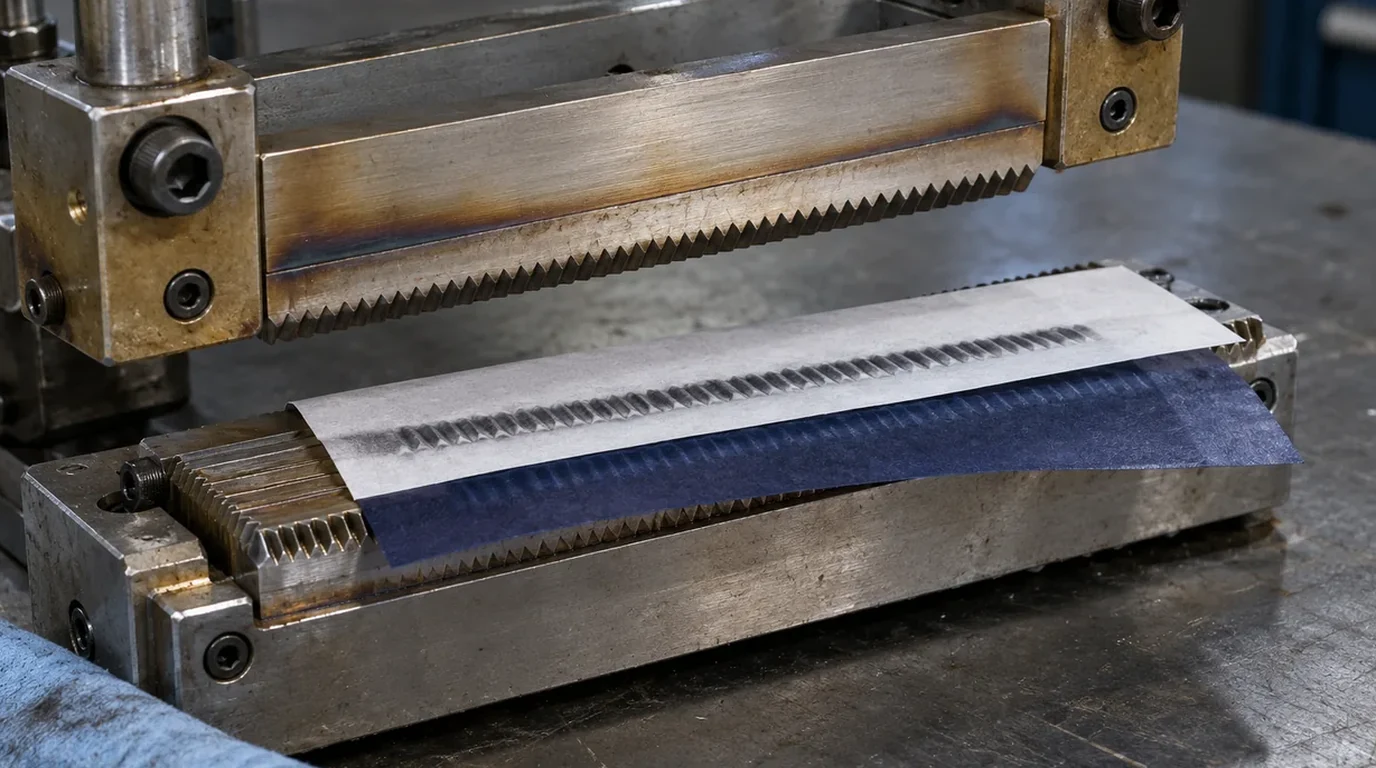
For sealing jaw impressions, carbon paper works best with unheated rotary sealing jaws and with reciprocating jaws at lower temperatures, whereas carbonless paper, also known as NCR paper, is used with heated rotary jaws and with reciprocating jaws at higher temperatures.
To separate film and jaw setup issues from product drop contamination, operators stop the doser and run a short strip of empty sachets on the same film roll at the same cycle speed.
Seal strength peel testing and internal pressurization leak detection
Qualify sealed foil packets during factory acceptance and routine in-process checks using recognized peel and gross-leak test standards.
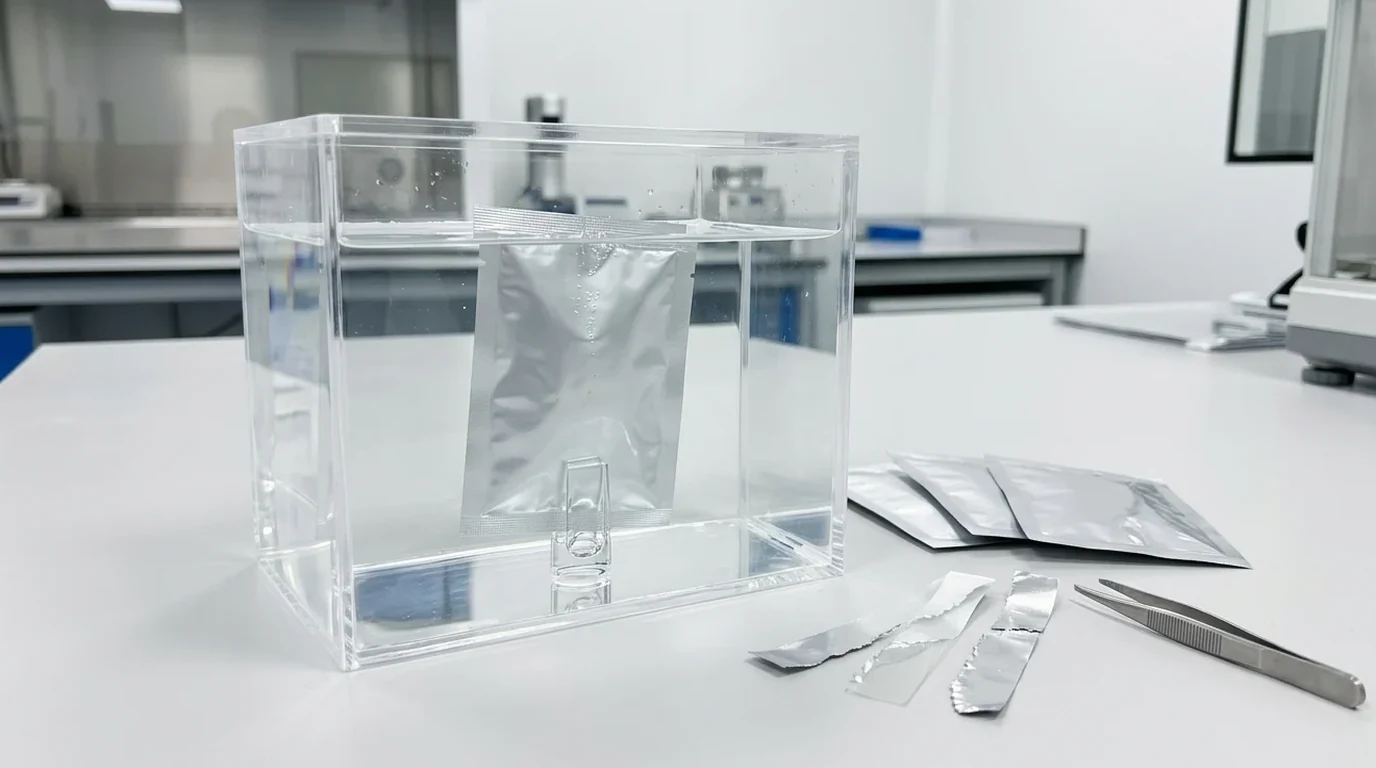
ASTM F88/F88M-23 is the Standard Test Method for Seal Strength of Flexible Barrier Materials.
The internal pressurization bubble test method covers the detection of gross leaks in packaging, has a method sensitivity down to 250 μm (0.010 in.) with an 81 % probability, and may be used for tray and pouch packages.
Batch coding, vision verification, checkweighing and multi-lane output
Define electronic calibration controls, batch-code verification, inline checkweighing, and multi-lane machine geometry alongside our multi-lane sachet machine overview and our sachet packaging machine price and scope guide.
When automatic, mechanical, or electronic equipment is used in pharmaceutical packing, it shall be routinely calibrated, inspected, or checked according to a written program designed to assure proper performance, and written records of those calibration checks and inspections shall be maintained.
Appropriate controls shall be exercised over computer or related systems to assure that changes in master production and control records or other records are instituted only by authorized personnel.
Drug product packaging and labeling procedures must provide for identification of the drug product with a lot or control number that permits determination of the history of the manufacture and control of the batch.
On one Italian OEM's sachet lines, inline vision inspection systems are installed directly on the sealing machines and analyze in real-time 100% of the products (not statistic control) also at high speeds.
OIML R 51-1 covers metrological and technical requirements for automatic catchweighing instruments; NIST Handbook 44 covers specifications, tolerances, and other technical requirements for weighing and measuring devices.
For controlled pharmaceutical production, the checkweigher reject process can also include a confirmation sensor and a lockable collection bin, and these features help show that the correct package was removed.
Multi-lane granule and powder sachet machine configurations
Compare catalog parameters across single-cycle multi-lane granule and servo-auger powder sachet machines when sizing line throughput.
When each active lane makes one sachet per cycle on a multi-lane sachet machine, theoretical output (sachets/min) equals active lanes multiplied by cycles/min.
Our LINEVO LV-350X is a four-side seal granule sachet machine engineered as a multi-lane sachet packaging configuration for solid beverage granules and similar granular formulations.
In our specification table for the LV-350X four-side seal granule sachet configuration, the fill range is 1–50 g, sachet length is 50–180 mm, and sachet width is 30–80 mm per lane.
On our four-side seal granule sachet configuration, four lanes form, fill and seal in one cycle, taking less floor space than several single-lane machines.
Our granule sachet configuration serves instant drink mixes and solid beverage granules such as coffee, milk tea, ginger tea, and electrolyte powders, as well as granule sachets for collagen, fibre, vitamin powders, and herbal granules.
When fill volume differs between lanes or fine granules leak from the seal on our granule sachet configuration, we set lane dosing and seal pressure per lane during sample review.
With Independent Multi-Lane Servo Auger Dosing on our LINEVO multi-lane powder sachet machine, each lane uses an independently servo-driven vertical dosing screw to control powder delivery.
For our LINEVO multi-lane powder sachet configuration, we specify output, sachet dimensions and utilities around your selected powder, dose, film and lane configuration.
One vertical sachet machine model described in manufacturer documentation handles granules, powders, and pills, dosing powders from 0.5 to 40 g and making sachets 30 to 100 mm wide and 35 to 160 mm long.
What to send for a pharmaceutical powder or granule sachet quotation
Prepare the following engineering inputs before scheduling a material trial through our product and film sample testing page or requesting a line proposal:
- Formulation physical state, flow behavior, bulk density range, particle friability, and target fill mass per packet.
- Required product-contact stainless steel grade, polymer seal materials, and alloy or polymer verification certificates needed at factory acceptance.
- Sachet outer width and length, seal border widths, laminate layer structure, and nominal film thickness.
- Target output in sachets per minute, preferred lane count, and cleanroom floor-space or ceiling-height constraints.
- Inline quality-control requirements including batch coding format, camera vision inspection, dynamic checkweighing, confirmation sensors, and lockable reject bins.
Send your formulation details, sachet drawing, foil laminate specification, and target output on WhatsApp to review dosing tooling and lane configuration with our engineering team.
Frequently asked questions
Why is low-carbon molybdenum stainless steel specified for pharmaceutical powder hoppers while the frame uses standard austenitic steel?
Product-contact hoppers and dosing paths use 316L stainless steel because its molybdenum (Mo) content improves corrosion resistance against reactive salts or sanitizers, and its low-carbon ("L") chemistry prevents weld-zone sensitization and intergranular corrosion. Non-contact structural frames do not touch the drug product, making standard 304 stainless steel suitable.
How can buyers verify stainless steel and anti-stick polymer grades during a factory acceptance test?
Inspectors verify metallic contact parts non-destructively with a handheld X-ray fluorescence (XRF) analyzer to confirm Chromium (Cr), Nickel (Ni), and the Molybdenum (Mo) signature that distinguishes 316-series steel from 304. Polymer contact components such as PTFE seals and guides are verified using Fourier Transform Infrared Spectroscopy (FTIR).
How does auger flight geometry change between cohesive pharmaceutical powders, delicate granules, and free-flowing granules?
Cohesive, non-free-flowing powders use an auger flush with the funnel exit, a throat-extending agitator blade, and wider-diameter compressive over-flights in the hopper. Delicate or friable granules require uniform parallel flights to avoid crushing particles, while free-flowing granules add a saucer-shaped spinner disc at the auger tip to stop dribble between cycles.
Why do thick foil laminates and seam overlaps require careful jaw temperature, dwell time, and pressure setup?
Doubling base laminate thickness roughly doubles seal strength for a given sealant layer, but narrows the usable heat-sealing temperature window—a window that shrinks further as higher cycle speeds shorten jaw dwell time. Where side and cross seals intersect (or at four-layer back-seal junctions), heat must conduct through three to four film layers simultaneously, requiring calibrated jaw pressure and dwell to prevent unsealed corner channels.
Sources
- U.S. Food and Drug Administration — Current Good Manufacturing Practice for Finished Pharmaceuticals, Equipment Construction, Cleaning, Maintenance, Automatic Equipment, and Packaging and Labeling Operations
- World Health Organization and UNICEF — Oral Rehydration Salts Formulation Reference
- International Organization of Legal Metrology — Automatic Catchweighing Instruments, Metrological and Technical Requirements and Tests
- National Institute of Standards and Technology — Specifications, Tolerances, and Other Technical Requirements for Weighing and Measuring Devices
- ASTM International — Standard Test Method for Seal Strength of Flexible Barrier Materials
- ASTM International — Standard Test Method for Detecting Gross Leaks in Packaging by Internal Pressurization
- All-Fill International — Auger Filling Technology and Auger Filling Accuracy Guides
- Automate UK and All-Fill — Pharmaceutical Powder Micro-Filler Technical Release
- Auger Fabrication Inc. — Auger Fillers Not Your Only Option
- Greener Corporation — Sealing Jaw Carbon and Carbonless Paper Impressions and Thermal Transfer Efficiency Guides
- A. Hatzopoulos — Heat Sealing Troubleshooting in Flexible Packaging Laminates
- Sachet machine manufacturers (product documentation; vendor names withheld) — Granule Dosing Design, Film Compatibility, Inline Vision Inspection and Format Range
- Our LINEVO Official Catalog — Four-Side Seal Granule Sachet Machine Catalog
- Our LINEVO Official Catalog — Multilane Powder Sachet Packaging Machine Catalog