

Spice Sachet Packing for Powders, Granules and Blends
Spice sachet packing for fine powders, granular spices and blends: a requirements matrix, a copyable blend trial record and what to send for a trial and quote.
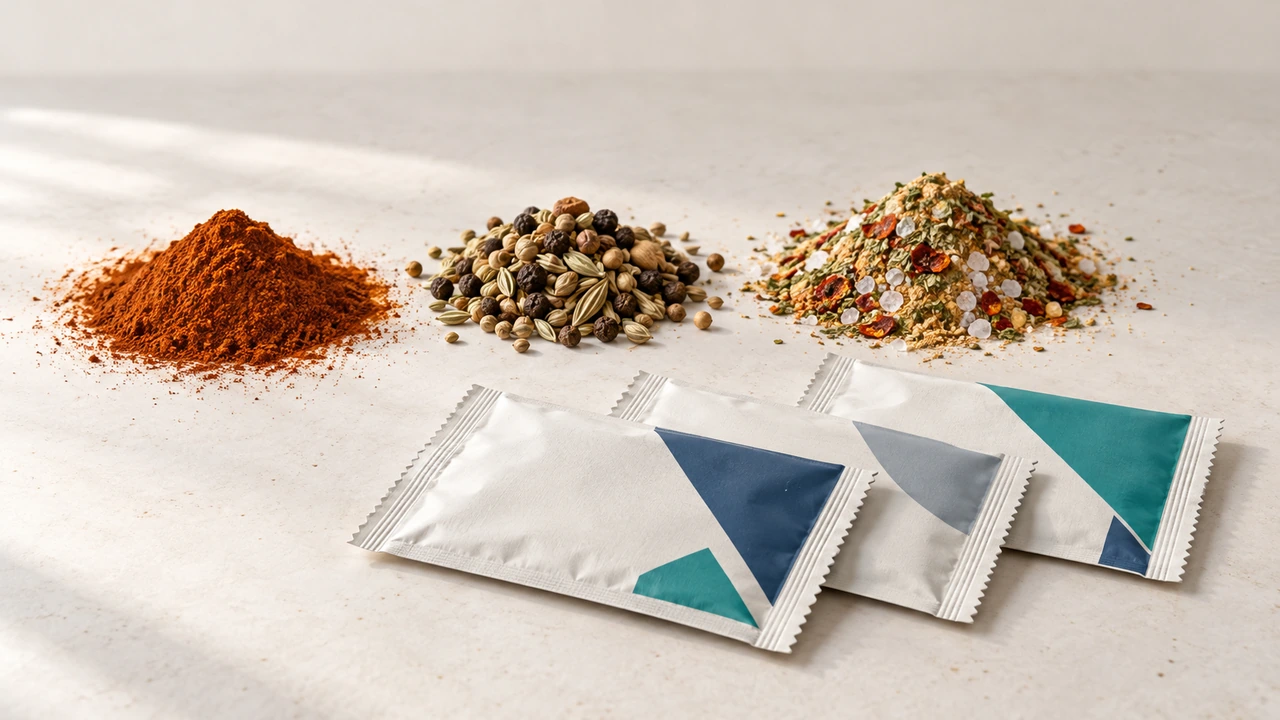 Illustration
Before packing spice into small flat sachets, decide whether it is a fine powder, a granular spice or a mixed blend. Pick the wrong dosing route and the run shows it as off-weight sachets, dusty seals or an uneven mix.
Fine spice powders usually start from auger dosing; watch flow, dust at the seal and density between batches. Free-flowing granules, seeds and flakes may suit cup or vibratory dosing if bulk density stays steady and the largest pieces clear the seal. Blends need a second check, because fine and coarse parts can separate and a correct sachet weight says nothing about the mix.
| Buyer input | Where it comes from | Why it matters |
|---|---|---|
| Spice form and behaviour | Your batches: flow, dust, oil, moisture, largest piece | Chilli powder and chilli flakes are different dosing problems |
| Target dose and tolerance | Your fill specification, as net product weight | Sets the pass limit for the dose check |
| Composition limits and test method | Your quality team | A weight check cannot show the mix |
| Flavour and allergen changes | Your product schedule | Each change adds cleaning and a release check |
Is your spice a powder, a granule or a blend?
Sort it by behaviour. One equipment supplier splits spice ranges into fine powders, granules, flakes, blends and whole spices when matching filling routes to them.
- Fine powders such as ground pepper, turmeric, chilli or garlic powder may bridge, hold air, cling to film or throw dust.
- Granules, seeds and flakes, such as seasoning crystals or dried herbs, mostly flow, but the pieces vary in shape and size.
- Mixed blends combine fine powder with coarser salt, sugar, herbs or flakes. They behave like both, and their parts can separate.
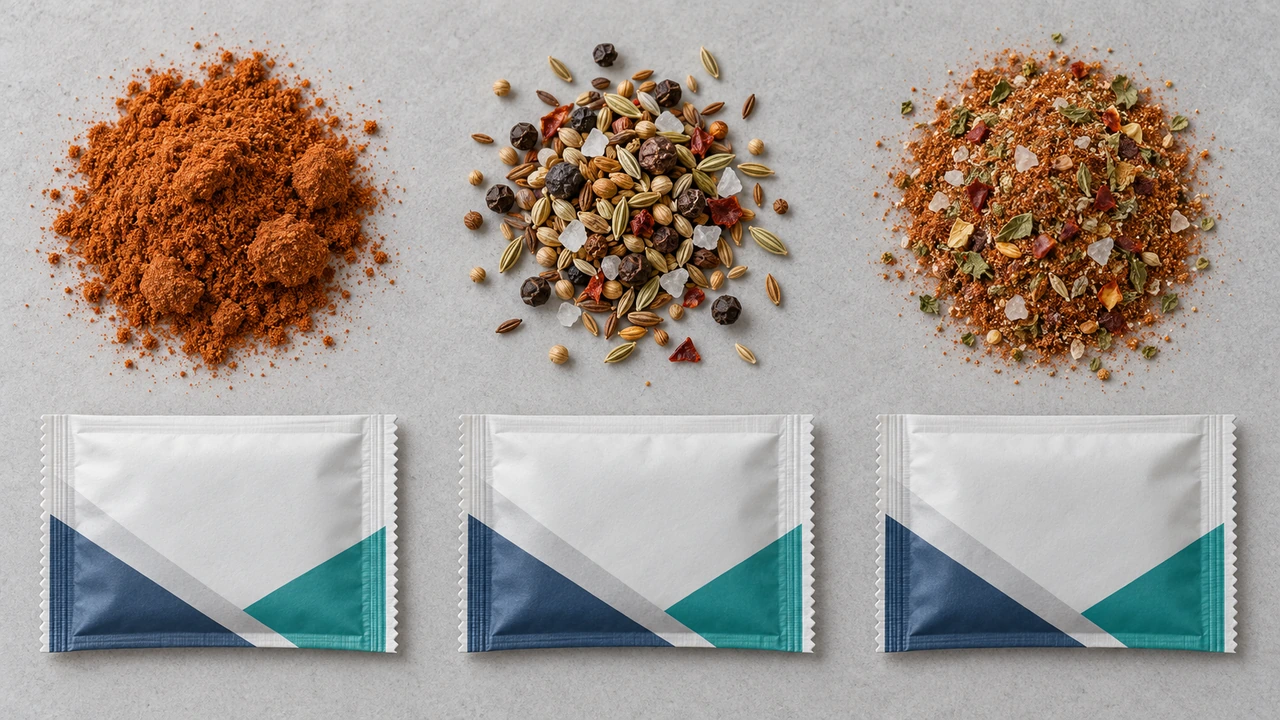
Illustration: from left, a fine spice powder, a granular spice of seeds and crystals, and a blend that combines both. Particle form changes what to check in a filling trial.
Moisture and oil shift a spice along this scale. One auger guide notes that moisture causes clumping and poor flow, and that cohesive or electrostatic products cling to surfaces, so describe the batch you actually pack.
How do the three forms compare in a small sachet?
This matrix is our proposed buyer tool, compiled from public supplier descriptions and our machine pages; confirm it by trial.
| Question | Fine spice powder | Granule, seed or flake | Mixed blend |
|---|---|---|---|
| Dosing route to evaluate first | Auger dosing, with hopper agitation if the powder bridges | Volumetric cup for coarse, seed-like products of steady density; vibratory feed for irregular pieces; auger for granular spices | Depends on the blend: weigh up an auger where fine powder makes up much of it and the coarse pieces pass the screw; prove by trial that the mix holds together |
| What upsets the dose | Bridging, aeration, batch density change | Bulk density change, mixed piece sizes, fines from broken pieces | All of these, plus separation of fine and coarse parts |
| What reaches the seal | Dust at the sachet mouth | Pieces or fines between the sealing faces | Dust from the fine fraction |
| What to send for a trial | Several batches, including the most cohesive or humid | Batches with the widest size range you receive | The blend as made, plus any batch that has separated in storage |
| Question to ask the supplier | How is dust kept off the seal area? | What is the largest piece the doser and seal can take? | How will composition be sampled during the trial? |
Granular spices that behave like sugar or salt follow the cup-filling notes on granule sachet packing machines; fine powders follow the auger and dust notes on powder sachet packing machines. Both routes meter volume, so bulk density turns a setting into grams, and aeration lowers it.
Does a consistent sachet weight prove the blend is right?
No. One auger guide explains that a wide particle size range causes segregation, where fines settle and larger particles rise, changing fill composition. A blend can pass every weight check while its salt, herb or chilli share drifts. A checkweigher also weighs the film: net product weight is gross weight less the empty sachet, so weigh empty sachets from the same film or tare the scale for them.
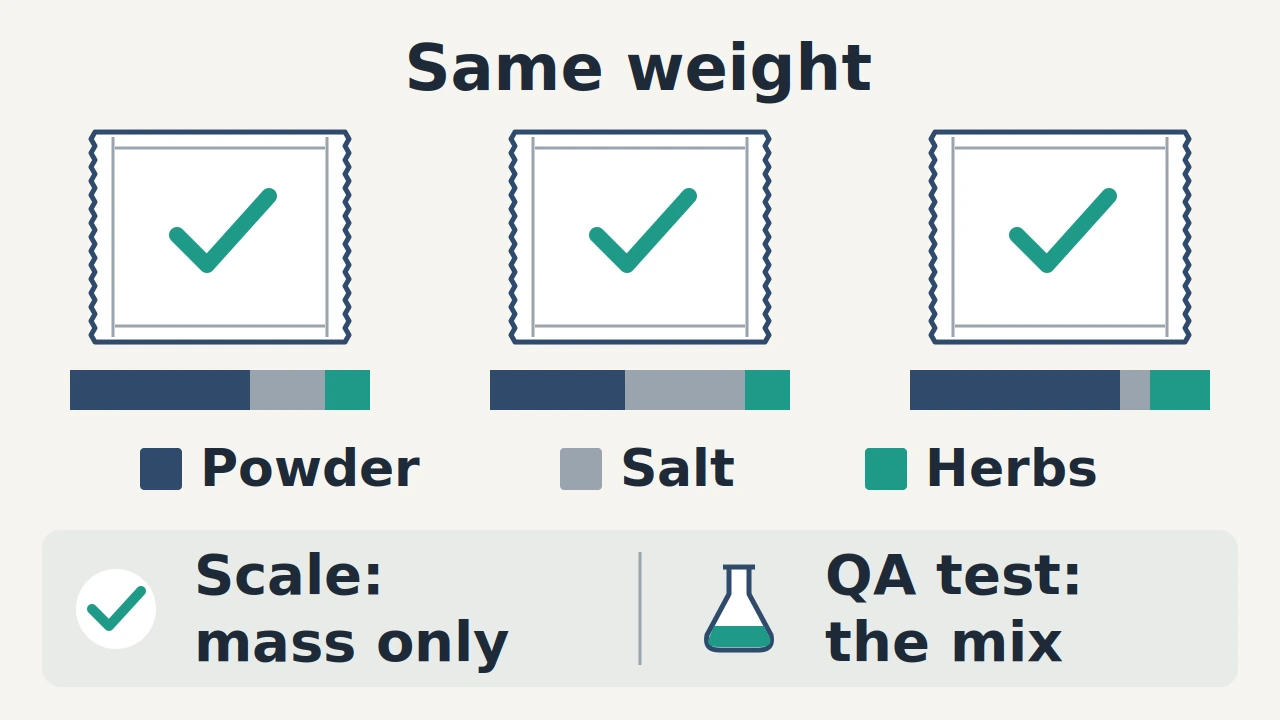
Illustration: the proportions are illustrative, not measured. A scale confirms mass; the mix needs a separate sampled test by your quality team.
Run two checks, each with its own owner:
- Dose consistency: weigh filled sachets across the run, take off the empty-sachet weight, and compare the net weights with your target.
- Mixture consistency: sample sachets from the start, middle and end of the run, and after any stop, for your quality team to test by their own method for that blend. Colour or specks can hint at separation; only that test measures it.
If composition matters for flavour, labelling or allergens, plan the sampling before the trial.
What should a blend trial record capture?
Record inputs, settings and both kinds of result, so a second trial can repeat the first. One auger guide advises sending best-case and worst-case batches, documenting fill weights and feeding issues, and setting pass and fail criteria before testing. The blank record below is our proposed format. It sets no pass limits; those come from your own specification.
| Field | Your entry |
|---|---|
| Product name and batch identity | |
| Form, blend components and largest piece size | |
| Storage condition of the batch | |
| Sachet format, size and film identity | |
| Empty-sachet weight, or how the scale was tared | |
| Target net dose and the tolerance you will accept | |
| Composition limits and the test method your quality team uses | |
| Dosing route and settings used | |
| Net fill weights, and where in the run each was taken | |
| Sachets sampled for composition: run position and result | |
| Bridging, dusting, flooding or separation observed, and when | |
| Dust or product seen at the seal, and seal result | |
| Previous and next product, and any allergen change | |
| Cleaning procedure followed and time taken | |
| Quality check after cleaning, release result and who released | |
| Pass or fail against the limits agreed beforehand |
Settle sachet dimensions early; the sachet sizes guide turns a dose into a size.
How do you handle dust at the seal and flavour changeovers?
Keep dust out of the seal area, and treat each flavour or allergen change as a cleaning step with a release check. One spice-equipment supplier names fine powders, dust management and sanitation standards among the factors affecting spice packing. Powder between the sealing faces can stop the film fusing, so watch the fill drop and the seal together.
For changeovers, one auger guide describes emptying the hopper, removing the auger and tube, cleaning product-contact surfaces and inspecting for build-up, then validating cleaning before release. Ask each supplier which parts touch the product and how long a full clean takes. Your quality team decides, by its validated process, whether the line may run the next blend. The machine selection guide shows how cleaning fits the wider choice.
What should you send for a trial and quote?
Send the four inputs from the table at the top, plus the sachet format and size (or a sample sachet), the film if chosen, and your daily quantity. Say which items are still open. Multi-lane sachet machines explains making several sachets per cycle.
Our catalog lists the LV-350X granule machine for products including seasoning packets, and our multi-lane powder configuration doses each lane with its own servo auger. A listing proves nothing about your spice, so the next step is a product and film trial. For pricing, send a quotation request on WhatsApp.
Limits of this guide
It covers small flat seasoning sachets, ranks no suppliers and leaves out bottles, jars, stand-up pouches and stick packs. It does not predict aroma retention, shelf life or barrier performance, and any tolerance needs confirming on your own material. Other topics are on the guides hub.
How this guide was put together
Spice categories and dosing routes come from public pages by spice-packaging equipment suppliers and a published auger-filler guide, reported as their descriptions; we quote none of their speeds, accuracies or certifications. The matrix, trial record and dose-and-mixture split are our own buyer tools. How sachet machines work covers forming, dosing and sealing.
Questions about spice sachet packing
What machine is used to pack spices into sachets?
For roll-film flat sachets, a form-fill-seal machine with a doser matched to the spice: often an auger for fine powders, a cup or vibratory feed for coarse free-flowing pieces. For a blend, a trial shows which route keeps the mix together.
Can one machine pack spice powder and whole seeds?
Sometimes, though not always with the same doser; a change may mean new tooling, settings and cleaning. List every product in your quote request.
Why can blend sachets taste different when the weight is right?
Fine and coarse parts can separate in the hopper or feed, so equal weights can hold different proportions.
How do you keep spice dust out of the seal?
Control the fill drop and dust, then test seals on your own spice and film.
How much spice should I send for a trial?
Agree the quantity with the trial team for your dose and run length, and send several batches, including the most difficult.
How do you change between flavours or allergen blends?
Empty, dismantle and clean the product-contact parts, record the time taken, and release the line by your own validated check.
What to send us
Send the details you know; mark anything undecided as “to be confirmed”. We reply within 24 hours.
| Item | Why we need it | Example format |
|---|---|---|
| Product | Choose the dosing route and trial inputs. | Product name; powder, liquid, paste or granules |
| Fill amount | Define the dose to review. | Target amount in g or mL per sachet |
| Sachet and film | Review pack format and sealing requirements. | Width × length in mm; film specification or sample photo |
| Output and destination | Set the project requirements for the quotation. | Target sachets/min; destination country |