

Sauce Sachet Packing Machines for Ketchup, Mustard & Condiments
Sauce sachet packing machine guidance for ketchup, mustard and condiments: viscosity, particles, portion size, dripping, seal contamination and trial checks.
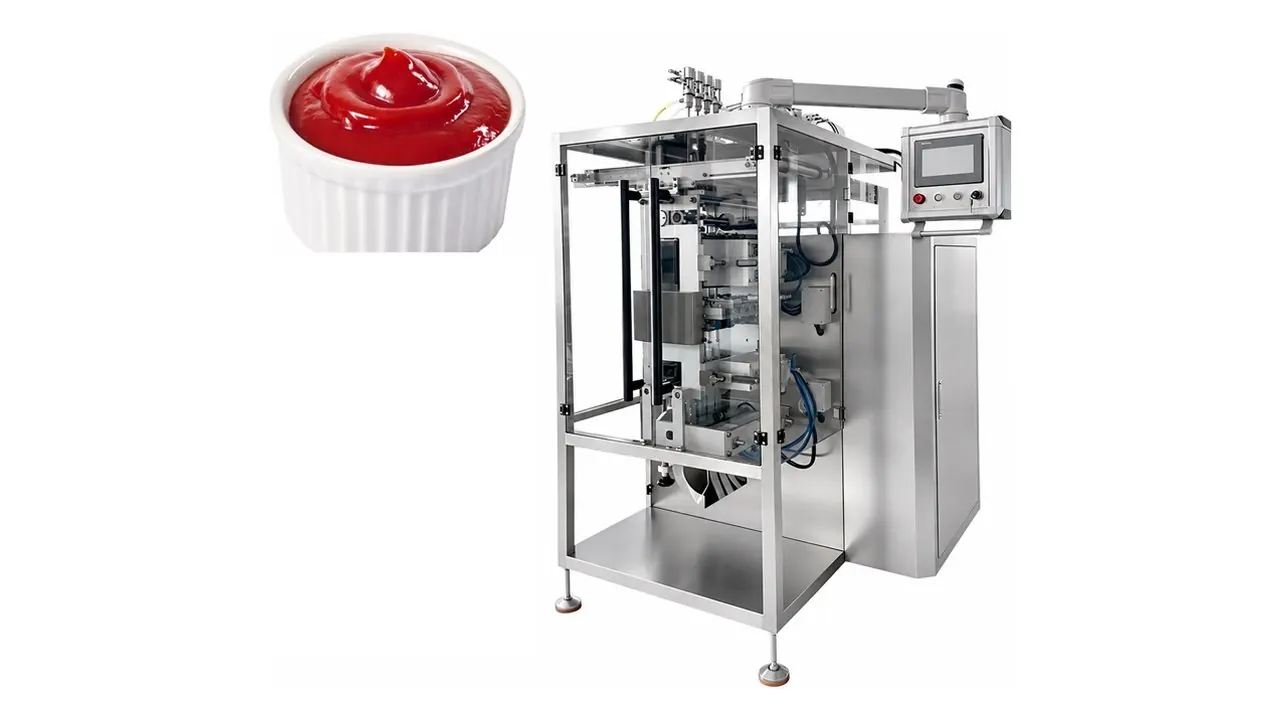
A sauce sachet packing machine doses ketchup, mustard or another condiment into a flat sachet and seals it without leaving sauce in the seal. Sauces are thick, can be sticky, and often carry particles, so the dosing system, the nozzle and the seal checks matter more than the label on the bottle.
Ketchup, mustard and tomato sauce share this page, but their formulations differ. Settings and results from one recipe never carry over to another.
Product characteristics to confirm
These points decide the dosing method more than the sauce name does.
- Viscosity: a smooth ketchup, a thicker tomato sauce and a spreadable mustard all behave differently. Send a measured value with its temperature, and say whether the sauce thins when stirred or pumped. We don't give a viscosity range as a capability.
- Particles: seeds, mustard grains, herbs, pulp and vegetable pieces affect the choice of valve and nozzle. Give us the largest particle size.
- Fill temperature: some sauces are filled warm. Check the machine and film against that temperature for your sauce.
- Stickiness and stringing: a sauce that leaves a tail at the end of the dose can get into the seal.
- Acidity and salt: product-contact materials have to suit the sauce, and that is checked machine by machine.
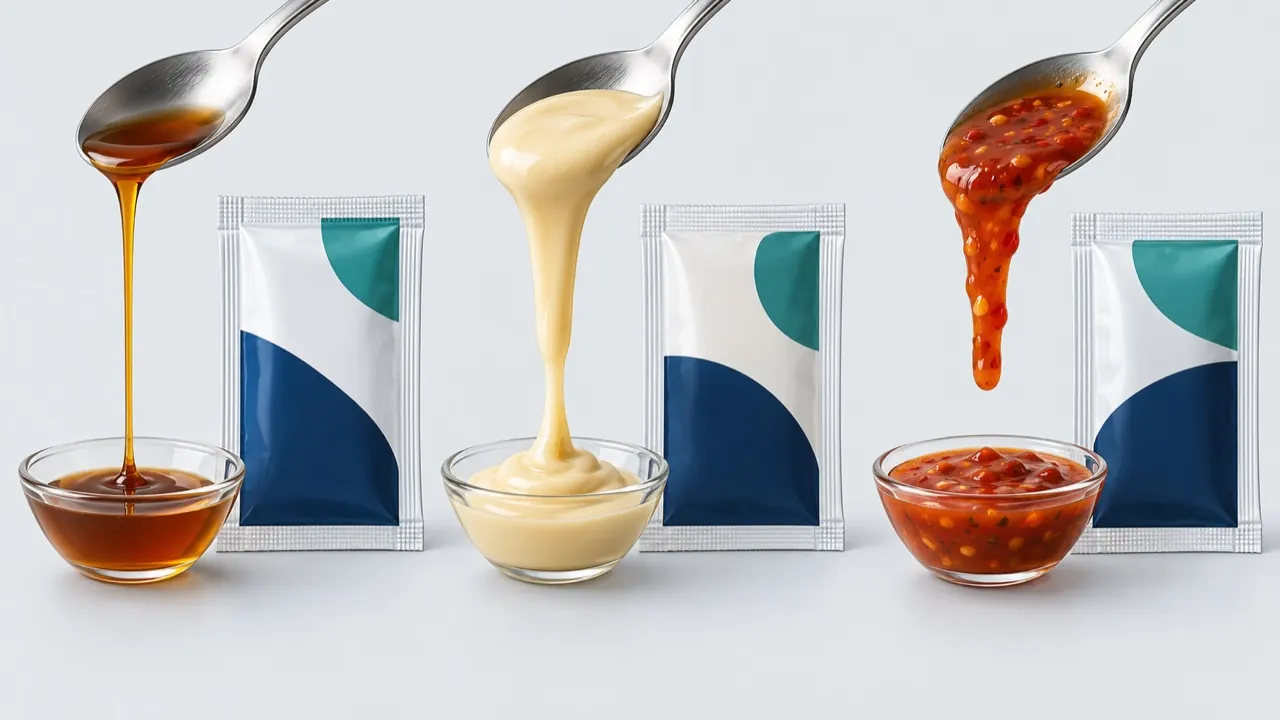
Illustration: a thicker sauce holds its shape and resists flow, so it has to be metered differently.
Sachet formats and portion requirements
Condiment sachets are usually flat three-side or four-side seal sachets. You set the portion in grams or millilitres. Sauces differ in density, so a portion in grams and a portion in millilitres are not interchangeable until you check them on the actual sauce.
The sachet has to fit the portion with room left for a clean seal and an easy tear. If the pack needs an even look or a particular seal layout, see the four-side seal sachet page. Tell us whether the consumer will squeeze the sachet, dip into it, or tear it and pour. That changes the seal strength and shape you need.
Suitable filling and sealing configurations
Most sauces are dosed with a positive-displacement pump, usually a piston pump with a rotary valve, because it moves thick product and fills a defined volume. Other pump types suit some sauces. The full comparison, including particles, temperature and foaming, is on the liquid and paste sachet machine page.
Output comes from the number of lanes and the cycles per minute. Sauces can cap the lane count, since each lane needs its own accurate dose and a clean seal. For more output, look at multi-lane sachet machines and ask us what your sauce will allow.
Product trial and sealing checks
A sauce trial uses your sauce and your film, and it should check:
- dose repeatability across a run;
- whether any sauce reaches the seal area, including drips and strings;
- seal appearance and strength;
- a squeeze test, pressing the closed sachet to see whether it holds;
- a leak check after the sachet has been handled and stored;
- what happens as the sauce warms or cools during a run.
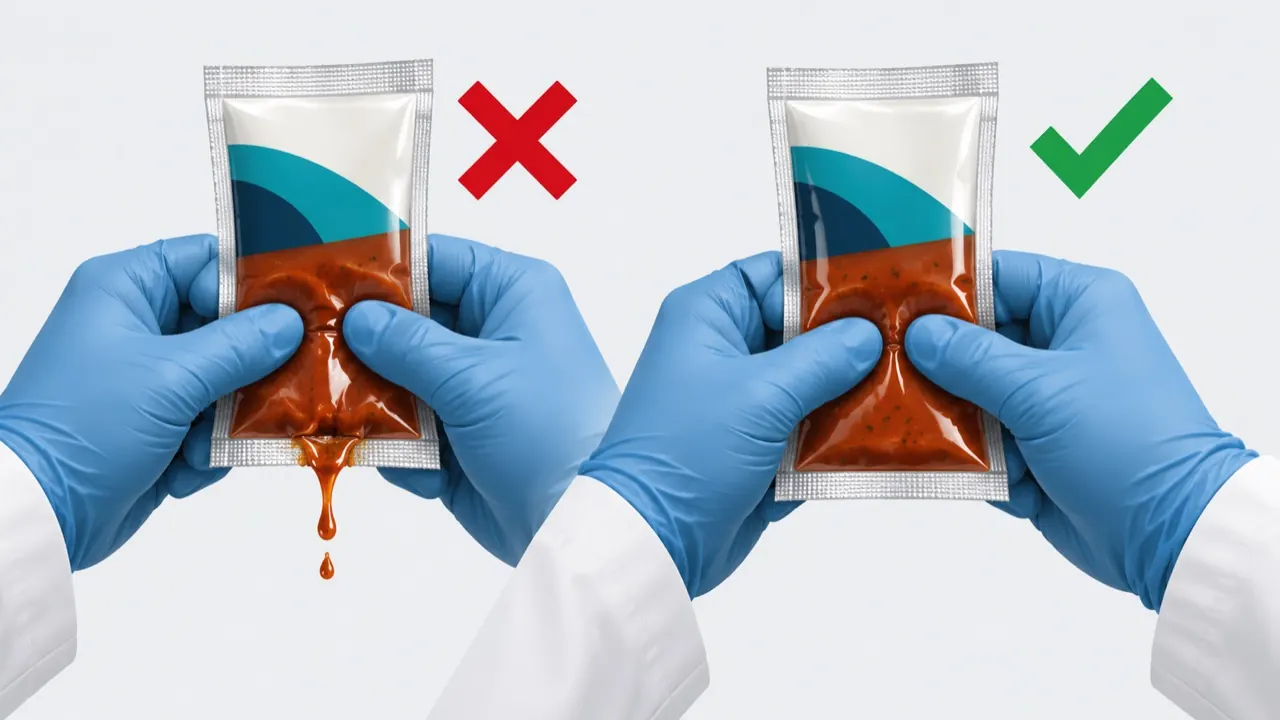
Illustration: pressing the sachet shows whether the seal holds and whether sauce has crept into it.
Sauce in the seal is the main risk. A thin film of sauce can look fine on the line and still leak a week later. We record the sauce, portion, film and conditions with each result, and the result applies to that recipe only. You can arrange this through our product and film trial.
Packaging film and downstream considerations
The film has to seal through a thin film of sauce and resist the sauce for its intended shelf life. Barrier needs, print, tear features and film width are settled with the film supplier and in a trial. One film will not suit every sauce.
Think about what happens after sealing. Sachets may be counted, cut, collated or put into cartons or dispensers, and each step sets how the sachets must look and how strong the seal must be. Sauce residue builds up fast around the filling and sealing area, so keep the guards in place and follow your cleaning procedure.
Request a sauce packaging proposal
To get a recommendation, send us:
- sauce type and recipe name, with a measured viscosity and its temperature;
- particle type and size, if any;
- portion size in grams or millilitres;
- sachet format and size, if known, and the film you plan to use;
- target output and the number of lanes you expect;
- a sample, if you want a trial.
The applications overview lists the other products we can look at the same way.
Questions about sauce sachet machines
Can the same machine pack ketchup and mustard?
Possibly, but test each recipe. Viscosity, particles and stickiness differ, so we don't carry settings or results from one to the other.
How do you stop sauce getting into the seal?
We adjust the nozzle design, how the dose ends, and the timing of fill and seal during a trial. Squeeze and leak checks then show whether the seal is sound.
What should I know about how sachet machines work before I ask?
Our guide on how sachet packaging machines work explains forming, filling, sealing and cutting in plain terms.
Can you tell me the speed for ketchup sachets?
Not in general. Speed depends on the sauce, portion, film, sachet size and number of lanes, and we only give a figure after running your own ketchup.
LINEVO catalog example
Configurations from the LINEVO sachet catalog. Figures are catalog listings, not guaranteed performance: every value is confirmed for your product, film and sachet in the written quotation.
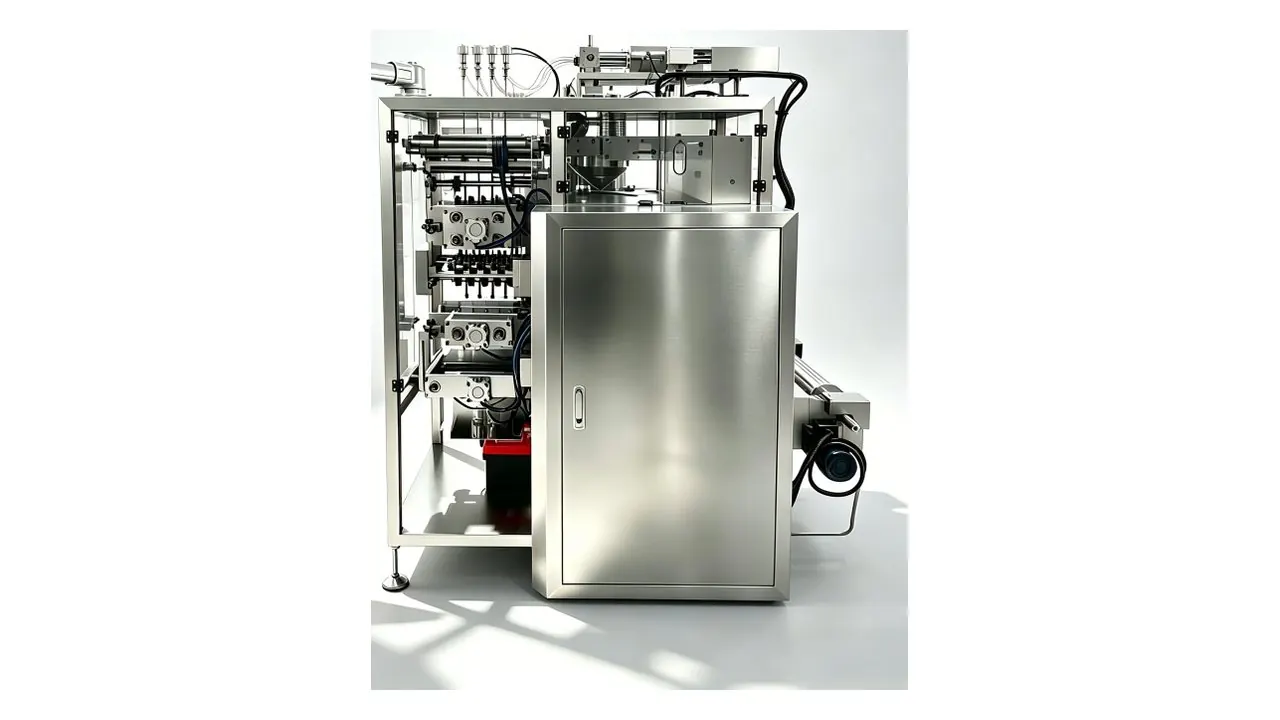
LV-400Y
Four-side seal sauce sachet machine
Listed products
Ketchup, tomato paste, chili sauce and other viscous liquids
Catalog listing
- Lanes
- 3 to 10
- Fill range
- 5 to 100 ml
- Sachet length
- 50 to 180 mm
- Sachet width
- 30 to 140 mm
- Film width
- up to 320 mm
- Dosing
- Piston pump with rotary valve, anti-drip
Product photographs: authorized catalog images shared by Dession, LINEVO's sister team in the same company. Original markings may appear.
Not sure which configuration fits your product?
Send your product and pack details, or ask for a trial on your own material before you decide.