

Piston Pump vs Gear Pump for Small Liquid Sachets
Published by the LINEVO sachet equipment team. Technical questions and corrections
Offered a piston pump or a gear pump for liquid sachets? Compare particles, priming, pressure relief and nozzle cut-off, then trial both on one recipe and film.
A pump that fills bottles well can still leave liquid sachets underfilled, or leaking because product reached the seal. When one proposal meters a small sachet dose with a piston and another with a gear pump, compare the product passages, the particles in your recipe, priming, pressure relief and the nozzle cut-off, then run both on the same recipe and the same film.
A piston pump meters the volume of one stroke. A gear pump carries product between two meshing gears, and in a servo-driven arrangement, pump rotation is a dose-control input. Review the gear pump’s product compatibility, particle and abrasive restrictions, priming procedure and dry-run protection against the actual recipe and component instructions. If your recipe has seeds, pulp or other pieces, start from the piston side and ask whether the largest piece passes its valve. If the recipe is smooth, both proposals stay open, and the answer has to come from a run on your product: start-up, cut-off at the nozzle, the seal zone and the weighed dose.
| Decision point | Piston proposal | Gear proposal |
|---|---|---|
| How the dose is set | The volume of one stroke | Pump shaft rotations counted by the controller, in servo-driven fillers |
| Particles and abrasives | Ask whether the largest piece passes the valve and the valve still closes cleanly | Accutek’s APD gear-head guidance specifies products without particulates or abrasives |
| Priming and running dry | Specify the selected pump’s priming, feed-loss stop and restart procedure | Specify the selected pump’s priming and dry-run restrictions |
| Between-dose flow and pressure | Review valve sequence, stroke stop and nozzle shut-off together | Review drive stop, outlet closure and the circuit’s pressure protection |
| Parts to inspect and replace | Seals and check valves | Gears, bushings and their clearances |
| Machine scope | Piston dosing is listed for the LINEVO SY sauce series | Identify the quoted pump, drive and sachet-machine interface |
Record the pump identity, priming procedure, permitted operating conditions and shutdown sequence for both proposals. Follow the selected component’s operating instructions.
How does each pump meter a sachet dose?
A piston pump draws product into a cylinder and pushes out the volume of one stroke. A valve decides when product enters and when it leaves. Our sauce sachet page notes that most sauces are dosed with a positive-displacement pump, usually a piston pump with a rotary valve, because it moves thick product and fills a defined volume. Include the piston seals and valves in the maintenance and inspection review.
Accutek’s positive-displacement filling explanation describes fluid moving from intake to discharge as the gears rotate. Review the actual head, wetted materials, internal clearances and drive control in the proposal. For a servo-driven arrangement, record the rotation command and compare the delivered dose under the agreed feed and product conditions.
Neither description tells you the dose accuracy on your recipe. Our liquid and paste sachet page makes the same point for every pump type. The mechanism tells you what to inspect. The run tells you what the sachet weighs.
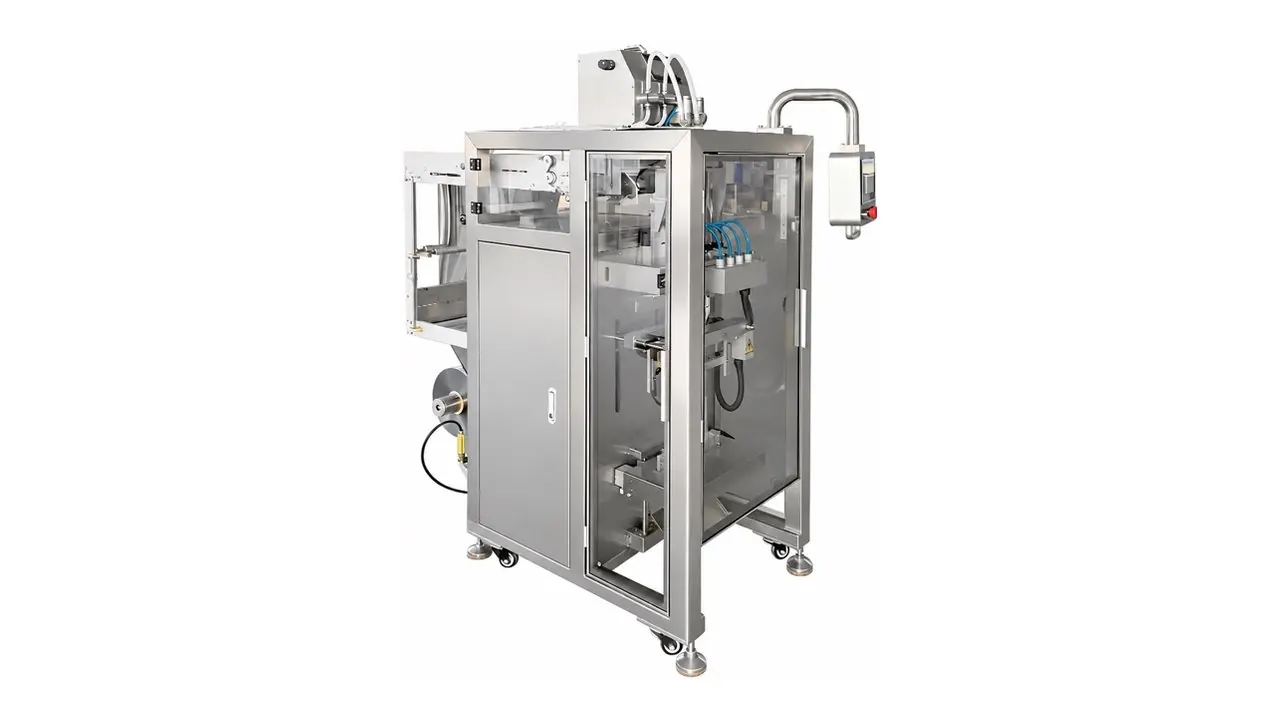
LINEVO catalog photograph. The open front guard exposes the filling and sealing area for configuration and access review.
Which recipe details rule a pump in or out?
Particles come first. Accutek’s pump-head guidance describes its APD gear head for viscous products without particulates or abrasives. A recipe with seeds, pulp, fibre or spice pieces is outside what that documentation covers. Its separate lobe-head description covers semi-liquid products with large particulates. If a gear proposal turns into a lobe proposal because of your particles, compare it as a third pump, not as the gear pump.
A piston does not make particles harmless. Our liquid page lists seeds, fibre, pulp, spices and soft pieces as things that can jam valves and damage seals. Tell both suppliers what the pieces are, the size of the largest one, and how much of the product is solid.
Send a measured viscosity with its temperature and measurement conditions. Review the selected pump’s viscosity range alongside particle restrictions and the intended feed arrangement. Identify any measurement still needed before choosing the head.
Fill temperature and chemistry decide the parts that touch the product. Review the tubing, manifold, pump and elastomers for compatibility with the actual formulation, handling temperature and any abrasive particles. Ask each proposal to name its product-contact materials.
What do priming and pressure relief change on a sachet machine?
Confirm the component’s priming procedure and protection against running without product. On a sachet machine that raises two questions. How is the pump filled with product before the first sachet you keep? What stops the pump from running dry when the feed runs low at the end of a batch?
Review pressure protection with the between-dose sequence. Viking Pump explains how a relief valve diverts flow when discharge pressure rises. For the quoted filling circuit, identify when the drive stops, when the outlet closes and how pressure is limited. The required arrangement follows the selected pump and circuit design.
Record hopper level and inlet pressure with the dose checks. If the proposed configuration includes level control, identify the sensor and its set points, then observe filling during replenishment as well as steady feed. Keep the feed arrangement the same when comparing pumps.
For a piston pump, confirm the priming sequence and the action required if product supply is interrupted. Record dry-running restrictions, the stop condition and the restart procedure for the selected pump.
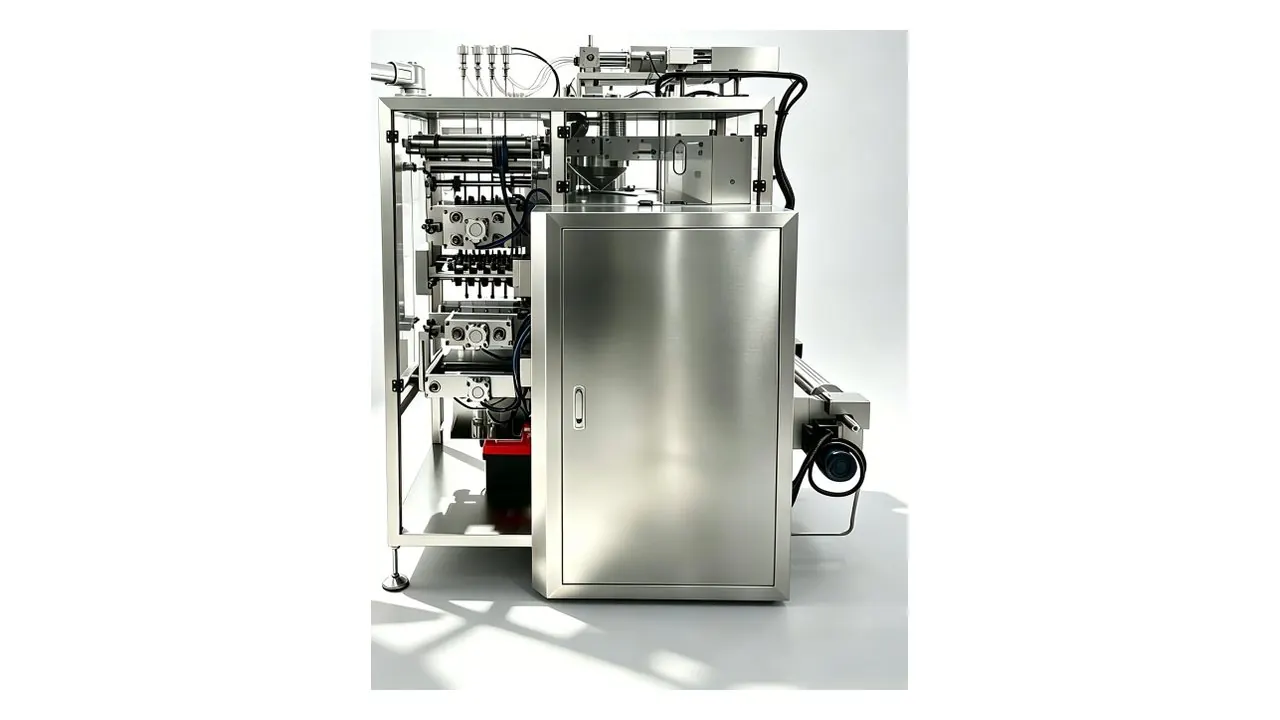
LINEVO catalog photograph. Supply tubes and filling outlets are visible behind the guard. Review the quoted fluid path and access for cleaning.
Where do the nozzle cut-off and the seal decide it?
Both pumps end at a nozzle, and the nozzle decides much of what reaches the seal. Compare the proposed nozzle bore, flow profile and cut-off on the actual product. Record splash, foam, retained product and any drip after the dose; agree a representative nozzle comparison when those observations affect the choice.
On a flat sachet, a drip or a tail that lands on the seal band becomes a leak risk. Our liquid page describes product caught between the seal jaws weakening the seal. Review the proposed nozzle shut-off and package timing to keep the sealing area clear. Watch the moment the dose ends on each pump, then look at the closed seal.
If the two proposals use different nozzles, the cut-off result compares nozzles as much as pumps. Use the same nozzle on both when the pumps allow it. When they do not, write each nozzle on the sheet.
How do you run both proposals on the same recipe?
This blank sheet is the comparison. Keep the rows marked "Yes" identical on both sides, or the two columns are not the same test. Leave a cell empty until someone has looked; an empty cell is not a pass.
| What to record | Keep identical? | Piston proposal | Gear proposal |
|---|---|---|---|
| Recipe name and batch code | Yes | ||
| Temperature as handled, with unit | Yes | ||
| Largest particle, and how much of the product is solid | Yes | ||
| Film | Yes, one roll | ||
| Sachet style and size: 3-side or 4-side seal, width and length | Yes | ||
| Target dose, with unit | Yes | ||
| How the dose is set: stroke setting or rotation setting | No, record each | ||
| How the pump was primed, and sachets made before the first one kept | No, record each | ||
| How flow stops between sachets, and where the pressure goes | No, record each | ||
| Nozzle used | Yes, if both pumps can use it | ||
| Tail at cut-off: yes or no, and where it landed | Compare | ||
| Seal band after sealing: clean, or product in it (name the seal) | Compare | ||
| Weighed dose of each sachet in a short series | Compare | ||
| Product-contact parts, and how they come off for cleaning | No, record each |
For the dose row, weigh the filled sachets and subtract measured empty-pack tare to record net product mass. Keep the tare method with the results. Stroke volume and rotation count are dosing settings. Keep the seal row separate from the dose row too: a sachet can weigh the target and still have product in its seal.
Read the columns in this order. If the recipe has pieces and the gear column shows pieces caught in the pump, or a pump that will not prime cleanly, the gear proposal is a weak fit for that recipe. If the piston column shows a valve that catches pieces or a tail that reaches the seal, look at the valve and the nozzle before you blame the stroke. If both columns are clean and weigh within your own tolerance, choose on the parts you will clean and replace, and on what the written quotation confirms. If the columns differ only because the batch, the film or the nozzle changed, the sheet is not finished; run it again with those rows locked.
Specify the pump and machine interface
Use the comparison to review pump displacement, feed conditions, cutoff and cleaning access for the selected product. The LINEVO liquid-machine listing specifies a piston dosing pump. A gear-pump proposal needs its own confirmed machine interface, wetted-part specification and operating instructions; bottle-filler pump documentation describes that mechanism within its own installation. Keep compatibility, viscosity at filling temperature, dose, output and cleaning requirements together in the configuration record.
What should you send before a pump is chosen?
Send the recipe with its handling temperature and largest particle, the film, sachet style and size, and target dose on WhatsApp. Identify the pump in each proposal and any input you still need to measure. Our engineering team reviews the wet path and cut-off arrangement, identifies the proposed components and agrees the sample observations needed for the comparison.
The sample-testing steps explain what to agree before any product or film is shipped.
Define the complete wet-path scope
Review the proposed hopper, metering device, valves, transfer path and outlet as one system. Identify the actual recipe condition, particle characteristics, cleaning method and allowable product treatment with the plant team. Compare dose, cut-off, retained product and seal cleanliness on the same film and pack. The final quotation identifies the selected components and interfaces; the mechanism name alone does not define the complete configuration.