

Auger Filler vs Volumetric Cup Filler for Small Sachets
Compare an auger filler and a volumetric cup filler on one film and one dose. Record density changes, run-on, seal contamination and weighed mass.
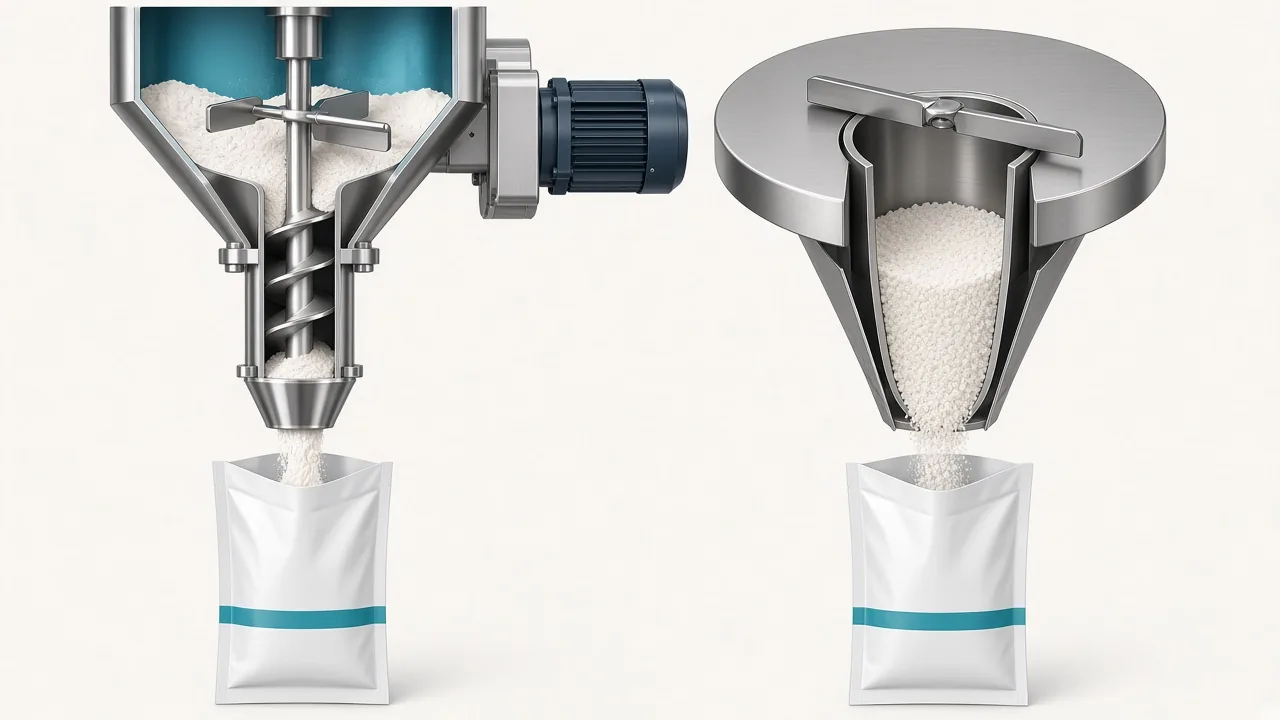 Illustration
A dusty seal or a drifting fill weight can turn a small sachet into a reject. An auger filler and a volumetric cup filler both meter a volume, so the grams in the pack move when the batch packs tighter, holds more air, or keeps flowing after the dose should have stopped.
When a powder or granule can run on either doser, compare that batch with the sachet you will seal before you choose an auger filler or a volumetric cup filler. An auger filler moves product with a rotating screw. A volumetric cup filler lets product fall into a cavity, levels the cavity, and dumps it. Equipment descriptions treat uniform, free-flowing granules as the usual cup case, and cohesive or dusty powders as the usual auger case. Ground blends, and mixes of fines with larger pieces, often sit between those two. Lock the film and the target dose, then record density changes, run-on, seal contamination, and the mass you weigh.
| What you see in the batch | Where to start the paired check | What to write on the other side |
|---|---|---|
| It pours and levels, and the pieces stay whole | Volumetric cup filler | Whether a screw breaks pieces or keeps feeding after it stops |
| It bridges, clumps, or will not fill a cavity evenly | Auger filler | Whether the same dose dusts the seal when a cup dumps it |
| A handful does not tell you which | Either doser, same film and same target mass | Both columns of the worksheet |
Read the two columns as notes from this batch. Speed and accuracy stay with a trial on your product.
What is the auger filler vs volumetric cup filler difference?
Auger fillers and volumetric cup fillers both set a volume. Neither one weighs the sachet while it fills.
An auger filler uses a rotating screw in a tube. How far the screw turns sets the volume that leaves the tube. An agitator in the hopper is there to keep powder moving toward the screw and to limit bridging, so the bulk density at the screw stays steadier from one dose to the next. Whether it does that on your batch is a scale question. The description does not answer it.
A volumetric cup filler uses gravity. Product falls into cups of a set volume. A wiper or leveler takes off the excess. The cup then moves to a discharge point and the product drops. You change the dose by changing the cup volume.
On a small sachet, that mechanical difference shows up in three places you can watch: whether the product fills the volume evenly, whether product keeps moving after the dose should have stopped, and whether dust or pieces sit on the film that has to seal.
Which batches still need both dosers?
Start with the cup when the product is a uniform granule that pours and levels. Coarse salt, whole beans, and seeds are the sort of pieces equipment descriptions put in that group. A screw can break fragile pieces, so write breakage on the auger side of the worksheet if the pieces matter.
Start with the auger when the product is cohesive or holds air. Flour and a fine spice powder are the usual examples, because they can bridge in a gravity cup. Air in the product lowers bulk density. The same volume then weighs less.
Run both sides, on the worksheet, when flow changes with humidity or with the blend. A ground mix, or a blend of fines and larger pieces, is that middle case. Powder sachet packing machines go further into auger feeding and dust for powders. Granule sachet packing machines compare a cup with weighing when the product is clearly a granule and the tolerance is a weight. This page stays on the case where either volumetric mechanism is still open.
What has to stay the same before you compare doses?
Hold these fixed, or the two columns are not the same test.
- The film you will actually buy, including its structure. A stand-in roll answers a different question.
- The sachet style and size. Name 3-side seal, 4-side seal, or back seal, plus the width and length.
- One target dose, as a mass. The screw setting and the cup setting will not look alike. They are two ways of aiming at that mass.
- One batch, when you can. If the batch changes between the two runs, write the new batch code. A density change and a mechanism change will otherwise sit in the same result.
The dose has to be inside the pack before the jaws close on that film. Name the seal you are looking at. A back seal and a cross seal are different strips of film, so "dust on the seal" has to say which strip.
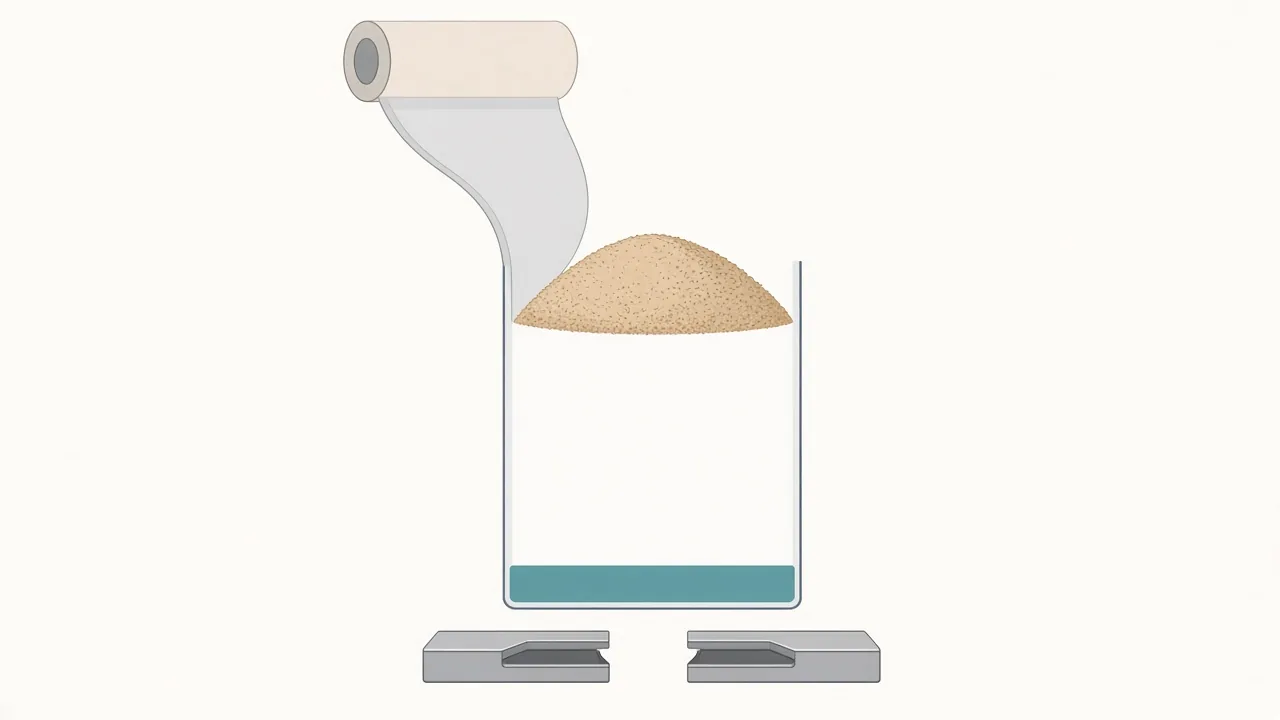
Illustration: the dose sits above the seal band, and the jaws are still open at that band. The drawing is a schematic, not a trial photo.
How do you record a side-by-side small-dose trial?
Copy this table and fill it from the run. Leave a cell as "not observed" if you did not look. Weigh each finished sachet and write the scale reading in the measured-mass row.
| Record | Keep identical | Auger filler | Volumetric cup filler |
|---|---|---|---|
| Film | Yes. One roll identity. | Same film | Same film |
| Sachet style and size | Yes. 3-side, 4-side, or back seal; width and length. | Same style and size | Same style and size |
| Target dose | Yes. One mass. | The mass you intend | The same mass |
| Batch | Yes, unless you mark a change. | Batch code | Same code, or the new code |
| Density change | Record the value. Do not assume the two runs matched. | Bulk density of this batch, and whether it rose, fell, or held versus the previous batch | The same note, if the batch did not change between runs |
| Run-on | Compare. | Product still moving after the screw stops | Product still moving after the cup has dumped |
| Seal contamination | Compare. Name the seal. | Product on the film where that seal closes | Product on the same zone |
| Measured mass | Weigh the sachets. | Scale reading | Scale reading |
Run a short series on each side. If the weighed mass wanders, read the density row and the run-on row before you treat the mechanism as the cause. A heavy sachet can still have product in the seal, and a clean seal can still be the wrong mass. Keep those rows separate.
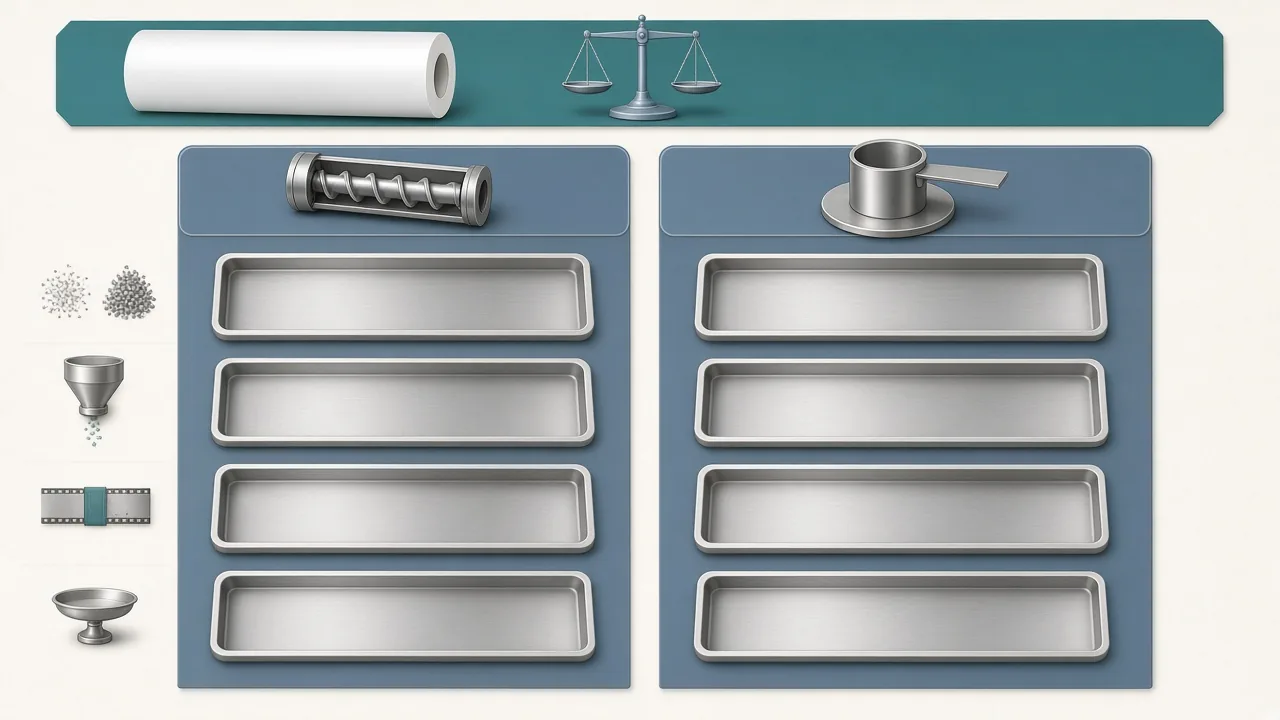
Illustration: a blank paired record. The film and the target mass stay fixed. Empty trays under the screw and under the cup are for density change, run-on, seal contamination, and measured mass. It is not a completed trial.
Free-flowing pieces can keep leaving a screw after it stops, unless the outlet shuts the stream off. Write that as run-on. A cup can keep trickling from the hopper into the next cavity, so the cup column gets the same kind of note. A cup path is more open, so fine dust has more room to stay in the air and land on the film. An auger path is more enclosed. Look at the seal on both sides anyway.
What does a volume-to-mass example show, if the numbers are assumed?
Mass equals volume times bulk density only when the volume is the volume you think it is and the density is uniform through that volume. The figures below are typed-in inputs so the multiplication is visible.
Assumption, not a measured trial. Suppose the metered volume is 8 cm³, and you have not put a sachet on a scale. At an assumed bulk density of 0.40 g/cm³, the implied mass is 8 × 0.40 = 3.2 g. At an assumed bulk density of 0.48 g/cm³, the same volume implies 8 × 0.48 = 3.84 g. The 0.64 g gap is the arithmetic of those two assumed densities. Those grams exist only on paper. The worksheet mass cells stay empty until you weigh sachets.
Use your own density. The 0.40 and 0.48 figures are placeholders. They are not a typical powder, not a catalog value, and not a dose this page assigns to a machine.
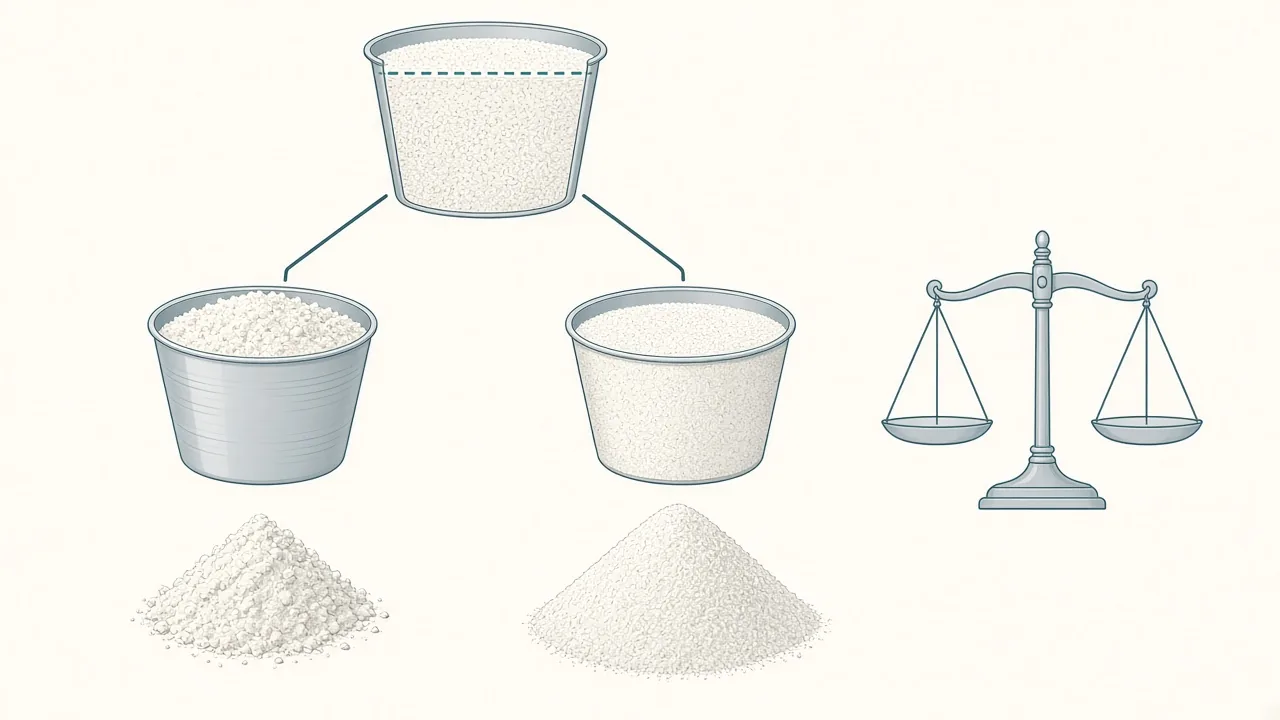
Illustration: an assumption. The same volume is drawn loosely packed and packed tighter, so the implied piles differ. The scale is empty. Replace the densities with yours, and weigh the sachet for the worksheet.
How should you read the two columns?
If the cup side shows an uneven cavity, and the auger side meters the same batch into the same sachet with a steadier fill, the cup is a weak fit for that batch. If the auger side keeps feeding after the screw stops, or breaks fragile pieces, and the cup side dumps a level cavity and stops, the cup is the cleaner volumetric fit for those pieces. If both columns show density swings that move the weighed mass outside the tolerance you need, stop the volumetric comparison and look at weighing on the granule page.
If the columns disagree only because the film, the sachet style, or the batch changed, the worksheet is unfinished. Repeat the run with those items locked.
What should you send before a doser is chosen?
Send the actual product, the film, and the sachet style on WhatsApp: 3-side, 4-side, or back seal, with the size if you know it. Add the target dose, and say whether batches change density. A product and film trial can then fill this worksheet, or one side can be set aside because of the way the product flows.
Questions before you pick a volumetric doser
Can one powder use both an auger filler and a volumetric cup filler?
Some powders can. A free-flowing powder can level in a cup, and the same powder can run on after a screw stops or dust the seal. The worksheet keeps the film, the sachet style, and the target dose fixed, and it records both sides.
Does a density change affect an auger filler and a volumetric cup filler?
Both dose by volume, so a real change in bulk density changes mass unless something else in the setup compensates. An agitator is meant to steady powder at a screw. A cup has no screw. The weighed sachets show whether that difference appears. They do not import a supplier accuracy figure.
What should the run-on row say?
Write the product that keeps leaving the doser after the dose should have ended. On an auger, that is flow after the screw stops. On a cup, that is flow after the cup has dumped. Keep that note out of the mass cell.
Why record seal contamination apart from mass?
A sachet can be the right mass and still have product in the seal, or have a clean seal and the wrong mass. Dust on the seal is its own check. Name the seal, and look at it on both dosers.
When this comparison does not apply
This comparison is for a powder or granule that might still suit either volumetric doser. It leaves out liquids and pastes. It also leaves out a net-weigh choice, except to point you there when density swings already sit outside the tolerance you need. The 8 cm³ example is arithmetic with assumed densities. It is not a measured bulk density and not a result from a trial. What a machine will do with your product stays with the trial and the quotation.
Method and sources
The mechanism descriptions are compiled from public dosing-equipment notes: a screw metered by how far it turns, with an agitator to limit bridging; a gravity cup that is leveled and then dumped; bulk density, moisture, cohesion, aeration, and particle-size spread as reasons a volume does not stay one mass; and dust on the seal as a separate check from fill mass. Those notes are supplier descriptions. They are not results from a trial on this site, and no accuracy percentage, speed, or model rating from them is used here. The worksheet is a blank record. The volume-to-mass figures are assumed inputs. The sample-testing process is where a filled record would be made.
What to send us
Send the details you know; mark anything undecided as “to be confirmed”. We reply within 24 hours.
| Item | Why we need it | Example format |
|---|---|---|
| Product | Choose the dosing route and trial inputs. | Product name; powder, liquid, paste or granules |
| Fill amount | Define the dose to review. | Target amount in g or mL per sachet |
| Sachet and film | Review pack format and sealing requirements. | Width × length in mm; film specification or sample photo |
| Output and destination | Set the project requirements for the quotation. | Target sachets/min; destination country |