

Small Sachet Packing: What Hand and Tabletop Routes Can Do
Small sachet packing machine options for low volumes: what hand filling, tabletop dosers and heat sealers can handle, how to time your own run, and when to automate.
 Illustration
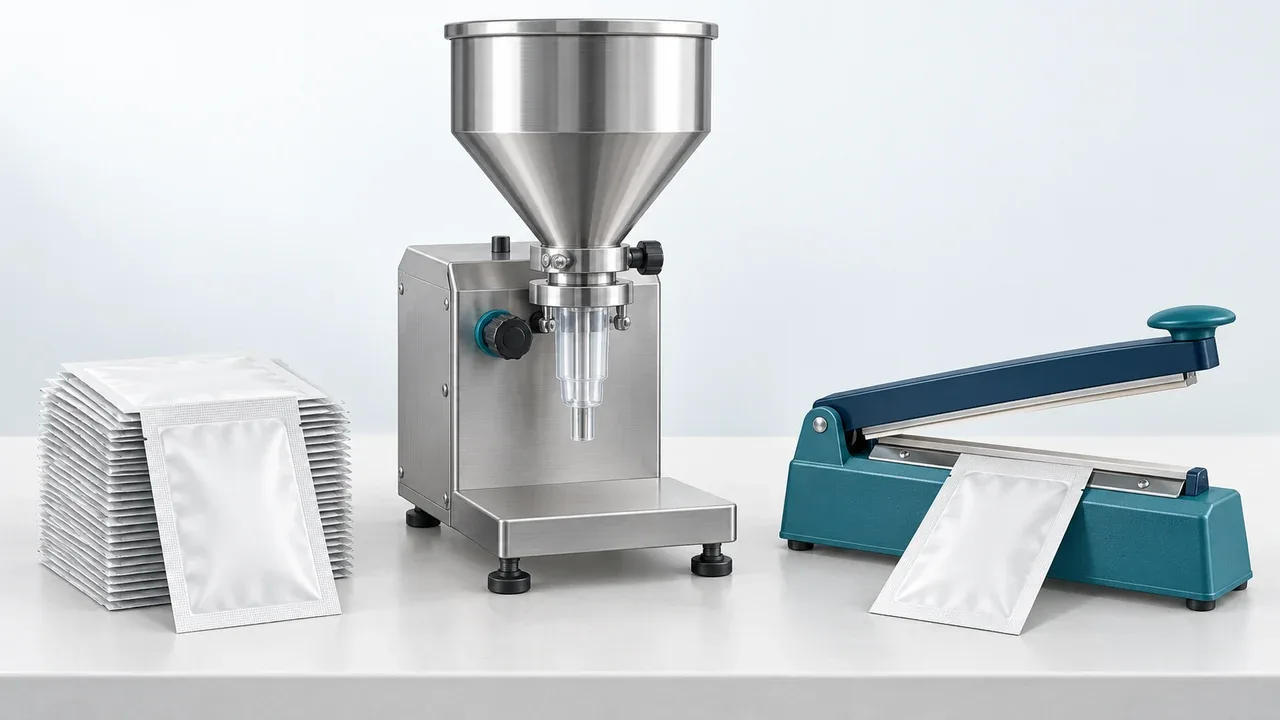
A small sachet run can start by hand or on a tabletop doser, working with premade sachets that you fill and close on a heat sealer. A separate doser and sealer do not form sachets from roll film; when forming, filling and sealing from roll film need to happen in one machine, that is a form-fill-seal machine. This guide sets out what each route can handle, how to time your own run, and which signs say it is time to compare automatic options.
Can a small sachet packing machine be manual? Filling and sealing can be: a person or a tabletop doser fills premade sachets, and a heat sealer closes them. That route suits trial batches, samples and runs with many products. Compare automatic options once the daily count outruns what your own timed trial shows the route can pack, once dose or seal failures remain after the filling and sealing steps have been worked on, or once you need printed roll film with every sachet cut in register. The first automatic option to compare is a form-fill-seal machine with one lane.
Key points:
- The product sets the limit first: drips, foam and dust in the seal area cause weak seals whichever route you choose.
- Time a full working cycle of your own product, not just the fill, and compare it with your daily target.
- Fix dose and seal problems at their cause before deciding they call for a new machine.
- Product changes and cleaning eat into the day on every route, so count them in.
- We do not supply hand or tabletop equipment. We do supply small automatic sachet machines, as well as the multi-lane form-fill-seal configurations in our catalog.
What are the routes for a small sachet run?
There are three routes, and they differ in where the sachet comes from and who does each step.
- Hand filling with a heat sealer. A person doses each premade sachet with a scoop, syringe or measure, and closes it on a heat sealer.
- Tabletop doser with a heat sealer. A semi-automatic doser measures each portion. A person places each sachet under the outlet, removes it after the fill and passes it to the sealer.
- Form-fill-seal machine. The machine unwinds roll film, forms the sachet, doses the product and seals and cuts it in one cycle, on one lane or several.
One equipment supplier describes semi-automatic and compact automatic machines as the starting point for small producers, and names budget, product type, floor space and ease of operation as the factors that decide between them.
What can each route handle?
Each route has a different weak point. Hand filling is limited by the person, the tabletop route by the hand-off between doser and sealer, and a form-fill-seal machine by the product and film it is set up for. The table compares them on the same points. It is compiled from suppliers' public descriptions, so treat it as a starting point to confirm with your product and sachet, not as a guarantee for any combination.
| Route | Where the sachet comes from | How the dose is measured | How it is sealed | Products it can take | Main limit |
|---|---|---|---|---|---|
| Hand filling + heat sealer | Premade sachets | By the person, with a scoop or measure | Heat sealer, one sachet at a time; confirm the sachet's sealant layer suits the sealer | Products a person can portion without drips, strings or dust reaching the sachet mouth; confirm by a trial | Dose and pace depend on the person |
| Tabletop doser + heat sealer | Premade sachets | Suppliers describe piston fillers for liquids, pastes and creams, augers for powders, and cups for free-flowing granules of stable bulk density | Heat sealer, fed by hand; confirm the sachet's sealant layer suits the sealer | Liquids, pastes, powders or granules, if the dosing method matches the product | Every sachet is placed and removed by hand |
| Single-lane form-fill-seal | Roll film, formed in the machine | Doser built into the machine | Machine seals and cuts | Set by the dosing system fitted | Changeover and set-up for each product and size |
| Multi-lane form-fill-seal | Roll film, several sachets across one web | Each lane receives its own dose; the dosing arrangement depends on the configuration | Machine seals and cuts across the web | Set by the dosing system and lane balance | Film width, lane balance and downstream handling |
Two cost points follow from where the sachet comes from. Two equipment suppliers state that roll film costs less per pack than premade pouches, and one adds that machines filling premade pouches need more labour for loading pouches and keeping pouch stock. Our guide to how sachet machines work follows the film through a form-fill-seal machine step by step.
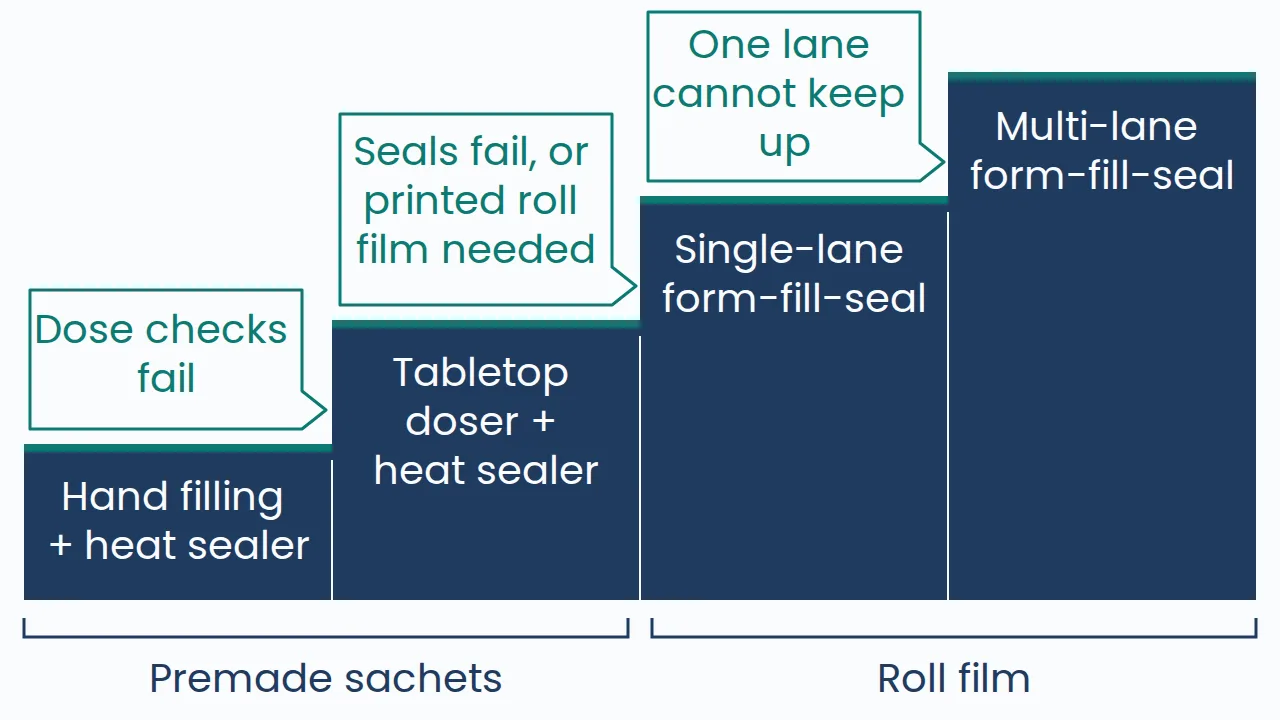
Illustration: the four routes, and the signals that prompt a look at the next step once the current route has been worked on.
Which products are hardest to pack by hand?
Products that put themselves into the seal area are the hardest at small scale, because the hand-off between filling and sealing leaves the seal area exposed. Start with whether your product can be portioned without drips, strings or dust reaching the sachet mouth, and let a short trial decide. Check yours against this list before you buy anything.
- Thin liquids drip from the nozzle or the edge of the sachet, and liquid in the seal area gives a weak seal or a leaker.
- Foaming products such as shampoo make the dose part liquid, part air, and the foam can climb into the seal.
- Fine powders dust the inside of the sachet mouth, and powder trapped between the sealing faces stops the film fusing.
- Sticky or stringy pastes leave a tail after the dose, and the tail lands on the seal.
- Products with particles need a doser with clearance for the largest piece, and a particle in the seal leaves a channel for air or moisture.
The product pages go further: liquid and paste machines, powder machines, granule machines and shampoo sachets.
How do you work out whether hand packing keeps up?
Time a run of your own product, then compare the rate you measured with the rate your orders need. Two divisions give you both numbers. Use the same time basis for both, and take each loss off only once.
- Needed rate. Sachets needed per day ÷ available minutes per day = sachets per minute. Available minutes are the shift minus breaks, cleaning and product changes.
- Measured rate. Pack a representative batch of real sachets and time the whole working cycle: opening or placing the sachet, filling, sealing, checking, refilling the hopper and reworking any rejects. Count only sachets that pass your dose and seal checks. Good sachets ÷ minutes taken = sachets per minute. Record how many people packed the batch.
- Compare. If the measured rate is below the needed rate, you need more hours, more people or a faster route. A second person does not always double the rate, because people share the sealer and the hopper, so time two people together before you count on it.
Example with assumed inputs, not a measured rate for any product or machine: a brand needs 2,000 sachets a day and has 6 available hours after cleaning and changes, which is 360 minutes. The needed rate is 2,000 ÷ 360 ≈ 5.6 sachets per minute. If a timed trial of the full cycle shows one person packing a good sachet every 15 seconds, that is 4 per minute, or 4 × 360 = 1,440 sachets in the same 6 hours. One person falls short by about 560 sachets a day.
Count only sachets that pass. A fast hand run with leaking seals gives a rate you cannot sell.
What signals that it is time to automate?
Compare automatic options when one of these signals shows up in your own numbers and stays after you have worked on its causes, not when a supplier quotes a speed. Each signal has causes to check first and a next step to compare.
| Signal | Causes to check first | Option to compare if it persists |
|---|---|---|
| The needed rate is above your measured rate, and adding hours or people is not practical | Steps in the cycle that could be shortened, such as sachet handling or hopper refills | A single-lane form-fill-seal machine, priced against the extra labour |
| Dose checks fail, or the dose drifts across a batch | The measuring method, product density changes, settling or foam | A doser matched to the product, tabletop or built in |
| Seals fail from product in the seal area | Drips or strings at the end of the dose, dust at the sachet mouth, sealer settings, the sachet's sealant layer | A machine that doses and seals in one controlled cycle, tested on your product |
| You want printed roll film, cut in register on every sachet | Whether printed premade sachets would meet the need | A form-fill-seal machine reading the print mark |
| Premade sachet cost or stock handling has become a real line item | Order quantities and how stock is handled | Roll film against premade sachets, per pack |
| Product changes and cleaning take a large share of the day | How many products you run, batch sizes and how often you change | Fewer changes per day, or a single-lane machine with quick-release contact parts |
| One lane would already run near its limit for your product | Whether the product, rather than the lane, sets the rate | Multi-lane sachet machines |
Our reading of these signals: if the only signal is a dose problem, a tabletop doser matched to the product may be enough. If seal failures remain after the causes above have been worked on, or the decision is to move to printed roll film, that is the point to compare form-fill-seal machines.
What does the first automatic step look like?
The first automatic option to compare is a form-fill-seal machine with one lane or a few. A single lane suits small volumes, frequent product changes, products that are hard to dose, large sachets and pilot batches. More lanes raise output but bring film width, lane balance and cleaning into the decision.
Our catalog machines are multi-lane: the LV-400Y for sauces is listed with 3 to 10 lanes, and the LV-350X for granules is described with four lanes in one cycle. We do not supply hand or tabletop equipment, but we do supply small automatic sachet machines for low volumes. If your timed run says hand filling still fits, keep it and come back when a signal from the table shows up. If a signal has appeared, the sachet machine buying guide walks through the selection, and our price guide explains what moves the cost of a configuration.
What should you send us?
Send the numbers the steps above produce, so a configuration can be matched to them, or the hand route kept for now. Say which items are not decided yet.
- Product and its state: liquid, paste, powder or granule, and whether it drips, foams, dusts or carries particles.
- Sachets needed per day and available hours per day.
- How many products you run, typical batch sizes and how often you change product.
- Your measured rate from a timed full-cycle trial, if you have one, how many people packed, and how many sachets failed dose or seal checks.
- Dose per sachet in grams or millilitres, and the tolerance you need.
- Seal format and sachet size, or a sample of the premade sachet you use now.
- Whether you want printed roll film.
A product and film trial shows how your product doses and seals on a form-fill-seal set-up. When you want pricing, send a quotation request on WhatsApp. Other topics are on the guides hub.
How this guide was put together
The routes and their limits are compiled from public product pages and guides by packaging equipment suppliers, covering semi-automatic fillers, heat sealers, premade pouch machines and form-fill-seal machines, together with the product-behaviour notes on our own machine pages. Supplier statements are reported as their claims. We quote no supplier speeds or prices, because they come without the product, dose and sachet behind them. The worked example uses assumed inputs, as labelled, and the signals table is our reading of these sources.
Questions about small sachet packing
Three questions the sections above leave open: the words sachet and pouch, cost, and running liquids and powders on one set-up.
What is the difference between a sachet and a pouch?
A sachet is a small, flat, single-portion pack. It can be bought premade and filled, or formed, filled and sealed from roll film. Pouch is a broader word that overlaps with sachet and also covers stand-up packs, and neither size nor production method draws a fixed line between them.
How much does a small sachet filling machine cost?
It depends on the route and the configuration: hand tools, a tabletop doser and sealer, or a form-fill-seal machine with one or more lanes. Our price guide lists what changes the cost of a form-fill-seal configuration.
Can one small set-up pack both liquids and powders?
Plan on a separate doser for each. Suppliers match the dosing method to the product: piston fillers for liquids and pastes, augers for powders and cups for free-flowing granules of stable bulk density. A shared heat sealer is possible if it suits each sachet's sealant layer, and the seal still has to be checked on each product.
Not sure which configuration fits your product?
Send your product and pack details, or ask for a trial on your own material before you decide.