

Tear Notch Packaging: Die Slits, Laser Scoring & Margins
Published by the LINEVO sachet equipment team. Technical questions and corrections
Place the tear notch inside the seal band, compare a slit with a laser score, and keep the inner seal intact on 3-side and 4-side sachets.
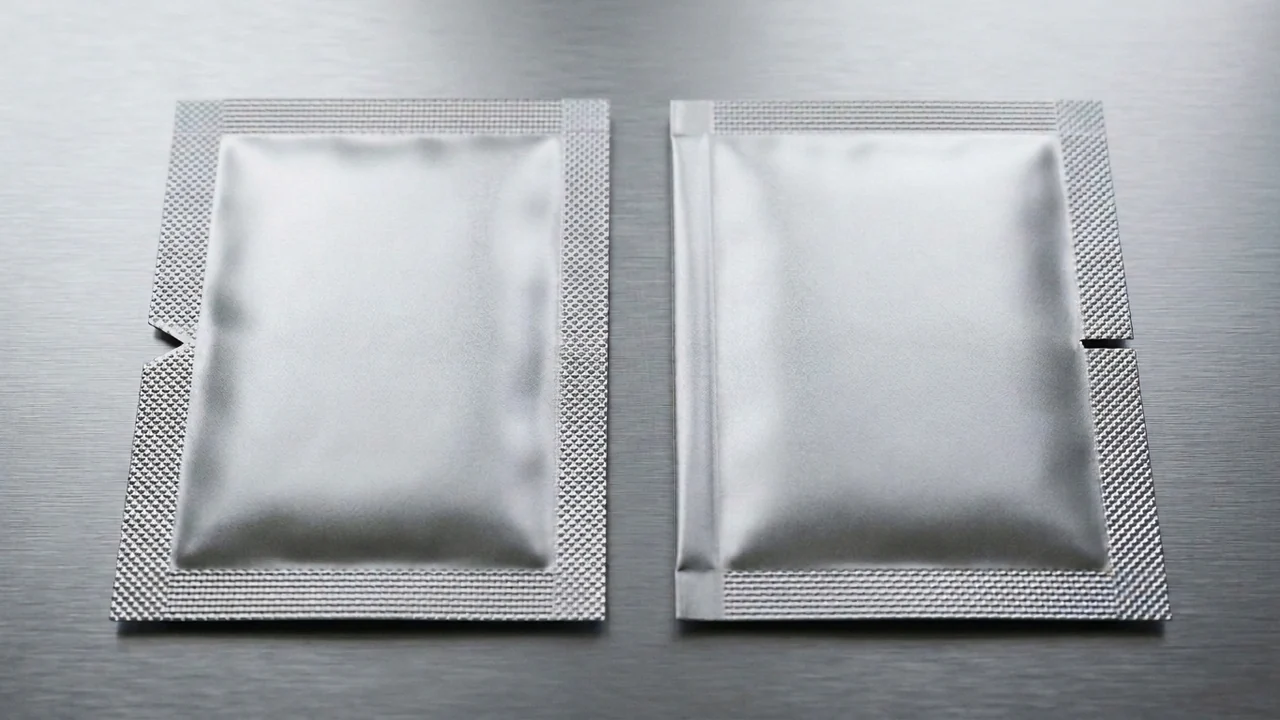
On a heat-sealed sachet, an edge tear notch is a small V-shaped cut, U-notch, or straight slit punched inside the perimeter seal band so a user can open the packet by hand without scissors while the product compartment stays completely sealed. Because the notch only initiates the tear, the laminate structure governs where that tear travels: isotropic foil structures tear cleanly from an edge cut alone, whereas oriented plastic laminates that deflect crookedly or delaminate pair the edge notch with a partial-depth outer-layer laser score to guide a straight opening across the pack without breaching the barrier or inner sealant layer.
Our 4-side seal sachet packaging machines form flat sachets sealed along all four edges with inline notching and cutoff tooling, whereas a 3-side seal sachet replaces one sealed border with a continuous film fold as compared in our 3-side seal vs 4-side seal sachet machine guide. Use the engineering checks below to specify notch geometry, seal-band margins, inline punch clearances, laser-score registration, and child-resistant packaging limits alongside our sachet sizes guide, our how sachet packaging machines work guide, and our sachet sealing problems checklist.
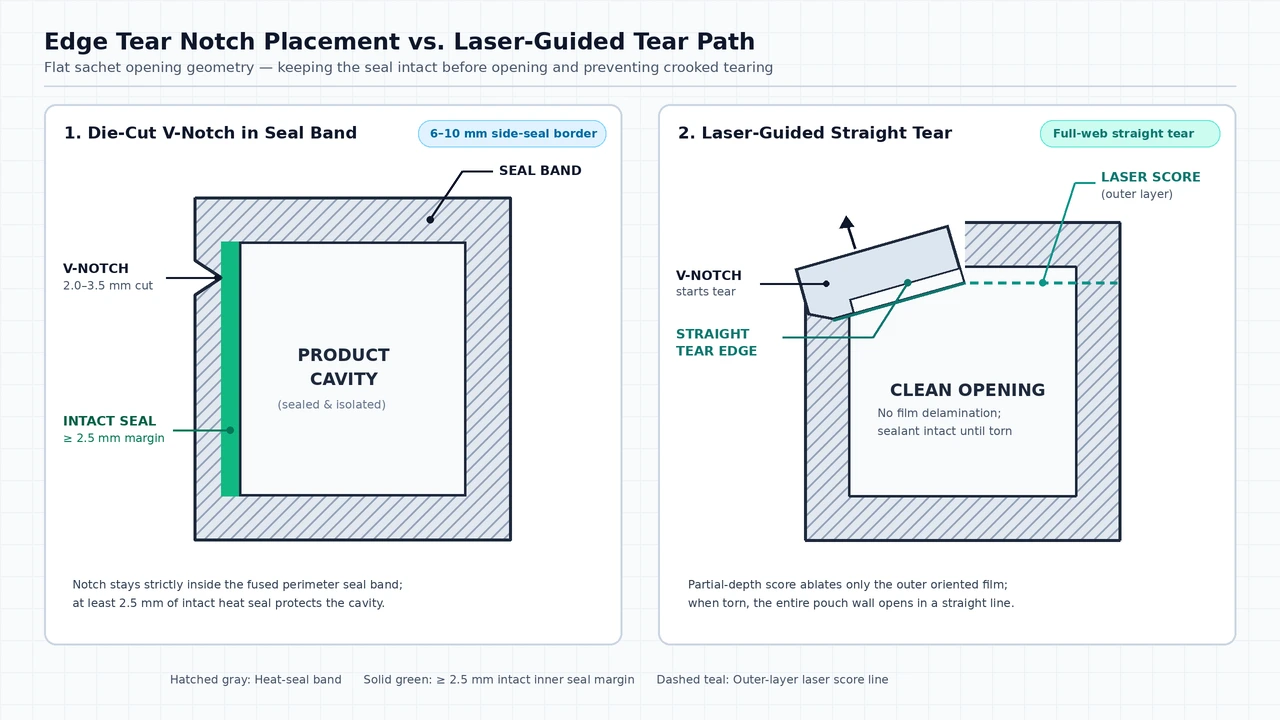
Left: a 2.0–3.5 mm V-notch stays inside the 6–10 mm perimeter seal band with at least 2.5 mm of intact inner seal. Right: an outer-layer laser score guides a straight full-web tear across the pouch without delamination while keeping the inner sealant intact until opened.
What Does a Tear Notch Do, and How Do Notch Cuts Compare?
A tear notch concentrates hand-opening stress at a single point on the heat-sealed edge of a pouch or flat sachet so the user does not have to stretch or scissor the film. On LINEVO quotation specification forms, buyers specify tear notches independently from other functional pouch features—such as hang holes, zippers, spouts, degassing valves, or tear tapes—and converting-punch tooling manufacturers likewise separate edge tear notches from hanger, handle, and vent punches. On reclosable zippered pouches, the notch must sit above the zipper track so tearing the header open leaves the reclose profile intact.
Common opening features fall into mechanical edge cuts formed at the sealing/cutting station and pre-scored or inline-scored tear guides:
| Opening feature | Geometry and placement | Functional role on the packet | Primary tooling or film control |
|---|---|---|---|
| Triangular V-notch | Small V-shaped cutout inside the side-seal band | Concentrates peel-and-tear initiation from either pull angle; the most widely used sachet edge notch | Punch depth and lateral web guiding must leave an intact inner seal margin |
| Straight die slit | Short linear slit cut into the sealed border | Low-scrap edge cut on narrow side seals or twin-pack strips where no slug removal is desired | Clean shear clearance prevents unsevered film strands across the slit |
| Inline V/U-notch punch | Dedicated mechanical punch cycling after horizontal cross-sealing | Forms consistent consumer notches on roll-fed 4-side seal sachet machines alongside single-pack or strip cutoff | Keep punch-to-die clearance at or below 0.03 mm and maintain sharp punch edges |
| Outer-layer laser score | Partial-depth laser ablation line registered to a print mark or encoder count | Guides a straight tear across oriented multilayer laminates without breaching the barrier or sealant layer | Tune beam power and dwell to film absorption window through roll-stock trials |
How Far Inside the Seal Band Should a Tear Notch Sit?
The tear notch must remain strictly inside the fused perimeter seal band so it never encroaches on the product cavity, and its exact coordinates belong on the dimensioned package dieline. As detailed in our 3-side seal vs 4-side seal sachet machine guide, a 4-side seal sachet carries a heat-sealed border on all four edges, while a 3-side seal sachet has three heat-sealed borders and one unsealed fold. Never assign an edge cut to the folded edge of a 3-side sachet unless that edge also receives a lap or fin seal; place notches only into fused seal bands after confirming outer width, cavity width, and seal deductions in our sachet sizes guide.
In our LINEVO sachet packing machine troubleshooting reference for roll-fed sachet machines, standard tear-notch depth is 2.0–3.5 mm inside a 6–10 mm side-seal border, maintaining at least 2.5 mm of intact fused seal margin inboard of the notch tip. When an inline punch fails to cut cleanly or nicks the inner product pocket, inspection usually points to one of three mechanical causes:
- Excessive punch-to-die clearance above
0.03 mm, which stretches and tears laminated foil or film instead of shearing cleanly. - Dulled V/U-notch punch edges that pull threads of oriented outer film toward the cavity.
- Lateral web tracking drift: a common production failure mode occurs when web tracking skew narrows one side-seal border until the fixed tear-notch punch pierces the inner pocket and causes shelf leaks. Operators prevent this by locking automatic EPC web edge guiding and holding at least
2.5 mmof intact seal inboard of the notch tip.
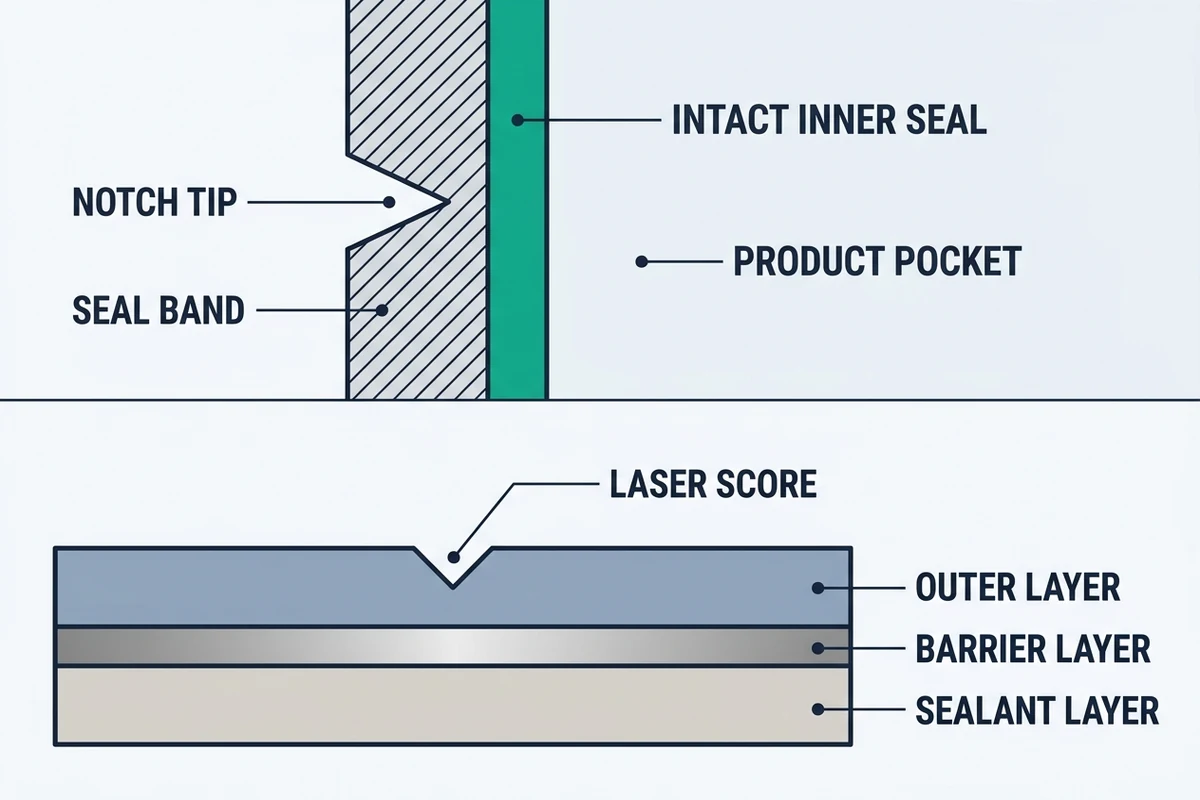
Top cutaway shows an intact inner seal zone maintained inboard of the notch tip within the side-seal band; bottom cross-section shows an outer-layer laser score stopping above the barrier and sealant layers.
When Do Oriented Laminate Films Need Laser Scoring?
An edge notch only starts a tear; polymer orientation inside the film web determines how that tear propagates. Under ASTM D1922-23, plastic films frequently exhibit strong anisotropy in tearing resistance caused by molecular alignment during extrusion and drawing. As summarized in the Kettering University reference note on boPET, biaxially oriented polyester (boPET) is stretched sequentially or simultaneously in the machine and transverse directions at draw ratios of roughly 3 to 4 in each axis and heat-set above 200 °C (392 °F) to lock planar orientation; for food sachets, shiny outer or metallized boPET is commonly laminated to a dull inner polyethylene sealant layer for sealability and puncture resistance. When hand tearing across such oriented PET/PE or nylon/PE laminates veers diagonally into the seal or delaminates between plies, a partial-depth laser score line provides a controlled low-resistance path straight across the packet.
Multilayer flexible packaging laminates suit laser scoring well because individual polymer and foil layers absorb infrared energy at different rates. Standard flexible-packaging laser systems typically use 40–300 W CO2 lasers whose beam energy vaporizes a controlled groove in the outer oriented layer while transmitting harmlessly through—or stopping short of—the underlying barrier and inner sealant layers. Controller recipes balance beam power and web dwell time inside a structure-specific depth window: scoring too shallow fails to steer the tear, whereas scoring too deep compromises oxygen/moisture barrier integrity or causes pinholes. Industrial laser-scoring controllers register the score line to a printed eye mark or encoder count at web speeds reaching up to 500 m/min on qualified structures, while recyclable mono-material PE and MDO-PE films have narrower thermal windows than PET/foil laminates and require dedicated scoring trials to initiate a straight tear without weakening tensile web strength.
How Do Inline Tear Notch Punches Work on Sachet Machines?
Our how sachet packaging machines work guide distinguishes three cutoff-station operations—a cross-knife that separates individual sachets, perforation blades that leave a tear line for connected strip packs, and the tear-notch punch. On vertical form-fill-seal equipment—including the sealing-jaw sequence analyzed for flexible paper webs by Merabtene et al. in BioResources and roll-fed sachet lines covered in our LINEVO troubleshooting reference—horizontal jaws fuse the end seams before a full-width rotary shear knife or pneumatic guillotine blade severs the web and a precision punch cuts the consumer tear notch. On LINEVO multi-lane frames from LV-400 to LV-980, one horizontal knife severs all 2 to 16 lanes in a single stroke, whereas single-lane cross-knives cycle inside or immediately below the horizontal jaws; packs that fail to separate or show frayed foil filaments across the cut typically stem from blade-to-anvil shear clearance above 0.04 mm, pneumatic pressure below 0.55 MPa, or knife timing phased before full jaw clamp.
Match punch mechanics to how the web moves through the notching station. As compared in our 3-side seal vs 4-side seal sachet machine guide, intermittent-motion horizontal and vertical sachet machines pause web advance during cross-sealing and punching—even when upstream unwind rollers pay film off continuously—allowing stationary intermittent die punches to cycle cleanly during jaw dwell, whereas continuous-motion lines require rotary or flying-shear notching units synchronized to line speed.

Printed eye marks pass a registration sensor above the horizontal sealing jaws; laser-score placement tracks print marks or encoder counts independently from the mechanical punch that cuts the edge tear notch after cross-sealing.
How Do Seal Strength and Film Tear Tests Differ From Hand Opening?
Form-fill-seal heat-sealing studies—such as Merabtene et al. in BioResources on coated flexible paper webs—demonstrate that every heat-sealable structure operates within a material-specific temperature and dwell window, and our sachet sealing problems guide notes that overheating can distort film or weld a cooled seam so rigidly that an edge tear notch stalls or rips off-angle. Laboratory standards isolate individual material properties rather than replicating how a consumer tears an entire filled packet:
- Seal strength (ASTM F88/F88M-23): Measures the force required to separate a cut strip across a heat seal and logs the failure mode for process control, while explicitly noting that strip peel testing does not simulate hand-opening a complete pouch. Minimum seal-strength limits verify closure integrity; upper seal-strength limits apply mainly to peelable seals rather than tear-through weld seals.
- Tear initiation vs. tear propagation (ASTM D1938-19 & ASTM D1922-23): ASTM D1004 measures unnotched tear-initiation force, whereas trouser-tear method ASTM D1938-19 (for non-brittle plastic film and thin sheeting
<= 1 mm/0.04 in., with film defined up to0.25 mm/0.010 in.) and Elmendorf pendulum method ASTM D1922-23 (7.6 to 46 m/minor300 to 1800 in./mintear rate, reporting mN or gf alongside thickness) measure force to propagate an already-started slit—the role played by a pre-cut sachet tear notch. Because tearing resistance is nonlinear with thickness and varies sharply between machine direction (MD) and transverse direction (TD)—with inter-set reproducibility under ASTM D1922 ranging from±5 %to±50 %—always test and label both MD and TD orientations and validate final opening feel on filled sample sachets.
When Do Child-Resistant Packaging Rules Restrict Easy-Open Sachets?
Standard food, beverage, condiment, and cosmetic sachets are unaffected by child-resistant rules. Under the U.S. Poison Prevention Packaging Act (CPSC Special Packaging FAQs), special-packaging restrictions apply only when a sachet contains a household substance listed in 16 CFR 1700.14—such as oral prescription drugs, regulated over-the-counter medications, dietary iron supplements, or hazardous household chemicals.
Rather than prohibiting a named cut style, 16 CFR 1700.15 and 16 CFR 1700.20 regulate the finished unit package by panel testing: unit packaging must achieve at least 80% child-resistant effectiveness (where a child accessing either a toxic dose calculated for a 25 lb / 11.4 kg child or more than 8 individual units within 10 minutes, whichever is lower, counts as a test failure) while retaining at least 90% senior-adult opening effectiveness within 5 minutes. Because an exposed edge tear notch lets young children rip thin laminates open by hand, PPPA-regulated unit-dose sachets normally omit standard easy-open notches in favor of heavy-gauge child-resistant laminates or fold-over hidden-notch designs certified to 16 CFR 1700.20 by the filler—whom the PPPA designates as the responsible manufacturer—except where regulations allow a single non-child-resistant household size carrying the mandatory "Package not child resistant" warning.
Custom Tear Notch Packaging Specification & Dieline Checklist
Use this dieline and trial checklist before ordering printed roll stock or locking cutting and notching tooling on a form-fill-seal line:
| Specification item | What to record on your drawing and trial sheet | Why it governs pack integrity |
|---|---|---|
| 3-side or 4-side format | Flat 4-side seal sachet sealed on all four edges, or 3-side seal sachet with three seals and one fold | Sets which perimeter edges carry fused seal bands available for notching |
| Folded-edge location | Which longitudinal edge is the continuous fold on a 3-side seal sachet | Ensures the tear notch is assigned to a heat-sealed border rather than an unsealed fold |
| Seal-band width | Top, bottom, and side seal-band widths on the dieline (typically 6–10 mm on side seals) | Defines total seal width available to house both the notch cut and intact inner margin |
| Notch cut form | Triangular V-notch, U-notch, or short straight die slit | Matches inline punch tooling and controls whether a cutout slug must be evacuated |
| Notch coordinate on dieline | Dimensioned distance from packet top edge, positioned above any zipper on reclosable pouches | Aligns the tear path across the top of the cavity and preserves zipper reclosure |
| Intact seal inboard of tip | Remaining fused seal inboard of the notch tip (2.0–3.5 mm cut depth leaving >= 2.5 mm intact seal) | Prevents minor EPC web-guiding drift or punch wear (> 0.03 mm clearance) from piercing the cavity |
| Laser-score requirement | Whether oriented PET, nylon, or PE laminates tear crookedly and require an outer-layer laser score | Confirms laser power and dwell ablate only the outer ply while leaving barrier and sealant layers intact |
| Print-mark or encoder sync | Eye-mark or encoder reference used to register any pre-applied or inline laser score | Keeps score-line registration aligned with cross-seal cutoff and mechanical notch punching |
| Regulated substance check | Whether the fill is listed under 16 CFR 1700.14 requiring PPPA special packaging | Regulated unit packs must pass 16 CFR 1700.20 child (>= 80%) and senior-adult (>= 90%) testing rather than using an unrestricted easy-open notch |
When your package drawing and candidate laminate are ready, send your sachet dimensions, seal-band widths, and opening specification so our team can review inline punching and trial requirements.
Sources
- ASTM D1938-19: Standard Test Method for Tear-Propagation Resistance (Trouser Tear) of Plastic Film and Thin Sheeting by a Single-Tear Method
- ASTM D1922-23: Standard Test Method for Propagation Tear Resistance of Plastic Film and Thin Sheeting by Pendulum Method
- ASTM F88/F88M-23: Standard Test Method for Seal Strength of Flexible Barrier Materials
- U.S. Consumer Product Safety Commission: Special Packaging (PPPA) FAQs
- Electronic Code of Federal Regulations: 16 CFR 1700.15 Poison Prevention Packaging Standards
- Electronic Code of Federal Regulations: 16 CFR 1700.20 Testing Procedure for Special Packaging
- Merabtene, Tanninen, Varis, and Leminen: Heat-Sealing Evaluation and Runnability Issues of Flexible Paper Materials in a Vertical Form Fill Seal Packaging Machine, BioResources
- Kettering University Library: Biaxially Oriented Polyethylene Terephthalate (boPET) Reference Note
- LINEVO Engineering Reference: Sachet Packing Machine Troubleshooting
- LasX Industries: Laser Scoring Capabilities for Flexible Packaging
- Packaging Strategies: Film Testing — Common Problems with Common Tests
- Laser Focus World: Precision Laser Scoring for Flexible Film Packaging
- Ambalaj Packaging Glossary: Tear Notch Entry
- EDGE Industrial Technologies: Converting Punches and Equipment