

Sachet Filling and Sealing Machine: Premade vs Rollstock
Published by the LINEVO sachet equipment team. Technical questions and corrections
A sachet filling and sealing machine times dosing cut-off ahead of jaw closure on premade flat-pouch filler-sealers and multi-lane rollstock FFS lines.
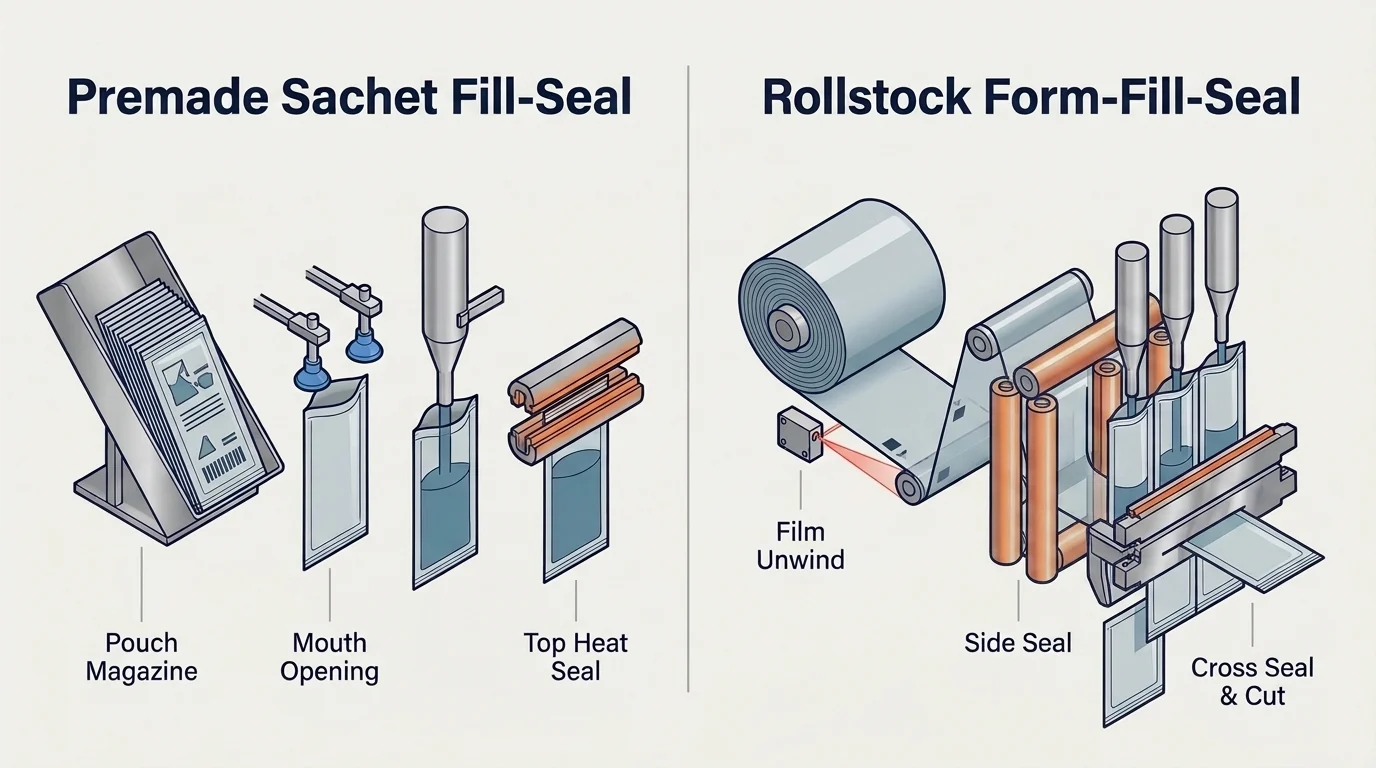
A sachet filling and sealing machine coordinates metered product cut-off ahead of heated jaw closure so the inner sealant layer melts, wets, and entangles polymer chains across a clean seam upon cooling. Premade pouch filler-sealers suit multi-SKU formats with zippers or spouts, whereas integral rollstock form-fill-seal systems scale multi-lane output from flat film.
Selecting between manual benchtop pairs, magazine-fed premade pouch equipment, and inline rollstock baggers depends on SKU changeover frequency, pre-converted pouch features, and whether product discharge clears the upper seal band within every cycle. Compare how stations interact across our how sachet packaging machines work guide, review dual-web rollstock frames on our four-side seal sachet machines page, check fault isolation in our sachet sealing problems guide, and evaluate quotation scope in our sachet packaging machine price guide.
| Equipment architecture | Pouch or web supply | Dosing-to-seal sequence | Batch profile and primary trade-off |
|---|---|---|---|
| Manual or semi-automatic benchtop setup | Preformed flat sachets loaded by hand | Operator meters each dose and transfers the open packet to a separate sealer | Suits limited-SKU startup runs and recipe validation; output depends on manual loading and inspection pace |
| Premade flat-sachet filler-sealer | Preprinted preformed pouches fed from a magazine | Suction opens the pouch mouth, a dosing head fills inline, and top jaws seal the header | Handles zippers, pour spouts, and bottom W-gussets without re-threading forming tubes; higher per-pouch consumable cost |
| Single-web vertical form-fill-seal (VFFS) | One continuous flat roll of plastic film, metallized foil/film, or paper | Film wraps a conical forming tube for a vertical fin seal while a horizontal bar seals after dispensing stops | Compact vertical floor footprint for solids and liquids; changing bag width requires forming-tube changeover |
| Dual-web multi-lane four-side-seal FFS | Two opposing film rolls or a slit parent roll across parallel lanes | Side and bottom seams seal first, top-mounted heads dose parallel lanes, and cross jaws seal, notch, and cut | High multi-lane throughput and dissimilar-web capability for food, IVD, and medical packs; requires eye-mark registration setup |
What distinguishes a dedicated sachet filling machine from a standalone bag sealer?
Unlike a standalone sealer applying heat and pressure to a loaded packet, a dedicated sachet filling and sealing machine synchronizes product dosing, shutoff timing, pouch or film indexing, date coding, and jaw clamping so oil, sauce, or dust stays out of the seal zone while governing dose consistency, appearance, labor, and scalability.
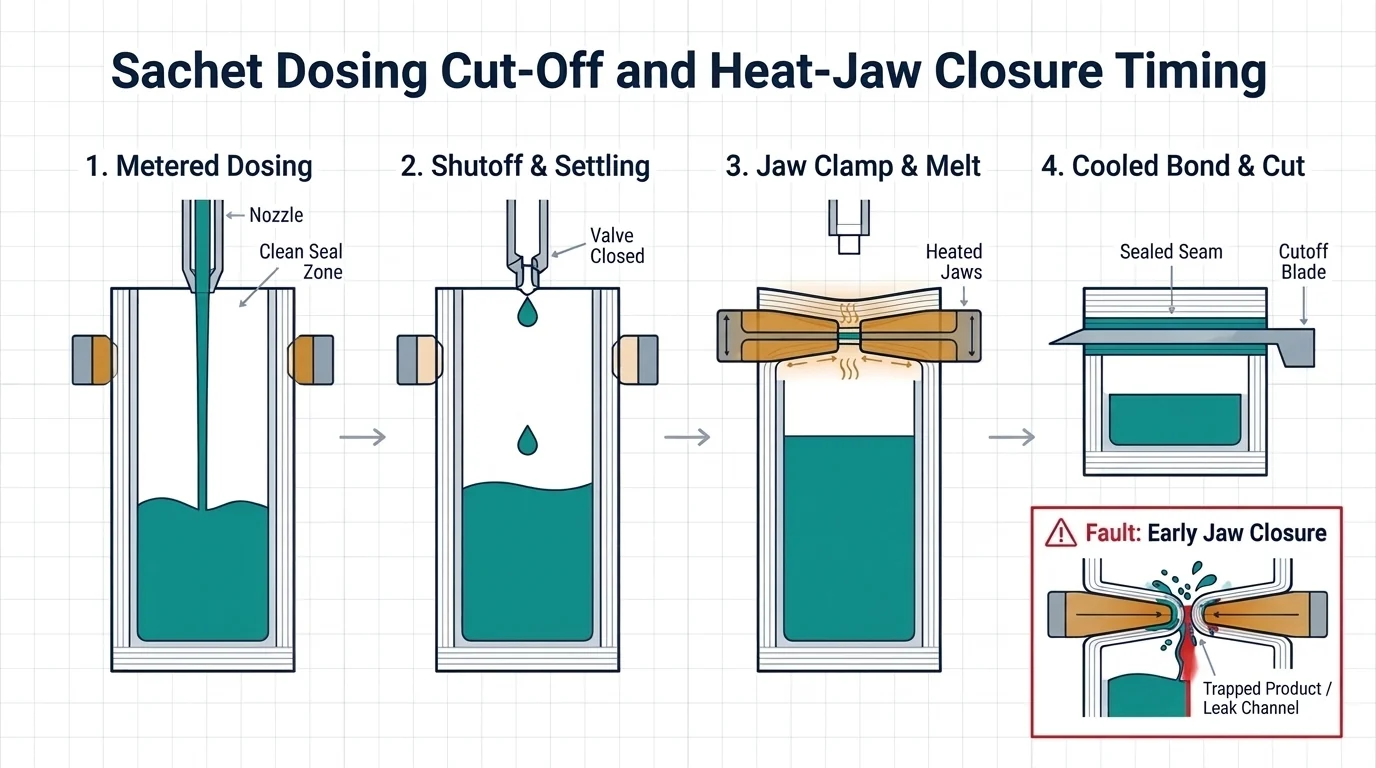
Synchronized shutoff lets the final drop clear the upper seal land before heated jaws clamp the inner sealant layer, preventing trapped product channels.
Heat-seal polymer diffusion, dwell thresholds, and seal-zone contamination
In food, pharmaceutical, and cosmetic flexible packaging, product shelf life depends on both film barrier properties and closure integrity, and seal failure is a frequent cause of product deterioration. As documented in the industrial VFFS heat-sealing evaluation by Merabtene, Tanninen, Varis, and Leminen in BioResources, closure jaws apply heat and pressure toward the inner sealant layer until it becomes partially molten, achieves wetting across the opposing face, and allows molecular segments to diffuse and entangle into a strong bond upon cooling. Laboratory and machine studies on LDPE, HDPE, and EVA flexible web films show that sealing temperature and dwell time control seal strength, whereas varying sealing pressure has nearly no effect once sufficient jaw pressure of 3 bar is maintained.
In those industrial VFFS trials at a 2 s dwell time, the first observable seal formed at 90 °C on polyethylene-coated paper (which offered a sealing window up to 220 °C before turning brown) and at 100 °C on thermoplastic film (which shrank at 140 °C). When dwell time dropped to 0.5 s at 100 °C, polyethylene-coated paper materials showed zero or very low seal strength—too weak to hold product falling from the dispensing doser—meaning the minimum dwell time plateau at 100 °C should be greater than 1 s to prevent seals opening during production. Even inside a valid temperature and dwell window, powder dust, oil, sauce, or liquid splash on the inner sealant face creates open channels and incomplete seals; for step-by-step jaw fault isolation, see our sachet sealing problems checklist.
When is a manual or tabletop sachet filling setup sufficient before automation?
Entry-level manual or semi-automatic sachet filling equipment is sufficient during limited-SKU startup runs where operators handle pouch loading and visual inspection by hand, whereas higher-automation investments match confirmed workload and contract demand over a 12 to 24 month horizon once daily volume outgrows benchtop throughput and manual labor capacity.
When comparing benchtop pairs against automated inline baggers, evaluate usable daily capacity rather than the published maximum operating range: net shift output is lower once operator experience, SKU changeovers, washdown cleaning, and quality inspections are deducted. Food, drink, and medical pouch operations also carry strict sanitizing and wash-down requirements, so packagers without enough volume to fill complex inline equipment to capacity often use contract packagers before bringing automated lines in-house. For hands-on benchtop timing checks and early transition signs, read our small sachet packing machines guide.
What compact small sachet filling and sealing layouts fit multi-SKU batches?
Compact multi-SKU operations choose between magazine-fed premade pouch filler-sealers that run preprinted formats with spouts, zippers, or bottom W-gussets without re-threading forming tubes, space-saving vertical single-web rollstock baggers, and compact four-lane four-side-seal frames that pack four parallel lanes in less floor space than several single-lane machines.
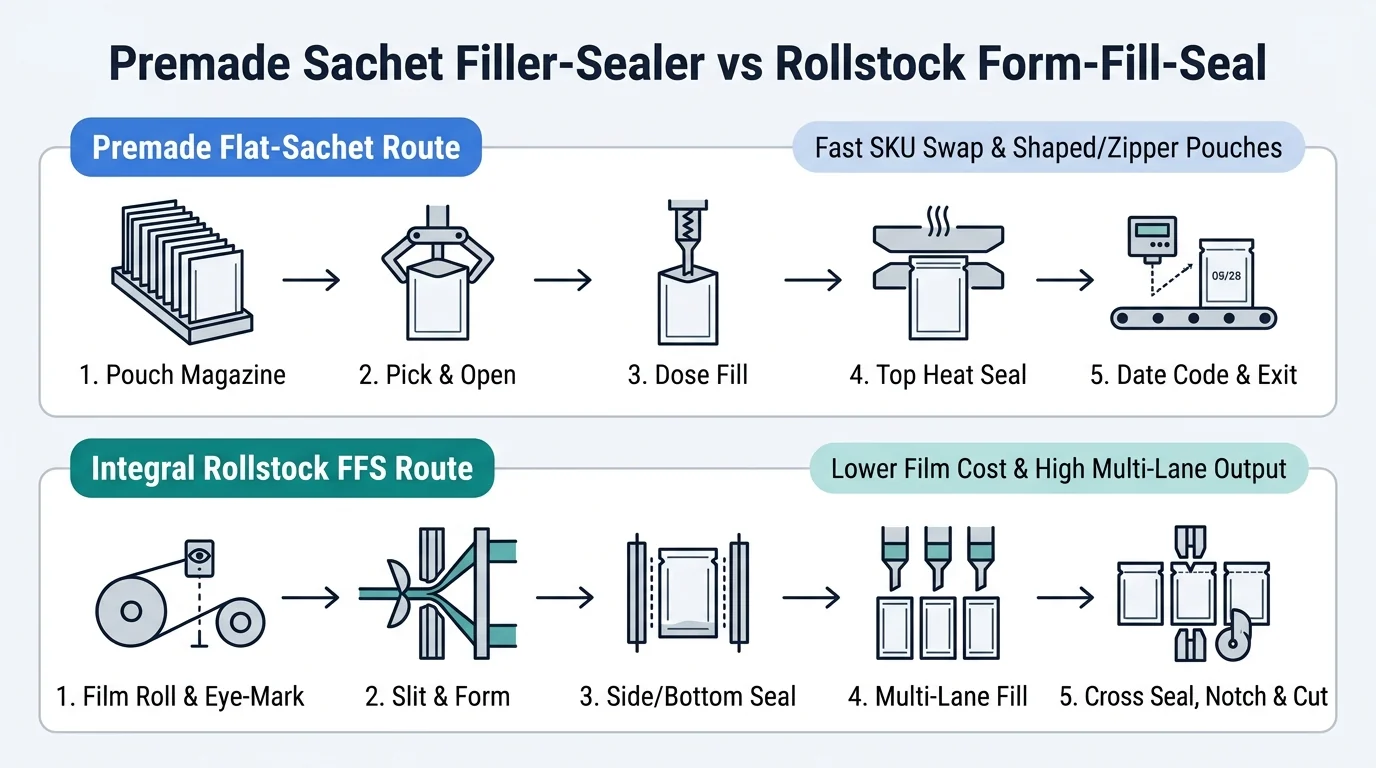
Premade flat-sachet equipment eliminates inline web forming and eye-mark setup between SKUs, while rollstock form-fill-seal integrates slitting, side sealing, multi-lane filling, and tear-notch cutoff.
Premade flat-sachet filler-sealers versus single-web and dual-web rollstock FFS
As summarized in the Wikipedia overview of preformed pouches and form-fill-seal equipment, flexible pouch lines follow one of two architectures: preformed multi-layer pouches (plastic film, paper, or foil with specialized heat-seal layers, bottom W-gussets, side gussets, pour spouts, or re-closable zip strips) are shipped to the packager to be filled and top-sealed, or an integral vertical or horizontal form-fill-seal machine forms, fills inline, and seals from roll stock. Co-packers and multi-SKU brands changing pouch widths and fill weights across weekly runs often need interchangeable sets of augers, cups, forming tooling, and saved settings compared with a plant running one sachet size every day.
Where floor space is tight, vertical form-fill-seal systems generally use less floor space than horizontal form-fill-seal machines. As detailed in the Wikipedia reference on vertical form-fill-seal systems, single-web VFFS pulls flat plastic film, metallized foil/film, or paper around a conical forming tube for a vertical fin seal while an intermittent fixed-height or continuous downward-moving horizontal bar seals the bottom, waits until product dispensing stops, and seals the bag top while forming the next bag bottom. Dual-web four-side-seal systems—widely used for IVD and medical device products as well as flat food sachets—feed two rolls from opposite sides (allowing different materials on each face), heat-seal the bottom and sides, load product from the top, index by pouch length or optical eyespot registration mark, optionally flush inert nitrogen gas to displace oxygen, and seal the top while punching a tear notch and cutting off; compare folded-edge and four-sealed-edge geometry in our three-side vs four-side seal sachet machine guide.
How do dosing heads adapt between liquid sachet filling, powders, and granules?
Sachet dosing heads match product flow behavior to protect weight accuracy and keep the upper seal land clean: thicker gels, syrups, sauces, and lotions use anti-drip piston pumps while thin fluids use liquid valves, cohesive fine powders use agitated rotating-screw augers, and free-flowing solids use volumetric cups, vibratory feeders, or weighers.
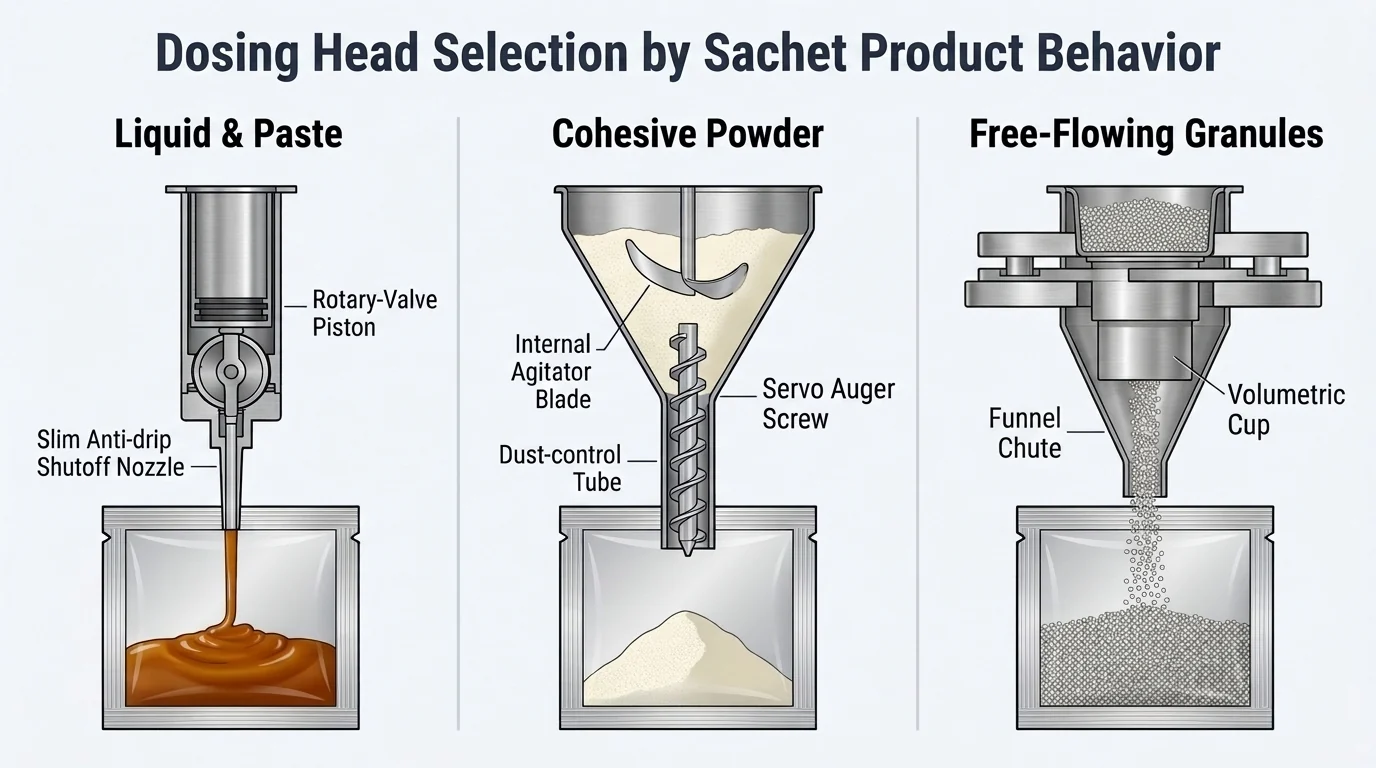
Each dosing head shields the upper sachet seal land differently: anti-drip shutoff nozzles for viscous sauces, enclosed auger tubes for dusty powders, and timed funnel chutes for free-flowing granules.
Matching pump, servo-auger, and cup designs to published LINEVO configurations
When sauces or lotions contain particulates, nozzle diameter and cleanout access must be sized so solids pass without hanging up in the shutoff seat. On the LINEVO LV-500SY, LV-700SY, and LV-980SY four-side-seal sauce sachet series, an anti-drip rotary-valve piston pump and photoelectric eye color-mark tracing coordinate piston metering, continuous downward dual-layer film pulling, roller side and bottom sealing with date coding, and nozzle filling across 2–4, 3–10, and 4–16 lanes on maximum 500, 700, and 980 mm film widths at 20–40 cuts/min; explore viscous pump setups on our liquid sachet machines page.
Fine cohesive powders—including protein powder, spices, drink mixes, flour blends, and powdered supplements—rely on rotating-screw auger fillers whose repeatability depends on bulk density, screw sizing, and hopper agitation. For multi-shift nutrition and supplement runs, the LINEVO multilane powder sachet machine equips each lane with an independently servo-driven vertical auger screw and passive dust-controlled sealing validated for cohesive protein mixes, collagen peptides, and meal replacements; compare powder configurations on our powder sachet machines page.
| Published LINEVO configuration | Seal format & lane count | Listed sachet size range | Listed fill range & dosing head | Published web width & speed listing |
|---|---|---|---|---|
| LV-500SY / LV-700SY / LV-980SY sauce series | Four-side seal; 2–4 / 3–10 / 4–16 lanes | 50–125 mm width; 45–160 mm length | 5–100 ml (extendable up to 500 ml); anti-drip rotary-valve piston pump | Maximum 500 / 700 / 980 mm film width; 20–40 cuts/min |
| LV-350X granule sachet machine | Four-side seal; 4 lanes in one cycle | 30–80 mm width per lane; 50–180 mm length | 1–50 g adjustable volumetric granule dosing | Compact four-lane frame; roll changes scheduled between runs |
| Multilane powder sachet machine | Four-side seal; multi-lane matrix | Configured per powder bulk volume and lane pitch | Independent vertical servo auger per lane with passive dust-controlled sealing | Configured per powder recipe, dose, and film structure |
When do free-flowing solids use volumetric cup sachet filling ahead of top sealing?
Dry, uniform granules and seeds with stable bulk density use volumetric cup fillers ahead of horizontal cross-sealing when the entire metered charge drops cleanly clear of the upper seal band before the jaws clamp, whereas blends that bridge, segregate, or generate airborne dust switch to vibratory feeders, weighers, or servo augers.
Larger or irregular solids such as snack inclusions, seeds, and certain confectionery require volumetric cups, vibratory feeders, or weigh-based dosing depending on whether particles bridge, separate, or vary in bulk density. On the LINEVO LV-350X four-side-seal granule sachet machine, four lanes form, fill, and seal in one cycle across a 1–50 g fill range, 50–180 mm sachet length, and 30–80 mm sachet width per lane while taking less floor space than several single-lane machines. During sample review on the LV-350X, engineers set dosing and seal pressure per lane to resolve lane-to-lane fill differences or fine-granule seal leaks and schedule film roll changeovers between runs; compare screw and cup trade-offs in our auger vs cup filling sachets guide and on our granule sachet machines page.
What sanitary and validation rules apply to pharma sachet filling and sealing lines?
Food sachet lines must maintain cleanable, corrosion-resistant, nontoxic contact surfaces and smooth seams under 21 CFR § 117.40, whereas finished pharmaceutical sachet lines shall add non-reactive contact parts, written disassembly and line-clearance logs, routine instrument calibration, and authorized computer controls under 21 CFR §§ 211.65, 211.67, and 211.68 alongside seal verification.
Under U.S. food cGMP rules in 21 CFR § 117.40, packing equipment must avoid adulterating food with lubricants or metal fragments, use corrosion-resistant nontoxic contact surfaces (such as food-grade SUS304 stainless steel listed on the LV-500SY series) that withstand food action and sanitizing agents, maintain smoothly bonded seams against particle buildup and allergen cross-contact, keep automated, gravimetric, and pneumatic systems sanitary, and treat compressed air or flushing gases introduced into food or contact surfaces so they do not contaminate product. Finished drug packaging under 21 CFR §§ 211.65–211.68 adds written cleaning, disassembly, batch-mark obliteration, and pre-use inspection records under §§ 211.180 and 211.182, plus written calibration programs and computer access/backup verification under § 211.68; see our pharmaceutical powder and granule sachet packaging guide.
| Compliance or QA check | Food sachet lines (21 CFR § 117.40) | Pharmaceutical sachet lines (21 CFR §§ 211.65–211.68) |
|---|---|---|
| Product-contact materials & seams | Corrosion-resistant, nontoxic contact surfaces with smoothly bonded seams to minimize particle buildup, microbial growth, and allergen cross-contact | Contact surfaces shall not be reactive, additive, or absorptive so drug safety, identity, strength, quality, or purity are unaltered |
| Lubricant & utility gas isolation | Prevent adulteration from lubricants or metal fragments; treat compressed air or flushing gases contacting food or product surfaces | Lubricants or coolants shall not contact drug products, containers, or closures |
| Cleaning & line-clearance records | Equipment installed and maintained for sanitary cleaning of automated, gravimetric, and pneumatic systems | Written disassembly, cleaning, previous batch-mark removal, and pre-use inspection procedures with logs kept per §§ 211.180 and 211.182 |
| Controls & recipe validation | Temperature and process instruments must be accurate, precise, and maintained | Written routine calibration records, authorized-only master record edits, input/output accuracy checks, backup files, and program validation |
| Seal strength & leak testing | Peel-strength verification per ASTM F88 / F88M-15 (2015) and dye penetration leak checks using dyed ethanol or rhodamine dye | Validated seal-strength testing per ASTM F88 / F88M-15 (2015) paired with dye penetration channel inspection |
Which automation and dosing choices drive sachet filling and sealing machine price?
Sachet filling and sealing machine scope scales with pouch-handling architecture, lane count and parent web width, dosing head complexity, multi-SKU changeover tooling, inert gas flushing, and sanitary or pharmaceutical validation packages, moving upward from operator-loaded benchtop units to magazine premade filler-sealers and multi-lane four-side-seal rollstock systems.
In LINEVO rollstock configurations, sachet size, seal pattern, dosing method, and lane count define mechanical scope. Stepping up across the LV-500SY, LV-700SY, and LV-980SY four-side-seal frames expands parent web capacity from 500 to 700 and 980 mm across 2–4, 3–10, and 4–16 lanes, scaling rated 220 V 50/60 Hz power across 4, 5.5, and 7 kW and machine weight across 650, 850, and 1000 kg alongside PLC + touchscreen HMI controls and 0.6–0.8 MPa compressed air at 0.35 m³/min. Adding independent per-lane servo augers, extra format change parts for multi-SKU co-packing, nitrogen flushing, or 21 CFR §§ 211.65–211.68 calibration and validation documentation further expands engineering scope.
| Switching evaluation item | Stay on manual / benchtop two-step | Choose premade flat-sachet filler-sealer | Choose integral rollstock FFS (single- or multi-lane) |
|---|---|---|---|
| Confirmed demand horizon | Early recipe validation and limited-SKU pilot runs | Multi-SKU commercial runs with frequent size or artwork swaps | Sustained 12 to 24 month workload per format justifying inline setup |
| Package structure | Preformed flat three-side or four-side pouches | Pre-converted pouches with zippers, pour spouts, side gussets, or bottom W-gussets | Flat three-side, fin-seal, or four-side sachets formed inline from roll stock |
| Changeover work | Manual dose adjustment and jaw temperature check | Magazine width adjustment and saved recipe recall without web re-threading | Film roll splice, eyespot registration alignment, and forming or slitting tooling sets |
| Next specification step | Benchmark shift output in our small sachet machine guide | Verify pouch opening and top-seal clearance in sample testing | Review cost drivers in our sachet machine price guide and request a quotation |
Frequently Asked Questions About Sachet Filling and Sealing Machines
Why should heat-seal dwell time exceed 1 second at 100 °C on polyethylene-coated paper sachets?
In industrial VFFS trials reported by Merabtene, Tanninen, Varis, and Leminen in BioResources, polyethylene-coated paper sealed at 100 °C for only 0.5 s produced zero or very low seal strength, leaving the bottom seam too weak to hold product falling from the dispensing doser. Holding dwell time greater than 1 s at 100 °C—while maintaining at least 3 bar jaw pressure—allows inner sealant polymer chains to wet and entangle before cooling.
Can one sachet machine run both premade pouches and flat rollstock film?
Standard production machines are built around one feeding architecture: premade pouch filler-sealers pick, open, fill, and top-seal pre-converted pouches from a magazine, whereas integral form-fill-seal machines unwind continuous flat roll stock over a forming tube or dual-web sealing station. Facilities running both zipper or spouted pouches and high-volume flat sachets split those formats across dedicated lines or contract packagers.
When do dual-web four-side-seal sachet machines outperform single-web VFFS?
Dual-web four-side-seal systems feed two opposing rolls so all four perimeter edges are heat-sealed, allowing different barrier webs on front and back faces, top-down dosing across parallel lanes, and crisp flat packets favored for IVD, medical device, condiment, and supplement sachets. Single-web VFFS wraps one web around a conical tube for a vertical fin seal in a compact footprint.
Why is daily usable sachet output lower than a machine's listed cuts per minute?
Published speeds—such as 20–40 cuts/min on the LV-500SY, LV-700SY, and LV-980SY sauce series—represent the machine's cyclic operating range during steady running. Usable daily output is lower once scheduled film roll splices, SKU changeovers, washdown cleaning, operator pace, startup adjustments, and seal inspections are deducted.
How do ASTM F88 peel tests and dye penetration tests check sachet seals differently?
ASTM F88 / F88M-15 (2015) measures the mechanical force required to separate a strip cut across a cooled heat seal, verifying weld strength across temperature and dwell settings. A dye penetration test using standardized dyed ethanol or rhodamine dye checks airtightness by revealing micro-channels caused by oil, sauce splash, powder dust, or jaw misalignment.
Sources
- Merabtene, Tanninen, Varis, and Leminen, Heat-Sealing Evaluation and Runnability Issues of Flexible Paper Materials in a Vertical Form Fill Seal Packaging Machine (BioResources, NC State University)
- Legal Information Institute, Cornell Law School, 21 CFR § 117.40 — Equipment and Utensils (Food cGMP)
- Electronic Code of Federal Regulations, 21 CFR §§ 211.65–211.68 — Pharmaceutical Equipment Construction, Cleaning, and Controls
- Wikipedia, Stand-up pouch — Preformed Pouches vs Integral Form-Fill-Seal Machinery
- Wikipedia, Vertical form fill sealing machine — Single-Web and Dual-Web Systems
- LINEVO Catalog, LV-500SY / LV-700SY / LV-980SY Four-Side-Seal Sauce Sachet Packaging Machine
- LINEVO Catalog, LV-350X Four-Side-Seal Granule Sachet Machine
- LINEVO Catalog, Multilane Powder Sachet Packaging Machine with Servo Auger Filler