

Liquid & Paste Sachet Packing Machines
How to choose a liquid sachet packing machine for liquids and pastes: viscosity, particles, temperature, dripping, foaming, dosing method and cleaning.
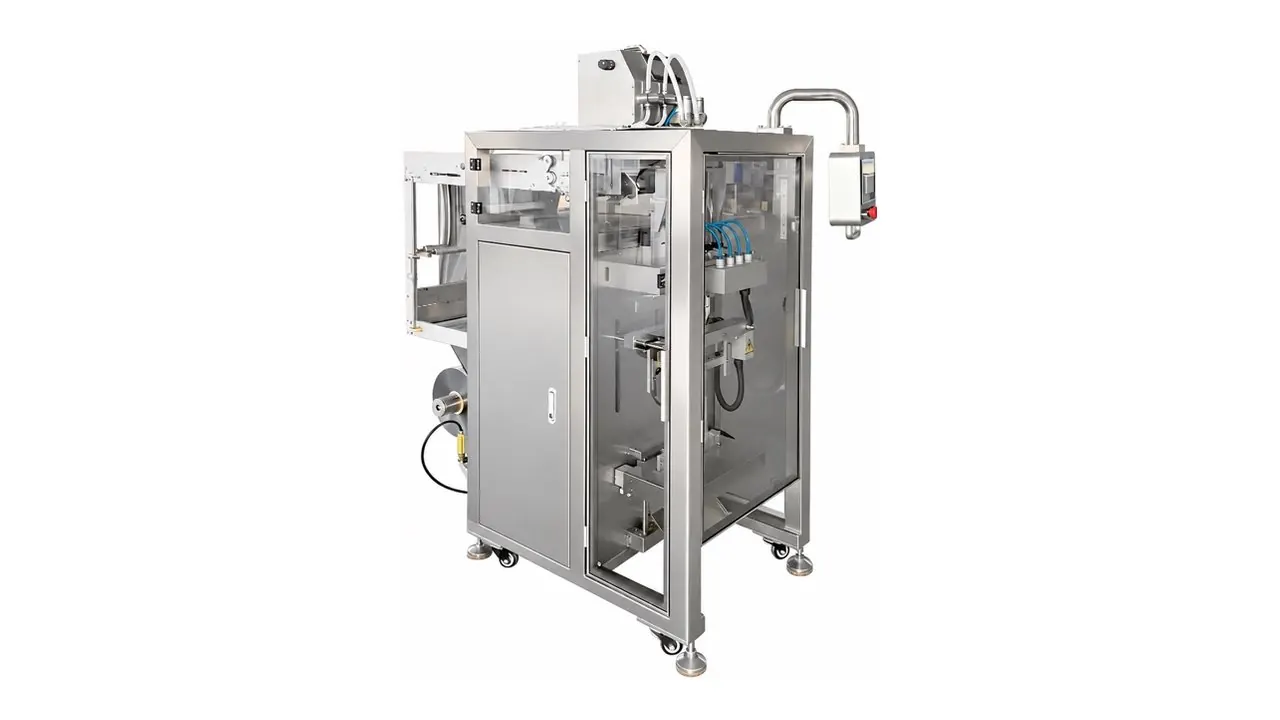
A liquid sachet packing machine doses a pourable or pumpable product into a flat sachet and seals it. What you need depends less on the product name than on how the product behaves: how thick it is, whether it carries particles, how it reacts to heat, whether it drips or strings, and whether it foams. Below are those properties, the common dosing methods, and the cases where you should test before you buy.
For product-specific advice, see sauce, ketchup and condiment packing and shampoo and other foaming liquids.
Liquid or paste: what is the difference for the machine?
There is no sharp line between a liquid and a paste. A thin liquid flows under gravity and meters quickly, but it splashes and drips. A paste resists flow, holds its shape, and usually needs positive displacement to move it through the filling path. Many products sit in between, and some change with shear or temperature.
Buyers often describe viscosity as thin, medium or thick, or give one number from their own lab. Neither is enough alone. Send the measured value with the temperature it was taken at, and tell us whether the product thins when pumped or stirred. We use that to recommend a dosing method. We don't publish a viscosity range as a capability, because the usable range depends on the pump, the nozzle, the filling path and the sachet size.
Which product properties decide the configuration?
Particles
Seeds, fibre, pulp, spices and soft pieces can jam valves, damage seals and make doses uneven. Tell us what the particles are, how large the biggest one is and how much of the product is solid. A smooth emulsion and a product with visible pieces are different jobs even when their viscosity matches.
Fill temperature
Some products are filled warm to keep them flowing, and some are sensitive to heat. Warm filling changes what the film has to tolerate, what the pump seals are made of, and how the seal forms. Check a given machine and film against your fill temperature before you assume it works.
Dripping and stringing
After the dose, a thick or sticky product can leave a tail hanging from the nozzle, and the tail falls into the seal area. Product between the seal jaws gives a weak seal and a leaker. You manage this with the nozzle design, how the dose ends, the timing between fill and seal, and sometimes the way the sachet is held open.
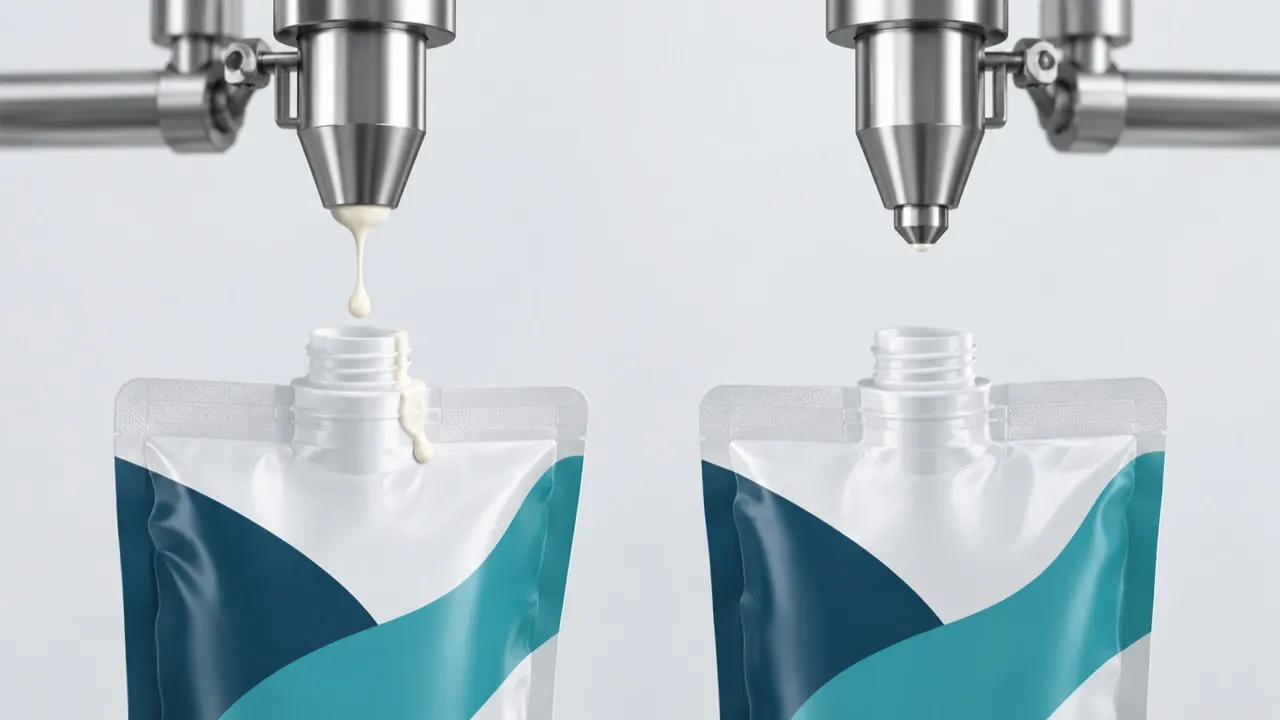
Illustration: a product tail that lands in the seal area after the dose is what causes weak seals.
Foaming
Products with surfactants, or products that carry air, foam when they are pumped or dropped into the sachet. Foam makes the dose volume unreliable and can climb into the seal. A low-turbulence filling path, a slower or submerged fill and the right pump all help. We still run your real product before calling it solved.
Which dosing methods are used, and what are the trade-offs?
The piston pump with a rotary valve is the usual choice for liquids and pastes. It moves a defined volume per stroke and copes with thick products. The valve switches the pump between drawing from the hopper and pushing to the sachet. Gear, peristaltic and lobe pumps suit certain products too, and the right one depends on viscosity, particles, shear sensitivity and how you clean.
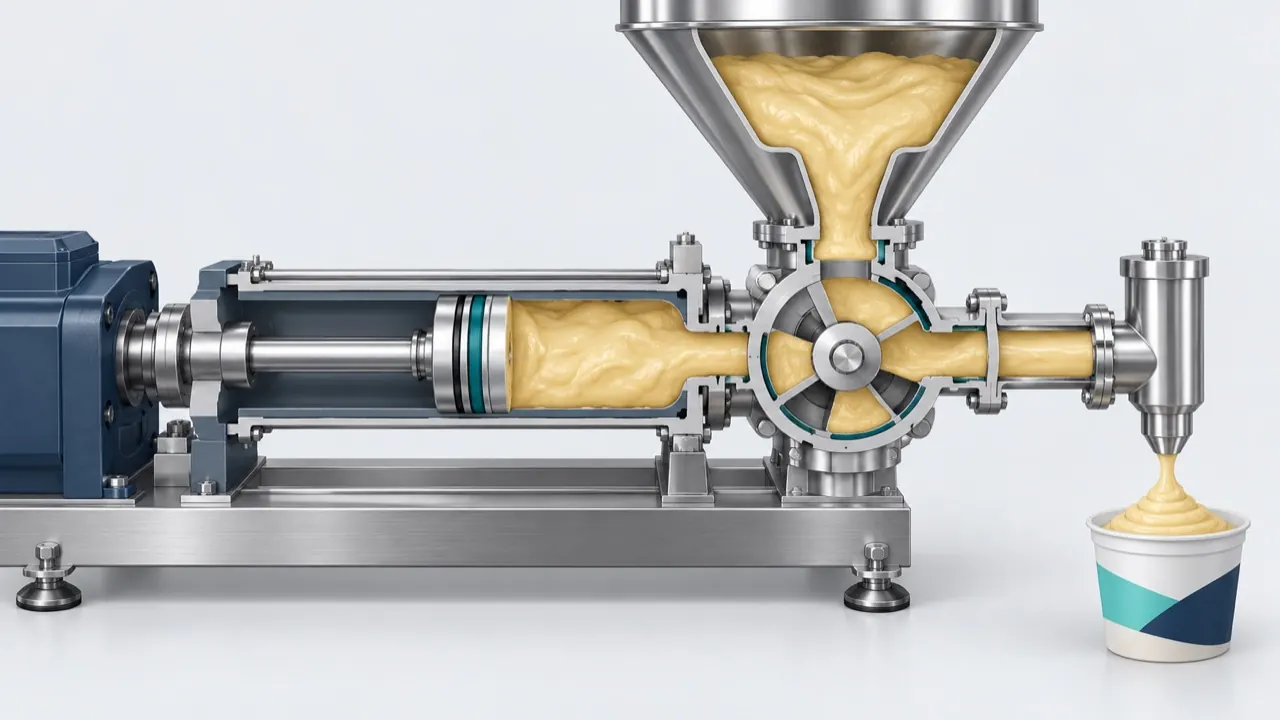
Illustration: the rotary valve alternates between drawing product from the hopper and pushing it to the nozzle.
| Dosing approach | Usually suited to | Points to watch |
|---|---|---|
| Piston pump with rotary valve | Liquids and pastes, including thick products | Particle size against valve clearance; more parts to clean |
| Other pump types, described generally | Products where shear, particles or gentle handling matter | Dose repeatability and wear depend on the product |
| Gravity or timed flow | Thin, free-flowing liquids | Sensitive to head pressure and temperature; may drip |
Treat the table as a starting point. Send us your product data and we will say which approach we would try first, and whether it needs testing.
Product-contact materials, cleaning and changeover
Anything that touches the product has to suit it, and acidic, salty or alkaline products are the usual troublemakers. We don't state one material grade for all machines here, so ask for the material specification in the written quotation.
Cleaning matters every time you change product, fragrance, colour or allergen. Count the product-contact parts, check whether they come off without tools, and ask how long a changeover takes. We don't claim hot filling or automated cleaning systems on this page. If your product has hygiene or regulatory requirements, tell us early so they can be checked against the actual machine and its documents. Keep the guards in place and follow your own safety procedure when you clean.
Sachet format and number of lanes
Liquids and pastes usually go into flat three-side or four-side seal sachets, and the four-side seal sachet page covers how to choose between them. If one lane can't deliver the output you need, look at multi-lane configurations. Liquids can limit the lane count, because every lane needs its own accurate dose and a clean seal.
When do you need a dedicated trial?
Test your product first if it:
- is thick, sticky or stringy;
- contains particles, seeds, fibre or soft pieces;
- foams or contains surfactants;
- must be filled warm or is heat sensitive;
- has strict dose or leak requirements;
- is a new recipe, even if a similar one ran before.
Run data does not carry over from one formulation to the next. The product and film trial measures dose repeatability, product in the seal area, seal strength and leaks, using your product and your film.
What information should you send?
- Product name, a measured viscosity with its temperature, and any particle details.
- Fill temperature and any heat limits.
- Dose per sachet in grams or millilitres.
- Sachet size, format and film, if known.
- Whether the product foams, drips or strings.
- Cleaning frequency and number of products to run.
- A sample, if you plan a trial.
Questions about liquid and paste sachet machines
Can one machine pack every liquid and paste?
No. Thin liquids, thick pastes, particulate products and foaming products need different dosing and nozzle setups. We recommend a configuration for your product after we look at it, not one machine for everything.
How do I stop the product from dripping into the seal?
Work on the nozzle design, how the dose ends, and the timing of the fill and seal steps. Then run your product and inspect the seal area to see whether it stays clean.
Does viscosity alone tell me which pump to use?
No. Particles, shear sensitivity, temperature and cleaning needs also count. Viscosity gets you started and no further.
How is price decided for a liquid machine?
It depends on the dosing system, the number of lanes, the sachet format and the options you pick. Our sachet packaging machine price guide explains what the quotation covers. For the wider decision, read how to choose a sachet packaging machine.
LINEVO catalog example
Configurations from the LINEVO sachet catalog. Figures are catalog listings, not guaranteed performance: every value is confirmed for your product, film and sachet in the written quotation.
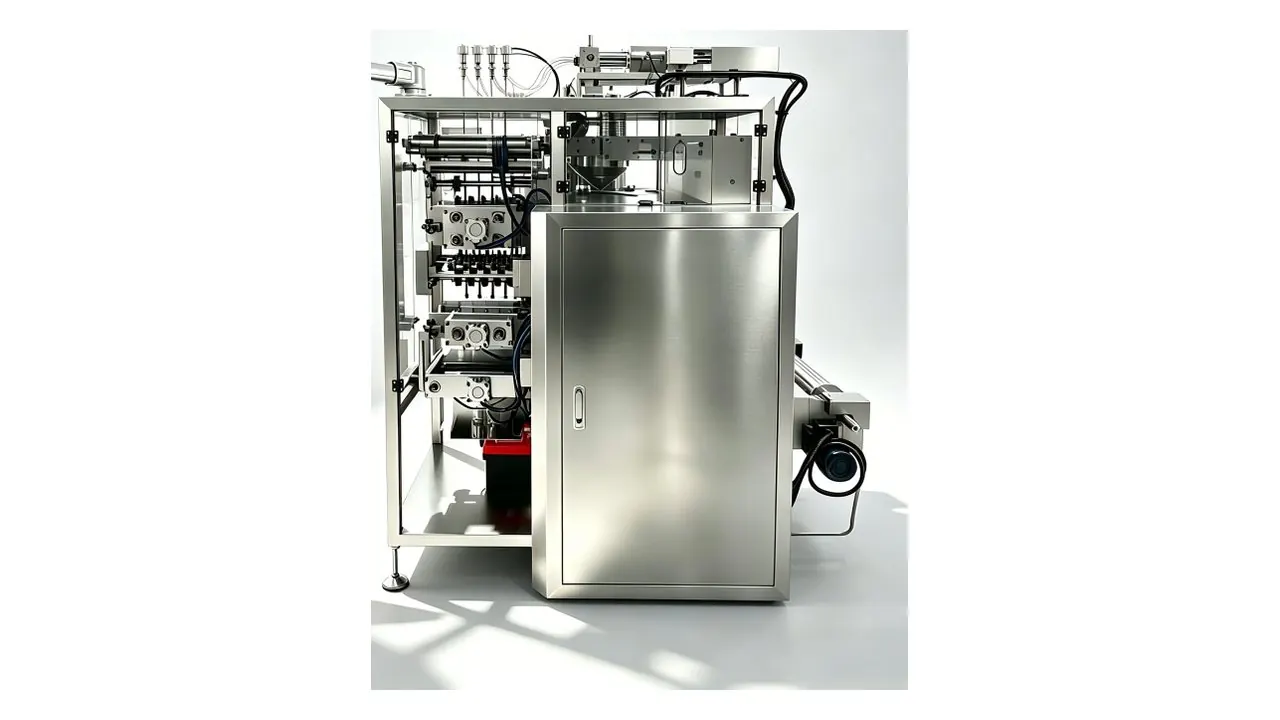
LV-400Y
Four-side seal sauce sachet machine
Listed products
Ketchup, tomato paste, chili sauce and other viscous liquids
Catalog listing
- Lanes
- 3 to 10
- Fill range
- 5 to 100 ml
- Sachet length
- 50 to 180 mm
- Sachet width
- 30 to 140 mm
- Film width
- up to 320 mm
- Dosing
- Piston pump with rotary valve, anti-drip
Product photographs: authorized catalog images shared by Dession, LINEVO's sister team in the same company. Original markings may appear.
Not sure which configuration fits your product?
Send your product and pack details, or ask for a trial on your own material before you decide.