

Sachet Packaging: Formats, Multilayer Barrier Films & Heat Sealing
Published by the LINEVO sachet equipment team. Technical questions and corrections
Sachet packaging seals a single-use food or consumer dose inside flat 3-side or 4-side roll-film laminates using print, barrier, and inner thermoplastic layers.
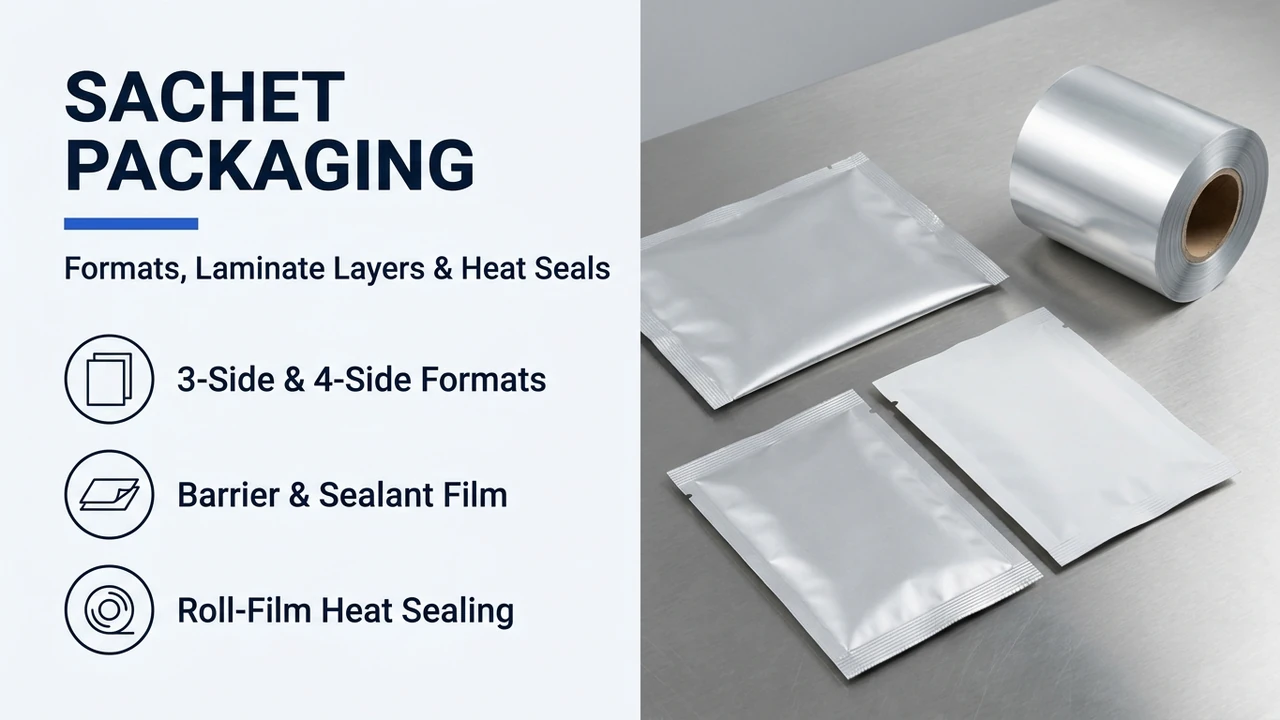
In packaging, a sachet is a small single-use bag or packet made from plastic film, foil, or paper that holds one portion of a food or consumer good such as ketchup or shampoo and opens with a small tear so you can squeeze out the contents. Unlike a scented cloth bag filled with herbs or potpourri, or a porous desiccant packet placed inside a larger container to exchange vapors with its atmosphere, sealed product sachet packaging uses roll-stock film formed into a flat 3-side seal packet with one folded edge or a flat 4-side seal packet sealed along all four edges. Those flat packets also stay distinct from a narrow tubular stick pack and from a bottom-gusseted stand-up pouch, because a flat sachet machine does not convert into a stand-up pouch line through a recipe change alone.
Product shelf life depends on both the barrier properties of the flexible material and the integrity of the heat seal, where heat, pressure, and contact time partially melt compatible inner thermoplastic sealant faces to close the pocket. Under U.S. laminate regulation § 177.1395, that inner food-contact layer does not function as a barrier to component migration from non-food-contact layers. We manufacture automatic sachet packaging equipment for powders, liquids, pastes, and granules, and this guide covers the format-and-film stage of our sachet packaging machine buying guides.
What Is a Sachet and Where Are Single-Dose Packets Used?
Single-use sachets package measured portions of liquids, pastes, powders, and granules into tear-open roll-film packets. Documented condiment packets distribute ketchup, mustard, mayonnaise, salad cream, HP sauce, relish, tartar sauce, vinegar, and soy sauce, and flexible packaging applications include frozen food, pharmaceutical products, and cosmetics. In 2011, 87% of shampoo sold in India was in sachets.
Defining a product sachet starts with the fill itself: whether it is fine or coarse, free-flowing or sticky, contains particles, oils, sugar, or salt, absorbs moisture, or reacts to heat or light. Those product traits separate sealed barrier consumer packets from porous vapor-exchange sachets such as desiccants packed inside larger containers.
How Do 3-Side, 4-Side, Stick, and Stand-Up Formats Differ?
Flat 3-side sachets, flat 4-side sachets, narrow stick packs, and stand-up pouches use different unfolded film geometries, seam layouts, and forming hardware. On a 3-side seal sachet configuration, a single strip of film folds over a forming plow so one edge remains a continuous fold while the open side and top and bottom ends are heat-sealed. A 4-side seal sachet forms a flat rectangle sealed along all four edges, joining two opposing rolls fed from opposite sides, a single web split inside the machine, or a folded web given a fourth edge seal.
Start with a flat sachet when a broad printable face matters, and review our sachet versus stick pack comparison when a narrow pour opening suits the dose, since vertical tube-formed stick packs clamp film edges into a melted fin seal and follow separate dimension rules on our sachet sizes and fill volume guide. Compare folded and dual-web paths in our 3-side seal vs 4-side seal sachet machine guide, and consult our sachet vs stand-up pouch packaging comparison when a bottom-gusseted doypack stands erect on its bottom for display, storage, and convenience.
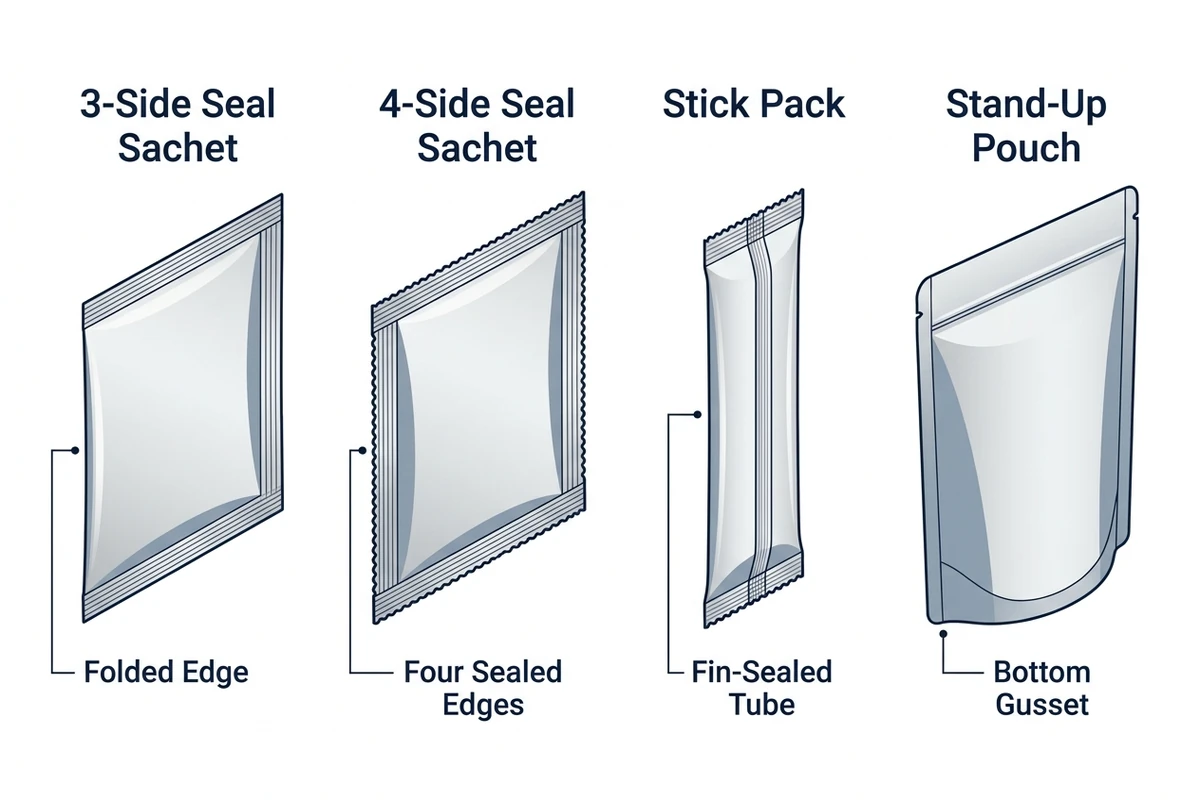
| Package format | Web path and seam layout | Face geometry and use boundary | Deeper engineering guide |
|---|---|---|---|
| 3-side seal flat sachet | Single film strip folded over a plow; one folded edge and three heat seals | Flat packet with wraparound film fold across one long edge | 3-side vs 4-side seal guide |
| 4-side seal flat sachet | Opposing dual webs, split web, or folded web with four sealed edges | Flat bordered rectangle with two lengthwise side seals and top and bottom cross seals | Sachet sizes and fill volumes |
| Narrow stick pack | Film pulled around a vertical tube and clamped into a melted fin seal | Narrow tube built on separate tooling with its own size system | Sachet versus stick pack |
| Stand-up pouch (doypack) | Multilayer pouch formed with a bottom gusset on dedicated equipment | Stands erect on its bottom for food display and storage | Sachet vs stand-up pouch |
What Roles Do Print, Barrier, and Sealant Layers Play?
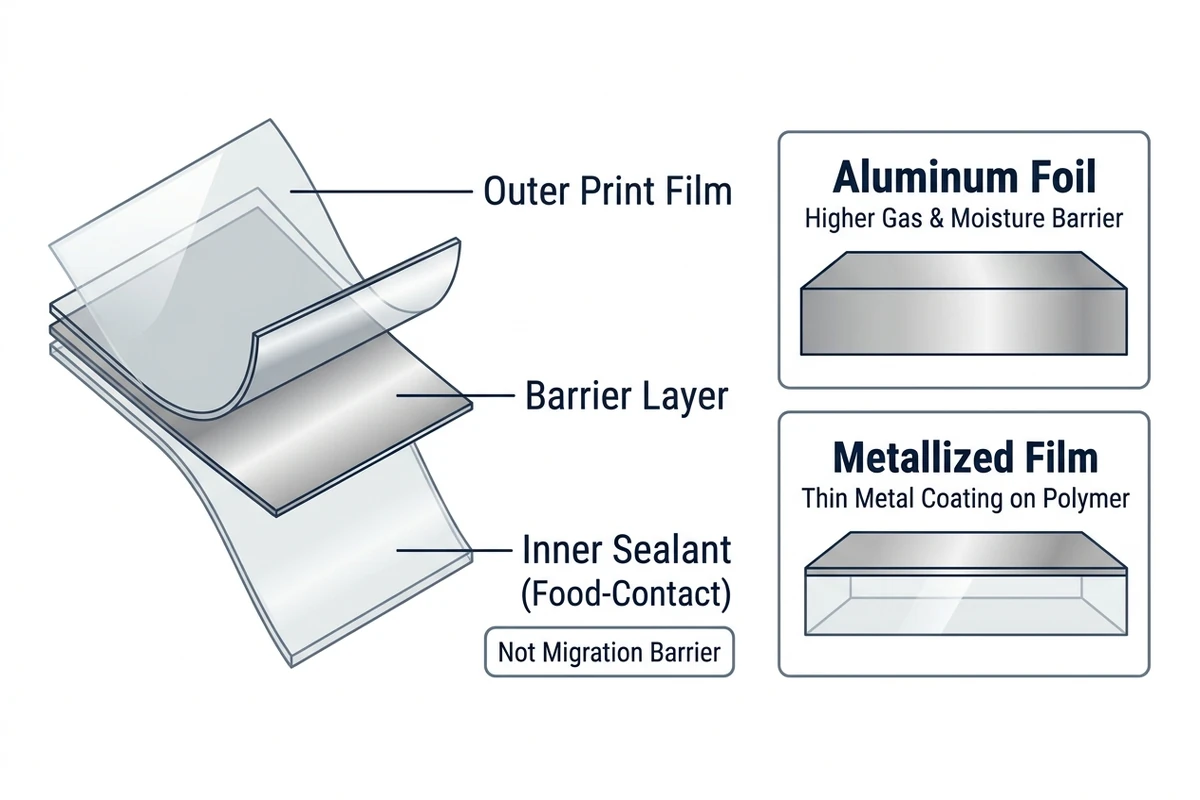
Printing, a gas or moisture barrier, and thermoplastic heat sealing can sit on separate layers that are laminated, extruded, coextruded, or fused. Under U.S. federal regulation § 177.1395 for laminate structures used between 120 °F and 250 °F, the inner food-contact layer does not function as a barrier to migration of components from non-food-contact layers. For higher-temperature applications, § 177.1390 covers laminate structures used at 250 °F and above for food contact not exceeding 135 °C (275 °F) unless otherwise specified.
Retort pouch construction varies from one application to another, because a liquid product needs different barrier properties than a dry product, and an acidic product needs different chemical resistance than a basic product. In retort-pouch laminates engineered to block outside gas permeation, polyester (PET) provides a glossy rigid layer that may be printed on the inside, bi-oriented polyamide (nylon) adds puncture resistance, aluminum (Al) forms a thin gas barrier, and food-grade cast polypropylene (CPP) or polyethylene (PE) serves as the inner sealing layer. In other food packaging webs, biaxially oriented PET (BoPET) supplies tensile strength and dimensional stability and can be aluminized and laminated to PE for sealability and puncture resistance, or oriented polypropylene (OPP) can pair with a PE sealant layer, and the inner layer must seal within a temperature range the machine can hold across the full seal width.
When Should You Choose Aluminum Foil Over Metallized Film?
Moisture, oxygen, or aroma sensitivity decides how much barrier the laminate needs, and a thin aluminum coating on polymer film reduces light, water, and oxygen permeability without matching the barrier of aluminum foil. Metallized film is a polymer plastic substrate, most commonly oriented polypropylene (PP) or PET and also nylon, PE, or cast polypropylene, coated with a thin layer of aluminum that reduces permeability to light, water, and oxygen. Although aluminized BoPET reduces gas permeability and reflects up to 99% of light including much of the infrared spectrum, metallized films are sometimes mistaken for solid foil and still cannot match the barrier properties of aluminum foil laminates.
Metallized PET and PP have replaced foil laminates on snack foods, coffee, and candy that do not require the superior barrier of aluminum foil. Approximately 75% of aluminum foil is used for packaging of foods, cosmetics, and chemical products, and 25% is used for industrial applications such as thermal insulation, electrical cables, and electronics.
| Laminate layer option | Construction | Documented role in flexible packaging |
|---|---|---|
| Solid aluminum foil | Very thin aluminum gas-barrier layer in a flexible plastic and metal-foil laminate | Provides a very thin but effective gas barrier; the laminate does not allow outside gas to enter the pouch |
| Metallized polymer film | Thin aluminum coat on PET or oriented PP (or nylon, PE, or CPP) | Lowers light, water, and oxygen permeability and reflects up to 99% of light on BoPET without matching solid foil |
| Inner thermoplastic sealant | Food-grade cast polypropylene (CPP), or polyethylene (PE), as the inner contact layer | Partially melts and wets under heat, pressure, and dwell time; not a migration barrier under § 177.1395 |
How Do Roll-Film Machines Form and Heat-Seal Flat Sachets?
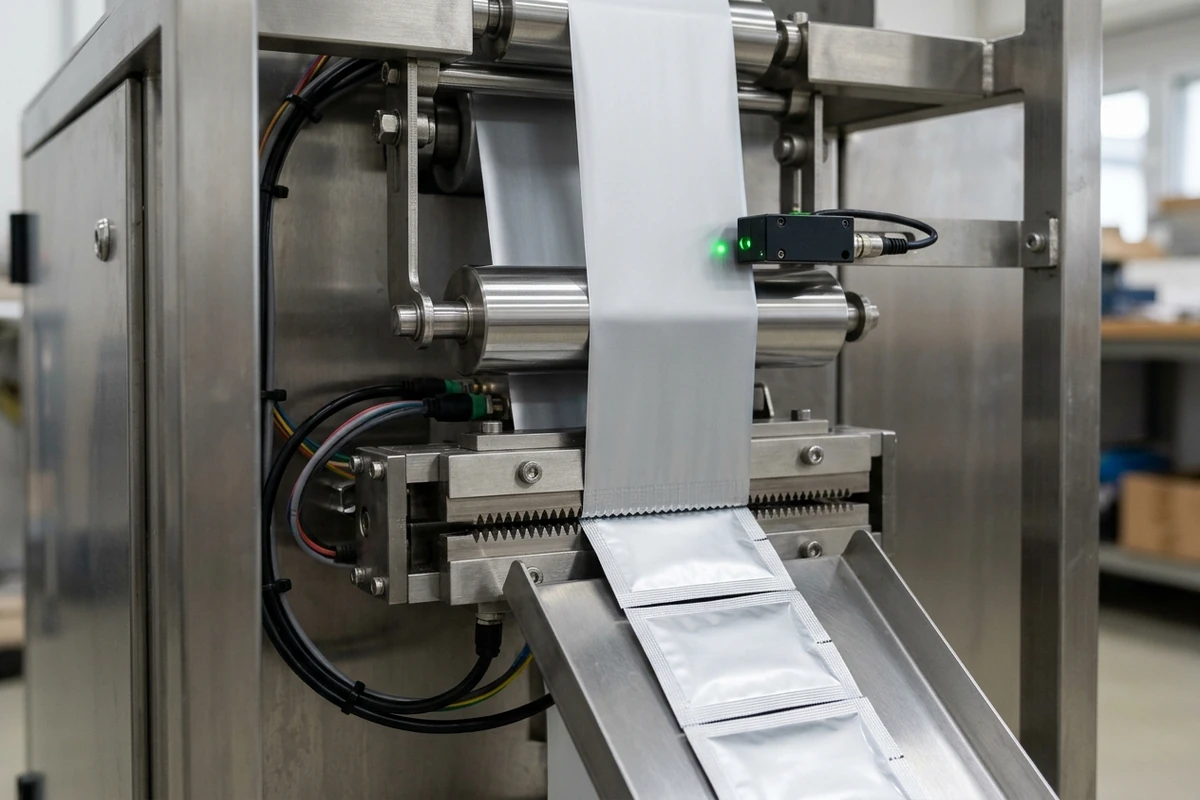
Automated form-fill-seal sachet equipment unwinds a continuous flat roll of plastic film, which has usually had labeling and artwork applied, shapes or aligns opposing layers around the pocket, doses the product, and bonds compatible thermoplastic inner faces using heat, pressure, and dwell time. On printed film, an optical sensor reads an eyespot registration mark to index sealing, optional tear-notch punching, and cutoff so artwork lands in the same position on every sachet. Many food-filled packages are filled with an inert gas such as nitrogen to extend shelf life without the use of chemicals, and changing the edge sealing methods lets the same technology form continuous metallized foil or film, paper, and fabric containers.
For identical slit strips, master-web width equals lane count multiplied by lane-strip width plus total edge trim, and a finished sachet face width does not define the unfolded strip width. Check parent-reel arithmetic in our sachet sizes and fill volume guide, follow unwinding through discharge in how sachet packaging machines work, and use our sachet sealing problems checklist when qualifying time, temperature, pressure, and clean seal surfaces.
What Should You Specify Before Contacting a Sachet Supplier?
Prepare a dimensioned sachet drawing, your target laminate structure and roll width, product flow and sensitivity traits, and your seal-test scope before approaching a machine builder or co-packer. In laboratory and quality screening, the standard seal-strength test method for flexible barrier materials measures the force needed to separate a sealed strip and identifies its failure mode. By contrast, standard laboratory heat-seal preparation practices cover laboratory preparation of heat seals, do not cover the required validation procedures for the production equipment, and do not apply to hot-tack testing under Test Methods F1921.
| Pre-inquiry item | What to include in your specification | Why a supplier or co-packer needs it |
|---|---|---|
| Product form and sensitivity | Powder, liquid, paste, or granule; fine or coarse; free-flowing or sticky; oils, sugar, salt, particles, and moisture, heat, or light sensitivity | Configures dosing, roll-film forming, and sealing around the product, and sets how much moisture, oxygen, or aroma barrier the laminate needs |
| Sachet and seal drawing | 3-side folded or 4-side sealed format, outer width and length, filled area, seal-band widths, and tear-notch position | Sets the folded forming-plow path or the opposing film layers the machine seals |
| Laminate stack and roll layout | Candidate laminate layers (such as PET/ALU/PE, metallized BoPET/PE, or OPP/PE, or not yet selected), total thickness, roll width, and registration mark layout | Confirms barrier level, parent-reel slitting math, and inner sealant temperature window |
| Roll-stock vs premade scope | Whether packets form inline from roll film or arrive as premade pouches | A premade pouch request needs a separate equipment review |
| Lab vs production seal checks | Force to separate a sealed strip, failure mode, and hot-tack requirements on actual film | Separates laboratory seal-strength measurement and heat-seal preparation from production-equipment validation |
Sources
- Wikipedia: Packet (container)
- Wikipedia: Sachet
- Wikipedia: Vertical form fill sealing machine
- Wikipedia: Stand-up pouch
- Wikipedia: Retort pouch
- Wikipedia: Metallized film
- Wikipedia: BoPET
- Wikipedia: Aluminium foil
- Wikipedia: Heat sealer
- Electronic Code of Federal Regulations: § 177.1395 Laminate structures for use at temperatures between 120 °F and 250 °F
- Electronic Code of Federal Regulations: § 177.1390 Laminate structures for use at temperatures of 250 °F and above
- ASTM International: Standard Test Method for Seal Strength of Flexible Barrier Materials
- ASTM International: Standard Practices for Laboratory Preparation of Heat Seals in Flexible Barrier Materials
- Merabtene, Tanninen, Varis, and Leminen: Heat-Sealing Evaluation and Runnability Issues of Flexible Paper Materials in a Vertical Form Fill Seal Packaging Machine, BioResources