

Ketchup & Condiment Packet Machine Guide: Dosing, Hot Filling & Clean Seals
Published by the LINEVO sachet equipment team. Technical questions and corrections
Specify a condiment packet machine for ketchup, mustard or mayonnaise: compare piston dosing, suck-back, hot-fill requirements and per-lane seal checks.
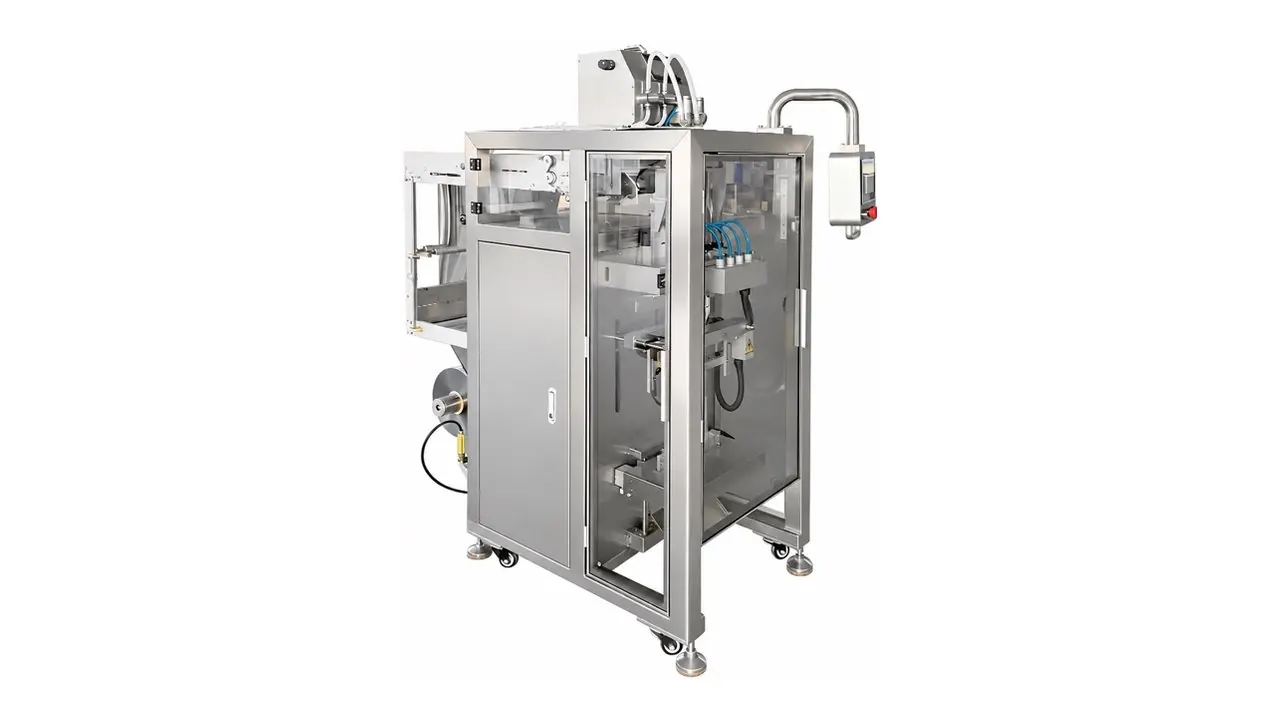
Sauce caught in the seal can waste a correctly measured portion. Choose a condiment packet machine by testing the dosing path, nozzle cutoff and film together on your ketchup, mustard or mayonnaise, then size the lane count around accepted output.
For multi-lane hot filling, confirm the approved product temperature and the complete filling path before discussing speed. This guide gives you a configuration comparison, a clean-seal check and a trial record to use alongside the broader sauce sachet machine selection page.
Inputs that change the configuration
Describe the recipe at its intended filling temperature. A sauce name alone cannot tell the supplier how it flows, whether a valve will pass its particles or how its dose ends.
| Input or item | Value or source to provide | Why it matters |
|---|---|---|
| Recipe and flow | Viscosity with measurement method and temperature; physical sample | Sets the starting point for pump and nozzle evaluation |
| Particles | Largest size, shape and concentration of seeds, herbs or pulp | Requires review of the entire product passage |
| Portion | Target g or mL, with density if converting | A volumetric piston setting does not establish a fill weight |
| Temperature | Your approved filling range and expected variation | Defines conditions for product, contact parts and film review |
| Flat packet | Dimensioned drawing, seal band and actual film | Establishes usable cavity and clean sealing space |
| Production plan | Good packets per shift, recipes and changeovers | Distinguishes running speed from saleable output |
Match dosing and nozzle to the condiment
A piston dosing system is a sensible starting point for a viscous sauce packet. LINEVO's published four-side-seal sauce configuration lists piston dosing; the liquid and paste machine page shows the catalog baseline. Confirm the actual pump, valve and nozzle in the quotation, rather than treating that baseline as approval for every recipe.
| Recipe condition | Configuration question | Dominant Failure Mode & Prevention |
|---|---|---|
| Smooth ketchup or thick tomato sauce | Can the piston refill and discharge the portion consistently at the intended temperature? | Incomplete refill or a trailing dose: test the supply, dosing cycle and cutoff together |
| Mayonnaise or another emulsion | Does the proposed transfer and dosing path preserve the required product condition? | Entrained air or a changed product: inspect portions and product condition during the actual trial |
| Mustard with seeds, herbs or sauce with pulp | What is the smallest passage through the valve, manifold and nozzle? | Bridging or particle damage: confirm passage geometry and inspect actual samples |
| Thin dressing alongside a thicker sauce | Can the same quoted wet parts meter and stop both products? | Drips between doses: evaluate each recipe and identify any change parts |
Rules of thumb: if the largest particle is as large as or larger than the smallest open passage, that path fails the geometric screening check. A smaller particle still needs a passage trial because shape, concentration and bridging matter. If the proposed portion reaches the planned seal band, revise the packet cavity or dose before accepting the layout; a different pump cannot create missing seal space.
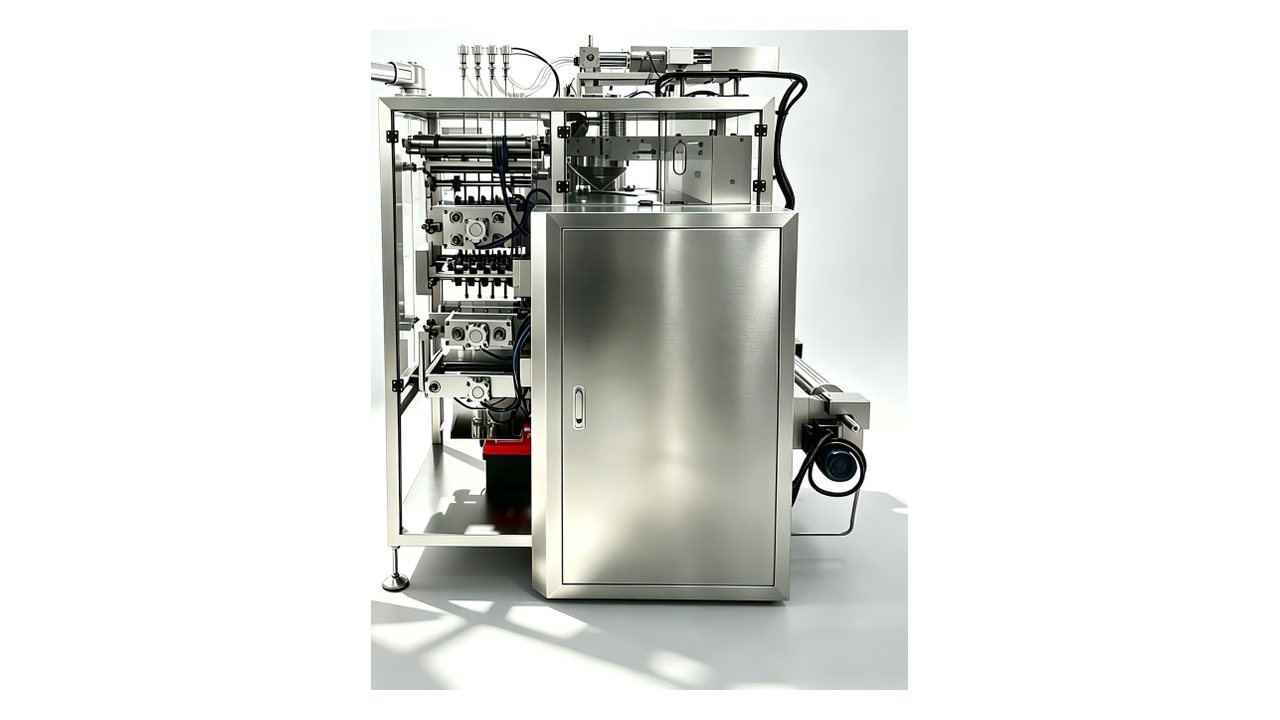
Photo: LINEVO catalog sauce sachet configuration. Several lanes share the packaging section; request dose and seal records for each running lane.
Use the four-side-seal machine page to review the flat packet layout. Lane count and bag format are separate choices: adding lanes does not resolve a poor dose or a contaminated top seal.
Keep the end of the dose out of the seal
Ask to see what happens after the main dose stops. A nozzle can deliver the right amount and still leave a string that falls across the closing seal band.
A shut-off closes the flow path. Suck-back draws residual product back toward the nozzle at cutoff. LINEVO's separately listed multi-lane ketchup configuration describes a pneumatic suck-back assembly, so ask whether that assembly is included in your proposal. Its description does not set a universal pullback distance, volume or timing for your sauce.
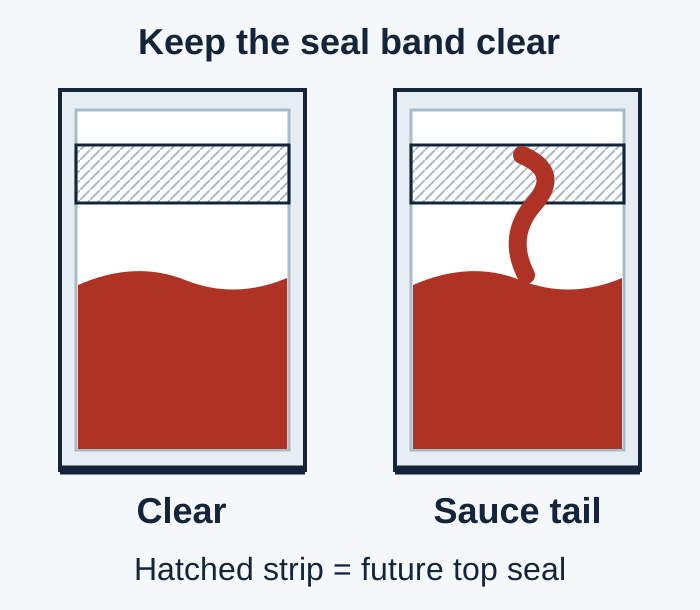
Illustration: the hatched strip marks the future top seal. Judge the tail as well as the bulk fill level; this drawing is schematic, without machine dimensions.
Define the timing question as fill time + tail-clearance time ≤ available filling window. The available window ends when the machine requires a clear seal area. If the recipe cannot clear within that window at the proposed cycle rate, request a revised configuration or a slower verified cycle. Have the supplier establish settings on the quoted machine with its guarding and operating procedure in place.
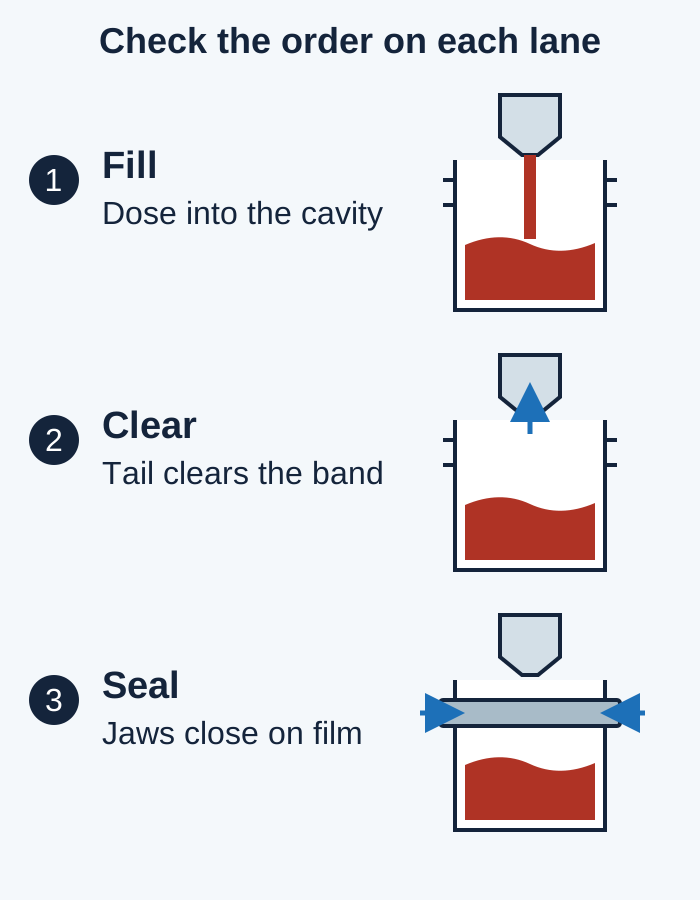
Illustration: verify filling, clearance and sealing in order on each lane. The sequence explains what to observe, not a universal machine timing program.
Include startup and restart observations in the trial plan. Record the nozzle setup and product temperature with the result so the supplier can investigate a tail or drip without guessing which conditions produced it.
Confirm hot filling and acid or salt compatibility separately
A heated hopper can help manage product flow; it does not by itself qualify a hot-fill process. The listed multi-lane ketchup configuration describes a jacketed hopper. Your quotation still needs to identify which parts of the path are heated or monitored, and how product temperature is checked at filling.
The acceptable filling range must sit inside the intersection of the approved recipe process, the rated product-contact components and the qualified film/package conditions. If those ranges do not overlap, revise the process or configuration. Obtain the ranges from your process owner, equipment supplier and film supplier; do not substitute a generic ketchup temperature.
For salty or acidic condiments, send the formulation conditions and cleaning chemistry for a written compatibility review of contact metals, seals, hoses and valves. A stainless frame description cannot establish the suitability of every wetted part. Ask for the proposed contact-parts list and cleaning method. Keep food preservation and shelf-life validation in the product process plan, alongside the mechanical filling and sealing trial.
Agree what a good seal must demonstrate
Separate seal strength from leak detection. A strong strip result and a clean-looking seal answer different questions from whether the whole filled packet leaks during its intended handling.
ASTM F88/F88M measures the force needed to separate a sealed strip and records how it fails. Its public scope supports that measurement distinction; it supplies no sauce-specific passing force. Keep the test technique consistent when comparing results and agree the acceptance limits for your packet with the responsible packaging team.
| Check | Record to request | Decision it supports |
|---|---|---|
| Seal-band observation | Lane, recipe, temperature and location of residue or wrinkles | Whether the dose stays out of the intended seal |
| Seal strength | Agreed strip method, specimen details, force and failure mode | Whether the seal meets the package specification |
| Filled-packet leak check | Method suited to the actual film, conditions and observed leakage | Whether the packet meets the agreed integrity requirement |
| Handling and opening | Agreed squeeze, transport or dispenser conditions and tear behavior | Whether the packet works in its intended use |
Do not accept a universal jaw temperature or leak-test setting in place of a film-specific trial. Agree the test method, sampling and pass criteria before running the product. The sample-testing process explains how to connect the observations to a useful record.
Compare accepted output and losses over one shift
Compare suppliers on the same recipe, packet and time boundary. For a machine producing one packet per lane per cycle:
Accepted packets = running lanes × cycles/min × running minutes × accepted fraction.
Worked example with hypothetical planning inputs: six running lanes, 30 cycles/min, a 480-minute shift, 40 minutes for changeover, 20 other stopped minutes and 98% acceptance during running time:
6 × 30 × (480 − 40 − 20) × 0.98 = 74,088 accepted packets per shift.
These assumed inputs illustrate the calculation; they are not a machine rating. Running production is 75,600 packets, including 1,512 rejects. At an assumed 10 g portion, those rejected packets contain 1,512 × 10 ÷ 1,000 = 15.12 kg of product, before counting overfill, startup purge or retained sauce. Stopped time is already removed, so do not deduct it again as another efficiency factor.
Use the multi-lane machine page to review lanes and downstream capacity. Define total cost of ownership over the same shift for both proposals:
| Cost item | Same-shift quantity to record | Valuation basis |
|---|---|---|
| Rejected filled packets | Film and sauce in rejects, with reasons | Actual film cost plus product cost |
| Startup and recipe change | Purged product, wasted film and cleaning time | Actual material and labor costs |
| Overfill | Measured excess mass across accepted packets | Product cost per unit mass |
| Utilities and cleaning | Metered use and cleaning consumables | Site tariffs and purchase costs |
| Lost production time | Changeover and other stopped minutes | Record as capacity loss; avoid also charging the same loss elsewhere |
Track upstream sauce supply interruptions separately from filling faults, and confirm that counting, inspection and packing can accept the proposed output. Include those interfaces in the brief without assuming they are supplied with the machine. The machine price and quote-scope page helps compare what each proposal includes.
Keep a per-lane trial record
Approve the actual recipe and film combination. A combined average can hide one underfilling or leaking lane, so retain lane identity when recording portions and seal results.
| Trial record field | What to retain |
|---|---|
| Product and setup | Recipe/batch, temperature, portion unit, density where used, film and packet drawing |
| Dosing by lane | Individual measured portions, lane identity, agreed sample count and tolerance |
| Cutoff by lane | Residue observations, nozzle configuration and recorded setup |
| Seal results | Strength/leak methods, conditions, sample identification and agreed pass criteria |
| Output | Elapsed time, running time, lane count, accepted packets and rejects |
| Transitions | Agreed startup, restart and recipe-change observations; cleaning and change parts |
Repeat the relevant checks when a recipe, filling temperature, film or wet-part configuration changes. Keep the approved record with the quotation and factory acceptance requirements.
What to send us
Send the inputs below to discuss a sauce configuration and the product-and-film trial. Confirm sample quantities and shipping arrangements before sending physical material.
| Item | Why we need it | Example format |
|---|---|---|
| Recipe and temperature | Review dosing, particles, flow and contact-part requirements | Product sheet, viscosity method, filling range and representative sample details |
| Portion and packet | Review dose, usable cavity and seal space | g or mL target, density where needed, dimensioned drawing and film datasheet |
| Shift requirement | Compare running lanes, accepted output and changeovers | Good packets per shift and planned recipe sequence |
| Acceptance requirements | Define what the trial must record | Portion tolerance, seal/leak methods, handling criteria and lane-level record fields |
Send your recipe, fill temperature, portion, packet drawing and shift requirement on WhatsApp to discuss a configuration and trial scope. Keep any undecided field marked for confirmation so it remains visible in the proposal.
Configuration and seal-test references
The LINEVO SY sauce series lists its piston dosing arrangement and four-side seal format. Define recipe conditions, packet dimensions and included components in the equipment specification.
ASTM F88/F88M covers seal-strength measurement. Agree the package acceptance limits and leakage checks for your film and product.