

Used Sachet Machine Inspection Checklist: Sealing Jaws, Dosing Wear & PLC Obsolescence
Published by the LINEVO sachet equipment team. Technical questions and corrections
Inspect a used sachet machine before buying: check sealing jaw impressions, auger or piston dosing wear, forming sets, drawdown belts, and PLC obsolescence.
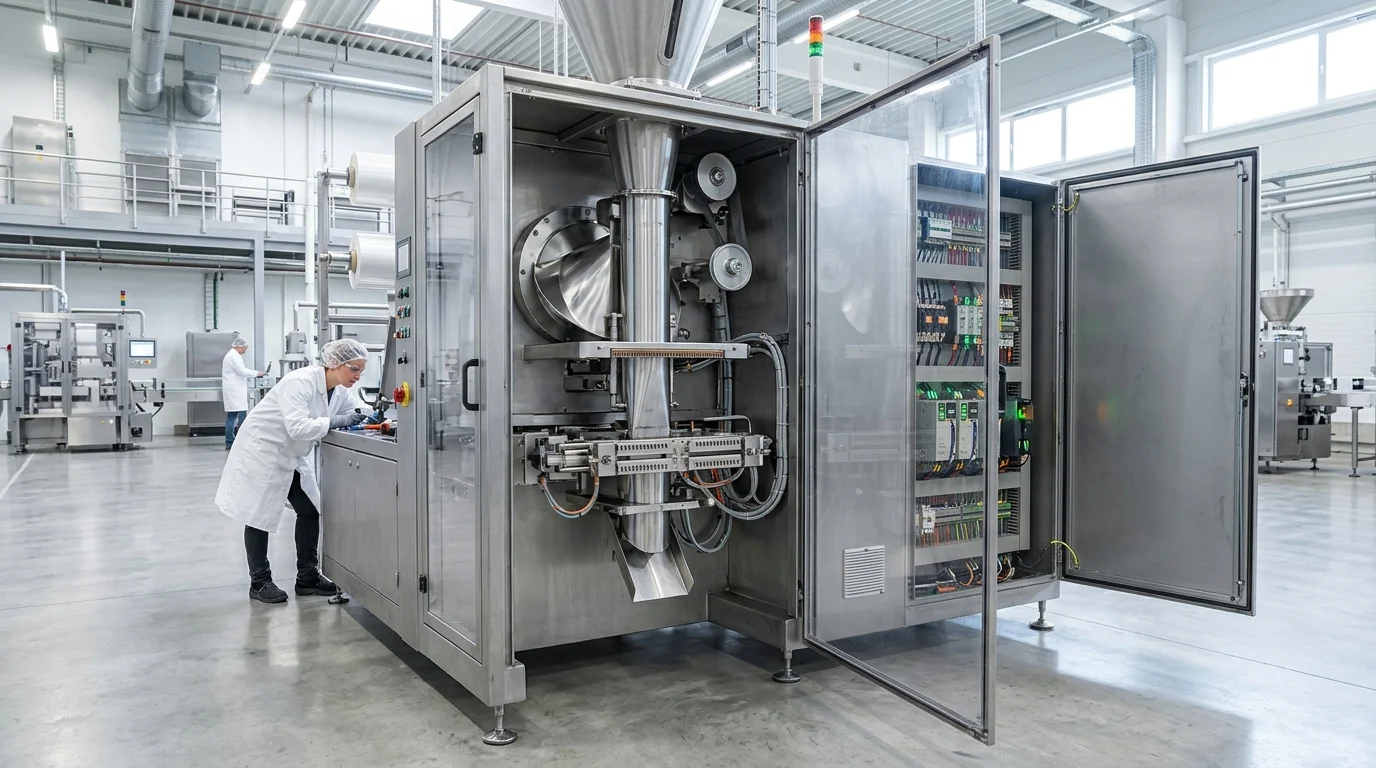
Evaluating a used sachet machine, a used sachet filling machine, or a used sachet packing machine for sale requires a physical audit of the sealing station, dosing head, forming set, and electrical control cabinet before committing capital. Use this second hand sachet packaging machine checklist alongside our sachet packaging machine buying guides and our selection guide for new sachet machines to record what is installed on the frame and what must be replaced before production.
| Inspection domain | What to verify on the machine | Questions to answer before purchase |
|---|---|---|
| Sealing jaws and impressions | Serration profile, jaw carrier alignment, heaters, probes, and paper impression strip | Do the jaws close with uniform contact across the web, and do filled sample packs pass peel and leak tests? |
| Dosing assembly and cut-off | Auger screw flights and funnel accessories, volumetric cup range, or piston valve seals | Does the installed dosing tooling match the flow behavior and target dose of your product? |
| Forming set and film drive | Forming collar lapel, forming tube geometry, drawdown belts, vacuum path, and drive couplings | Is the machine locked into a previous bag width, and do the belts pull film without slipping? |
| PLC, HMI and servo controls | Controller model numbers, servo converter availability, electrical schematics, and PLC source code | Are replacement drives still stocked, or will a failed component trigger a full electrical conversion? |
Inspect sealing jaws, serration wear and carbon impressions
Start the mechanical audit at the sealing jaws and cutoff knife, and cross-reference our sachet sealing problems checklist if you are running a live film trial on the unit.
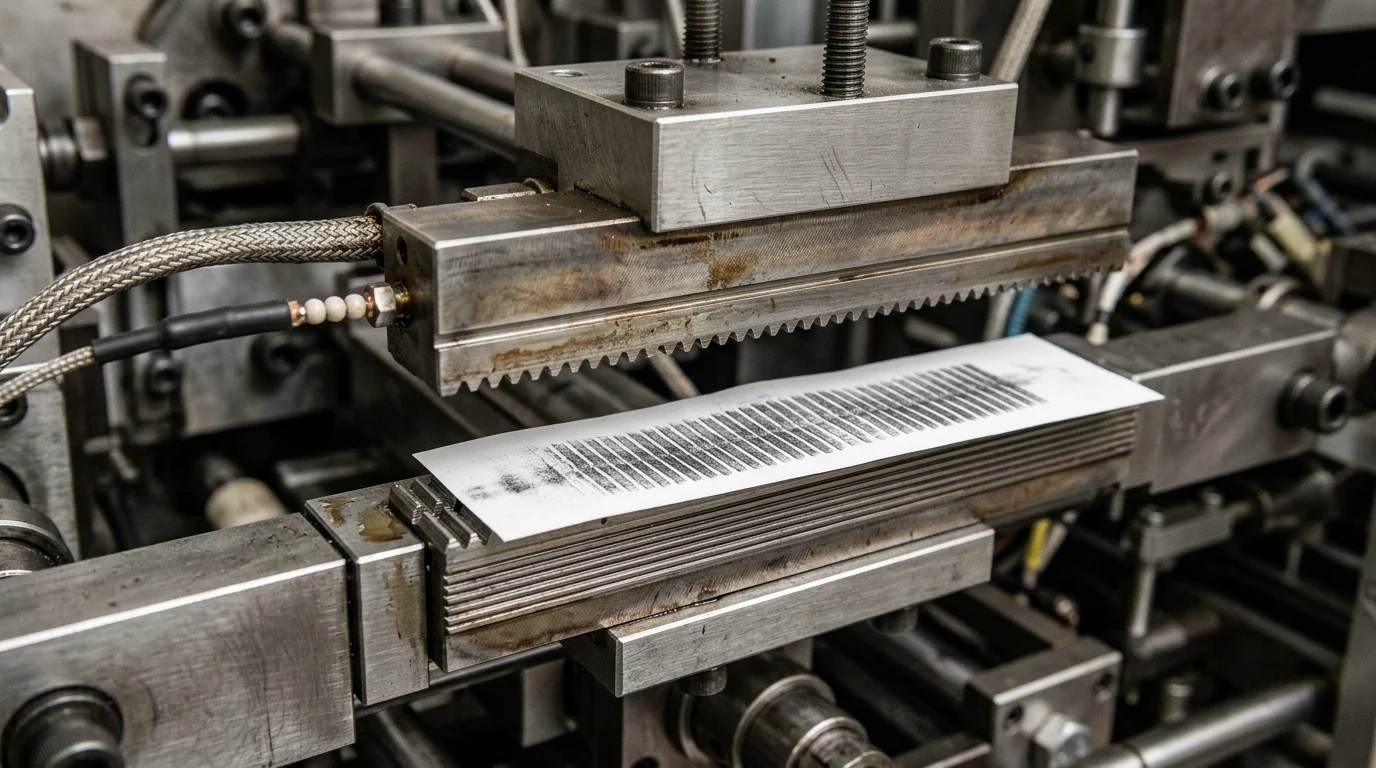
Sealing jaw carbon impressions are a vital diagnostic tool for solving cutting and sealing problems on flow wrappers and vertical baggers, and they also play a vital role in preventative maintenance.
Each sealing jaw impression should be labeled with the date, line and machine, direction arrow, and sealing jaw pair number to compare results over time and track changes.
For rotary jaws, carbon impressions check that the clearance between the upper and lower shafts is properly set and parallel, and indicate if the phasing between the shafts is synchronized.
For both rotary and reciprocating jaws, carbon impressions indicate if the serrations are misaligned and help adjust sealing pressure so that it is even from side to side and across the length of the jaws.
After cleaning the sealing jaws, checking temperature settings and running a carbon impression determines if spring pressure, alignment, or other settings have changed and need to be readjusted.
Plain paper does not provide adequate details; in a Greener Corporation diagnostic case, a carbonless paper impression revealed that jaw clearance was uneven from end to end and alternating light and dark lines showed that the serrations were misaligned.
On a vertical bagger with reciprocating jaws, uneven pressure on the upper and lower seals is often created by damage or product buildup on the jaw mounting surfaces or by misalignment of the jaw carriage; in one Greener case the cause was worn linear bearings.
In a Greener Corporation diagnostic case where nine of ten packages failed a seal quality test, carbon impressions showed extensive sealing jaw contamination, and after the jaws were cleaned, the failure rate went down to zero.
Carbon and carbonless impressions reveal wear on reciprocating jaws on a vertical bagger, wear on rotary jaws, and weak spots caused by sealing jaw damage confirming that the jaws need to be replaced.
The seal range for a packaging material and conditions spans between the seal initiation temperature and the distortion temperature, and the effective seal range narrows as machine speed is increased and dwell time is reduced.
Model-specific jaw alignment and thermal maintenance examples
Review the original manufacturer maintenance procedures for the specific bagger model under inspection.
On a Rovema VPK-260 VFFS machine, the horizontal sealing device consists of a front and rear jaw assembly, a drive system, and a knife assembly, and at some point the heating cartridges and temperature probes inside the horizontal sealing jaws must be replaced.
When adjusting horizontal jaw pressure distribution in Rovema's procedure, the jaws are closed until touching between 330° and 340°, and turning the adjusting screws clockwise increases pressure while turning them counterclockwise decreases pressure.
On Rovema VPI-260 and VPI-400 machines, the rear carrier shaft alignment procedure positions the draw bars so they extend the same distance through the machine front plate, centering the rear jaw body under the forming tube so the sealing jaws meet at the center of the forming tube when they close and apply even pressure.
On the Rovema VPI-260 rear jaw alignment example, the center line dimension is 320 mm from the frame, and with a 20 mm thick front plate the rear jaw body is positioned 300 mm away from the machine front plate.
Qualify sealed sample packs with laboratory peel and leak methods
During a pre-purchase acceptance run, qualify filled packs using recognized seal-strength and gross-leak test methods.
ASTM F88/F88M-23 covers the measurement of the strength of seals in flexible barrier materials, measuring the force required to separate a test strip of material containing the seal and identifying the mode of specimen failure.
Under ASTM F88/F88M-23 Clause 4.1, seal strength is a quantitative measure for use in process validation, capability, and control, measuring the packaging processes' ability to produce consistent seals.
Under ASTM F88/F88M-23 Clause 4.2, consistent use of one tail-holding technique—Technique A (Unsupported), Technique B (Supported 90° By Hand), or Technique C (Supported 180°)—throughout a test series is recommended.
Under ASTM F2096-11(2019) Clause 1.1, this test method covers the detection of gross leaks in packaging, has a method sensitivity down to 250 μm (0.010 in.) with an 81 % probability, and may be used for tray and pouch packages.
Under ASTM F2096-11(2019) Clauses 1.2 and 1.3, the sensitivity of this test method has not been evaluated for use with porous materials other than spunbonded polyolefin or with nonporous packaging, and this test method is destructive in that it requires entry into the package to supply an internal air pressure.
Audit auger, volumetric cup and liquid piston dosing wear
Inspect the dosing head fitted to a used sachet filling machine and compare its tooling against our powder sachet machine configurations, granule sachet machine configurations, liquid and paste sachet machine configurations, and auger versus volumetric cup filling guide.
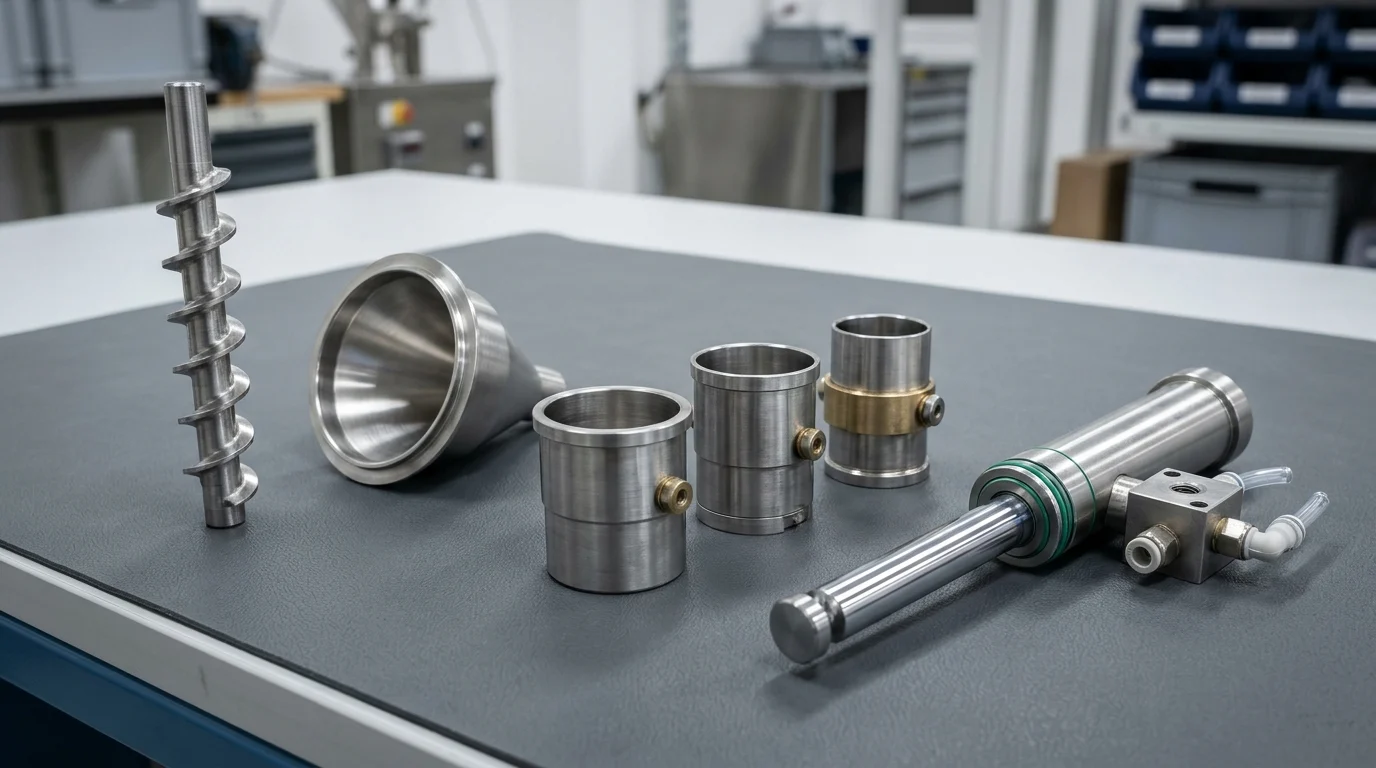
Due to the abrasiveness of the product to be packed, dosing augers are subject to constant wear, and a worn auger leads to deviations in dosing and weight accuracy and has to be exchanged regularly.
Inherent to its design, an auger dispenses a specific amount of product for each revolution, so if product density changes due to misuse of agitation blades, inadequate head pressure in the product supply hopper, or excessive auger speed, differing amounts of product will be dispensed in each revolution.
In All-Fill auger fillers, the Free Flow configuration is used with products such as sugar, salt, and bread crumbs, and comprises a Straight Auger & Funnel, Spinner Plate (secured with a left-hand nut), Collector Funnel assembly, and slow speed agitator blade.
In All-Fill auger fillers, the Non-Free Flow configuration for products such as bakery mixes, carbon, or talc typically includes a Self Feeding Auger fitted with a Drip Washer (secured with a left-hand screw), and a Lip Funnel.
Accuracy problems can occur when auger tooling is substituted for products with the opposite flow characteristics or is incorrectly sized, and worn and damaged tooling—even if not visible to the naked eye—may also result in gradually deteriorating levels of accuracy.
In standard clutch/brake auger fillers, the possibility of clutch/brake coasting and slippage—especially as the machine ages—will affect accuracy over time and can be remedied through a consistent, regular preventative inspection and replacement program.
In a Volumetric Cup filler for free-flow granular products, each cup set has a 40% volume adjustment and consists of three pieces, achieving dispense rates of up to 120 per minute in continuous motion with cup volume sizes from .25 in³ (4ml) to 300 in³ (4916ml).
On the FILAMATIC Model IFC-15 liquid filling system, each nozzle is equipped with a shut-off valve in its tip and a suck-back system to prevent dripping.
Check forming sets, web width lock-in and film drive belts
Measure the installed forming assembly against your target package layout using our sachet sizes guide before assuming a second-hand bagger can run your film width.
In a VFFS machine, the forming set transforms the film from a 2-dimensional to a 3-dimensional shape and is made of three primary components plus securing hardware: the Forming Tube, the Forming Collar, and the Product Transfer chute at the end of the filling tube.
Bag quality issues from graphics being off-center to wrinkles around or in the seals might be due to wear on the lapel of the collar, the angle of the forming shoulder being too steep, or non-OEM forming sets being used.
During format changes or transport from storage to the place of installation in the VFFS machine, the forming set—mainly consisting of the forming shoulder and filling tube—can lose its proper setting, leading to a lower bag quality both optically and in terms of tightness and seal quality.
Kenray formers eliminate film tracking problems and increase package quality versus the marginally acceptable packages associated with incorrectly designed or improperly constructed formers; hard chromed shoulders reduce wear and K-Flow specialist coatings reduce drag.
Inspect the film drawdown belts, vacuum assist system, and drive couplings while jogging the web.
On a VFFS machine, the most common production issues caused by film feed belt slippage are short bags, inconsistent bag lengths, or difficulty holding print registration (registration mark sensor error).
The 7 causes of VFFS film feed belt slippage identified by Rovema are dirty belts, worn belts (worn in the profile of the shape of the tube), misaligned belts, an increase in film drag, not enough pressure on the film feed belts, inadequate film feed vacuum, and a loose or broken servo coupling.
On ROVEMA VPR 250, VPK 260, and BVK 260 cross-sealing stations, an alignment tool consisting of two clamps for fixing the front and rear drive shaft avoids shifting of the toothed belts during fitting and tensioning and helps prevent serious damage to the sealing tools caused by incorrectly adjusted belts.
Evaluate PLC, HMI and servo obsolescence against new configurations
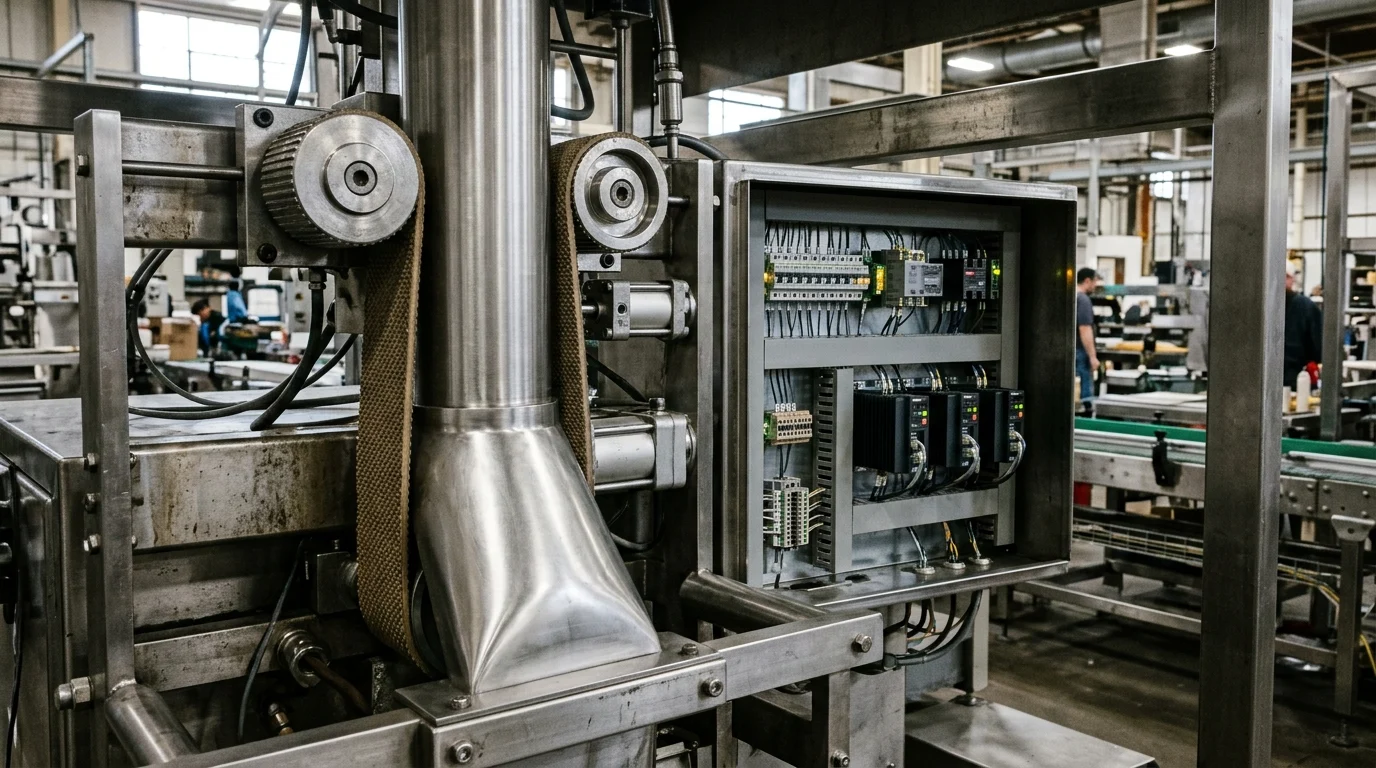
Open the electrical enclosure to audit spare-part availability, drive obsolescence, and total conversion scope, then compare the refurbishment boundary against our sachet packaging machine price and scope guide.
Rovema notes that components of older machine types potentially involve a risk regarding delivery time (8-10 weeks) and availability because they are produced in gradually decreasing batches at increasing cost, leading Rovema to cease constant stockpiling of the clutch for the film drive of MVP/VPM machines (used up until approximately 20 years ago).
For the analog working AC converter BUM 60 (04037459) formerly fitted in ROVEMA packaging machines, the supplier stopped production some years ago and ROVEMA's spare part stock is now used up, leaving a last-time EOL-order or an alternative.
Preparing a VFFS electrical conversion requires compiling existing drawings, programs, and the BOM (Bill of Material), followed by an electrical technician site visit to take photos and measurements of items such as the gearing and panel.
During a VFFS electrical conversion installation, programs are developed for the PLC and HMI, I/O checks and sensor flagging verify wiring and accurate movements, followed by a dry cycle without film or product, empty-bag film testing, and full product testing.
Compare new LINEVO sachet machine configurations
When a second-hand machine lacks the required lane count, dosing head, forming set, or supported control hardware, compare the catalog parameters of purpose-built LINEVO configurations.
The LINEVO LV-500SY / LV-700SY / LV-980SY configuration is a multi-lane four-side-seal sachet machine with rotary-valve piston dosing for ketchup and viscous sauces (5–100 ml, 500/700/980 mm web widths).
The LINEVO LV-500SY / LV-700SY / LV-980SY series lists 2–4 / 3–10 / 4–16 lanes respectively, with a 5–100 ml filling range (can be extended up to 500 ml).
The LINEVO LV-500SY / LV-700SY / LV-980SY series lists bag length 45–160 mm, bag width 50–125 mm, maximum film width 500 / 700 / 980 mm, and packing speed 20–40 cuts/min.
The LINEVO LV-500SY / LV-700SY / LV-980SY series lists voltage 220 V, 50/60 Hz, power 4 / 5.5 / 7 kW, machine weight 650 / 850 / 1000 kg, and machine dimensions 1540 × 1375 × 2270 / 1790 × 1445 × 2340 / 1940 × 1600 × 2650 mm.
The LINEVO LV-500SY / LV-700SY / LV-980SY series specifies PLC Control + Touch Screen HMI, Food Grade Stainless Steel SUS304 machine material, and air consumption of 0.6–0.8 MPa, 0.35 m³/min.
In the LINEVO LV-500SY / LV-700SY / LV-980SY series, Rotary-Valve Piston Dosing uses an anti-drip piston pump to meter thick liquids, and engineers validate fill settings and discharge behavior with the sauce and target volume.
In the LINEVO LV-500SY / LV-700SY / LV-980SY specifications table, each pack style needs its own sealing tooling, and the forming and cutting configuration and forming tooling are confirmed in the quotation.
The LINEVO LV-350X four-side seal granule sachet machine lists a 1–50 g fill range, 50–180 mm sachet length, and 30–80 mm per lane sachet width, where four lanes form, fill and seal in one cycle.
For the LINEVO LV-350X, if fill volume differs between lanes or fine granules leak from the seal, lane dosing and seal pressure are set per lane during sample review.
The LINEVO Multilane Powder Sachet Packaging Machine is a multi-lane four-side seal sachet bagger with an Independent Servo Auger Dosing Matrix (an independently servo-driven vertical dosing screw per lane) and Passive Dust-Controlled Sealing.
What to send when comparing a used machine against a new build
When deciding between refurbishing a used sachet packing machine for sale and ordering a new line, assemble the following project inputs for engineering review:
- Product form, flow behavior, bulk density or viscosity condition, and target fill weight or volume per sachet.
- Sachet seal layout, outer width and length drawing, parent film roll width, and laminate structure.
- Required lane count and shift output target.
- Photos or part numbers of the existing forming collar, dosing tooling, sealing jaws, and electrical panel if auditing a second-hand unit.
- Agreed package evaluation methods for cooled seal strength and gross leak inspection.
Send your product details, sachet drawing, film structure, and inspection notes on WhatsApp to compare a new configuration and trial plan with our engineering team.
Frequently asked questions
How are new multi-lane powder sachet specifications and sample trials arranged before quotation?
For the LINEVO Multilane Powder Sachet Packaging Machine, LINEVO engineers develop an application-specific specification covering output, pack-size range, machine dimensions and utilities for the product and packaging format.
LINEVO states that a representative sample test helps resolve material-specific questions before quotation, and buyers should not ship physical samples until the team has confirmed the quantity needed and where to send them.
Coordinate trial materials through our product and film sample testing page before shipping any samples.
Which impression paper should be used on cold versus hot sealing jaws during an inspection?
Once rotary jaws are hot, carbon paper begins to melt and no longer provides a clear impression, so technicians switch to carbonless paper to fine tune setup and make additional adjustments.
For reciprocating sealing jaws, Greener Corporation specifies using carbon paper for initial installation and all adjustments because carbonless paper is not properly activated by these jaws and should be avoided.
In Rovema's Paper Alignment Test for horizontal sealing jaws, Type A Pencil Carbon Paper is used on jaws at room temperature, while Type B TP Paper (Temperature-Pressure) is used on hot jaws at approximately 200-300°F.
Why does a used machine with obsolete servo drives require more than a single drive swap?
When upgrading VFFS servos and controls due to difficulty finding spare parts, the upgrade is a total electrical conversion that includes the HMI, servos, PLC, gearbox, VFDs, and small items such as relays and terminals.
Once a VFFS electrical conversion installation occurs, Rovema states to expect around 1 week downtime for one machine, whereas two machines require 1 ½ weeks when worked on in tandem.
Sources
- Greener Corporation — Use Sealing Jaw Carbon Impressions for Preventative Maintenance
- Greener Corporation — Analyzing Sealing Jaw Carbon Impressions to Troubleshoot Problems on Flow Wrappers & Vertical FFS Baggers
- Greener Corporation — Improve Thermal Transfer Efficiency to Increase Seal Quality & Machine Speeds
- Greener Corporation — Parts for Forming (Forming Collars, Tubes, and Folding Boxes)
- Rovema North America — Horizontal Sealing Jaw Procedures
- Rovema North America — Jaw Carrier Alignment Procedures: Rear Jaw
- Rovema North America — Upgrades and Retrofits Available for Existing Rovema VFFS Machines
- Rovema North America — Electrical Upgrade For VFFS Servos & Controls
- Rovema North America — Troubleshooting and Solving VFFS Film Feed Belt Slippage
- Rovema North America — VFFS Forming Sets: Forming Shoulder and Forming Tube
- All-Fill Inc. — Auger Filling Accuracy Guide
- Auger Fabrication Inc. — Auger Fillers Not Your Only Option
- FILAMATIC — In-Case Liquid Filler Technical Brochure
- ASTM International — Standard Test Method for Seal Strength of Flexible Barrier Materials
- ASTM International — Standard Test Method for Detecting Gross Leaks in Packaging by Internal Pressurization
- LINEVO — Four-Side Seal Sauce & Liquid Sachet Machine Catalog
- LINEVO — Four-Side Seal Granule Sachet Machine Catalog
- LINEVO — Multi-Lane Powder Sachet Packaging Machine Catalog