

Coffee Sachet Packing Machines for Instant Coffee & Blends
Coffee sachet packing machine guidance for instant coffee and 2-in-1 or 3-in-1 mixes: segregation, moisture, barrier film and sachet format.
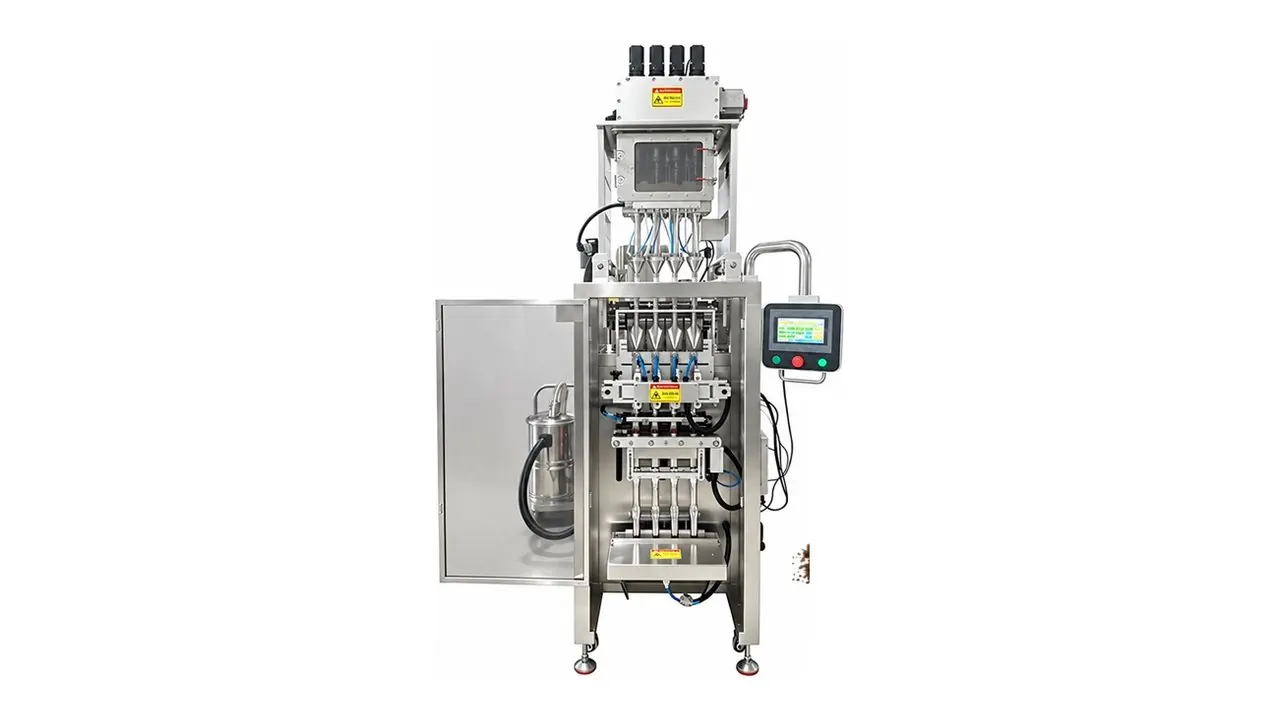
A coffee sachet packing machine fills instant coffee, or a coffee mix, into small flat sachets. Instant coffee on its own is a dry powder that reacts to humidity. A 2-in-1 or 3-in-1 mix adds sugar and creamer, and then the ingredients can separate on you. Most of what applies here is general powder sachet packing knowledge, plus the film barrier and format questions that coffee raises.
Dose weight and shelf life depend on your coffee and your film, so we judge them from sachets filled with your own product, not from a table.
Instant coffee on its own
Instant coffee is a light, often brittle powder or granule with low bulk density. It pulls in moisture, which makes it sticky, lets it form lumps and marks the sealing jaws. Check these:
- Humidity in the packing room and in the hopper changes flow and sealing. Ask how long product sits in the hopper during a run.
- Fine particles reach the seal area and weaken the seal.
- Bulk density is low and can vary between batches, so a dose set by volume can change in weight.
- Some instant coffee types break during handling and make more fines.
Auger dosing is the usual starting point for fine instant coffee, and cup dosing may suit coarser granules. Dosing details live on the powder page, so we will not repeat them here.
2-in-1 and 3-in-1 coffee mixes
A 2-in-1 is typically coffee and sugar, and a 3-in-1 adds creamer. The ingredients differ in particle size and density. Vibration and flow in the hopper pull them apart, so the first sachets can carry a different ratio from the last.
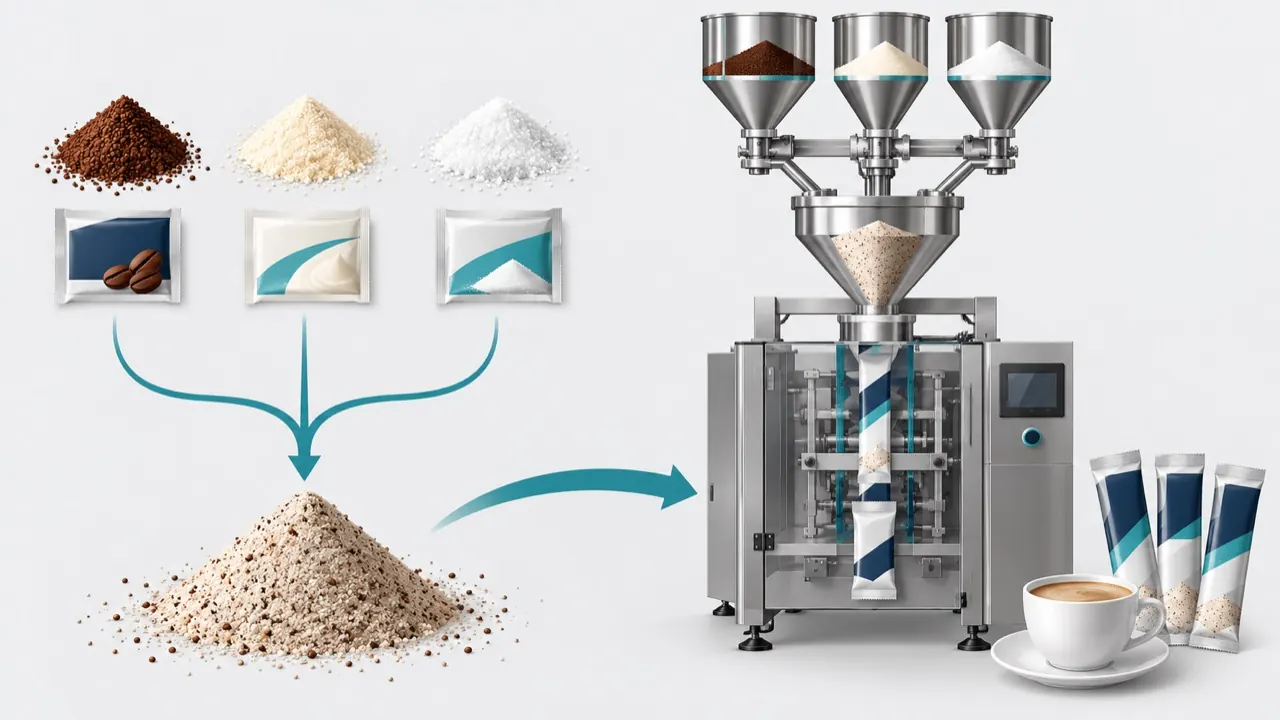
Illustration: ingredients of different size and density separate as a blend moves and settles in the hopper.
| Question | Instant coffee | 2-in-1 or 3-in-1 mix |
|---|---|---|
| Main risk | Moisture pick-up, light and dusty product | Segregation of ingredients as well as moisture |
| Typical concern | Dose weight and seal contamination | Ratio consistency from sachet to sachet |
| What to test | Dosing and seal on your coffee | Whether sachets keep the intended ratio over a long run |
| What to tell us | Type, density, moisture sensitivity | Recipe, particle sizes, how and where it is blended |
Tell us how the blend is made and how long it waits before packing. Dosing close to the blending step, keeping the hopper small and avoiding needless vibration all help. Only a long run shows whether the ratio holds, and we will not claim a fixed result before we have tested your recipe. If your mix has a sugar-like component, sugar sachet packing covers related granule behaviour.
Moisture and film barrier
Coffee suffers from moisture, oxygen and aroma loss, and the film has to hold all three off for as long as the product is meant to last. Choose the barrier from the product, the shelf life you want and the climate where it will be stored and sold.
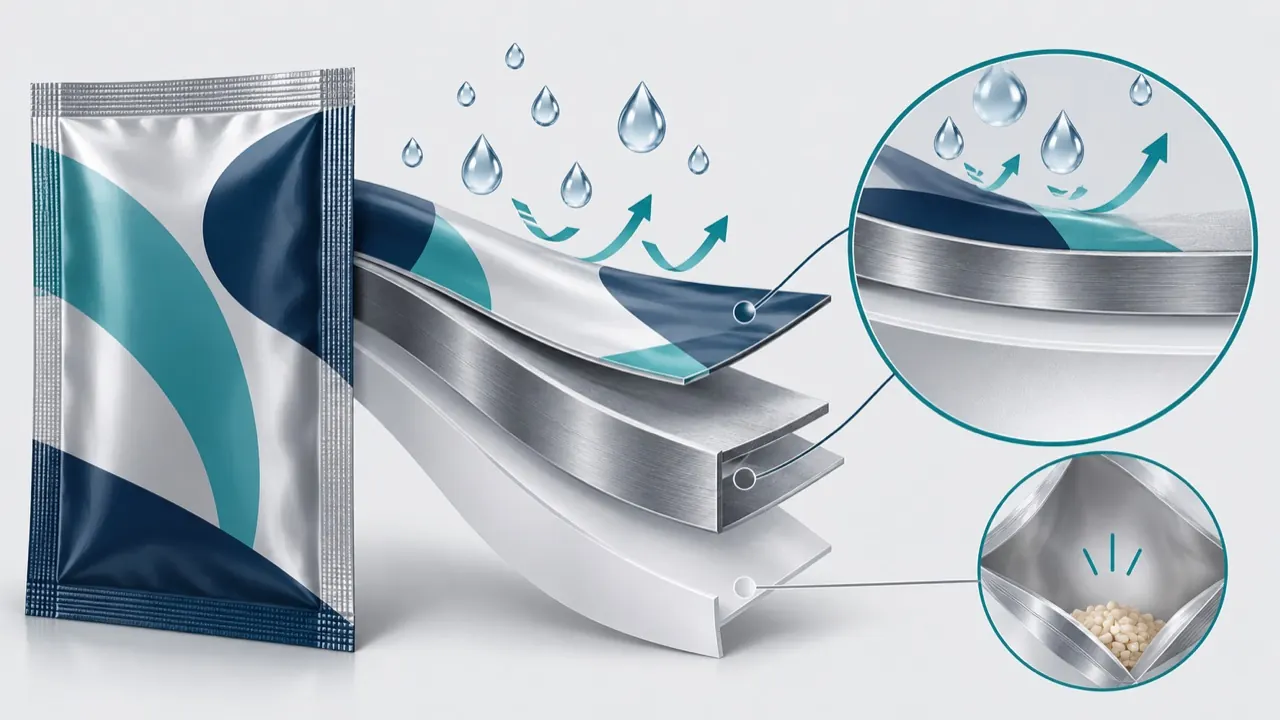
Illustration: a barrier layer slows moisture and oxygen entering the sachet, but only a good seal keeps that protection.
A few practical points:
- Barrier films are laminates, and the seal layer has to work with your machine and your product, dust in the seal included.
- A good barrier means little if the seal leaks, so check the seal on your own coffee.
- We do not state a shelf life. It depends on your product, film, seal and storage, and you have to establish it yourself.
- Nitrogen flushing is not in a default configuration. It is an option when your product and shelf-life target call for it, and it adds cost and complexity.
Choosing the sachet format
Flat 3-side and 4-side seal sachets are the usual coffee formats. 4-side seal sachets give a seal on every edge and a flat, rectangular pack. Dose and the way the consumer tears and pours the sachet drive its size. For higher output, multi-lane machines make several sachets per cycle, with lane count limited by sachet width and film width.
Where flat sachets stop and other formats start
Stick packs, drip bags and capsules are different formats. A stick pack is a narrow tube-like sachet, a drip bag holds ground coffee in a filter, and a capsule is rigid. We make flat sachets. If you are weighing a flat sachet against a narrow stick pack, read sachet vs stick pack. Other product types are on the applications overview.
From coffee to trial and quote
Define the product and the sachet, work out dosing with the powder sachet notes, then run sachets of your coffee. A product and film trial shows how it doses and seals on your film, and a quotation follows from that.
What to send
- the type of coffee, and the recipe if it is a 2-in-1 or 3-in-1 mix;
- bulk density and particle size of each ingredient, if known;
- target dose per sachet in grams, and target output;
- sachet type, size and film or barrier requirement;
- humidity and storage conditions that matter to your product.
Questions about coffee sachet machines
Can the same machine pack instant coffee and 3-in-1 mixes?
Often, but the mix may need different handling to keep the ingredients from separating. Send the recipe and we will look at it.
Do coffee sachets need nitrogen flushing?
Not by default. It is an option when your product and its intended shelf life require it. Film barrier and seal quality come first.
What film is used for coffee sachets?
A laminated barrier film is common. The right structure depends on the product, the shelf life you need and how it seals, and a trial confirms it.
Can you pack drip bags or capsules?
No. We cover flat sachets. Stick packs, drip bags and capsules are different formats with their own machines.
Not sure which configuration fits your product?
Send your product and pack details, or ask for a trial on your own material before you decide.