

3-Side Seal vs 4-Side Seal Sachet Packaging Machines: Web Forming, Cavity Math & Selection
Published by the LINEVO sachet equipment team. Technical questions and corrections
Compare a 3 side seal machine and a 4 side seal packaging machine: folded-web vs dual-layer forming, usable cavity deductions, multi-lane width, and seal testing.
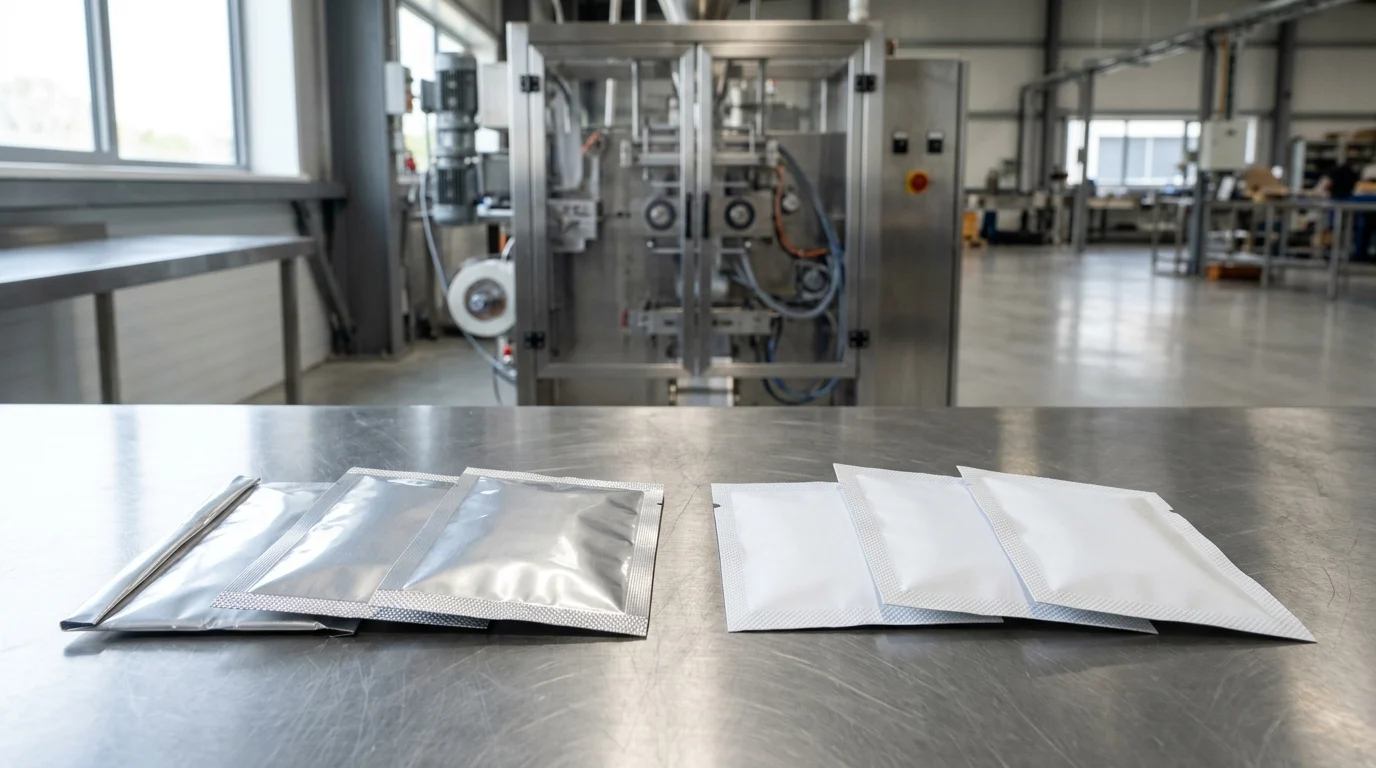
Evaluating a 3 side seal machine alongside a 4 side seal packaging machine requires reviewing the film web path, usable cavity arithmetic, print registration, and corner seal transitions before locking your package drawing. Use this comparison with our four-side seal sachet packaging machine configurations, our sachet packaging machine buying guides, and our sachet machine selection guide when preparing a project specification.
A 3-side seal sachet is made from folded film, so one edge is a fold and the other three are sealed.
A 4-side seal sachet has four sealed edges, often made from two film layers or from a folded web with an extra seal.
| Comparison area | Folded-edge (3-side seal) format | Four-sealed-edge (4-side seal) format |
|---|---|---|
| Pocket forming and web path | Single web folded over a plow along one longitudinal edge | Dual opposing webs, slit-and-realigned web, or folded web with fourth edge seal |
| Usable cavity deduction | 0 mm lost on the folded edge; deduct 3 perimeter seal widths | Deduct all 4 perimeter seal margins (W − 2×side, L − 2×end) |
| Print layout and registration | Wraparound panel across the fold; eye-mark registration control | Independent front and back face panels aligned by registration sensor |
| Seal junctions and inspection | 2-layer to 3-layer fold-corner step; peel and leak checks | Four perimeter seal bands; jaw nip impression, ASTM F88 peel, and ASTM F2096 bubble test |
How pocket forming, web paths and registration differ
Compare the web-handling and pocket-forming sequence on our how sachet packaging machines work guide and our sachet versus stick pack comparison before specifying forming hardware.
A folded web leaves a continuous fold along one sachet edge and heat-seals the remaining three edges, whereas a four-side seal architecture seals every perimeter edge using either dual parent webs or a single web slit and superimposed inside the machine.
On our 3-side-seal sachet configurations, each packet is formed from a single strip of film folded over a forming plow and sealed along the open side and across the top and bottom.
On our 4-side-seal sachet configurations, opposing film layers are heat-sealed along all four edges to create a flat, fully bordered perimeter.
On a 4-side seal sachet, the top and bottom are cross seals, the two side seals run along the length, and both flat faces can carry artwork within the limits of the film and print layout.
On printed film, a sensor reads a registration mark and tells the machine where to cut and seal, so the artwork lands in the same place on every sachet.
In Step 2 of our LINEVO LV-500SY working process, the film roll is pulled downward continuously and the bag-former shapes it into a dual-layer flat sheet for 4-side alignment.
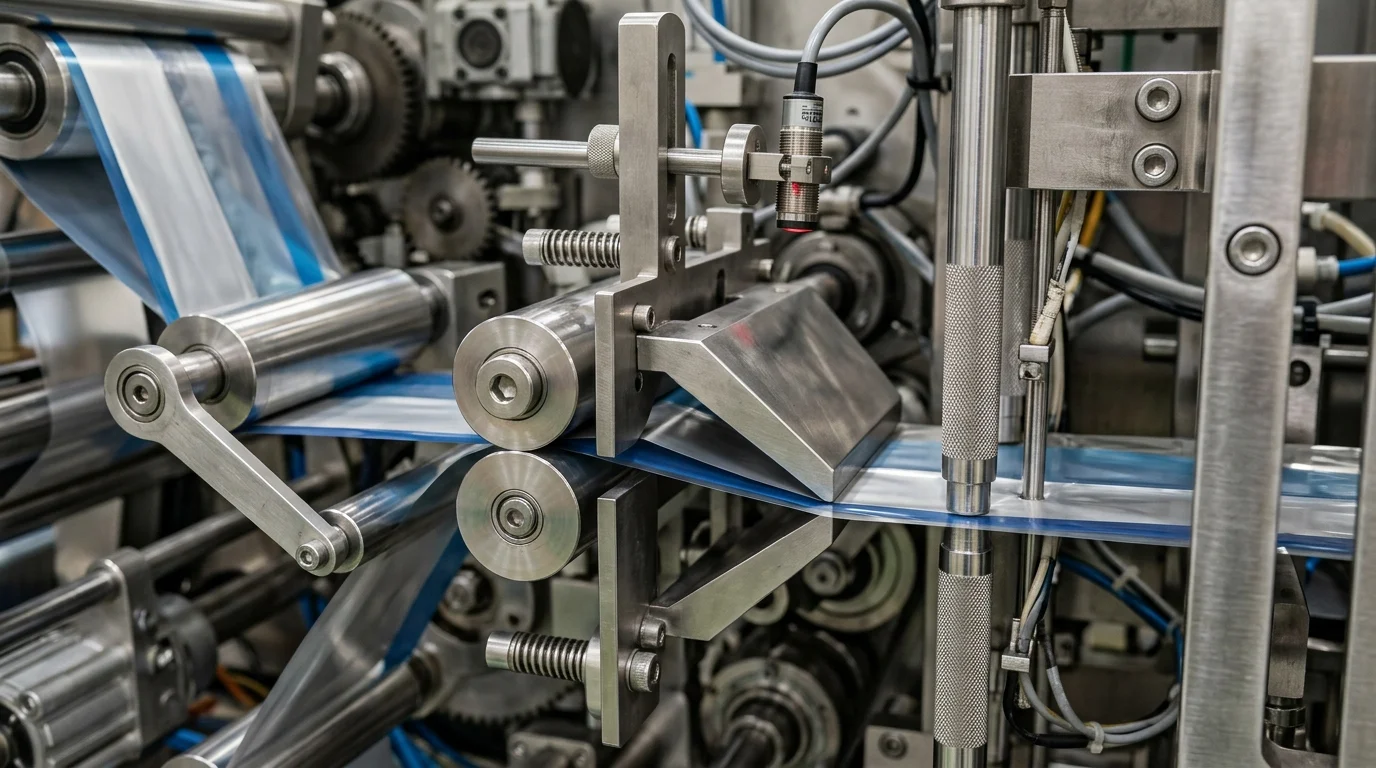
Vertical and horizontal heat-seal sachet machine architectures
Review how vertical and horizontal form-fill-seal platforms configure sealing bars or sealing plates for each sachet geometry.
We configure both vertical and horizontal form-fill-seal sachet architectures to produce single-dose sachets sealed on 3 or 4 sides depending on product flow and pouch geometry.
On intermittent-motion horizontal sachet machines, the web travels horizontally to produce three-side-seal, four-side-seal, or stand-up formats as individual packets or twin sachets joined by vertical perforations.
On intermittent-motion vertical sachet machines equipped with heated sealing plates or vertical rollers, opposing webs are sealed around all four edges for flat or contoured sachets across single or multiple lanes.
Usable cavity math, seal allowances and multi-lane web width
Calculate the internal cavity and parent reel width using the equations in our sachet sizes and fill volume guide before ordering printed laminate rolls.
Portion-to-volume conversion is Volume (ml) = portion (g) ÷ density (g/ml).
A 4-side seal sachet has a seal on every edge, while a 3-side seal sachet has a fold on one edge instead of a seal, and each seal on an edge is taken off the outer size.
Cavity width equals outer width minus the seals on its two long edges, cavity length equals outer length minus the seals at the two ends, and a folded edge takes nothing off.
With assumed seal widths of 5 mm on each long edge and 6 mm at each end, a 4-side seal sachet 40 mm wide and 60 mm long has a cavity 40 − 5 − 5 = 30 mm wide and 60 − 6 − 6 = 48 mm long.
For identical slit strips, master-web width equals lane count multiplied by lane-strip width plus total edge trim, and a finished sachet face width does not define the unfolded strip width.
In hypothetical arithmetic for a slit-strip layout, four assumed 60 mm lane strips plus 10 mm total edge trim require a 250 mm master web.
In a hypothetical layout check on an assumed 720 mm web, 8 lanes allocate 90 mm of pitch per lane before the specified edge handling.
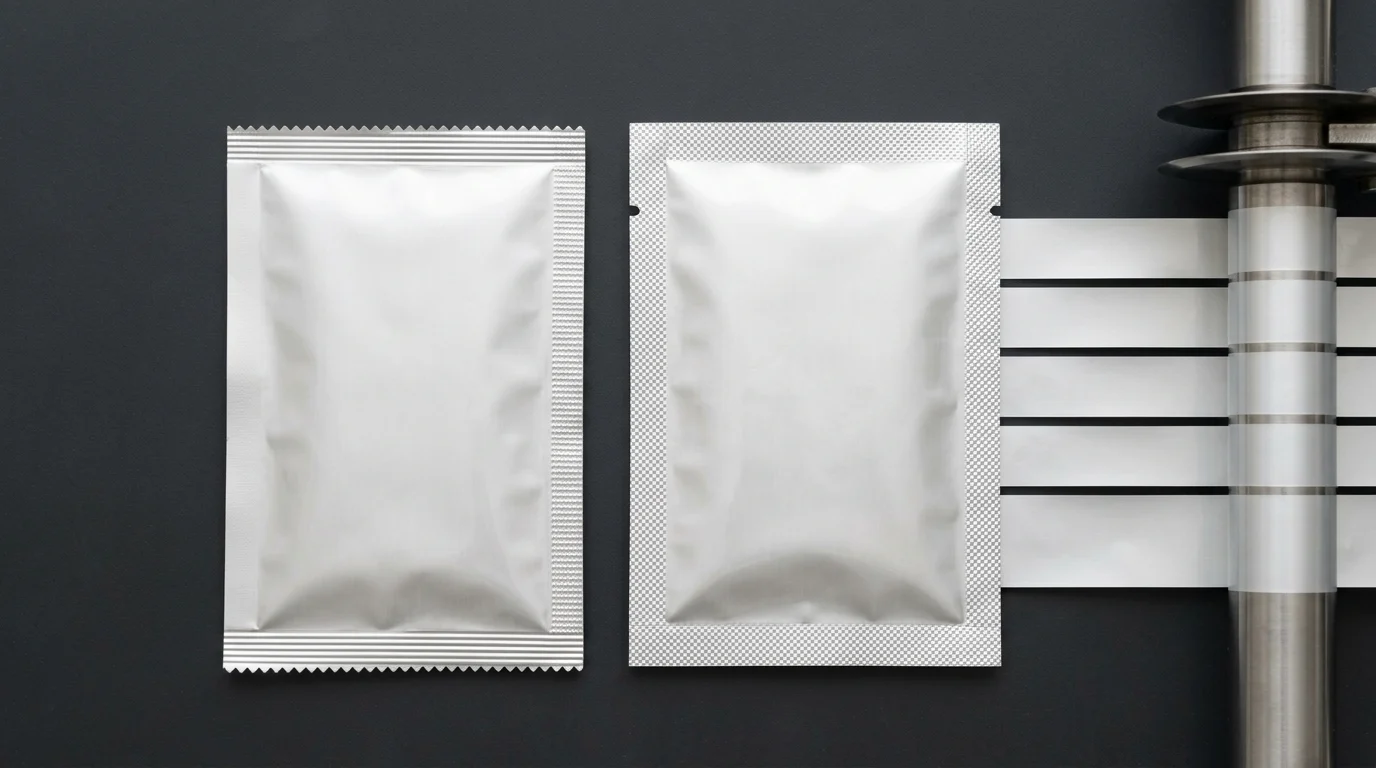
Comparing our LINEVO four-side seal configurations and multi-lane architectures
Match your liquid, granule, or powder formulation to the dosing and lane architecture on our multi-lane sachet packaging machine page, liquid and paste sachet machine page, granule sachet machine page, and powder sachet machine page.
Our LINEVO LV-500SY, LV-700SY and LV-980SY four-side seal sauce sachet machines are configured with 2–4, 3–10 and 4–16 lanes respectively.
Our LINEVO LV-500SY / LV-700SY / LV-980SY series covers a standard filling range of 5–100 ml, which can be extended up to 500 ml, using rotary-valve piston dosing.
Our LINEVO LV-500SY / LV-700SY / LV-980SY series forms a bag length of 45–160 mm and a bag width of 50–125 mm.
Our LINEVO LV-500SY, LV-700SY and LV-980SY models accommodate maximum film widths of 500, 700 and 980 mm respectively across lane ranges of 2–4, 3–10 and 4–16.
Our LINEVO LV-500SY / LV-700SY / LV-980SY series runs at a packing speed of 20–40 cuts/min, representing machine cycles per minute where each cycle cuts one pack in every lane.
Our LINEVO LV-500SY / LV-700SY / LV-980SY series operates on 220 V, 50/60 Hz power with ratings of 4 / 5.5 / 7 kW.
Our LINEVO LV-500SY / LV-700SY / LV-980SY series has machine weights of 650 / 850 / 1000 kg and machine dimensions of 1540 × 1375 × 2270 / 1790 × 1445 × 2340 / 1940 × 1600 × 2650 mm.
Our LINEVO LV-500SY / LV-700SY / LV-980SY series uses Food Grade Stainless Steel SUS304 construction and compressed air consumption of 0.6–0.8 MPa at 0.35 m³/min.
In Example 1, an assumed 10 g sauce portion at a density of 1.1 g/ml gives a volume of 10 ÷ 1.1 ≈ 9.1 ml, which sits inside the 5 to 100 ml fill range of our LV-500SY series.
Our LINEVO LV-350X four-side seal granule sachet machine covers a fill range of 1–50 g, sachet length of 50–180 mm, and sachet width of 30–80 mm per lane.
On our LINEVO LV-350X granule sachet machine, four lanes form, fill and seal in one cycle, taking less floor space than several single-lane machines.
In Example 2, an assumed 4 g sugar portion at a bulk density of 0.8 g/ml gives 4 ÷ 0.8 = 5 ml, which sits inside the 1 to 50 g fill range of our LV-350X, while at 0.75 g/ml a 5 ml cup gives 5 × 0.75 = 3.75 g.
Our LINEVO multi-lane powder sachet machine uses an independent servo auger per lane and a four-side seal, multi-lane format for protein mixes, collagen and meal-replacement powders.
Multi-lane output arithmetic and VFFS drive examples
Evaluate multi-lane cycle rates and drive architectures using the counting relationships below alongside our sachet packaging machine price and configuration guide.
When each active lane makes one sachet per cycle, theoretical output (sachets/min) = active lanes × cycles/min, and accepted output (sachets/min) = accepted sachets ÷ elapsed run time (min).
Cycle duration in milliseconds = 60,000 / cycles per minute; in hypothetical arithmetic, four active lanes at an assumed 30 cycles/min correspond to 120 gross reference packs/min and a 2,000 ms cycle.
The INVpack MVA9 EVO VFFS multilane flat sachet machine forms, fills and seals 4 side seal flat sachets and is designed to work with reels up to a 900 mm width.
On the INVpack MVA9 EVO, output ranges from 280 stickpacks per minute for a four-lane operation to 700 per minute with ten lanes, widths range from 100 mm for four lanes to 40 mm for ten lanes, and lengths range from 60 mm to 160 mm.
The INVpack BY3 EVO multilane stickpack machine forms, fills and seals 3 side stickpacks from 1 to 7 lanes, and the SP Series 6/9/12 produces three-side-seal stickpacks.
The Mespack ML Series 4 side seal sachet packaging machines are offered in two models, ML1000 and ML1200, with between 4 and 14 lanes available and integrated PLC functions that sequence 7 brushless motors.
Mespack ML Series main standard features include one brushless motor for the main film drive system and vertical cutting knives, two for the unwinder, two for the vertical seal bars, one for horizontal cutting knives, one for horizontal seal bars, and an 18.5” color touch screen.
Corner thickness transitions, jaw impressions and ASTM seal testing
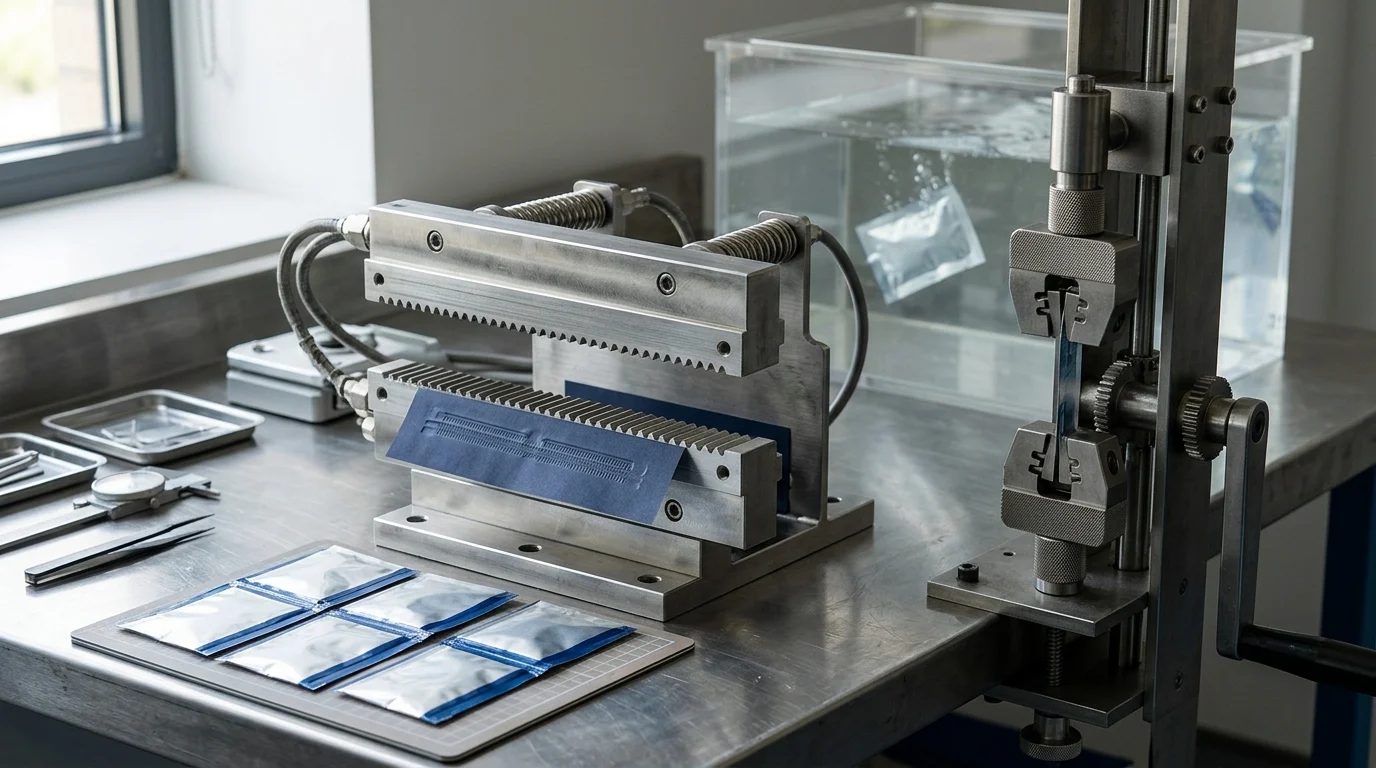
Verify corner overlap transitions, sealing jaw contact, peel strength, and gross-leak integrity using our sachet sealing problems checklist and product and film sample testing program.
Pinholes or leaks right where side seals overlap the top or bottom cross-seal require inspecting the multi-layer transition step (where 2 layers become 3 or 4 layers) and checking film fold alignment.
During our horizontal sealing jaw paper alignment test, we use Type A pencil carbon paper on jaws at room temperature, and Type B temperature-pressure (TP) paper on hot jaws at approximately 200–300°F.
When adjusting horizontal jaw pressure distribution, we close the horizontal jaws until they make contact between 330° and 340° of the cycle to verify uniform nip pressure across the full web width.
ASTM F88/F88M-23 covers the measurement of the strength of seals in flexible barrier materials, measuring the force required to separate a test strip of material containing the seal and identifying the mode of specimen failure.
What to send when requesting a sachet machine quotation
Include the following project parameters when preparing an inquiry so our engineering team can review the forming, dosing, and sealing configuration:
- Product form, viscosity or bulk density condition, and target fill weight or volume per sachet.
- Package drawing showing the seal layout, outer width and length, seal band widths, and tear notch location.
- Film laminate structure, total thickness, roll width, and registration mark layout.
- Required active lane count and shift output target in accepted sachets per minute.
- Package qualification methods for jaw impression checks, peel strength, and gross leak inspection.
Send your product details, sachet drawing, film structure, and target output on WhatsApp to review the machine configuration with our engineering team.
Frequently asked questions
How does the fold on a three-side seal sachet change the usable cavity compared with a four-side seal sachet?
Replacing one side seal with a continuous film fold eliminates one seal-width deduction, increasing usable pocket width by that single seal margin (for example, from 30 mm to 35 mm on a 40 mm wide sachet with 5 mm side seals).
Which impression paper should be used on rotary versus reciprocating sealing jaws?
On cold or hot reciprocating jaws, use standard carbon paper (or temperature-pressure paper at 200–300°F) and avoid carbonless paper. Once rotary jaws are heated, carbon wax melts on the rotating face, so operators switch to carbonless (NCR) paper.
How are specimen tails supported during seal peel testing and how are gross leaks detected on flat sachets?
Seal peel tests under ASTM F88/F88M-23 Clause 4.2 use three tail-support geometries: Technique A (unsupported), Technique B (90° hand-supported), or Technique C (180° supported). Gross channel leaks are verified by internal pressurization bubble testing under ASTM F2096-11(2019), which detects defects down to 250 μm (0.010 in.) with 81% probability (Scope 1.1).
Sources
- Our LINEVO Engineering Library — 4-Side Seal Sachet Packaging Machines (/machines/4-side-seal)
- Our LINEVO Engineering Library — Multi-Lane Sachet Packaging Machines (/machines/multi-lane)
- Our LINEVO Engineering Library — How Sachet Packaging Machines Work (/guides/how-sachet-packaging-machines-work)
- Our LINEVO Engineering Library — Sachet Sizes: Size Chart, Fill Volumes and Seal Types (/guides/sachet-sizes)
- Our LINEVO Engineering Library — Sachet Sealing Problems: A Controlled Trial Checklist (/guides/sachet-sealing-problems)
- Our LINEVO Catalog — LV-500SY / LV-700SY / LV-980SY Four-Side Seal Sauce & Liquid Sachet Machine
- Our LINEVO Catalog — LV-350X Four-Side Seal Granule Sachet Machine
- Matrix / INVpack — MVA900 (MVA9) VFFS Multilane Flat Sachets Machine
- Mespack — ML Series (ML1000 / ML1200) Multilanes Vertical FFS Machine for 4-Side Sealed Sachets
- Greener Corporation — Analyzing Sealing Jaw Carbon Impressions to Troubleshoot Problems on Flow Wrappers & Vertical FFS Baggers
- ASTM International — ASTM F88/F88M-23 Standard Test Method for Seal Strength of Flexible Barrier Materials
- ASTM International — ASTM F2096-11(2019) Standard Test Method for Detecting Gross Leaks in Packaging by Internal Pressurization (Bubble Test)