

4-Side Seal Sachet Packaging Machines
A 4 side seal sachet packing machine makes flat sachets sealed on every edge. Sachet anatomy, size against fill, strips, seal patterns and film, in one place.
A 4-side seal sachet packaging machine makes a flat sachet sealed along all four edges: a neat rectangle with a flat face you can print on. This page starts from the finished sachet rather than the machine, because the sachet is what your customer holds. If your main question is output, go to the multi-lane configuration page.
What does a 4-side seal sachet look like?
There are four seals. The top and bottom are cross seals, and the two side seals run along the length. Depending on the design, the side seals join two film layers or seal a folded web. The cavity is the unsealed space inside, and it is smaller than the outer sachet because the seals eat into it. A tear notch, a small cut or serration in the seal, lets the user open the pack by hand without scissors. Both flat faces can carry artwork, within the limits of the film and print layout.
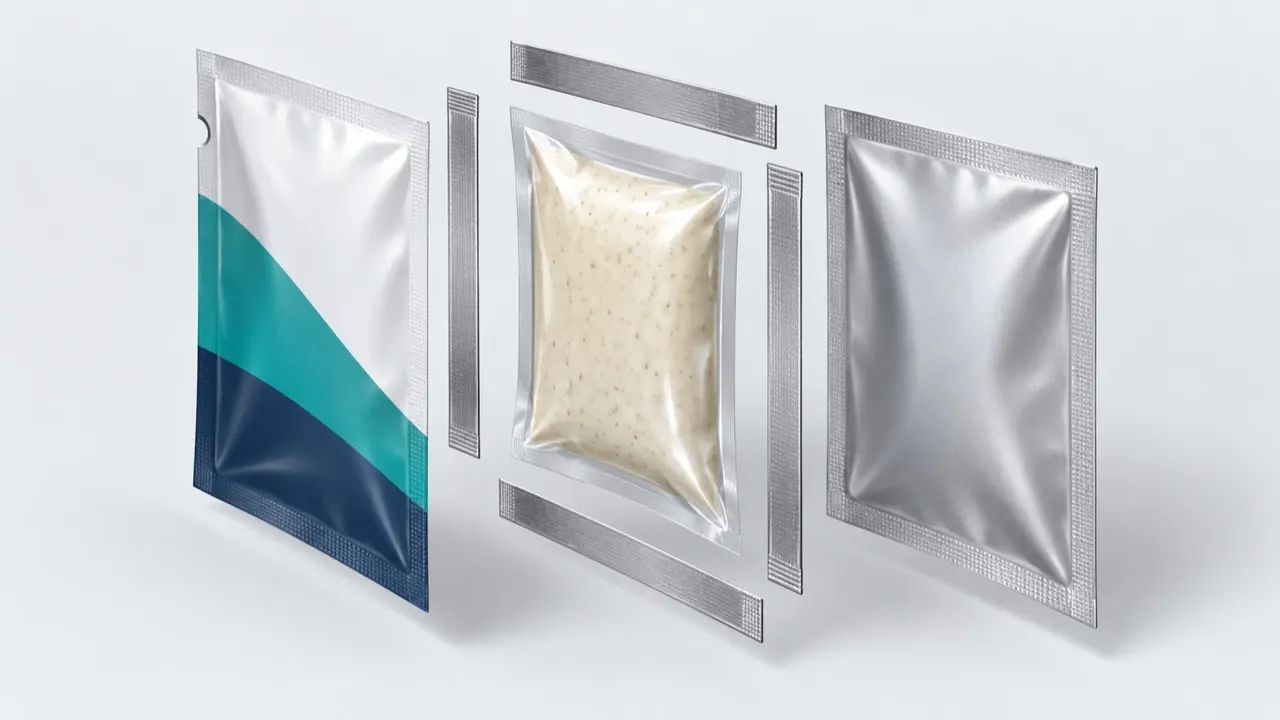
Illustration: the four seals surround the cavity, and the tear notch sits in one of them.
How do sachet size and fill volume relate?
The sachet is a flat pouch, so the cavity limits the fill, not the outer size. Wider seals leave less room inside. A light, fluffy powder takes far more volume per gram than a dense granule, so the same portion may need a bigger sachet. Fill level matters too. An over-filled sachet bulges and pushes product into the seal area, which leaks. An under-filled one looks slack and may fold badly.
We give no sizes or fill ranges here. Portion, product, film and dosing method together set the right sachet size, and we only commit to one after seeing your product in a sachet. For the forming, filling and sealing sequence, see how sachet packaging machines work.
Which shapes and corner options can we discuss?
Most 4-side seal sachets are rectangular. Square corners are the simplest. Rounded corners can look neater and may be gentler to handle. Cut or shaped edges are possible in some configurations, but they depend on the tooling. Aspect ratio matters more than people expect: a long narrow sachet and a short wide one with the same cavity behave differently in dosing and in strips. What is available depends on the machine and tooling, and we confirm it in the quotation.
Connected strips or single sachets?
Sachets can leave the machine cut apart, or joined in strips with a perforation between them.

Illustration: strips tear apart along perforations, while singles are cut free.
| Option | Where it suits | What to check |
|---|---|---|
| Connected strips | Retail packs, display strips, easy counting by strip | Perforation tears cleanly without opening a seal |
| Single sachets | Counting into cartons, hospitality, sample packs | Counter and carton feed handle loose sachets |
What seal patterns are used?
Seals can be flat, or carry a pattern such as fine lines or a cross-hatch. A pattern can improve grip on the film and help a seal form on some materials, but it also changes how the seal looks and how easily it opens. The right choice depends on the film and the product. Powder that dusts into the seal area is the usual cause of a weak seal, and oily or wet products cause the rest. Because seal strength depends on all of that, we test it on sachets made from your product.
What film considerations apply?
The film has to seal to itself, protect the product and run reliably on the machine. Settle these early.
- Barrier: moisture, oxygen or aroma sensitivity decides how much barrier the laminate needs.
- Sealant layer: the inner layer must seal within a temperature range the machine can hold across the full seal width.
- Thickness and stiffness: thicker film resists tearing but can be harder to open, and thin film may wrinkle.
- Print and registration: printed film needs registration marks and consistent print placement.
- Food contact: suitability of the film and the machine parts must be confirmed for your product and market.
How does 4-side seal compare with 3-side seal?
A 3-side seal sachet is made from folded film, so one edge is a fold and the other three are sealed. A 4-side seal sachet has four sealed edges, often made from two film layers or from a folded web with an extra seal. In general, 4-side gives a flatter, more uniform pack with a seal on every edge, which suits products that want a clean flat face or where the seal pattern matters. 3-side seal is common and simpler in many projects. Which one to pick is a decision we make with you once we know the product and the sachet you want.
Which machines and configurations produce it?
4-side seal sachets come off flat-sachet machines, and the configuration follows the product and the target output. More lanes raise output, within limits set by film width and dosing, as the multi-lane page explains. Dry powders, granules, liquids and pastes each need their own dosing method. The cutting and notching tooling decides whether you get strips or singles and what the tear notch looks like. Products pull the choice in different directions too: compare sugar sachets with coffee sachets to see how.
If you are weighing single-serve formats, our sachet versus stick pack guide covers the comparison.
What do we need to recommend a configuration?
Send us the product and its form, with any flow, stickiness or aroma issues. Add the fill portion and the sachet size you want, the film type, whether you prefer strips or singles, and your target output and downstream equipment.
You can ask for a sample test to see the finished sachet, or ask for a quotation on WhatsApp.
Questions about 4-side seal sachets
What is a 4-side seal sachet?
It is a flat sachet sealed along all four edges, with a cavity for the product and usually a tear notch for opening.
Can the tear notch be positioned differently?
Notch style and position depend on the tooling. Tell us how your users open the pack and we will say what is possible.
Why does my sachet bulge or leak at the seal?
The usual causes are over-filling, product dusting into the seal area, or seal temperature and pressure that do not suit the film. Running your own product and film shows which one it is.
Is a 4-side seal sachet right for every product?
No. The choice depends on the product, the portion and how the pack is used, so we look at your requirements first.
Not sure which configuration fits your product?
Send your product and pack details, or ask for a trial on your own material before you decide.