

Horizontal Sachet Machine: HFFS Web Path, Stations & Vertical VFFS Trade-Offs
Published by the LINEVO sachet equipment team. Technical questions and corrections
How does a horizontal sachet machine fold, side-seal, fill, and cut rollstock along a horizontal web path, and when does HFFS beat vertical VFFS or premade pouches?
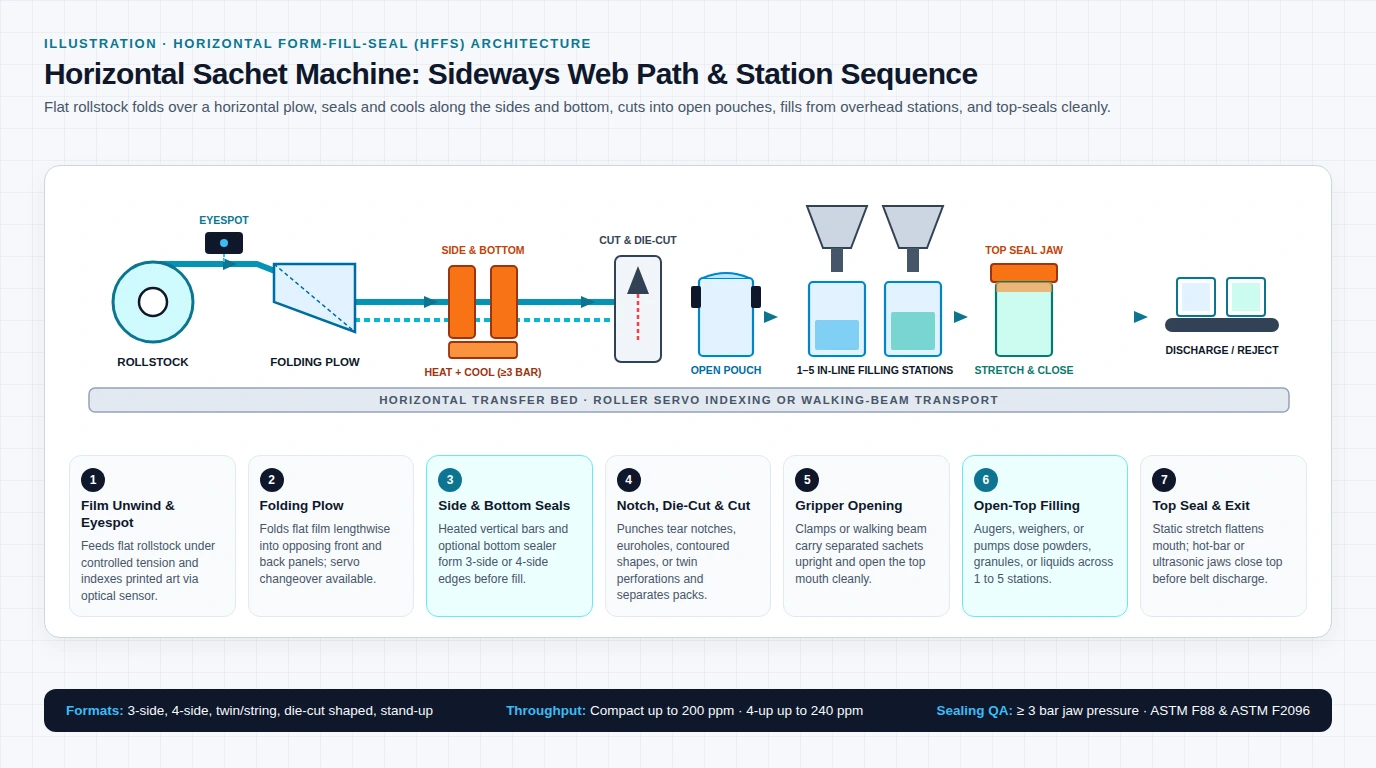
A horizontal sachet machine is an automated horizontal form-fill-seal (HFFS) system that moves heat-sealable rollstock sideways across a folding plow, vertical side-seal bars, an optional bottom sealer, a cutting and opening section, overhead filling stations, and top cross-sealing jaws to produce 3-side-seal, 4-side-seal, twin, or die-cut shaped sachets.
Because horizontal web travel separates side and bottom pouch forming from open-top dosing while occupying more floor length than vertical layouts, choosing between HFFS and vertical equipment starts with mapping your packet geometry, dosing stages, and available plant bay. Review this architecture breakdown alongside our four-side seal sachet machines page, our how sachet packaging machines work walkthrough, and our three-side vs four-side seal sachet machine guide.
How does a horizontal form-fill-seal sachet line form packets from flat rollstock?
A horizontal form-fill-seal sachet line unwinds continuous flat heat-sealable film sideways through a folding plow, tracks printed artwork with an optical eyespot sensor or stroke-length indexer, heat-seals the vertical sides and optional bottom edge, cuts the web into individual pouches, opens each pouch top, fills product, and closes the top seal before discharge.
Unlike single-web vertical baggers that wrap film around a hollow conical forming tube and drop product downward during vertical travel, horizontal sachet machines advance the film laterally across sequential stations. Forming the pouch envelope first lets the side seams and optional bottom seal close before product ever enters the open cavity, which protects lower seal bands from powder dust or viscous liquid splashes during filling.
Horizontal folding plow, registration indexing, and web control
On a standard horizontal line, continuous rollstock leaves the unwinder under controlled tension and passes a triangular folding plow that folds the flat web lengthwise into opposing front and back panels. On modular HFFS platforms, a servo-driven changeover system adjusts plow formation between pouch heights, while a roller servo-driven stroke indexing system advances the web accurately from station to station.
As documented in the Wikipedia technical reference on form-fill-seal machines, material feeding and pouch cutting on roll-film machines are governed either by programmed pouch length on unprinted film or by a visual sensor reading a printed eyespot (photo registration mark). Keeping print marks crisp and web tension steady prevents registration creep before the side-seal bars and cutoff knives engage.
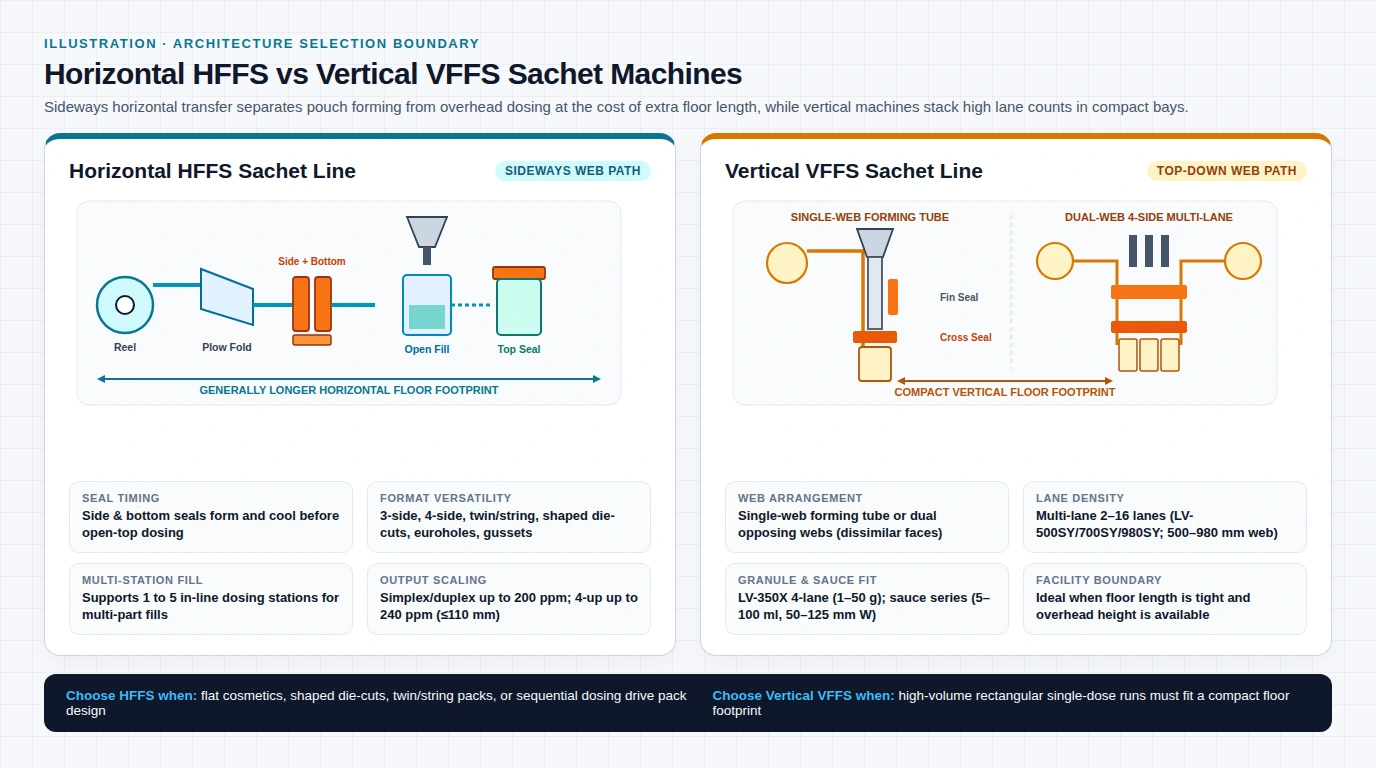
Sideways horizontal HFFS web path versus top-down single-web and dual-web vertical VFFS sachet layouts, highlighting floor footprint and lane-scaling trade-offs.
What stations link pouch forming, side sealing, and horizontal sachet filling?
A horizontal sachet machine links seven core mechanical zones in series: film unwind and eyespot registration, folding plow, vertical side and optional bottom sealing bars, notch and die-cut cutoff, gripper or walking-beam pouch opening, one to five overhead filling stations, and static mouth stretching ahead of final top sealing and belt discharge.
Modular HFFS lines standardize mechanical assemblies along the main frame so operators can add specialty cutting tools, gas-flushing nozzles, or multiple in-line dosers without redesigning the core transport bed. On larger pouch formats, a cam-driven walking-beam transport system stabilizes horizontal pouch indexing during filling and closure to maintain alignment across wide or heavy packs.
Station-by-station HFFS machine parts and mechanical roles
| Station in sequence | Primary HFFS machine parts | Mechanical function along horizontal path | Key alignment and process check |
|---|---|---|---|
| 1. Film unwind and registration | Reel shaft, guide rollers, optical eyespot sensor | Feeds flat rollstock laterally and indexes printed panels by eyespot or stroke length | Verify optical mark contrast and roller tracking stability |
| 2. Plow forming | Triangular folding plow and servo changeover mechanism | Folds flat web lengthwise into front and back sachet panels | Match plow geometry to target sachet height and laminate stiffness |
| 3. Side and bottom sealing | Vertical hot-bar sealers and optional bottom seal jaw | Bonds side edges for 3-side seal or adds bottom seal for 4-side seal | Maintain at least 3 bar clamping pressure across full jaw width |
| 4. Notch, die-cut, and cutoff | Tear-notch punch, eurohole or contour die-cutter, cutoff knife | Cuts tear notches, shaped contours, or twin perforations and separates pouches | Check blade clearance, die alignment, and clean edge separation |
| 5. Transport and mouth opening | Gripper clamps or walking beam with opening station | Carries individual pouches horizontally and opens the top mouth for filling | Confirm synchronized gripper timing and unobstructed pouch opening |
| 6. Open-top filling | 1 to 5 overhead dosing stations (auger, weigher, or pump) | Meters powders, granules, liquids, or multi-component fills into open pouches | Keep nozzles centered so product clears the upper top-seal band |
| 7. Stretch, top seal, and exit | Static pouch stretcher, top hot-bar or ultrasonic jaw, reject gate | Flattens the open mouth, welds the top seam, and discharges or rejects packs | Confirm uniform jaw contact, release-layer condition, and seal peel |
Sealing jaw technologies and verified thermal operating windows
As explained in the Wikipedia overview of heat sealers, flexible packaging equipment relies on three primary sealing mechanisms. Constant-heat hot-bar sealers hold heated bars or dies at steady temperature and use release coatings or Teflon interposer films to prevent molten laminate sticking. Impulse sealers energize Nichrome elements only during clamping and cool the weld under pressure before releasing stress, while ultrasonic sealers apply high-frequency acoustic vibrations under pressure to bond thermoplastics cleanly through challenging seal zones.
According to the industrial flexible-packaging study by Merabtene, Tanninen, Varis, and Leminen in BioResources, heat sealing melts the inner sealant layer under pressure so polymer chains wet, diffuse, and entangle upon cooling. Two quantitative thresholds from that study govern reliable closure on roll-film machines:
- Minimum 3 bar jaw pressure: Below 3 bar, the sealant layer lacks enough clamping force for polymer chain entanglement regardless of temperature; in trials, the first observable seal appeared at 3 bar and 80 °C.
- Laminate temperature windows at 2 s dwell: Oriented polypropylene/polyethylene (OPP/PE) thermoplastic film formed its first seal at 100 °C and shrank at 140 °C, whereas PE-coated paper initiated sealing at 90 °C and remained within its window up to 220 °C before turning brown.
If seals pucker, channel, or fail intermittently across side or top jaws, use our sachet sealing problems checklist to isolate pressure, dwell, and contamination faults systematically.
How do horizontal sachet packing machines handle three-side, four-side, and shaped formats?
Horizontal sachet machines convert flat rollstock into 3-side-seal packets with a folded bottom edge, 4-side-seal flat packets with a heat-sealed bottom, perforated twin or string sachets, dual-chamber pouches, contoured die-cut shapes with euroholes, and bottom-gusseted stand-up pouches by switching sealing jaws and inline die-cutting modules.
Because the folded web travels upright along a flat horizontal bed before final cutting and filling, modular cutting stations have unobstructed mechanical access to punch rounded corners, retail hang slots, double-scissor cuts, laser scores, or bottle-shaped contours without destabilizing a vertical film tube. Modern HFFS platforms also seal recyclable mono-material PE and PP structures alongside multi-layer barrier laminates, and can integrate zippers, pour spouts, or straw attachments on larger pouch frames.
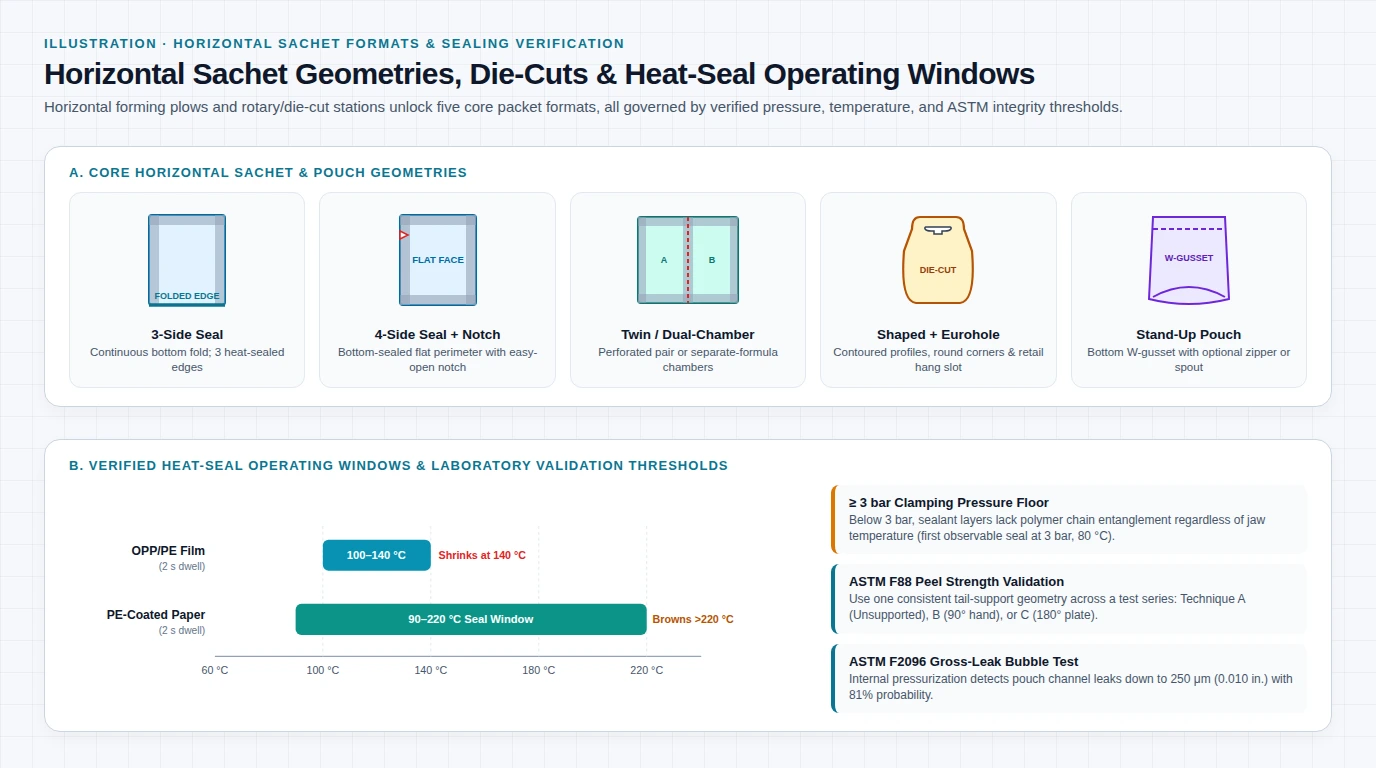
Five core horizontal sachet and pouch geometries alongside verified heat-seal temperature windows, the 3 bar pressure floor, and ASTM F88 and ASTM F2096 verification criteria.
Horizontal packet styles and required machine tooling
| Sachet or pouch format | Seal and fold construction | Horizontal tooling required | Typical packaging use case |
|---|---|---|---|
| 3-side-seal flat sachet | Continuous folded bottom edge plus 2 side seals and 1 top seal | Folding plow, vertical side sealers, top seal jaw, optional tear notch | Single-dose dry powders, granules, and standard flat samples |
| 4-side-seal flat sachet | Full perimeter sealed along both sides, bottom, and top | Folding plow plus bottom sealing bar, vertical side sealers, top seal jaw | Flat retail sachets requiring crisp uniform borders and easy-open notches |
| Twin and string sachets | Joined 4-side-seal pairs or strips separated by perforations | Perforating blade between sealed center seams and synced duplex dosing | Dual-step cosmetic formulas, shampoo-and-conditioner pairs, display strips |
| Shaped die-cut sachet | Contoured outer profile with rounded edges or eurohole hang slot | Inline die-cut press, laser cutter, or hole-punch station before discharge | Promotional cosmetics, contoured personal-care samples, pegged retail displays |
| Stand-up pouch (Doypack) | Bottom W-gusset that opens flat, optional zipper or pour spout | Bottom gusset folder, optional zipper or spout applicator, walking beam | Multi-serve foods, sauces, pet treats, and reclosable retail pouches |
Which food powders, liquids, pastes, and specialty fills suit a horizontal sachet machine?
Horizontal sachet machines handle dry food powders, free-flowing granules, thin liquids, heavy cosmetic pastes, and multi-component formulas by mounting dedicated overhead dosing heads—such as auger screws, vibratory weighers, volumetric fillers, or positive-displacement liquid depositors—across one to five synchronized in-line filling stations.
As outlined in the Wikipedia technical summary of packaging fillers, matching the dosing mechanism to product rheology keeps the upper seal band clean and holds portion accuracy steady across production shifts:
- Auger and agitator fillers for dry powders: Designed for dry mixes such as flour and sugar, a conical hopper feeds an agitator-controlled auger screw that meters powder directly into the open pouch mouth. Maintaining steady upstream powder supply into the hopper is critical for consistent fill weights.
- Vibratory weighers and volumetric fillers for granules and solids: Linear feeders paired with precision weighing hoppers meter granular or piece-based dry foods accurately without crushing friable particles.
- Positive-displacement pumps and liquid depositors for liquids and pastes: Originally engineered for creams, gels, and lotions, positive-displacement pump fillers handle both water-thin liquids and heavy viscous pastes including sauces, thick shampoo, hair conditioners, honey, hair gels, and paste cleaners.
- Multi-station dosing and Modified Atmosphere Packaging (MAP): Because modular HFFS lines accept 3 to 5 filling stations in sequence, one frame can dose two-part blends, combine solids with liquids, or flush inert nitrogen gas before final closure to displace oxygen and slow bacterial spoilage in food packets.
For U.S. food packaging lines, 21 CFR § 117.40 requires equipment to be cleanable, maintained against allergen cross-contact, constructed to prevent adulteration from lubricants, fuel, metal fragments, or contaminated water, and built with corrosion-resistant, nontoxic food-contact surfaces able to withstand cleaning compounds and sanitizing agents. Modular horizontal frames serving food, beverage, or personal-care facilities can incorporate clean-in-place (CIP) or sterilize-in-place (SIP) options to support washdown hygiene.
When does a compact horizontal sachet machine fit limited floor space vs vertical VFFS?
A compact all-in-one horizontal sachet machine fits limited floor space when you run flat 3-side-seal, 4-side-seal, twin, or die-cut formats up to 200 sachets per minute in simplex or duplex mode, whereas vertical multi-lane VFFS machines win when high-volume rectangular single-dose runs need to fit a tighter floor footprint across 2 to 16 parallel lanes.
Horizontal form-fill-seal machines generally use more floor space than vertical systems because unwinding, plow folding, side sealing, cutting, filling, and top sealing unfold sequentially from left to right. However, compact horizontal sachet frames consolidate all stations on one unit for small facilities and scale output through multi-up indexing:
- Simplex vs duplex width-speed trade-off: Across compact horizontal sachet models such as 110 mm, 140 mm, and 170 mm width classes (where a 170-class frame handles sachets up to 170 mm wide in simplex mode), switching to duplex operation packs 2 sachets per cycle—halving maximum sachet width while doubling output up to 200 sachets per minute.
- High-speed 4-up horizontal indexing: Larger modular 4-up horizontal platforms push small flat pouches up to 110 mm wide to 240 pouches per minute, though with a longer horizontal machine footprint.
- Compact vertical multi-lane density: When your pack is a standard rectangular four-side-seal sachet and floor length is constrained, vertical multi-lane equipment stacks parallel lanes across one wide master web. In our vertical four-side-seal catalog, the LV-500SY, LV-700SY, and LV-980SY sauce machines scale across 2–4, 3–10, and 4–16 lanes on 500, 700, and 980 mm maximum film widths (5 to 100 ml fills, 50 to 125 mm sachet width, 45 to 160 mm length), while the four-lane LV-350X granule machine produces 4 lanes per cycle (1 to 50 g fills, 30 to 80 mm width per lane, 50 to 180 mm length).
Floor footprint, output scaling, and format boundary: HFFS vs Vertical VFFS
| Evaluation factor | Compact horizontal HFFS (simplex / duplex) | Modular multi-up HFFS (4-up) | Vertical multi-lane 4-side-seal VFFS |
|---|---|---|---|
| Primary web direction | Sideways across horizontal bed | Sideways across extended horizontal bed | Top-down dual-web or single-web vertical drop |
| Floor-space demand | Moderate horizontal length; compact all-in-one frame for small facilities | Longest horizontal footprint (generally more floor space than vertical) | Compact floor footprint; scales upward in height and web width |
| Published output and width benchmark | Up to 170 mm max width (simplex); duplex packs 2 pouches/cycle up to 200 sachets/min | Up to 110 mm pouch width at 240 pouches/min in 4-up configuration | 2–16 lanes (500–980 mm film, 50–125 mm width) or 4-lane LV-350X (30–80 mm width) |
| Format strength | 3-side, 4-side, twin/string, easy-open, shaped die-cuts | Shaped pouches, gussets, zippers, spouts, 3 to 5 filling stations | High-volume rectangular flat sachets and dissimilar dual-web laminates |
| Best plant scenario | Moderate output needing flat cosmetics, twin packs, or quick tool-free changeovers | High-speed complex pouches with long floor bays available | High-volume sauces, granules, or powders in tight floor-length bays |
Compare lane-width scaling and parent-roll limits in detail on our multi-lane sachet packaging machines page.
How does an HFFS sachet machine differ from a horizontal premade pouch filler?
An integral horizontal form-fill-seal (HFFS) sachet machine forms, fills, and seals pouches directly from continuous flat rollstock in one line, whereas a horizontal premade pouch filler loads converter-manufactured preformed pouches shipped to the packager, opens each pouch, fills the product, and seals only the top edge.
As summarized in the Wikipedia engineering overview of stand-up pouches, both routes serve food, beverage, cosmetic, and medical packaging, but they shift complexity between your packaging plant and your film converter:
| Selection criterion | Integral horizontal HFFS machine | Horizontal premade pouch filler |
|---|---|---|
| Incoming packaging material | Continuous preprinted heat-sealable rollstock | Preformed pouches converted off-site and shipped ready to fill |
| On-machine operations | Unwind, plow fold, side/bottom seal, cut/die-cut, open, fill, top seal | Magazine pick, open mouth, fill product, top heat-seal |
| Mechanical complexity | Higher—integrates forming plows, side/bottom sealers, and cutoff tooling | Lower—eliminates rollstock forming, side sealing, and die-cutting stations |
| Washdown and sanitation scope | Requires strict sanitizing and washdown across forming and filling zones | Concentrated around pouch-opening, dosing, and top-sealing stations |
| Volume and contract-packing boundary | Favored when steady volume utilizes integrated rollstock forming capacity | Favored for lower-volume SKUs, frequent pouch graphics swaps, or outsourced converting |
Packagers whose volume cannot fill an integral form-fill-seal machine to capacity often start with preformed pouches or contract packagers before investing in rollstock HFFS equipment.
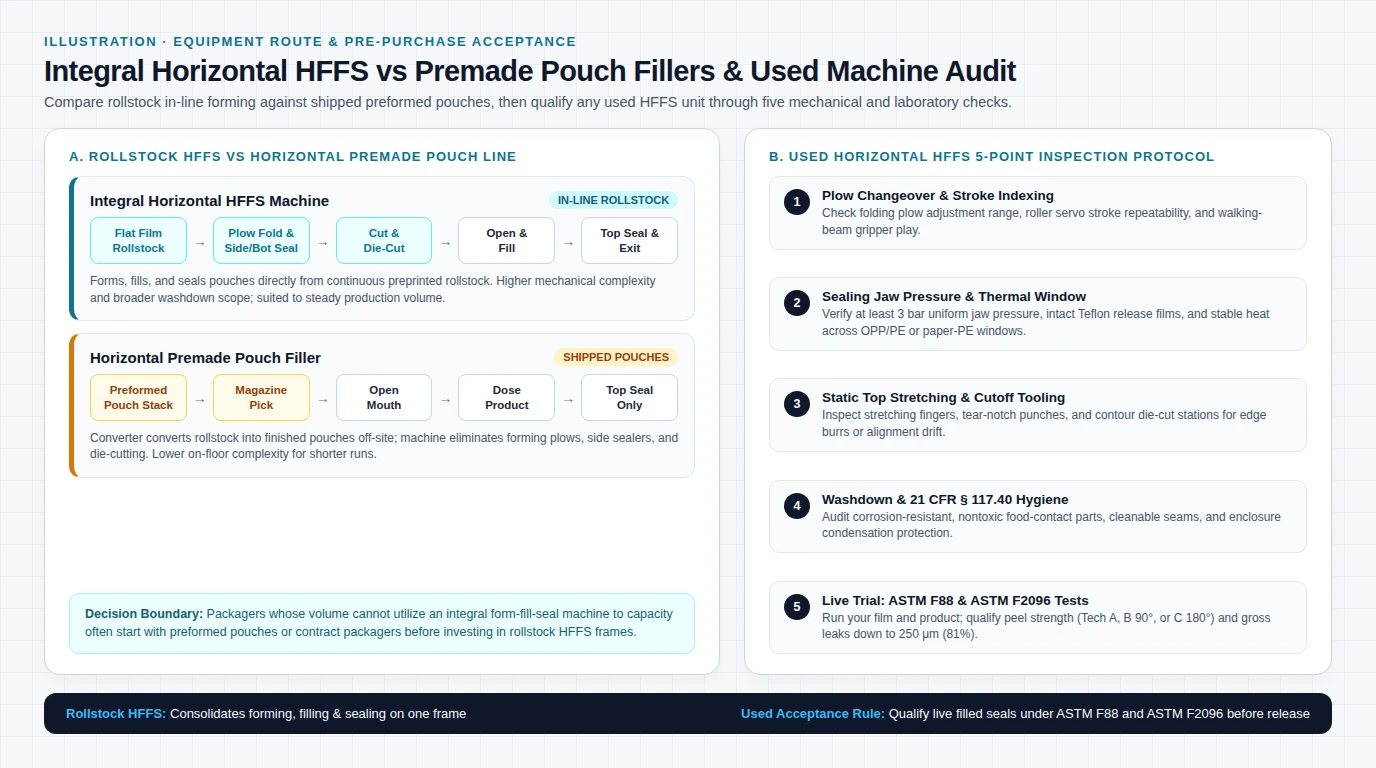
Integral rollstock horizontal HFFS versus shipped preformed pouch filling workflow, paired with the five-point pre-purchase audit protocol for used HFFS equipment.
What should you inspect on a used horizontal HFFS sachet machine before buying?
Before buying a used or refurbished horizontal HFFS sachet machine, inspect the folding plow changeover assembly, roller servo or walking-beam indexing accuracy, side and top sealing jaw parallelism and Teflon release surfaces, dosing-head hygiene, electrical enclosure washdown protection, and live sample seals verified under ASTM F88 peel and ASTM F2096 bubble leak protocols.
As highlighted in the Wikipedia overview of packaging machinery, equipment can be sourced off-the-shelf, custom-built, or refurbished and upgraded—but evaluating any unit requires checking maintainability, serviceability, changeover flexibility, floorspace, washdown resilience against high-pressure chemical cleaning and enclosure condensation, and documented heat-seal verification and validation.
Pre-purchase technical checks specific to used horizontal HFFS lines
- Plow formation and stroke indexing: Verify whether the folding plow adjusts smoothly across your target pouch heights and confirm that roller servo stroke indexing or cam-driven walking-beam grippers hold repeatable alignment without play.
- Sealing jaw pressure, temperature, and surface condition: Confirm side, bottom, and top jaws deliver at least 3 bar clamping pressure evenly across the seal band, hold stable temperatures across your laminate's window (for example, 100 to 140 °C on OPP/PE or 90 to 220 °C on PE-coated paper at 2 s dwell), and have intact release coatings or Teflon interposer films.
- Static stretching and cutoff tooling: Inspect top-mouth stretching fingers, tear-notch punches, and contour die-cut stations for wear that causes misaligned cuts or wrinkled top seals.
- Food-contact and washdown readiness: Audit wetted dosing parts and frame seams against 21 CFR § 117.40 for corrosion-resistant, nontoxic, cleanable construction free of lubricant leak paths or cabinet condensation damage.
- Laboratory acceptance testing on live filled packs: Never accept a used HFFS frame on dry cycling alone. Run your own rollstock and product, then test cooled seals under ASTM F88 using one consistent tail-holding geometry—Technique A (Unsupported), Technique B (Supported 90° by hand), or Technique C (Supported 180°)—and screen whole pouches for channel defects using the ASTM F2096 internal pressurization bubble test, which detects gross leaks down to 250 μm (0.010 in.) with 81% probability.
For a complete jaw-impression, dosing-wear, and PLC obsolescence walkthrough across second-hand sachet lines, pair these HFFS checks with our used sachet machine inspection checklist and validate your own film and product through product and film sample testing.
Frequently Asked Questions About Horizontal Sachet Machines
What is the main difference between a horizontal sachet machine and a vertical VFFS sachet machine?
A horizontal sachet machine moves heat-sealable rollstock sideways across a folding plow, side/bottom sealers, cutoff, gripper opening, overhead filling stations, and top sealing jaws, generally requiring more floor space while excelling at shaped die-cuts, twin packs, and multi-station dosing. A vertical VFFS machine draws single or dual webs downward into a compact floor footprint and scales easily to 2 to 16 parallel lanes for rectangular sachets.
How does duplex mode change width and speed on a compact horizontal sachet machine?
On a compact horizontal sachet machine—such as a 170 mm maximum-width model—switching from simplex to duplex mode forms and fills 2 sachets per cycle. Duplex operation halves the maximum individual sachet width while doubling output, allowing compact units to reach up to 200 sachets per minute.
Can a horizontal sachet machine produce both 3-side-seal and 4-side-seal packets?
Yes. Horizontal sachet machines fold continuous rollstock lengthwise and seal the vertical sides and top to produce 3-side-seal packets with a folded bottom edge, and add a bottom heat-sealing station to produce flat 4-side-seal packets as well as perforated twin or string sachets and die-cut shapes.
Why does a horizontal HFFS line cost more complexity than a horizontal premade pouch filler?
An integral horizontal HFFS machine converts flat rollstock into finished pouches in-line—adding unwinding, eyespot registration, plow forming, side and bottom sealing, and cutting stations ahead of filling—whereas a premade pouch filler only picks, opens, fills, and top-seals converter-made pouches shipped ready to load.
What minimum sealing pressure and laboratory tests verify horizontal sachet seal integrity?
Flexible heat-sealing studies show that below 3 bars of sealing jaw pressure, the inner sealant layer lacks sufficient clamping force for polymer chain entanglement regardless of temperature (with the first observable seal appearing at 3 bars and 80 °C). To validate finished pouches, measure peel strength consistently under ASTM F88 (Technique A, B at 90°, or C at 180°) and verify gross leak integrity under ASTM F2096 bubble testing, which detects leaks down to 250 μm (0.010 in.) with 81% probability.
Sources
- Wikipedia, Vertical form fill sealing machine — Single-Web, Dual-Web, and Horizontal FFS Comparison
- Merabtene, Tanninen, Varis, and Leminen, Heat-Sealing Evaluation and Runnability Issues of Flexible Paper Materials in a Vertical Form Fill Seal Packaging Machine (BioResources, NC State University)
- Wikipedia, Stand-up pouch — Preformed Pouches vs Integral Form-Fill-Seal Equipment
- Wikipedia, Heat sealer — Hot-Bar, Impulse, Ultrasonic, and Seal Quality Testing
- Wikipedia, Filler (packaging) — Auger, Vibratory Weigh, and Positive-Displacement Pump Fillers
- Wikipedia, Packaging machinery — Verification, Validation, Washdown, and Equipment Selection
- ASTM International, ASTM F88 Standard Test Method for Seal Strength of Flexible Barrier Materials
- ASTM International, ASTM F2096 Standard Test Method for Detecting Gross Leaks in Packaging by Internal Pressurization (Bubble Test)
- Legal Information Institute, Cornell Law School, 21 CFR § 117.40 — Equipment and Utensils (Food cGMP)