

How to Choose a Sachet Packaging Machine
How to choose a sachet packaging machine: start from your product, then fix fill, format, output and film. Includes a supplier checklist and proposal red flags.
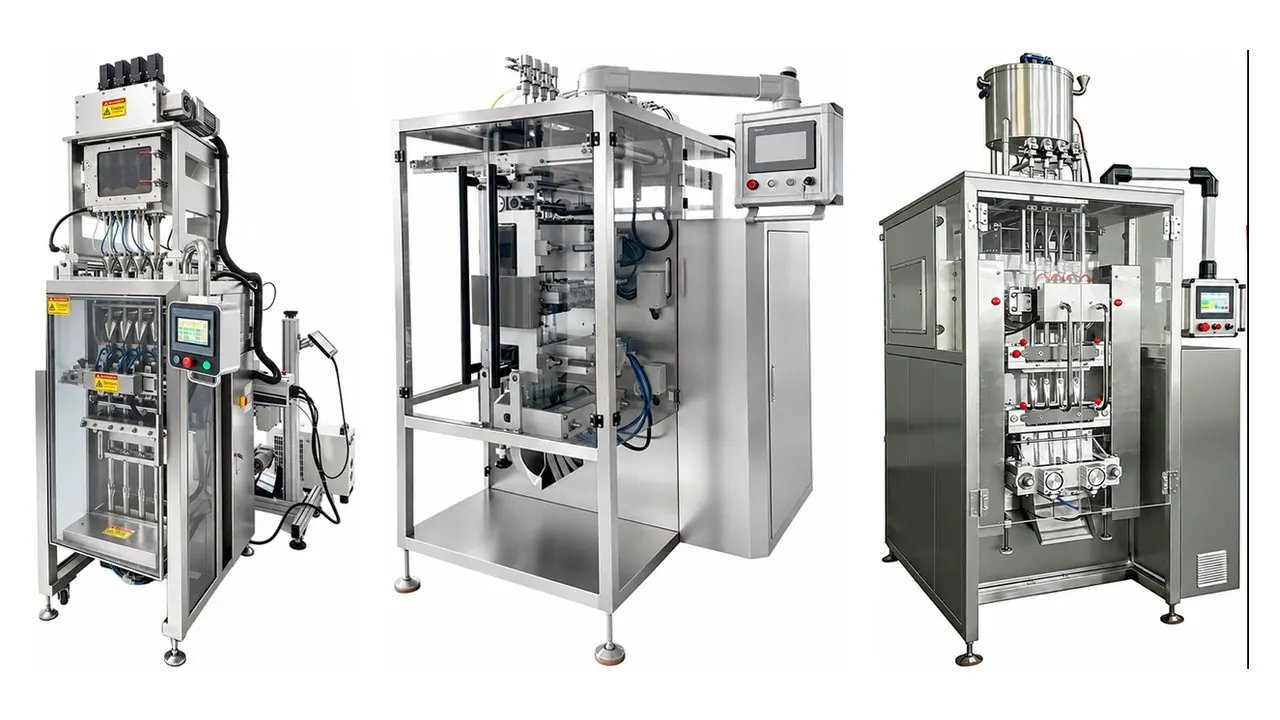
Work from the product outward. Start with how it behaves, then how much goes in each sachet, what the sachet looks like, how many you need per minute, and what film, cleaning routine, floor space and people the line has to live with. A supplier can then propose a configuration you can actually test. Below is that decision path, a table linking product behaviour to the dosing approach to evaluate, a checklist of what to send, and the red flags to look for in proposals.
We do not rank machines or name a best one. The right machine depends on your product, and the figures that separate one configuration from another have to come from your own sachets.
What is the decision path?
Take these in order, because each answer narrows the next.
- Product type and behaviour.
- Fill amount.
- Sachet format and size.
- Required output.
- Film.
- Cleaning and changeover.
- Floor space and utilities.
- Downstream equipment.
- Operators.
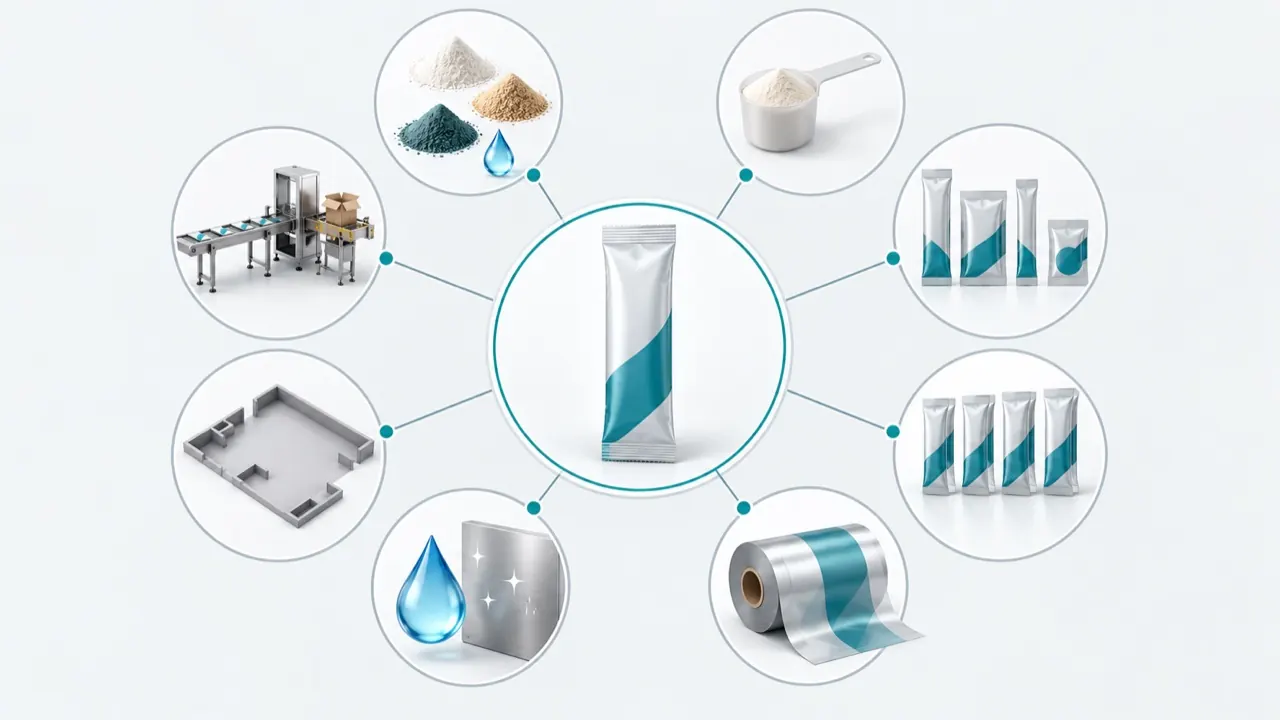
Illustration: the decision factors in the order you usually settle them. Each answer limits the next.
How does product type and behaviour affect the choice?
The product name tells you little. Behaviour decides the dosing system. For powders, ask whether it is fine or coarse, free-flowing or cohesive, dusty, and sensitive to moisture. If your powder cakes in an open jar overnight, plan for that in the hopper too. For liquids and pastes, ask about viscosity, particles, temperature, dripping and foaming. For granules, ask about size, shape and bulk density.
| Product behaviour | Dosing approach to evaluate | What to test |
|---|---|---|
| Fine, cohesive or dusty powder | Auger dosing | Fill consistency, dust in the seal, bridging in the hopper |
| Free-flowing powder or granules | Volumetric cup | Variation with bulk density changes, fines from handling |
| Mixed or fragile granules | Cup, or weighing if tolerance is tight | Fill spread, breakage, segregation |
| Thin liquid | Piston or similar pump | Dripping after the fill, foaming, seal contamination |
| Thick paste or sauce | Pump suited to viscosity | Stringing, particles through the nozzle, residue in the seal |
| Product with particles in liquid | Pump with suitable passages | Particle damage, clogging, uneven particle count per sachet |
Details are on the pages for powder sachet packing machines, liquid and paste machines and granule machines. Treat the table as a list of what to ask a supplier to test, not a prescription.
How do fill amount and sachet format fit together?
Fill amount sets the volume the sachet has to hold, and the sachet needs room for that volume plus the seal area. Push a large fill into a narrow sachet and the product ends up in the seal. Settle the sachet width first, because the lane count follows from it. Then decide the format: 3-side or 4-side seal, and any tear notch, hang hole or printed film. For the sealed shapes, see 4-side seal sachet machines. If you are unsure sachets are the right pack at all, read sachet versus stick pack.
State the fill by weight or volume and say what tolerance matters. A tolerance with no test method is not a requirement yet.
How do I work out the output I need?
Output is limited by cycles per minute and by the number of lanes. When each lane makes one sachet per cycle:
theoretical output (sachets/min) = lanes × cycles per minute
Arithmetic example only, not a performance claim: 6 lanes × 50 cycles/min = 300 sachets/min theoretical.
You cannot sell theoretical output. Verified output is the rate of acceptable sachets under stated conditions, with your product, film, fill and sachet. Product behaviour, film, sachet size and downstream equipment can all pull it down, so ask for the conditions behind any figure. Multi-lane machines covers what limits the lane count.
How does film affect the decision?
The film has to protect the product, seal reliably on the machine and run without distortion. Check the sealing layer, barrier needs, stiffness, thickness, printing and registration marks, and roll dimensions. Food-contact suitability has to be confirmed for the specific material and use. One film will not run on every machine, so try yours.
What about cleaning and changeover?
If you change product or sachet size often, quick cleaning and changeover matter as much as top speed. Ask which parts touch the product, how they come off and how long that takes. Sticky or allergen-bearing products make this harder. Ask for contact-material information on each machine rather than assuming it.
What do floor space and utilities add?
Check the footprint, access for cleaning and maintenance, power, compressed air, and room conditions such as humidity and temperature. A machine that fits on the floor plan but cannot be opened for cleaning is a poor fit. Guarding and safe access belong in the layout from the start.
What must connect after the sachet?
Sachets may go to a counter, strip cutter, cartoner or case packer, and may need coding or inspection. Downstream equipment is often the real limit on output, so define it before you set output targets.
Who will run the machine?
Think about operator skill, shift patterns and who maintains the machine. A machine that needs frequent fine adjustment suits experienced operators better than a rotating team. Ask what training and spare parts the quotation covers.

Illustration: the information a supplier needs before it can recommend a configuration.
What information should I send a supplier?
- Product description and behaviour, with a sample if possible.
- Fill amount by weight or volume, and the tolerance you expect with how it is measured.
- Sachet format, size and any features such as a notch or hang hole.
- Output target, working hours and what you need downstream.
- Film structure and supplier, or the film specification.
- Cleaning, product changes and hygiene requirements.
- Available space, power, air and room conditions.
- Operator experience and maintenance resources.
- Your market and any packaging requirements for the product.
Which red flags should I watch for in proposals?
- A speed with no product, film, fill, sachet size or lane count behind it. You cannot compare it with anything.
- An accuracy figure with no test method. A plus-or-minus number needs a sample size, a product and a way of measuring.
- No information on which materials touch the product, or how that is documented.
- One configuration offered for every product, when different products need different dosing.
- No trial offered for a sticky, foaming or particulate product.
- Prices compared across different scopes. What affects sachet packaging machine price helps you compare like with like.
When should I run a trial?
Run one when the product is unusual, the film is new, the tolerance is tight or the output target is demanding. A product and film trial shows how your product fills, seals and discharges, and gives the quotation something real to stand on.
Questions about choosing a sachet machine
Which sachet packaging machine is best?
There is no single best. The right one depends on product, fill, format, output and film. Define the requirement with the decision path, then compare proposals against it.
How do I know the output a supplier states is real?
Ask for the conditions: product, film, fill, sachet size, lanes and cycles. Then compare theoretical output with verified output.
Do I need to decide the film before the machine?
Decide the format first, then check the film on the machine. Each affects the other.
What should I do if my product is sticky or foams?
Say so early and ask for a trial. Both behaviours change dosing and sealing.
Not sure which configuration fits your product?
Send your product and pack details, or ask for a trial on your own material before you decide.