

Brown Sugar Sachet Packaging Machines: Anti-Caking Dosing and Barrier Film Selection
Published by the LINEVO sachet equipment team. Technical questions and corrections
Compare brown sugar sachet packaging machines: why molasses-coated sugar bridges cup fillers, agitated servo-auger dosing, and low-MVTR barrier films.
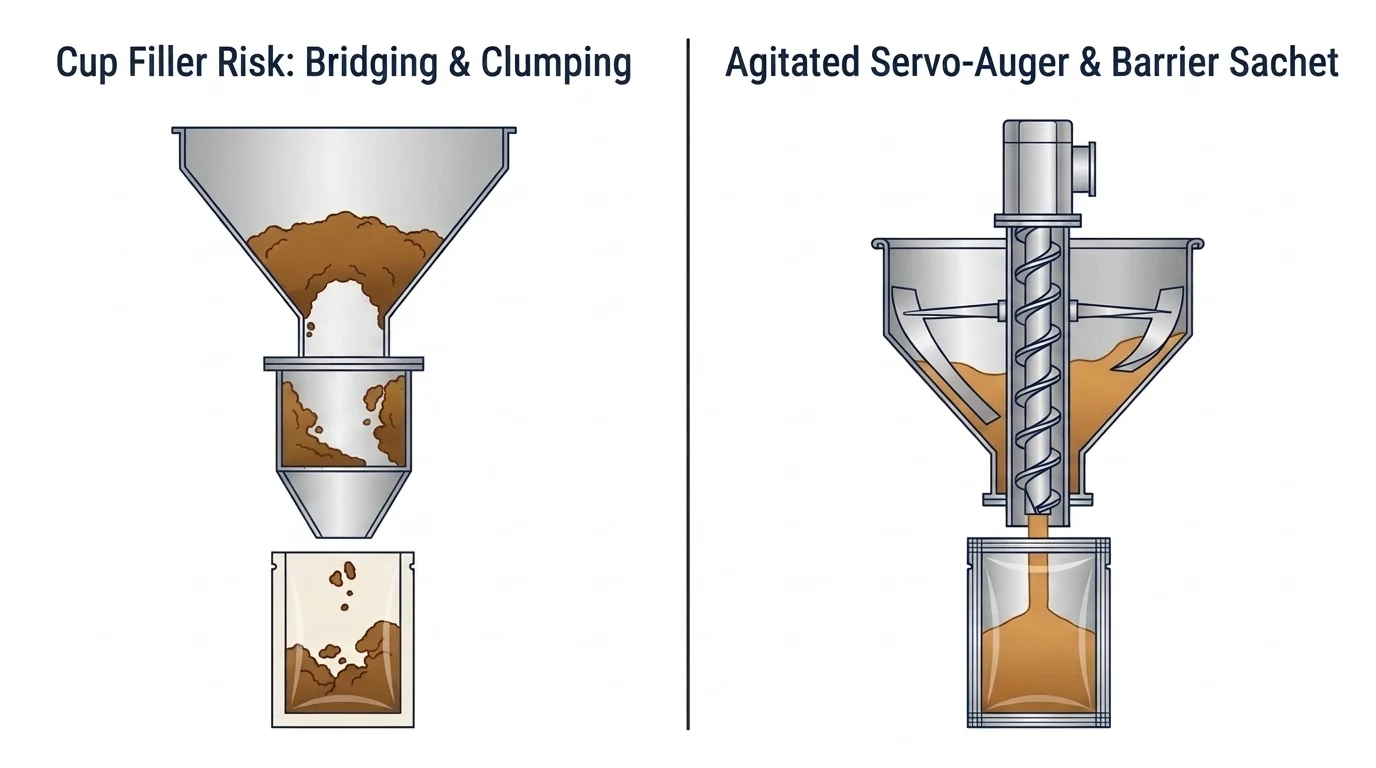
Brown sugar sachet packaging machines must match dosing hardware and barrier film to the sugar grade rather than copying a white-sugar setup. Centrifuged dry crystal sugars such as turbinado or demerara can run on a granular sugar packing machine, whereas moist, molasses-coated soft brown sugar requires agitated servo-auger dosing and low-MVTR barrier laminates to prevent hopper bridging and brick-hard caking.
Because commercial brown sugar carries hygroscopic molasses on finer crystals than granulated white sugar, moisture shifts drive both clumping inside the hopper and solid recrystallization inside finished packets. For an overview of general crystal-sugar lines, see our sugar sachet and packet packing machines page, or compare dosing mechanisms in our auger versus cup filling sachets guide.
Why does sticky brown sugar clump and bridge differently from free-flowing white sugar on sachet machines?
Sticky brown sugar clumps and bridges differently from white granulated sugar because it consists of finer sucrose crystals coated with 3.5% to 6.5% molasses by volume—up to 10% by total weight—which is hygroscopic and naturally moist. Surface moisture dissolves soluble sugar into capillary liquid bridges that adhere particles together, and evaporation later recrystallizes those bridges into permanent solid lumps.
As documented in the Wikipedia reference on brown sugar, Codex Alimentarius requires brown sugar to contain at least 88% sucrose plus invert sugar, either as unrefined or partially refined crystals with residual molasses or as refined white sugar with molasses added back. Adding molasses makes the sugar more hygroscopic than plain white sugar and leaves the product naturally moist and soft, while particle size is variable and generally finer than granulated white sugar—with industrial caster-based grades around 0.35 mm.
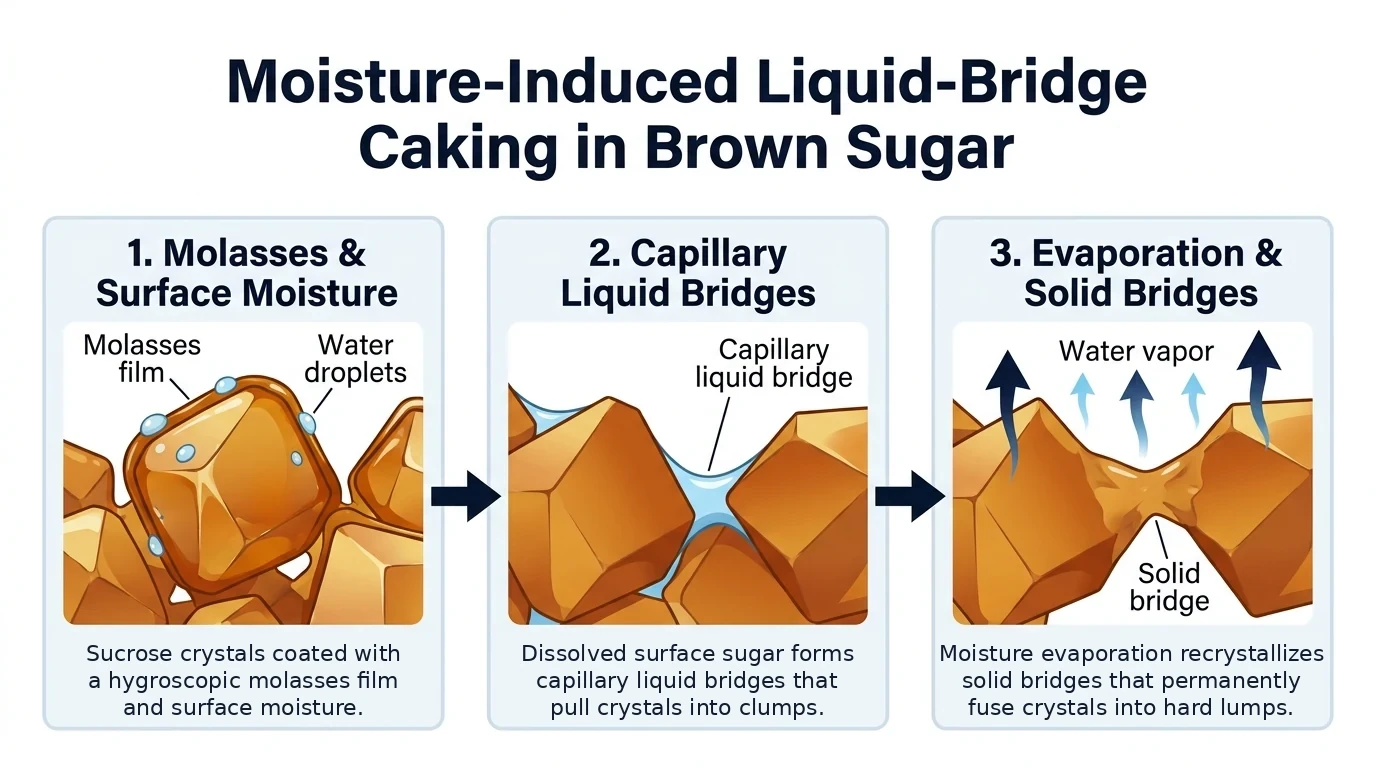
Hygroscopic molasses keeps brown sugar surfaces moist enough to form capillary liquid bridges; subsequent evaporation recrystallizes dissolved sugar into irreversible solid bridges.
Amorphous caking and liquid-bridge caking inside hoppers and packets
Peer-reviewed food powder research indexed on PMC / NIH explicitly lists brown sugar among powders particularly prone to solidification during storage and identifies two mechanisms driven by elevated temperature and humidity:
- Amorphous caking: When ambient heat or moisture pushes a powder past its glass transition temperature, it transitions from a rigid glassy state to a mobile rubbery state. Viscosity drops sharply while molecular diffusivity increases, making particle surfaces sticky so they adhere into lumps.
- Moisture-induced liquid-bridge caking: In any powder with soluble components, surface moisture dissolves soluble material at inter-particle contact points to form liquid bridges. These liquid bridges exert strong cohesive capillary forces that pull crystals together; when moisture later evaporates, the dissolved sugar recrystallizes into solid bridges that permanently bind particles, causing irreversible caking.
Because amorphous caking and liquid-bridge caking can act independently or synergistically, controlling temperature and humidity around the hopper and finished sachet is essential. Excessively fine particle size also exacerbates inter-particle agglomeration and degrades handling.
| Sugar grade | Molasses and sucrose profile | Crystal and moisture state | Flow behavior on a sugar packet machine |
|---|---|---|---|
| Commercial light brown sugar | 3.5% molasses by volume; up to 10% by weight across commercial grades | Naturally moist, soft, finer than granulated white sugar | Cohesive; prone to liquid-bridge clumping and hopper arching |
| Commercial dark brown sugar | 6.5% molasses by volume; up to 10% by weight across commercial grades | Higher hygroscopic molasses film; naturally moist and soft | High stickiness; builds up on unagitated chutes and cup walls |
| Industrial caster-based brown sugar | Molasses-coated sucrose (at least 88% sucrose plus invert sugar) | Fine crystals around 0.35 mm; may be processed to improve flowability | Fine particles increase inter-particle agglomeration under humidity swings |
| Turbinado and demerara | Centrifuged crystal grades; demerara is 97–99% pure sucrose | Large golden (turbinado) or amber (demerara) crystals with part of the molasses removed | Firmer crystal structure; closer to free-flowing granules |
| Muscovado and traditional dark sugars | Minimally centrifuged or uncentrifuged; retains high residual molasses | Darkest natural brown sugar; high surface tack | Strongest cohesive sticking; unsuitable for gravity cup fillers |
Takeaway: Separate centrifuged dry crystal grades from moist molasses-coated soft brown sugar before choosing a dosing head, because liquid-bridge cohesion changes hopper flow completely.
How does bulk density shift between packed and unpacked brown sugar inside a dosing hopper?
Bulk density shifts between packed and unpacked brown sugar inside a dosing hopper because finer molasses-coated crystals (around 0.35 mm in caster-based grades) form cohesive capillary liquid bridges that compress under hopper weight or loosen when agitated. Ambient temperature and humidity swings trigger sticky transitions, so volumetric dosers require stable feed density.
In a sachet machine for sugar, packing state changes the actual mass delivered per fixed volume whenever particles agglomerate or compact at the hopper throat. When brown sugar shifts toward a sticky rubbery state or develops capillary liquid bridges between particles, pockets of compacted sugar alternate with air voids left behind by bridging arches. Excessively fine particles further worsen inter-particle agglomeration, making unconditioned gravity discharge inconsistent.
Controlling ambient temperature and humidity around the hopper limits both amorphous softening and moisture-induced bridging, while mechanical agitation keeps the sugar bed at a repeatable density entering the metering zone. Final dose weight, machine output, and lane configuration still require verification with your actual sugar lot, target dose, and film.
Takeaway: Stabilize room temperature, humidity, and hopper agitation so the metering zone sees uniform packed density rather than alternating clumps and voids.
When can dry crystal grades run on a granular sugar packing machine versus agitated auger dosing?
Centrifuged dry crystal grades such as turbinado and demerara (97–99% pure sucrose) can be evaluated on a granular sugar packing machine like our LV-350X four-side-seal granule configuration (1 to 50 g fill range). Soft molasses-coated brown sugar and minimally centrifuged muscovado require agitated servo-auger dosing using an independent servo auger per lane.
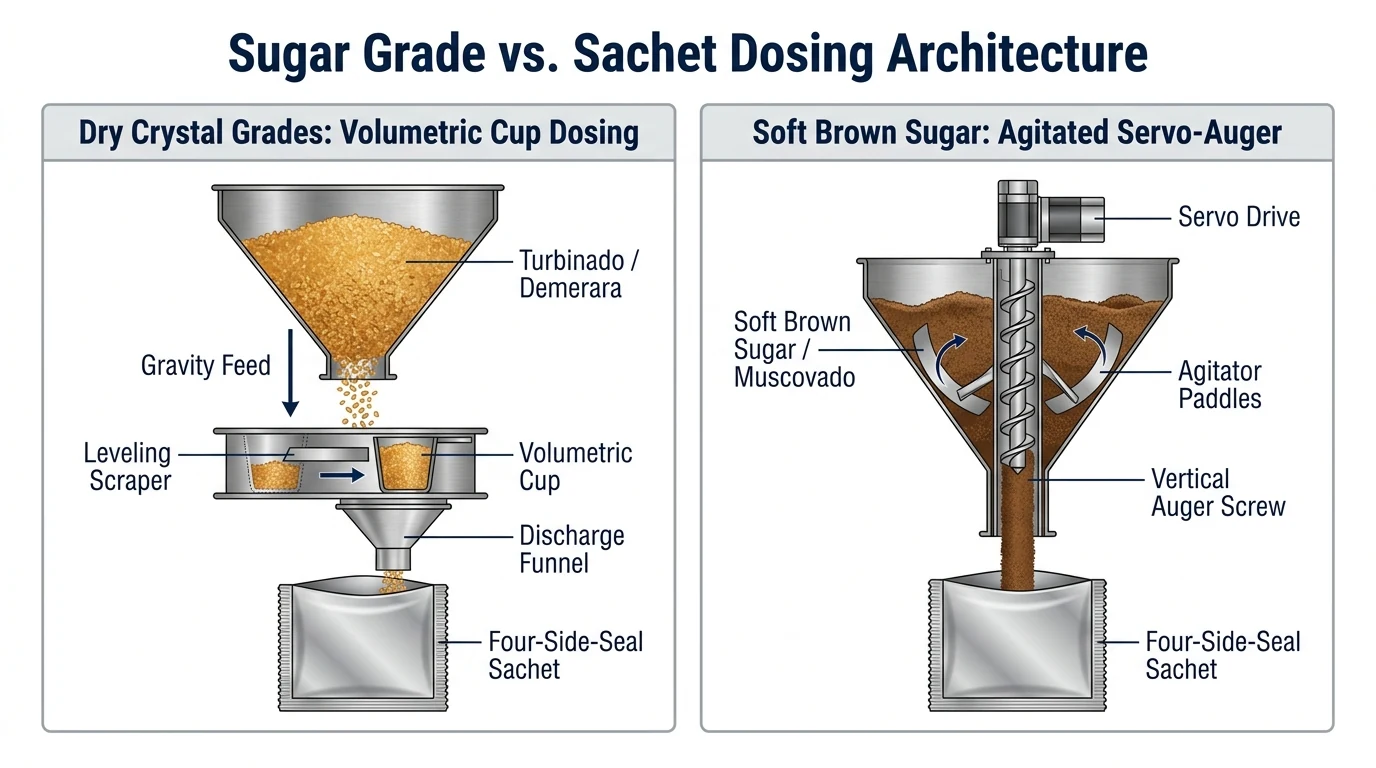
Free-flowing centrifuged crystal sugars can be evaluated on volumetric granule dosing, whereas cohesive soft brown sugar and muscovado require hopper agitation paired with an independent servo auger per lane.
Matching our machine configurations to crystal versus soft brown sugar
Our LV-350X four-side-seal granule sachet machine handles instant drink granules, herbal granules, sugar, and seasoning packets across a 1 to 50 g fill range, 50 to 180 mm sachet length, and 30 to 80 mm sachet width per lane. That architecture suits dry, free-flowing crystal sugars that fill and release cleanly by gravity.
For soft commercial brown sugar (3.5% to 6.5% molasses by volume) or minimally centrifuged muscovado, our multi-lane powder sachet machine uses an independent servo auger per lane with four-side sealing. Output, sachet dimensions, and utilities for the multi-lane servo-auger configuration are specified with the selected product, dose, film, and lane configuration rather than assumed from a white-sugar baseline.
| Sugar category | Typical grades | Recommended dosing route | Published catalog baseline |
|---|---|---|---|
| Centrifuged dry crystal sugar | Turbinado (large golden crystals), demerara (97–99% pure sucrose) | Evaluate volumetric granule dosing on a four-side-seal sachet machine | LV-350X: 1 to 50 g fill range, 50 to 180 mm length, 30 to 80 mm width per lane |
| Soft commercial brown sugar | Light (3.5% molasses by volume) and dark (6.5% molasses by volume; up to 10% by weight) | Agitated hopper feeding an independent servo auger per lane | Multi-lane powder sachet machine: independent servo auger per lane, four-side seal; output and dimensions specified by product, dose, film, and lane layout |
| Minimally centrifuged dark sugar | Muscovado, panela, piloncillo, chancaca, jaggery | Agitated hopper feeding positive servo-auger metering with trial validation | Multi-lane powder sachet machine: configured and verified on actual sugar lot, dose, and film |
Takeaway: Use the LV-350X granule route only for centrifuged, free-flowing crystal sugars; specify an independent servo auger per lane for moist, molasses-coated soft brown sugar.
What anti-bridging agitation and cut-off features belong on a dedicated brown sugar packing machine?
A dedicated brown sugar packing machine needs continuous hopper agitation to break cohesive capillary liquid bridges and positive screw metering—such as an independent servo auger per lane—to replace gravity drop into a fixed cup. Pairing controlled auger discharge with temperature and humidity management keeps feed density steady and protects the four-side heat-seal zone from sticky sugar buildup.
Because liquid bridges exert strong cohesive capillary forces between molasses-coated particles and fine crystals exacerbate agglomeration, passive gravity hoppers stall quickly on soft brown sugar. Mechanical agitation inside the hopper disrupts arching above the screw intake so each lane draws a consistent charge.
An independent servo auger per lane then meters the cohesive sugar positively into each formed sachet pocket rather than relying on sticky crystals to slide out of a volumetric cup. Before finalizing tooling, confirm discharge cleanliness and seal-area clearance during a live trial on your exact sugar lot, target dose, and packaging film, as machine output, dimensions, and utilities depend on that verified combination.
Takeaway: Specify hopper agitation plus an independent servo auger per lane so cohesive brown sugar is positively metered instead of relying on gravity release.
Can one multifunctional sugar sachet line switch between white sugar granules and soft brown sugar?
Switching one sugar sachet line between free-flowing white sugar granules and sticky soft brown sugar requires matching the dosing head to both materials rather than running soft brown sugar through a cup filler. Soft brown sugar carries 3.5% to 6.5% molasses by volume (up to 10% by weight) on finer crystals that bridge.
We separate our four-side-seal granule sachet configuration (LV-350X, 1 to 50 g fill range) from our multi-lane powder sachet configuration (independent servo auger per lane) because free-flowing granules and cohesive powders behave differently inside the hopper and metering zone. If a single foodservice producer needs both SKUs on one packaging line, the dosing architecture and changeover procedure must be validated with actual samples of both sugars, their target doses, and the chosen film roll. Review four-side-seal machine options on our four-side-seal sachet machines page.
Takeaway: Do not assume a white-sugar granule cup filler can run soft brown sugar; validate dosing-head compatibility and changeover cleaning on both sugar lots before ordering.
How do foodservice brown sugar sachets stop soft sugar from hardening into a solid brick, and what barrier film MVTR is needed?
Foodservice brown sugar sachets stop soft sugar from hardening into a brick by holding moisture equilibrium inside a low-MVTR barrier laminate with sound heat seals. Under FDA water activity principles, brown sugar loses moisture to dry air when ambient vapor pressure sits below product vapor pressure, recrystallizing surface sugar into irreversible solid bridges.
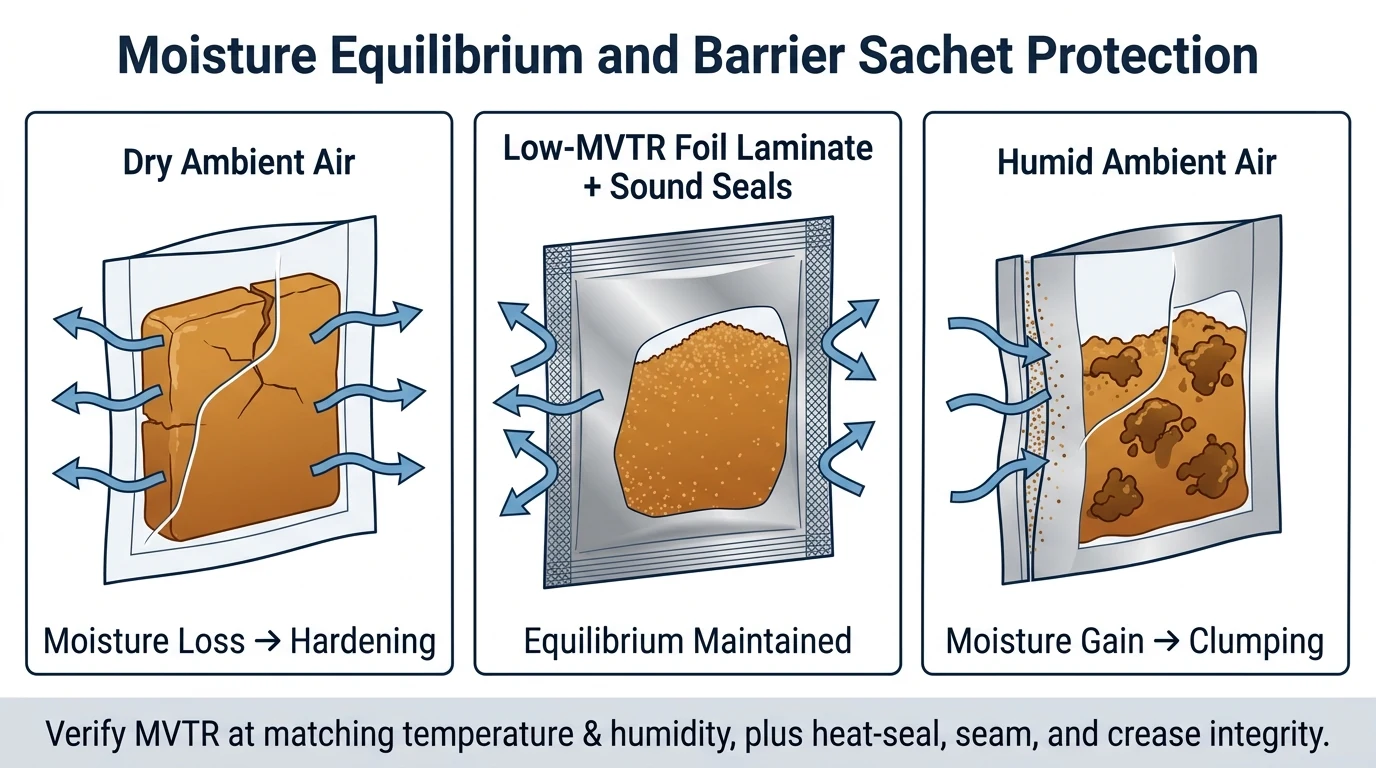
Brown sugar requires a two-way moisture barrier: losing moisture to dry air hardens the sachet into a brick, while absorbing moisture from humid air forms sticky clumps.
Water activity equilibrium and why brown sugar hardens or clumps
The U.S. FDA Inspection Technical Guide on water activity (aw) in foods defines water activity (aw) as the ratio between the equilibrium vapor pressure of the food and the vapor pressure of distilled water under identical conditions. Water activity increases with temperature and equals equilibrium relative humidity divided by 100 (aw = ERH / 100), where ERH is expressed as a percentage.
Sugar solutions lower vapor pressure relative to pure water, and a food releases water vapor to surrounding air only when ambient vapor pressure sits below the product's vapor pressure. At moisture equilibrium, the vapor pressure of the food matches the surrounding air, so water is neither given off nor absorbed. Even a 0.1 C temperature difference between product and headspace air at 25 C shifts water activity readings by roughly 0.005, underscoring why steady temperature control matters during both packing and shelf-life testing.
Comparing barrier film MVTR and heat-seal integrity
As explained in the Wikipedia reference on moisture vapor transmission rate (MVTR), MVTR (also called WVTR) measures water vapor passage through a barrier material in the standard international unit g/m2/day, allowing moisture-sensitive foods to hold quality, safety, and shelf life.
| Film and seal checkpoint | Governing engineering behavior | What to verify before approving film stock |
|---|---|---|
| Flat-sheet MVTR unit and laminate class | Standard unit is g/m2/day; aluminium foil laminates can reach as low as 0.001 g/m2/day | Request supplier MVTR datasheets in g/m2/day for your exact laminate structure |
| Test temperature and humidity conditions | Permeability can rise by up to 10% per °C, so 37°C MVTR can be 4 times higher than 23°C MVTR | Compare candidate films only at identical test temperature, humidity gradient, and thickness |
| Barrier thickness and temperature differential | MVTR decreases with greater barrier thickness and increases with larger temperature differentials | Match laminate gauge to expected storage and distribution temperature swings |
| Heat seals, seams, and creases | Seams, creases, access points, and heat seals are critical to end-use moisture performance | Inspect four-side seals for trapped brown sugar fines and verify seam integrity after forming |
Because MVTR values without stated temperature, humidity gradient, and sample thickness are almost meaningless, compare film quotes under identical test conditions. Even an aluminium foil laminate rated down to 0.001 g/m2/day loses moisture protection if brown sugar crystals contaminate the heat seal or crease the foil layer.
Takeaway: Specify a low-MVTR barrier laminate compared at matching temperature, humidity gradient, and thickness, and verify clean four-side heat seals so brown sugar neither dries into a brick nor absorbs humid air.
What trial checklist confirms dosing head, hopper setup, and barrier film before ordering?
Sending your actual brown sugar lot, target sachet weight, ambient plant conditions, and barrier film roll to a live trial confirms whether you need volumetric granule dosing or an independent servo auger per lane before locking machine specifications. We specify output, sachet dimensions, and utilities per selected product, dose, film, and lane configuration.
Before booking a product and film trial or requesting a configuration review on our request-quote page, prepare these six project inputs:
- Sugar grade and molasses content: Specify whether you pack centrifuged crystals (turbinado or demerara), commercial light or dark soft brown sugar (3.5% to 6.5% molasses by volume), or minimally centrifuged muscovado.
- Crystal size and flow treatment: Note approximate crystal size (for example, industrial caster-based grades around 0.35 mm) and whether the sugar has been processed for industrial flowability.
- Target fill weight and sachet dimensions: Provide target grams per packet and desired four-side-seal width and length (for reference, LV-350X covers 1 to 50 g, 50 to 180 mm length, and 30 to 80 mm width per lane).
- Packing room temperature and humidity: Share typical room temperature and humidity ranges, because heat and humidity swings drive amorphous softening and liquid-bridge caking.
- Barrier laminate datasheet: Include flat-sheet MVTR in g/m2/day along with the test temperature, humidity gradient, and film thickness used to measure it.
- Multi-SKU changeover needs: State whether the same line must also pack free-flowing white granulated sugar so dosing-head and sanitation requirements are scoped upfront.
Frequently Asked Questions About Brown Sugar Sachet Packaging Machines
Why does soft brown sugar bridge in a white-sugar cup filler?
Soft brown sugar carries 3.5% to 6.5% molasses by volume (up to 10% by total weight) on finer crystals than granulated white sugar. Because molasses is hygroscopic, surface moisture dissolves soluble sugar into capillary liquid bridges that exert strong cohesive forces, making particles cling to cup walls and arch across unagitated hoppers.
Can turbinado or demerara sugar run on a granular sugar packing machine?
Centrifuged crystal grades such as turbinado (large golden crystals with part of the molasses removed) and demerara (97–99% pure sucrose) retain a firmer crystalline structure than soft brown sugar. They can be evaluated on a four-side-seal granule sachet machine such as our LV-350X (1 to 50 g fill range), subject to a trial on the actual lot.
Why do foodservice brown sugar sachets harden into a solid brick?
Under FDA water activity principles, brown sugar releases water vapor whenever ambient vapor pressure is lower than the sugar's equilibrium vapor pressure. As moisture evaporates through a permeable film or weak seal, dissolved surface sugar recrystallizes into solid bridges that permanently fuse crystals into an irreversible hard lump.
How much does temperature affect barrier film MVTR for brown sugar packets?
Water vapor permeability can increase by up to 10% per °C, meaning MVTR measured at 37°C can be four times higher than MVTR measured at 23°C. Compare barrier laminates at identical test temperature, humidity gradient, and thickness.
Is a low-MVTR aluminium foil laminate enough on its own to keep brown sugar soft?
No. While aluminium foil laminates can achieve MVTR values as low as 0.001 g/m2/day, finished sachet moisture protection also depends critically on heat seals, seams, and creases. Clean discharge away from the sealing jaws is essential so sticky brown sugar particles do not compromise seal integrity.
Sources
- PMC / NIH, Rehydration and Caking Mechanisms of Instant Food Powders
- U.S. Food and Drug Administration (FDA), Water Activity (aw) in Foods — Inspection Technical Guide
- Wikipedia, Brown sugar
- Wikipedia, Moisture vapor transmission rate