

Multi-Lane Sachet Counting, Collating & Automatic Cartoning Line Integration Guide
Published by the LINEVO sachet equipment team. Technical questions and corrections
Integrate a sachet counting machine and sachet cartoning machine behind a multi-lane bagger: discharge chutes, collating, carton loading, and jam prevention.
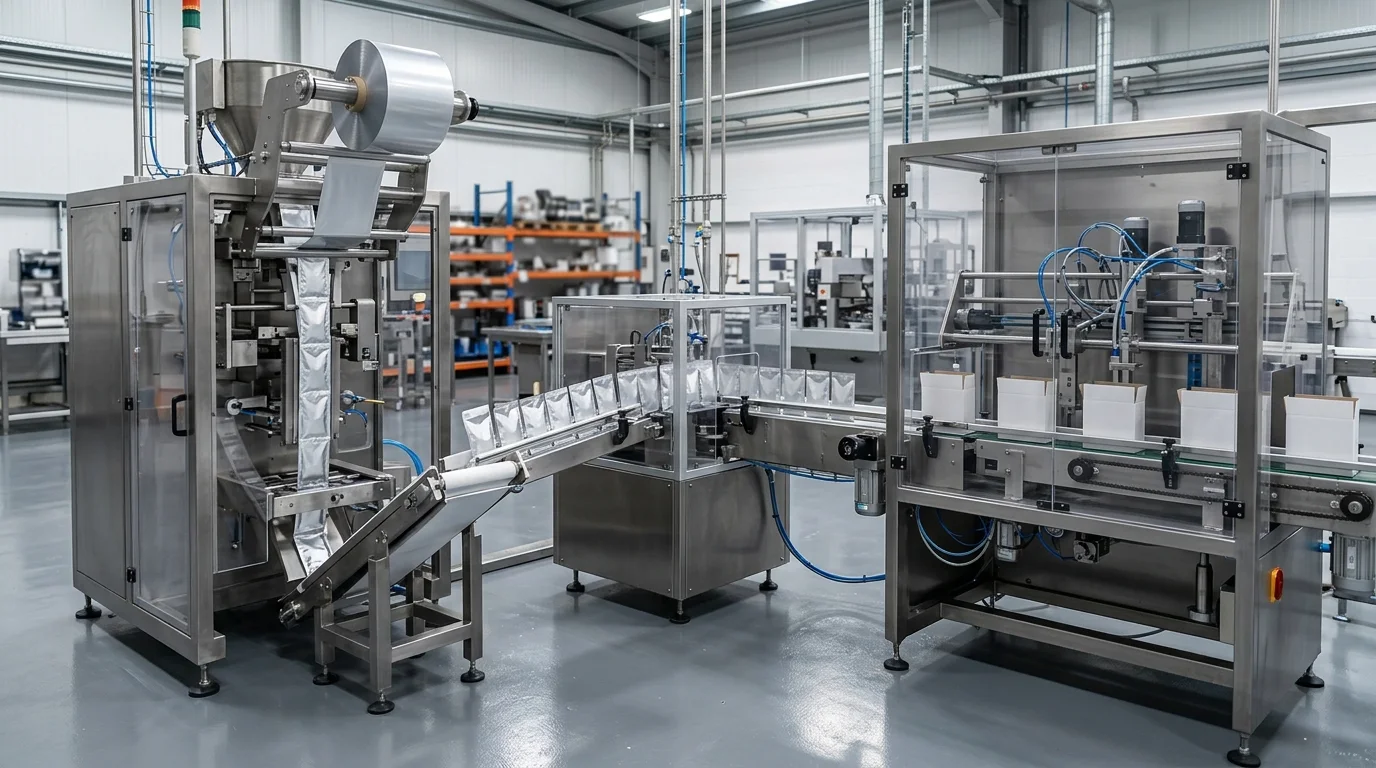
Connecting a primary multi-lane bagger to a sachet counting machine and a sachet cartoning machine requires matching the discharge format, total cycle output, collating orientation, and carton loading geometry across the entire packaging line. Use this secondary-packaging integration guide alongside our multi-lane sachet packaging machines overview, our sachet packaging machine buying guides, and our selection guide for new sachet machines to define the handoff between primary forming and downstream cartoning.
| Integration interface | Engineering parameters to verify | Pre-quotation decision |
|---|---|---|
| Primary cutter and chute exit | Cut singles vs perforated strips; lane pitch (W = lanes × strip + trim); chute angle | Single-pack cut vs continuous strip transfer |
| Sachet counting and collating | Combined multi-lane speed (lanes × cycles/min); sensor type; flat vs on-edge grouping | Counter capacity above peak multi-lane throughput |
| Cartoner loading architecture | Pre-glued side-load bucket pusher vs flat-blank top-load pick-and-place | Side-loading horizontal cartoner vs top-loading former/closer |
| Pouch profile and static control | Chute anti-static conditioning, shaping rollers, filled-pouch bulge, and ASTM F88/D3078 seal checks | Pouch flattening and carton throat clearance |
Match multi-lane cutter discharge and total output to the counter
Start the downstream audit at the primary cutting and discharge station, and cross-reference our how sachet packaging machines work guide and our sachet sizes guide when reviewing web slitting and cut modes.
When each active lane makes one sachet per cycle, theoretical output (sachets/min) = active lanes × cycles/min, using the cycle rate established for the selected product, portion and film.
Accepted output (sachets/min) = accepted sachets ÷ elapsed run time (min), including the agreed stoppages and reject counts.
Cycle duration in milliseconds = 60,000 / cycles per minute, and sealing contact occupies only part of that sequence.
In hypothetical arithmetic only, four active lanes at an assumed 30 cycles/min correspond to 120 gross reference packs/min and a 2,000 ms cycle.
For identical slit strips, master-web width equals lane count × lane-strip width + total edge trim, and a finished sachet face width does not define the unfolded strip width.
At the cutting station, a knife cuts between sachets, or perforation blades leave a tear line so the sachets stay in a strip, and a tear notch may be cut as well.
A multi-lane machine puts out sachets as several parallel strips or as cut singles, and the line after it has to match.
Strips and singles count and stack differently, so buyers must decide early which format they want and check that the counter can follow total speed, not per-lane speed.
Finished sachets leave by chute or conveyor, where a counter may group them into strips or batches and a separate machine may carton them or pack them into cases.
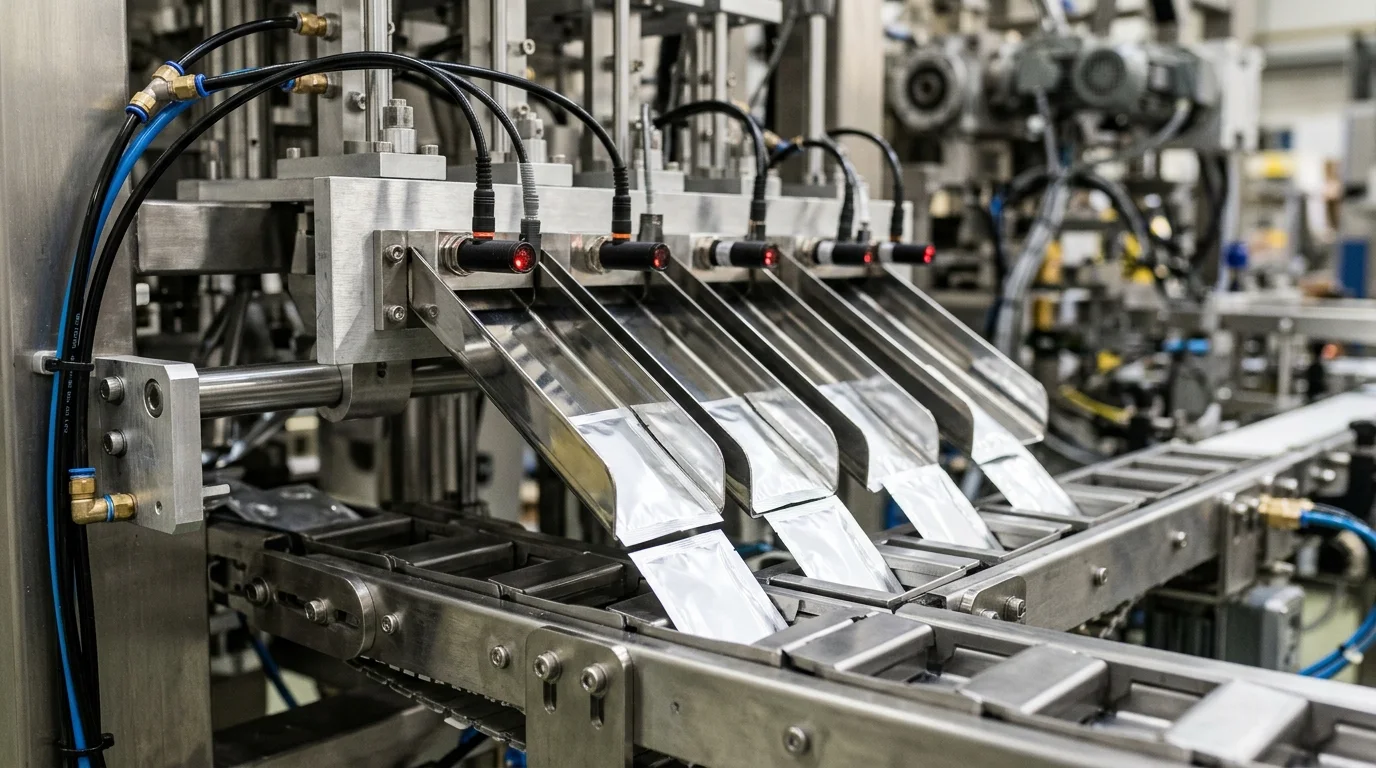
Compare primary multi-lane exit and inspection configurations
Review the published exit and inspection options across multi-lane vertical sachet platforms before specifying the intermediate transfer conveyor.
The Mespack ML-Series is offered in two different models, the ML1000 and ML1200, and both have between 4 and 14 lanes available.
Mespack ML-Series multi-lane sachet machines offer exit section systems comprising a ramp, conveyor belt or pick and place.
The Marchesini Group MS series vertical sachet machine features a stacking and counting unit with cartoner connection.
The Marchesini Group MS series vertical sachet machine lists an output speed of up to 75 cycles/min.
Marchesini SEA Vision inspection systems are installed directly on the sealing machines and analyze in real time 100% of the products (not statistic control) also at high speeds, performing one or more controls simultaneously.
Specify photoelectric counting, unscrambling and collating conveyors
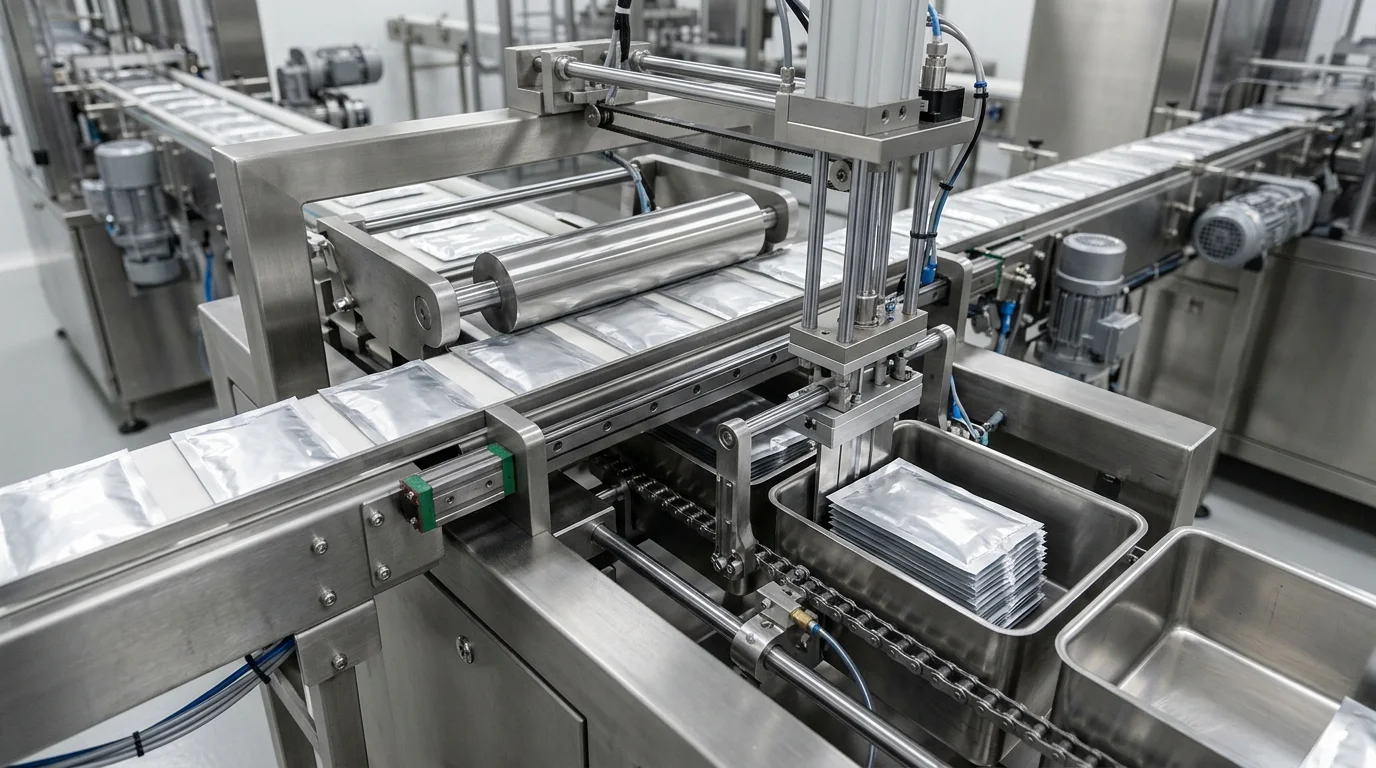
Compare lane-indexed counting and stacking units against bulk-belt unscrambling and sorting systems based on how sachets leave the primary bagger.
In Universal Pack sachet-in-carton lines, the primary packaging machine for sachets feeds a patented, customizable counting and stacking unit that transfers the sachets to the secondary packaging machine.
Upon request, Universal Pack counting and stacking units can be provided with a dedicated patented system to turn the sachets on edge, after which each row of sachets is transferred into the pockets.
Universal Pack Gamma Flexi sachet machines can dose from 0.1 to 200 g or ml of product in a shaped sachet, with dimensions that vary depending on marketing goals, product characteristics and production requirements.
Universal Pack sachet-to-carton lines allow placing from one to more than 100 sachets in the same carton using patented counting units for packages to be picked and placed into cartons.
In the Universal Pack Synthesis Alfa FS pharmaceutical configuration, the counting and stacking unit is combined with a delta robot system, in which the insertion of the stick packs into the carton is carried out by robotic arms.
On the Rich Packing bag sorting machine, stick packs enter through a matrix-based and multi-stage powered feeding system, and the rollers separate stacked packs into a single-file flow before counting.
The HonorPack stick pack and sachet sorting and counting machine can configure 16 sets of separation modules to realize a stacked pouch detection and separation function.
On the Rich Packing bag sorting machine, to coordinate the movement of rollers and separate stick packs precisely, 11 servo motors are connected.
On the Rich Packing bag sorting machine, for example, if each carton requires 10 stick packs, the system can automatically count and organize the packs into groups of 10 before feeding them to the cartoner machine through a conveyor.
On the Rich Packing bag sorting and counting machine, the counting error rate is below 0.009%, helping maintain stable quantities in each box.
Select horizontal pre-glued cartoners versus flat-blank carton formers
Match the secondary sachet cartoning machine to your carton blank format, loading direction, and line synchronization architecture, and review our sachet packaging machine price and scope guide when comparing standalone primary baggers against complete lines.
Horizontal cartoners work with pre-glued cartons, where the folded carton is opened and conveyed to the loading station where the sachets or stick packs in the infeed chain are loaded into the cartons sideways.
On Universal Pack pre-glued carton lines, once the counting and stacking unit transfers the sachets to the cartoning station, they are inserted from the side of the carton.
Universal Pack pre-glued cartoning solutions can be equipped with accessories such as dynamic or static checkweighers, leaflet insertion systems with presence check, and tamper-evident labeling machines.
Forming and closing machines work with pre-cut flat blanks, where the pre-cut carton is formed with the aid of a mold, fixed with some glue, and moved to the loading station where the sachets or stick packs are loaded from above.
Universal Pack flat-blank cartoning solutions include two separate units—one dedicated to carton forming and one dedicated to carton closing with hot-melt glue—and the system is equipped with a top-loading configuration.
The carton or case packer needs the right feed rate and sachet orientation, and if metal detection or vision inspection is used, it must handle the full rate too.
A filler that outruns the cartoner only builds a queue, so the line must be sized as a whole.
By defining common states for equipment and a common definition of communications, PackML makes it easier for different pieces of equipment across a packaging line to share information.
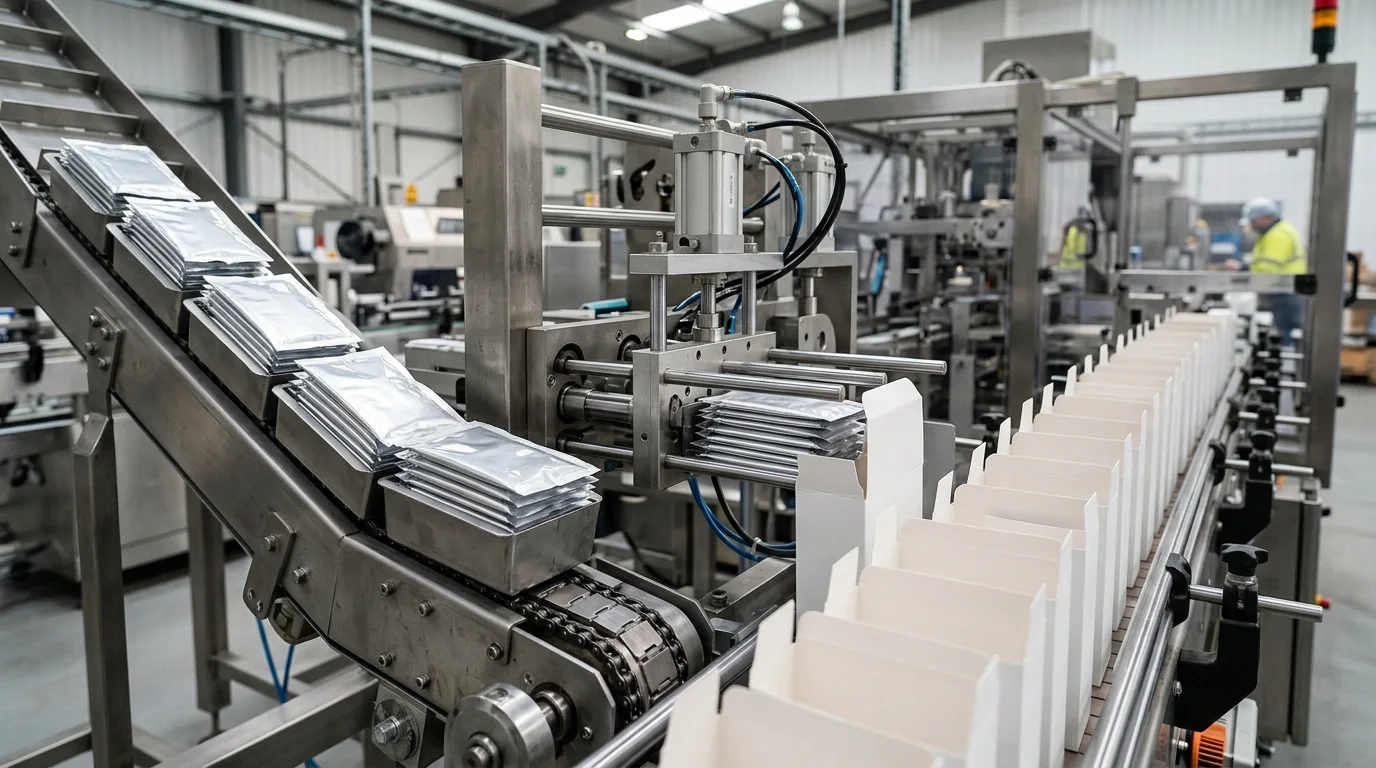
Prevent static clinging on chutes and bulged-stack jams at the cartoner
Address static clinging on chutes, and address filled-sachet thickness growth before finalizing cartoner throat dimensions, and use our sachet sealing problems checklist when qualifying seal integrity under mechanical handling loads.
At the discharge and counting end, jammed chutes, miscounts and static that makes light sachets cling are the usual problems.
There is no formula that turns a volume straight into a flat sachet size, because a filled sachet bulges.
The HonorPack stick pack and sachet sorting and counting machine can be equipped with 2 sets of shaping rollers to ensure even distribution of materials inside the pouch.
ASTM F88 addresses seal strength under the chosen technique, while ASTM D3078 addresses gross leaks in packages containing headspace gas.
ASTM F2029 concerns laboratory heat-seal preparation and ASTM F88/F88M concerns seal-strength measurement.
Compare our primary LINEVO multi-lane sachet configurations
Before specifying a downstream counter or cartoner, establish the primary multi-lane bagger baseline across our four-side-seal sachet machines, liquid and paste sachet machines, powder sachet machines, and granule sachet machines.
In our LINEVO sauce sachet lineup, we configure 2–4, 3–10, and 4–16 lanes for the LV-500SY, LV-700SY, and LV-980SY respectively, selecting the lane count per project.
Our LINEVO sauce sachet series is a multi-lane four-side-seal sachet machine with rotary-valve piston dosing for ketchup and viscous sauces (5–100 ml across 500/700/980 mm web widths).
Our LINEVO sauce sachet series provides a bag length range of 45–160 mm across all three models, with the forming and cutting configuration confirmed in the quotation.
Our LINEVO sauce sachet series provides a bag width range of 50–125 mm across all three models, with the forming tooling confirmed in the quotation.
Our LINEVO sauce sachet series runs at a packing speed of 20–40 cuts/min.
On our LINEVO granule sachet configuration, four lanes form, fill and seal in one cycle, taking less floor space than several single-lane machines.
Our LINEVO granule sachet machine covers a fill range of 1–50 g with an adjustable dosing system.
Our LINEVO granule sachet machine forms a sachet length range of 50–180 mm.
Our LINEVO granule sachet machine forms a sachet width range of 30–80 mm per lane.
On our LINEVO multi-lane powder sachet machine, Independent Multi-Lane Servo Auger Dosing uses an independently servo-driven vertical dosing screw in each lane to control powder delivery.
What to send when specifying a counting and cartoning line
Assemble the following project details so our engineering team can review the primary multi-lane bagger alongside your downstream counting and cartoning requirements:
- Product type, flow behavior, bulk density or viscosity condition, and target fill amount per sachet.
- Sachet outer width and length drawing, parent film roll width, laminate structure, and filled sample thickness.
- Primary discharge mode preference between individual cut sachets and perforated strips.
- Target carton count, sachet orientation inside the carton (flat stack versus on-edge rows), carton dimensions, and pre-glued versus flat-blank carton style.
- Target shift output and any inline checkweighing, metal detection, vision inspection, or leaflet insertion requirements.
Send your sachet drawing, discharge format, carton count, and output requirement on WhatsApp or arrange a trial through our product and film sample testing page before locking the line layout.
Frequently asked questions
Why must a sachet counting machine be sized to total multi-lane output instead of single-lane cycle speed?
A multi-lane bagger discharges one sachet per active lane on every machine cycle (theoretical sachets/min = active lanes × cycles/min), such as 120 packs/min from 4 lanes running at 30 cycles/min. Because cut singles and perforated strips collate differently and any counter or cartoner slower than the combined multi-lane discharge creates immediate backlog, downstream equipment must be rated above total line output.
What is the difference between a horizontal pre-glued sachet cartoner and a flat-blank carton forming and closing machine?
A horizontal cartoner erects pre-glued sleeves and pushes collated sachet stacks sideways from infeed buckets into the open carton end, integrating easily with checkweighers, leaflet inserters, and tamper-evident labelers. A flat-blank system uses two stages—forming a die-cut blank around a mandrel with glue and closing the filled box with hot-melt adhesive—so counted sachet groups are loaded vertically from above via pick-and-place or delta robots.
How do packaging lines prevent bulged sachets and static electricity from jamming the counter or cartoner infeed?
Light films accumulate static charge on exit chutes and filled pouches bulge unpredictably based on headspace and product settling. Lines prevent jams by eliminating static at the chute, passing pouches through dual sets of shaping/conditioning rollers to level internal product thickness before counting, and orienting grouped sachets either flat or on edge to fit the cartoner pocket opening cleanly.
Sources
- Our LINEVO Engineering Library — Multi-Lane Sachet Packaging Machines
- Our LINEVO Engineering Library — How Sachet Packaging Machines Work
- Our LINEVO Engineering Library — Sachet Sizes Guide
- Our LINEVO Engineering Library — Sachet Sealing Problems Guide
- Our LINEVO Official Catalog — LV-500SY / LV-700SY / LV-980SY Four-Side Seal Sauce Sachet Packaging Machine
- Our LINEVO Official Catalog — DS-350X / LV-350X Four-Side Seal Granule Sachet Packaging Machine
- Our LINEVO Official Catalog — Multilane Powder Sachet Packaging Machine with Servo Auger Filler
- Universal Pack — Automatic Packaging Lines for Sachets in Cartons
- Universal Pack — PackPedia: How Do Cartoning Machines Work?
- Universal Pack — Gamma Flexi Multi-Lane Sachet Machine for Pharmaceutical Products
- Universal Pack — Synthesis + Alfa FS Complete Packaging Line for Stick Packs in Cartons
- Mespack — ML Series (ML1000 / ML1200) Multilanes Vertical FFS Machine for Sachets
- Marchesini Group — MS Series Sachet Form, Fill & Seal Machine
- Marchesini Group — Sachet Vision Inspection & Defective Rejection System
- HonorPack — Stick Pack / Sachet Sorting and Counting Machine
- Rich Packing — How Bag Sorting Machine Improves The Stick Pack Cartoning Line
- Packaging Strategies — How Four OEMs Implemented PackML