

Sachet vs Stand-Up Pouch: Packaging Cost and Machine Selection
Published by the LINEVO sachet equipment team. Technical questions and corrections
Compare flat sachets and stand-up pouches by single-use or resealable format, packaging per gram, filling route, accepted output, and total equipment cost.
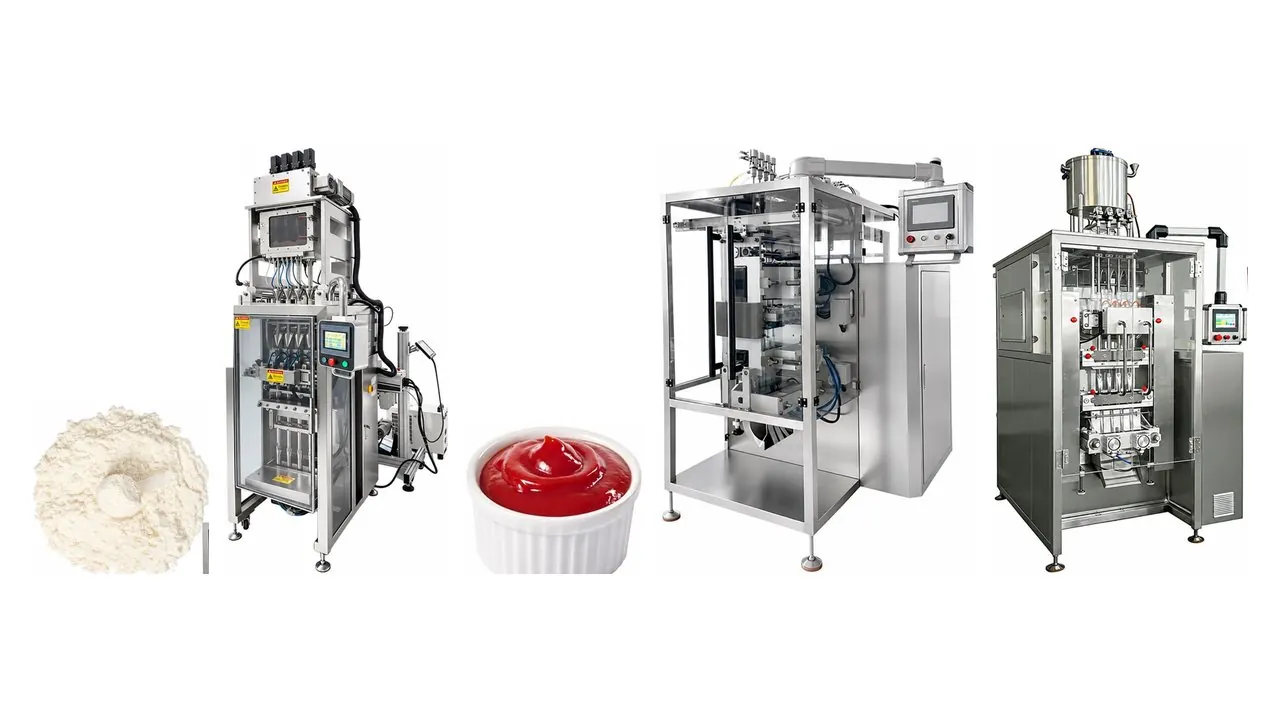
Comparing cost per bag can lead you to buy the wrong filling line. In a sachet vs stand-up pouch packaging comparison, start with a flat sachet for a separate single-use portion, and evaluate a stand-up pouch when shelf presentation or repeated access matters.
A sachet is a type of flexible pouch; “pouch” does not mean “premade.” Here, sachet means a flat portion pack, while stand-up pouch means a pack with a base that opens to support it upright. Compare the consumer use first, then the filling route and cost per equal mass of packed product. A zipper is an option, rather than a feature of every stand-up pouch.
| Input or item | Value or source to use | Why it matters |
|---|---|---|
| Portion and uses per pack | Product brief: g or mL per use and per pack | Separates one-time dispensing from repeated opening |
| Pack drawing | Film or pouch supplier drawing | Identifies seals, gusset, opening and usable filling space |
| Packaging supply | Roll-stock film or premade bags | Selects the forming or bag-handling equipment route |
| Accepted production | Good packs and kg per shift | Makes different dose sizes comparable |
| Commercial basis | Same product mass, period, currency and delivery scope | Prevents a low per-bag figure from hiding higher operating cost |
Which format fits the way the product is used?
Choose the pack around the amount the consumer needs on each occasion. A flat sachet suits a measured sample or portion that is opened and emptied; a reclosable stand-up pouch suits a product that the consumer needs to access again. Both still need a material structure suited to the product and distribution conditions.
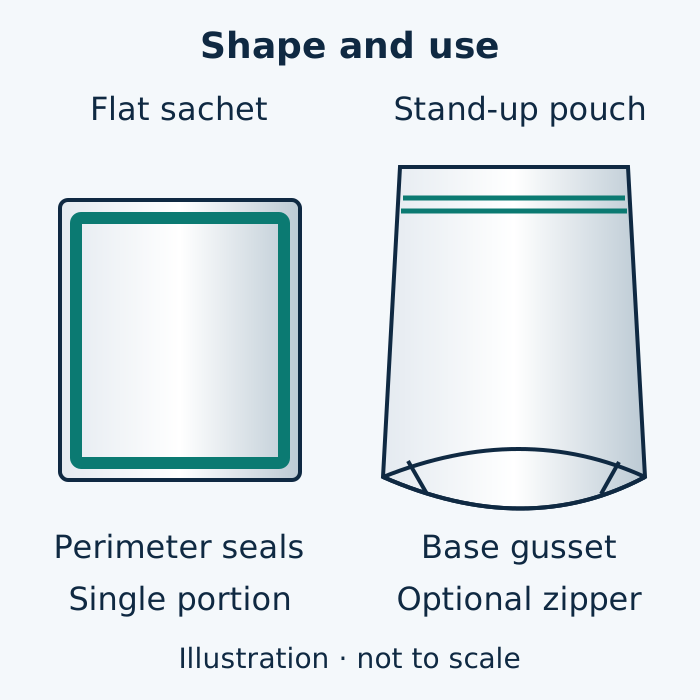
Illustration: a flat portion pack and an expanded-base pouch. The drawing shows format differences, not a capacity or size limit.
| Decision | Flat single-use sachet | Stand-up pouch |
|---|---|---|
| Consumer use | Open one portion; dispose of the empty pack | Dispense a portion or use the whole pack; add a suitable closure if reopening is required |
| Display and handling | Flat pack; assess any outer carton or display arrangement | Assess upright stability with the actual fill and base design |
| Packaging bill | Film, seals, cuts, printing and any secondary grouping | Film or finished pouch, base construction and any zipper or spout |
| Machine boundary | Form-fill-seal route matched to flat pack and dose | Premade fill-seal or a forming system designed for the specified stand-up format |
| Dominant Failure Mode & Prevention | Product in the seal area can cause defective seals; check dosing cut-off, dust or drip control and agreed seal tests | Poor opening can interrupt filling; verify bag opening before dispensing. Check base unfolding and closure cleanliness on filled samples |
| Reason to reject the candidate | Consumer needs to keep and reclose the same pack | Consumer needs individually sealed portions, or the filled pack fails the agreed stability/use test |
Selection rule: if the consumer needs more than one opening of the same pack, include a closure evaluation in the stand-up pouch brief. If the entire fill is used once and separately sealed doses are required, shortlist sachets. There is no universal gram cutoff between these choices.
Check capacity against the drawing, too. If the required product volume plus the agreed empty space exceeds the supplier's verified usable pack volume, revise the pack before selecting tooling. Converting grams to volume requires the actual product density; a powder's bulk density and a liquid's density are different inputs.
For a comparison between two single-serve shapes, use the separate sachet vs stick pack guide. The wider machine selection guide connects product, dose, film and site requirements.
How does the packaging route change the equipment?
Specify both the finished pack and its supply form. A roll-stock machine forms the pack from film before filling and sealing. A premade-pouch machine receives already formed bags and must present and open each bag for filling, then close its filling opening.
| Route to compare | Operations to include in the proposal | What to verify before purchase |
|---|---|---|
| Flat sachet from roll-stock | Film handling, sachet forming, dosing, sealing and cutting; multiple lanes where specified | Pack drawing, film registration, lane-by-lane dose and seal results |
| Stand-up pouch supplied premade | Bag supply, presentation, opening, filling and final sealing | Actual bag/zipper opening, positioning, filled stability and reject handling |
| Stand-up pouch formed from roll-stock | Forming and sealing system designed for the base and any closure, followed by filling and final sealing | Specific pouch drawing and closure capability, tooling, film and changeover demonstration |
Changing from flat sachets to gusseted zipper pouches requires a machine-specific review. A sachet machine does not become a stand-up pouch machine through a recipe change alone. Conversely, a stand-up pouch need not arrive premade: suitable forming equipment can produce it from roll-stock.
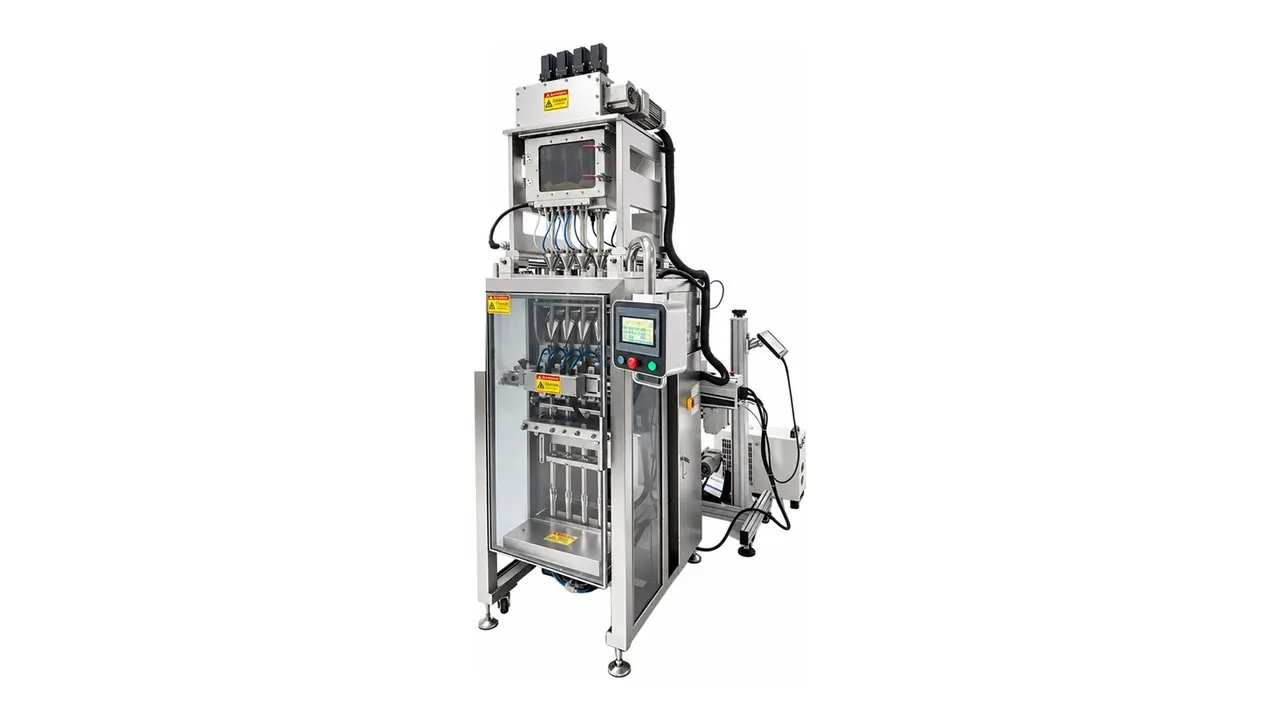
Photo: a LINEVO multi-lane powder sachet configuration. The parallel filling assemblies illustrate why lane count belongs in a sachet proposal; this photo does not establish stand-up pouch compatibility.
Review powder dosing requirements or liquid and paste filling requirements alongside the pack route. Product feeding and dosing remain separate choices from the pouch's shape. At discharge, include inspection, collation and secondary packing in the proposal scope; the multi-lane sachet page helps frame the sachet output requirement.
Compare accepted mass output as well as bag count:
Accepted kg/min = lanes × cycles/min × running fraction × acceptance fraction × fill g / 1,000
Hypothetical sachet calculation, with one pack per lane per cycle: 4 × 30 × 0.90 × 0.98 × 10 / 1,000 = 1.0584 kg/min.
Here, the running fraction is actual running time divided by scheduled time; the acceptance fraction is good packs divided by all packs made while running. Do not deduct quality again through an OEE figure that already includes it. Ask a pouch supplier for accepted kg over the same counting window, including its own stoppages and rejects.
Which uses less packaging per gram of product?
Weigh the empty finished packs and divide by their fill mass. A small sachet can use less material per individual pack while using more packaging per gram of product. The result depends on the actual drawing, laminate, closure and fill, so bag size alone cannot settle the comparison.
Packaging g/kg product = empty pack mass g / fill mass g × 1,000
Hypothetical inputs: a 1 g empty sachet holding 10 g uses 1 / 10 × 1,000 = 100 g/kg; a 6 g empty stand-up pouch holding 200 g uses 6 / 200 × 1,000 = 30 g/kg.
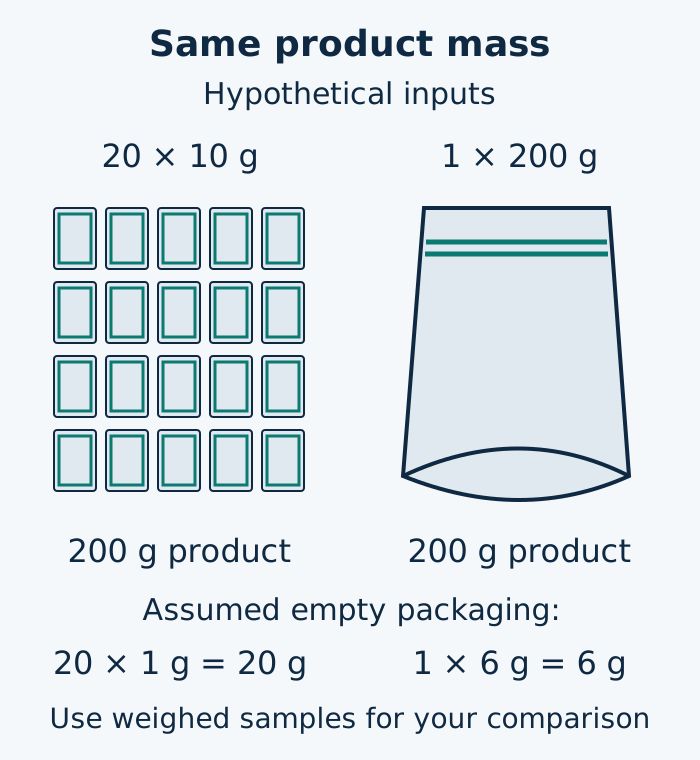
Illustration: compare equal product mass. These assumed empty-pack weights demonstrate the calculation; weigh your chosen samples before budgeting.
That arithmetic measures packaging mass. It does not establish shelf life, environmental performance or the cost of product left unused after opening. If part of a larger pack is discarded, record that loss separately when comparing the consumer-use scenarios.
For packaging purchase cost, use quotes on the same order quantity and delivery basis:
Packaging cost/kg product = packaging cost/pack × 1,000 / fill g
The larger pack is cheaper on this measure only when:
Pouch cost/pack ÷ sachet cost/pack < pouch fill g ÷ sachet fill g
For hypothetical fills of 200 g and 10 g, the threshold is 200 / 10 = 20: the stand-up pouch must cost less than twenty sachets to have a lower packaging purchase cost per equal product mass. Enter actual supplier quotes, including the closure and printing scope. This comparison excludes filling, rejects and secondary packing.
What belongs in a same-period total cost comparison?
Compare the same accepted product mass over the same operating period. Buying fewer large pouches changes bag count, but it does not remove the cost of bag handling, cleaning, material losses or outer packaging. Use the following ledger for each candidate.
Period TCO = installed investment + primary packaging purchased + product lost + primary-packing labour + utilities + maintenance + secondary packing + separately valued downtime − residual value
Keep the buckets separate: primary packaging covers film, bags and closures; secondary packing covers outer-pack materials and secondary-packing labour only. Primary-packing labour excludes those secondary-packing hours. Utilities and maintenance cover both stages and stay in their own terms; installed investment includes any secondary-packing equipment.
| Cost entry | Input to obtain for each route | Keep the comparison consistent |
|---|---|---|
| Installed investment | Machine, dosing, feeding, tooling, inspection, delivery and commissioning scope | Record the same start/end boundary and any existing equipment reused |
| Primary packaging purchased | Required accepted packs, rejects, startup scrap, rolls or bags, and closures | Exclude outer-pack materials; count rejected primary packaging here once |
| Secondary packing | Outer-pack materials and secondary-packing labour | Exclude primary packaging and primary-packing labour; equipment, utilities and maintenance remain in their separate terms |
| Product lost | Startup rejects, seal rejects, cleaning residue and measured giveaway | Include only product that cannot be recovered under the agreed process |
| Changeovers and cleaning | Events per period, elapsed hours, staffing and startup waste | Compare the same SKU schedule and cleaning requirement |
| Utilities and maintenance | Measured or quoted consumption, tariffs, parts and service | Separate confirmed figures from items awaiting a trial or proposal |
| Output interruption | Unrecovered lost production or another agreed downtime basis | Avoid charging the same loss again through both overtime and lost contribution |
For a hypothetical monthly schedule of eight changeovers, a measured or assumed 0.5 h/changeover gives 8 × 0.5 = 4 h/month. At 0.25 h/changeover, it gives 8 × 0.25 = 2 h/month. Across the same 36 months, the difference is 72 h; multiply by the buyer's agreed hourly cost to value it. Neither time is a rating for either machine route.
If hourly labour is already counted for the full shift, do not add it again as a downtime cost. Include a lost-production value only where the missed output is not recovered elsewhere in the schedule. Review the sachet machine quotation cost factors before treating an equipment-only quote as an installed-line budget.
What should the samples and trial prove?
Confirm the dose, seal condition and use of the finished pack on the intended product and packaging. For sachets, agree what to record across the proposed lanes. For stand-up pouches, add opening, base stability and any repeated-closure checks to the supplier's evaluation.
ASTM F88/F88M measures seal separation force and identifies specimen failure mode. Its published scope does not set a universal pass force for your pack. Agree the method, sampled seal locations and acceptance criteria with the responsible laboratory or supplier. A seal-strength result alone does not establish leak performance or shelf life.
Ask for records that identify the product, film or premade bag, fill, drawing, machine configuration, counting window, accepted and rejected quantities, and defects observed. Evaluate the intended opening and dispensing task on filled samples. For a zipper pouch, agree how repeated access and closure will be checked under the expected use conditions.
Discuss product and film sample testing before sending physical materials. Confirm the quantity, handling requirements and destination first.
What to send us
Send the sachet project inputs below to request a configuration recommendation and written quotation. If you are still deciding between a flat sachet and a stand-up pouch, include both drawings and describe the intended use so the format question is clear.
| Item | Why we need it | Example format |
|---|---|---|
| Product and handling conditions | Review feeding, dosing and seal contamination risks | Description, photos, available product/handling datasheet |
| Fill and consumer use | Separate portion size from pack size | g or mL per pack; single use or repeated access |
| Pack and material | Review the intended sachet and film | Dimensioned drawing, sample photos and film specification |
| Output and schedule | Review accepted production and changeovers | Good packs and kg per shift; SKUs and changes per month |
| Quotation boundary and destination | Compare the equipment and delivery scope | Required feeding/inspection/packing stages and destination country |
Send your product, fill, pack drawing, target output and destination on WhatsApp for a sachet configuration and quotation discussion. Add any undecided film or format requirements to the message.
Seal-test reference
ASTM F88/F88M covers seal-strength measurement for flexible barrier materials. Define acceptance limits and leakage checks for each package. Keep roll-stock forming and premade-pouch handling as separate equipment routes when comparing quotations.