

How Sachet Packaging Machines Work
How does a sachet packaging machine work? Follow the film from unwind to discharge, with what goes wrong at the seals, the dosing station and the cutter.
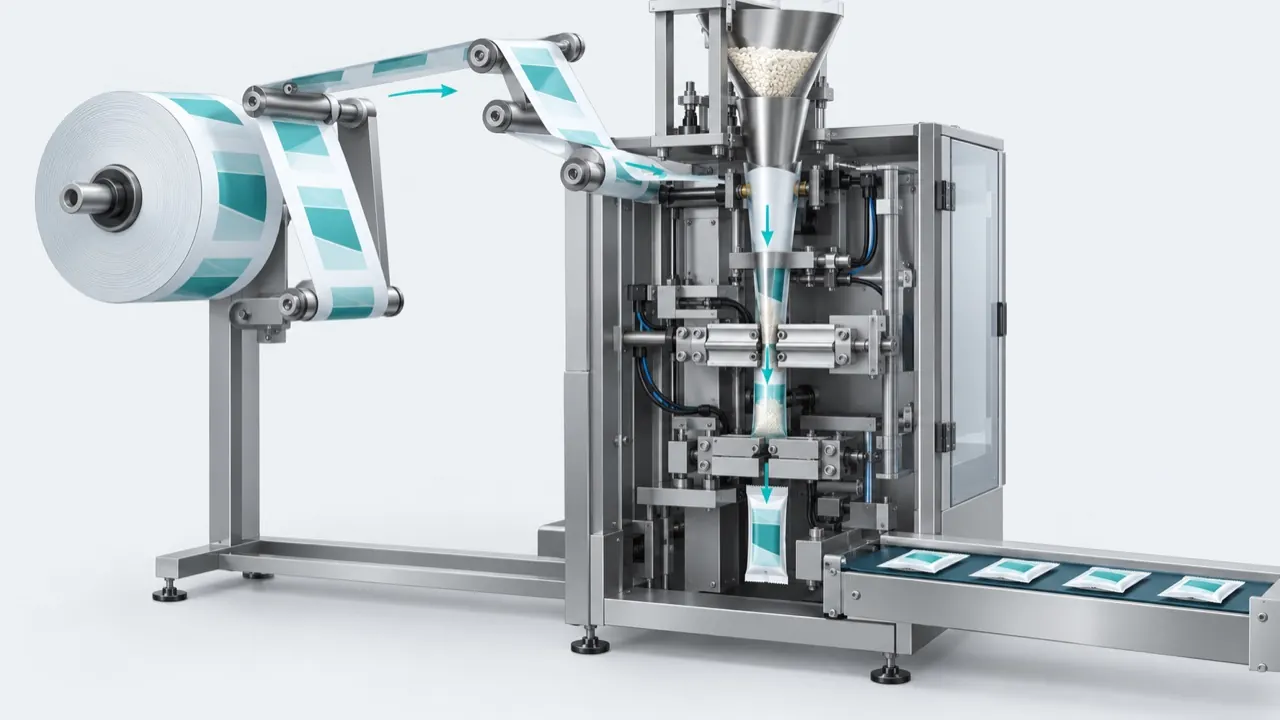 Illustration
A sachet packaging machine pulls film off a roll, shapes it into a pocket, drops product into it, seals and cuts it, and sends the finished sachets out. Powder, liquid and granule machines all follow that sequence. What changes is the dosing system, the seal details and how many sachets are made side by side. Below we follow the film and the product through each station and say where things usually go wrong.
Layouts differ. Some machines fold one web of film and some join two, and some run vertically while others run flat. Read this as a general description, not a spec for one model.
What is the overall process?
A flat sachet machine runs through these steps in order:
- Unwind the film and hold it at steady tension.
- Keep printed film aligned using registration.
- Form the film into a tube or pocket.
- Make the longitudinal or side seals.
- Dose and fill the product.
- Make the cross seal that closes the sachet.
- Cut or perforate between sachets.
- Discharge and count the finished sachets.
- Watch all of it through controls and sensors.
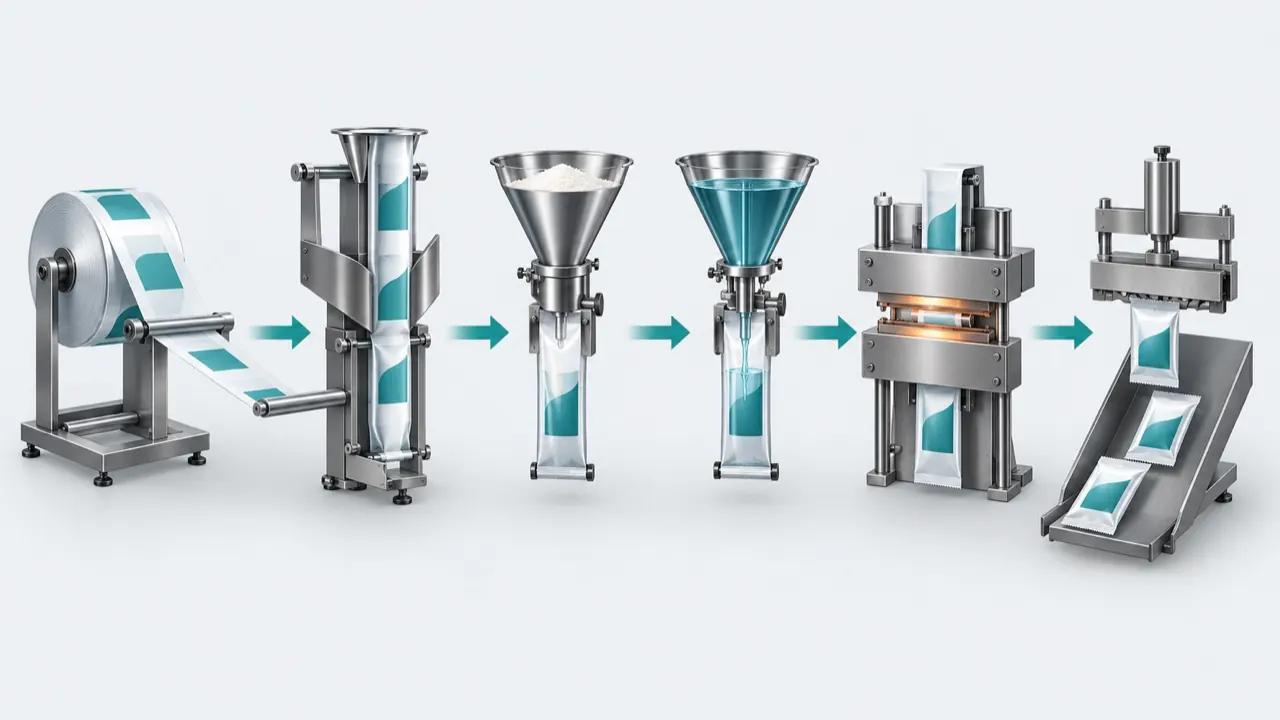
Illustration: a simplified process flow. Real machines vary in layout, and some stations swap places.
How is the film unwound and kept under tension?
The roll sits on a shaft and feeds the machine through rollers. A dancer arm or a brake keeps the film taut without stretching it. Too little tension and the film wanders or wrinkles. Too much and it stretches, which distorts the print and gives you sachets of different lengths.
When the film drifts sideways, wrinkles reach the forming area, or tension changes as the roll empties, look at the roll first. An off-centre core or an unevenly wound roll is the usual cause.
What is print registration?
On printed film, a sensor reads a registration mark and tells the machine where to cut and seal, so the artwork lands in the same place on every sachet. Plain film skips this step.
Print that creeps out of position over a run usually points to a low-contrast mark the sensor misreads, or to film whose length changes with tension or temperature. Clear marks and a steady film path fix most of it. Settle the mark contrast when you choose the film, and check it in a trial.
How is the sachet formed?
There are three common ways to form the pocket.
A single web can be folded over a former or plate, which leaves a fold on one side and two edges to seal. This is the usual 3-side seal sachet. Two separate webs can be brought together and sealed on all four sides, which gives the flat shape of 4-side seal sachet machines. Or the film can be wrapped around a forming tube with the product falling through the tube, as on most vertical machines.
Wrinkles at the fold, edges that do not meet squarely and sachets of uneven width usually trace back to film tension, the former setting, or film that is too stiff or too soft for the geometry.
How are the longitudinal and vertical seals made?
Heated jaws or wheels press the film edges together. Heat softens the sealing layer, pressure brings the layers into contact and dwell time lets them fuse. The right balance depends on the film structure and the machine, and moving one setting usually means moving another.
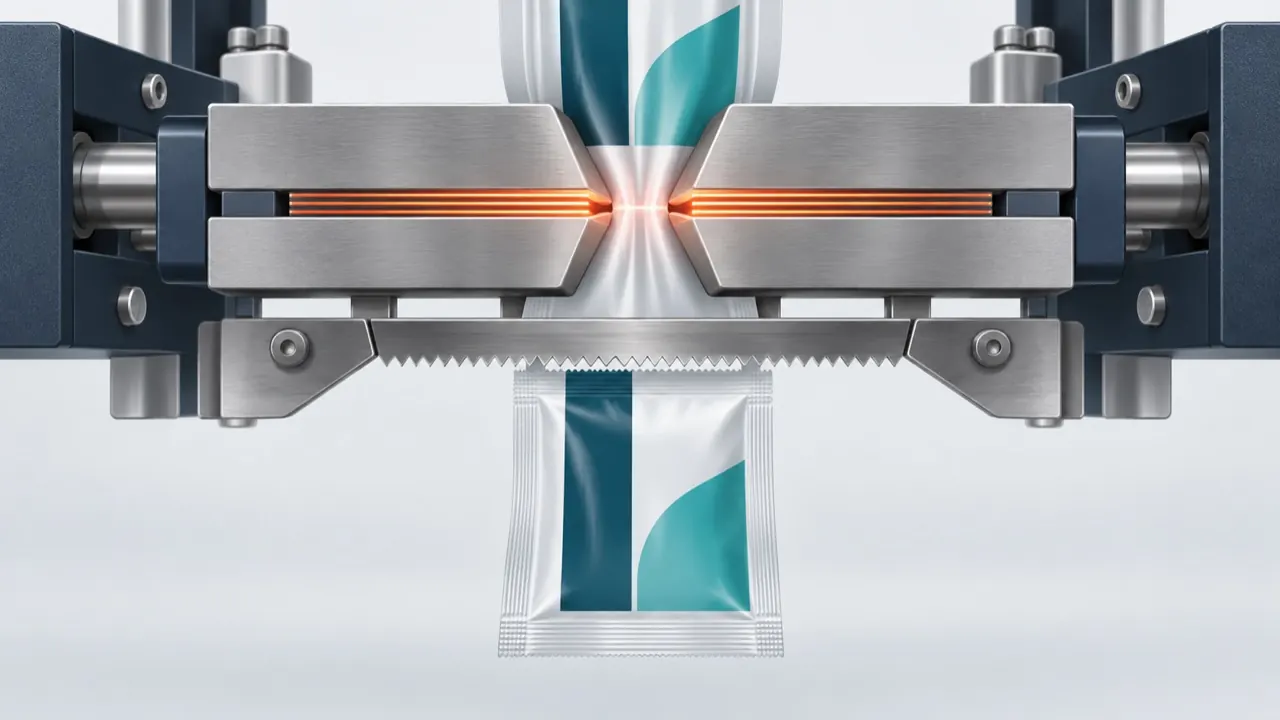
Illustration: heat, pressure and dwell time work together at the jaws. Product caught in the seal weakens it.
Weak or open seals, wrinkled seals and burned or distorted film are the common faults. Contamination is the other one: powder or liquid in the seal stops the layers fusing, and fine powders and sticky products are the worst offenders.
How is the product dosed and filled?
Dosing is the station your product affects most, and the choice follows how the product behaves.
An auger is a rotating screw that pushes a set amount of fine or cohesive powder into the sachet, and the number or angle of turns sets the fill. A volumetric cup fills from a hopper and then drops its contents. It suits free-flowing powders and granules with a steady bulk density. See powder sachet dosing and granule sachet dosing. A piston or similar pump meters a set volume of liquid or paste, and viscosity, particles and foaming drive the choice. See liquid and paste sachet dosing.
Expect fill weight drift, product bridging in the hopper, dust in the seal area and trapped air. With liquids, watch for drips and strings after the nozzle: a thread of sauce that lands on the seal area gives you a leaker later. Accuracy comes from the product as much as the machine, so weigh sachets made from your own product before you accept a tolerance on paper.
What does the cross seal do?
The cross seal closes the top of one sachet and the bottom of the next, usually in a single press. It is the seal most exposed to product, because the product has just fallen through it.
Leakers, creased cross seals, product in the seal and sachets that open when handled are the typical failures. Dust extraction, a clean fill drop and a suitable jaw design all help.
How are sachets cut and perforated?
A knife cuts between sachets, or perforation blades leave a tear line so the sachets stay in a strip. A tear notch may be cut as well.
Ragged cuts, sachets that will not separate and perforations that tear too easily or not at all usually come from a worn or misaligned blade, or from film that is hard to cut.
How does multi-lane slitting work?
A multi-lane machine makes several sachets across the film width at once. The wide film is slit into lanes and each lane has its own dosing point, so one cycle gives you several sachets. Multi-lane sachet packing machines covers what limits the lane count: sachet width, film width and dosing layout.
Multi-lane machines add their own faults, such as uneven fill between lanes, a frayed slit edge and lanes that drift apart. Check lane-to-lane variation, not just the average.
What happens at discharge and counting?
Finished sachets leave by chute or conveyor. A counter may group them into strips or batches, and a separate machine may carton them or pack them into cases. Jammed chutes, miscounts and static that makes light sachets cling are the usual problems at this end.
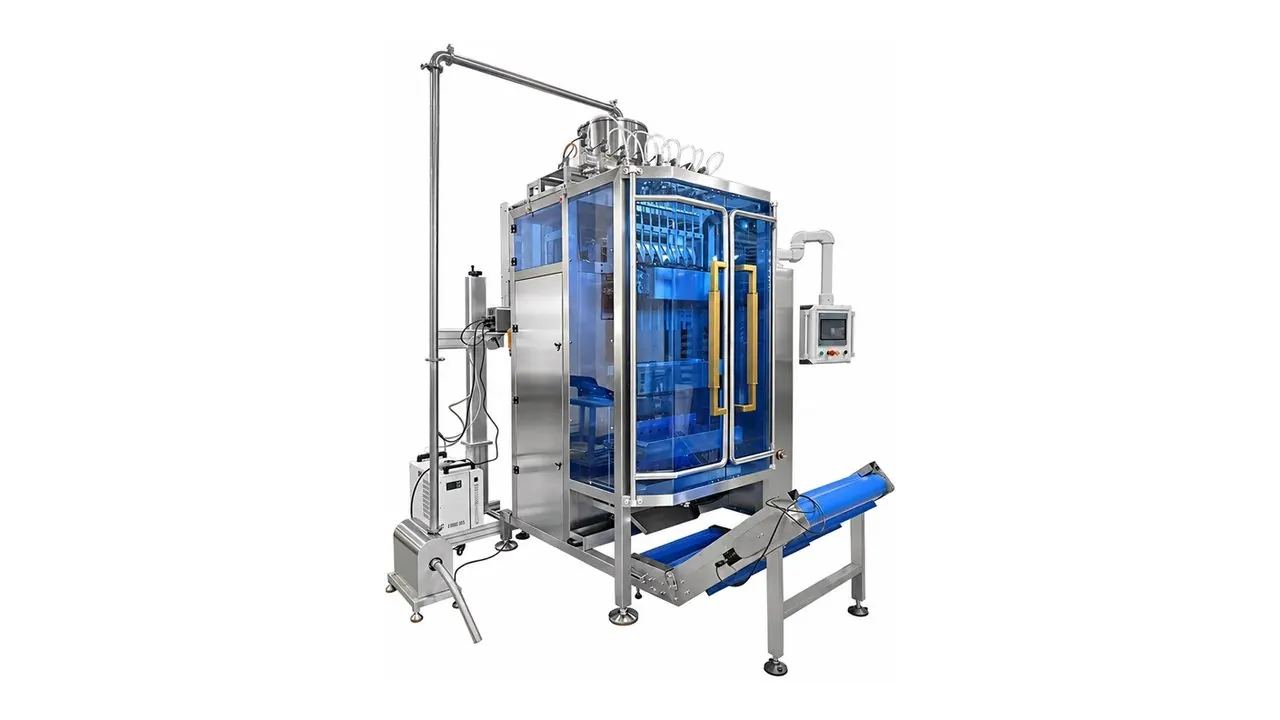
Photo: a multi-lane sachet machine with an inclined discharge conveyor taking finished sachets away from the sealing station.
What do the controls and sensors do?
The control system coordinates film feed, seal timing, dosing and cutting. Sensors track registration marks, film presence and sometimes product level or fill checks. A false film-out alarm usually means a dirty sensor eye. Settings that someone changed and never wrote down cause more trouble than most hardware faults.
What are the main variations between machines?
| Variation | What differs | Why it matters |
|---|---|---|
| 3-side seal versus 4-side seal | One fold plus three seals, or two webs with four seals | Affects pack appearance, seal count and film use |
| Single lane versus multi-lane | One sachet per cycle, or several | Sets theoretical output and complexity |
| Vertical versus horizontal | Product falls by gravity, or sachets travel flat | Affects dosing, space and product behaviour |
Vertical machines suit free-flowing products that fall cleanly. Horizontal designs lay the sachet flat, which helps with some products and formats. Your product decides which one fits.
What should I send to get a recommendation?
Send your product description, fill amount, sachet format and film structure. From those we can suggest a configuration. How to choose a sachet packaging machine shows how to prepare, and a product and film trial lets you see how your own product behaves on the machine.
Questions about how sachet machines work
Do all sachet machines use the same steps?
The broad sequence is the same. The structure differs: some machines fold one web, some join two, and the dosing system changes with the product.
Which stage causes the most problems?
Seals and dosing. Both depend on the product and the film together, so a machine that runs water well can still struggle with your sauce.
Does a printed film change how the machine works?
Yes. Printed film needs registration sensing, so mark contrast and film stability start to matter.
Is a machine for powders suitable for liquids?
Not usually without changes. The dosing system and often the sealing details differ, so ask the supplier about your product specifically.
Not sure which configuration fits your product?
Send your product and pack details, or ask for a trial on your own material before you decide.