

Oil Sachet Packing Machine: Anti-Drip Dosing, Heating & Barrier Seal Rules
Published by the LINEVO sachet equipment team. Technical questions and corrections
Configure an oil sachet packing machine to stop nozzle stringing, laminate delamination, and lipid oxidation across cooking, olive, palm oil, and ghee packs.
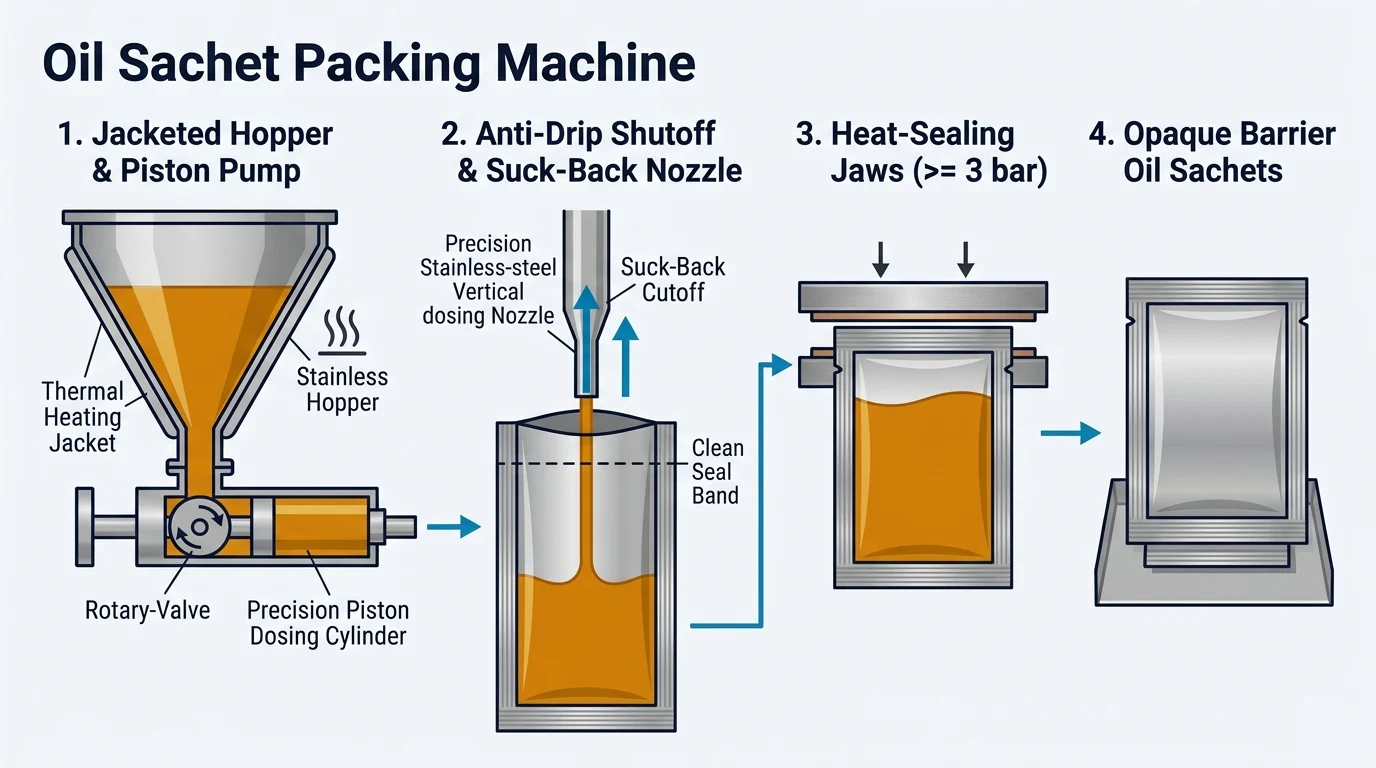
An oil sachet packing machine stops seal contamination, seepage, and rancidity by pairing positive-displacement piston dosing with positive-shutoff and pneumatic suck-back nozzles, applying at least 3 bars of sealing jaw pressure across fatty-food-compliant sealant laminates, and shielding unsaturated lipids from visible light and headspace oxygen using aluminium foil or EVOH barrier films.
Oil-phase recipes behave differently from water-based liquids because stray oil droplets do not evaporate off a sealing band and free fatty acids attack weak laminating adhesives over shelf life. Use the rules below alongside our liquid and paste sachet machine overview, our piston vs gear pump sachet filling comparison, our sachet sealing problems checklist, and our sauce sachet application guide.
What dosing and seal-through setups differ across cooking oil and palm oil sachet lines?
Free-flowing vegetable oils dose cleanly at ambient temperature with rotary-valve piston pumps and crisp anti-drip cutoff, whereas highly saturated palm oil and ghee solidify in temperate plant air and require jacketed heated hoppers, controlled wetted paths, and heat-sealing jaws clamped at 3 bar or higher to bond reliably.
As summarized in the Wikipedia technical reference on palm oil, palm oil's high saturated palmitic acid content renders it solid at room temperature in temperate regions, and refined palm oil fractionates by melting point into higher-melting solid palm stearin and liquid palm olein. Running palm oil or palm stearin through an unheated gravity pipe causes flow hesitation, erratic fill weights, and solidified buildup inside valve ports. Conversely, running ambient-temperature liquid vegetable oil without a mechanical shut-off lets thin oil creep down the nozzle tip between strokes.
Thermal handling, dosing, and sealing matrix by oil type
| Oil category | Ambient physical behavior | Hopper and fluid-path setup | Dosing and sealing focus |
|---|---|---|---|
| Free-flowing cooking oils (soybean, sunflower, canola) | Liquid across typical plant temperatures | Ambient stainless hopper with cleanable wetted path | Positive-displacement piston dosing with shut-off and suck-back; nitrogen flush option |
| Extra-virgin and refined olive oil | Liquid; pigments sensitive to 400 to 700 nm light | Ambient cleanable path; minimize iron or copper contact | Opaque aluminium foil barrier, low headspace oxygen, and clean top-seal clamping |
| Palm oil and palm stearin blends | Solid at room temperature in temperate climates | Jacketed heated hopper and temperature-controlled manifold | Keep fill temperature inside the overlap of recipe, contact-part, and film limits |
| Ghee and semi-solid edible fats | Semi-solid clarified milk fat sensitive to sunlight | Jacketed hopper to maintain uniform flow without scorching | Positive-displacement piston metering with crisp nozzle cutoff and light-blocking film |
Matching hot-bar and ultrasonic jaw setups to oil laminates
As outlined in the Wikipedia engineering overview of heat sealers, flexible sachet lines rely on constant-heat hot-bar sealers—which hold heated bars or dies at steady temperature with release layers or Teflon interposer films to prevent sticking—or ultrasonic welding, which applies high-frequency acoustic vibrations under pressure to bond thermoplastics.
In flexible packaging heat-sealing trials reported in BioResources by Merabtene and colleagues, clamping pressure sets the hard mechanical floor: below 3 bars, the inner sealant layer lacks sufficient clamping force for polymer chain entanglement regardless of temperature. In those tests, the first observable seal appeared at 3 bars and 80 °C, and a thicker polyethylene sealant layer increased chain entanglement upon cooling. Confirming uniform jaw pressure across every lane before raising sealing temperature prevents film shrinkage while closing oil-filled packets reliably.
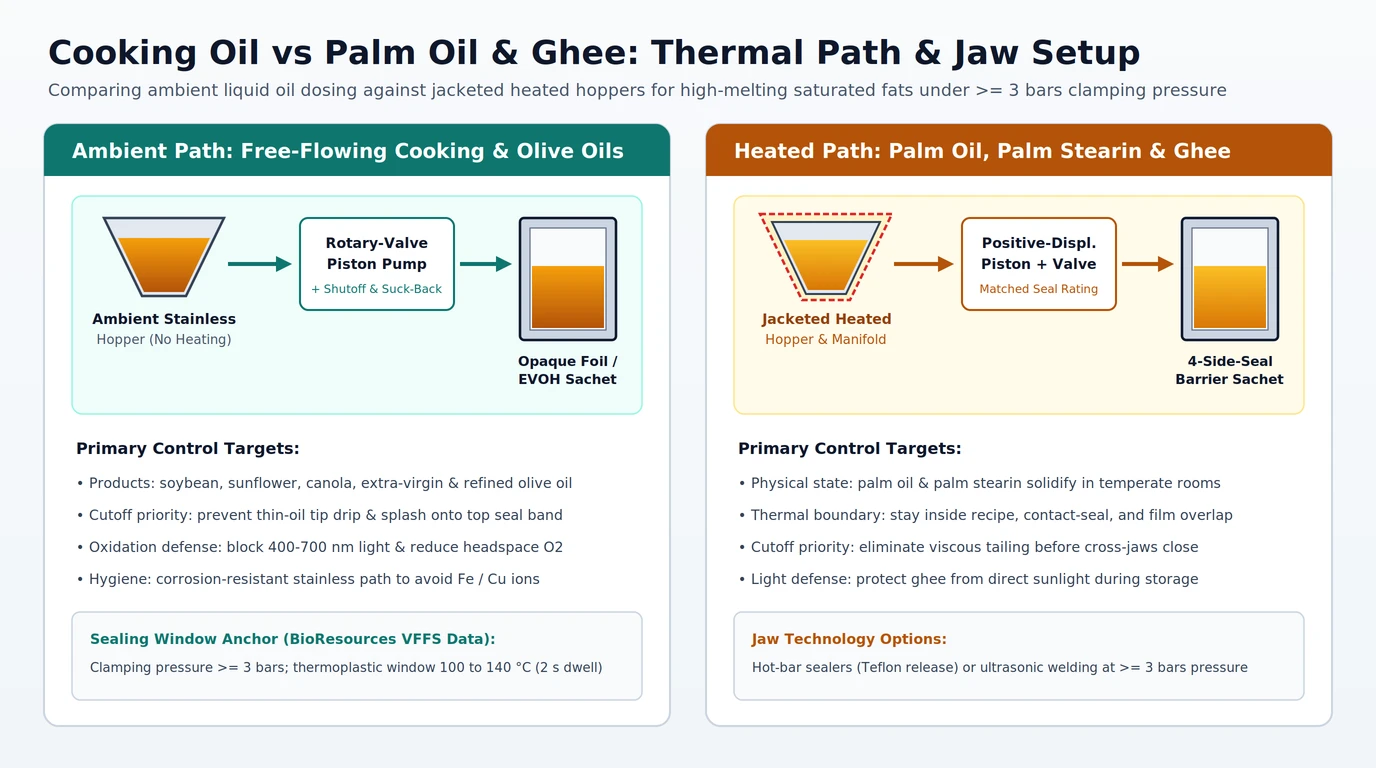
Ambient liquid oil dosing path versus jacketed heated hopper path for palm oil, palm stearin, and ghee, paired with the 3 bars sealing jaw pressure floor and thermoplastic sealing window.
How do positive-shutoff nozzles differ between free-flowing oil and semi-solid paste or ghee?
A positive-shutoff nozzle closes the fluid outlet mechanically at the end of each stroke while pneumatic suck-back pulls residual oil upward inside the tip, keeping fill time plus tail-clearance time inside the sealing window across both thin edible oils and thicker semi-solid fats such as ghee.
As described in the Wikipedia technical summary of packaging fillers, flow fillers serve thin liquids and oils on open bottle lines, whereas positive-displacement pump fillers handle a wide range of fill volumes from water-thin liquids to heavy pastes and creams. On a flat vertical or multi-lane sachet machine, rotary-valve piston dosing pairs positive displacement with controlled cutoff so free-flowing oil does not drip after the piston stops and semi-solid fats do not leave a hanging tail across the top seal jaws.
Separating shut-off closure, suck-back timing, and heated-path boundaries
- Shut-off plus pneumatic suck-back: A shut-off closes the flow path at dose completion, and suck-back draws residual product back toward the nozzle at cutoff. On multi-lane liquid lines, verify whether pneumatic suck-back is included on every nozzle rather than relying on gravity drip delay.
- Clearance window before jaw closure: Across every running lane, fill time plus tail-clearance time must remain less than or equal to the available filling window before the cross-seal jaws close. If thin oil splashes or thick ghee trails into that window, adjust stroke profile, nozzle placement, or cycle rate rather than increasing jaw heat.
- Jacketed hopper boundaries: A heated or jacketed hopper helps maintain uniform flow for palm oil or ghee, though a heated hopper alone does not qualify a hot-fill process. Confirm that your target temperature sits within the approved overlap of the recipe, the rated product-contact seals, and the packaging laminate.
- Sanitary construction and compressed-air purity: For food-grade edible oils, 21 CFR § 117.40 requires equipment to be cleanable, built with corrosion-resistant nontoxic food-contact surfaces able to withstand cleaning compounds and sanitizing agents, and designed to prevent adulteration by lubricants, fuel, or metal fragments. Under the same regulation, compressed air or other gases mechanically introduced into food or used on food-contact surfaces must be treated to prevent contamination with unlawful indirect food additives.
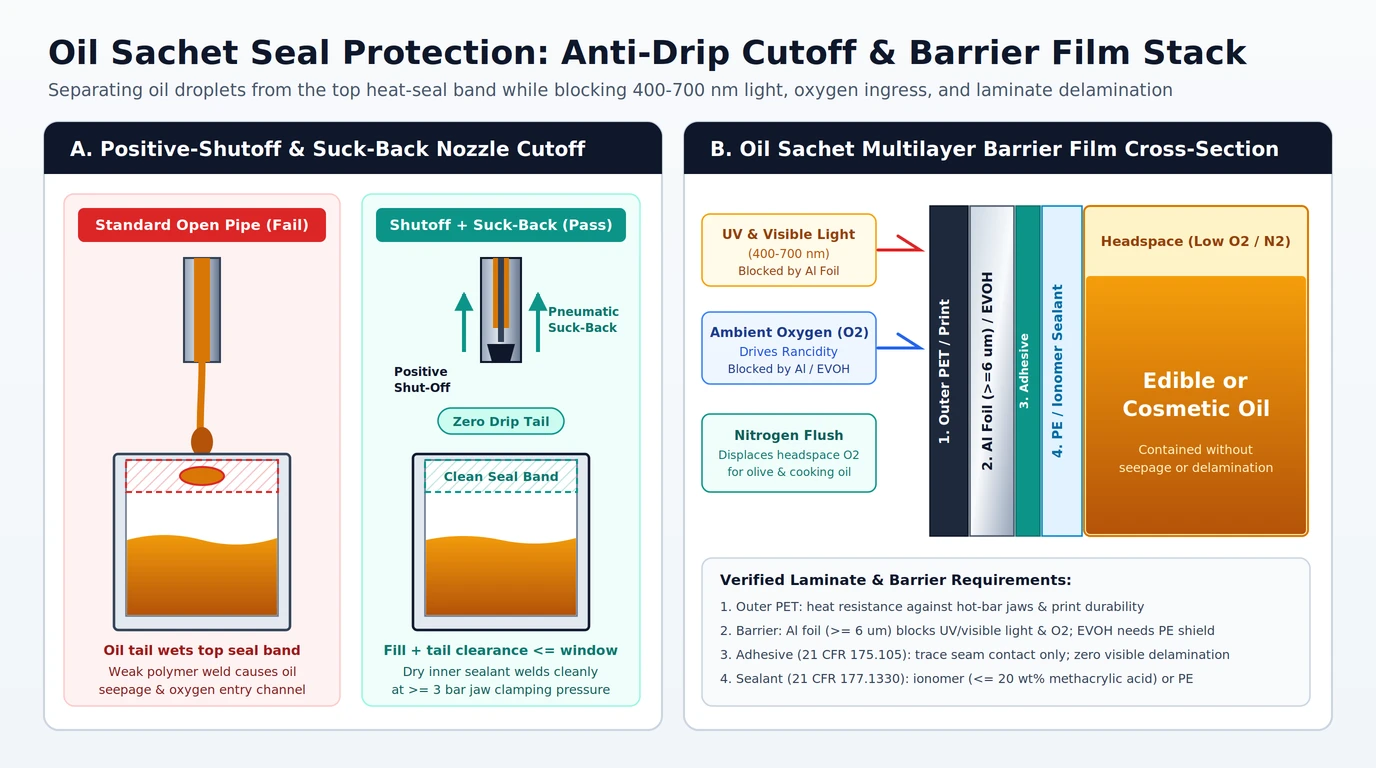
Positive-shutoff and pneumatic suck-back cutoff protecting the top seal band alongside a four-layer barrier film cross-section built to block light, oxygen, and laminate separation.
How do olive oil single-serve sachets block light and oxygen oxidation?
Olive oil single-serve sachets prevent rancidity by pairing opaque aluminium foil or moisture-shielded EVOH barrier laminates with tight low-oxygen seals and optional nitrogen headspace flushing, blocking both 400 to 700 nm visible and UV light that triggers rapid chlorophyll photo-oxidation and oxygen ingress that drives free-radical degradation.
According to the peer-reviewed food lipid review in PMC12146556, lipids in food are highly sensitive to light and elevated temperatures, which promote free-radical formation and accelerate oxidation—leading to nutritional loss, undesirable off-flavors, chemical breakdown, and potentially toxic oxidation compounds. Even brief light exposure matters for green oils such as extra-virgin olive oil: oil pigments including chlorophyll absorb visible light across 400 to 700 nm as well as ultraviolet (UV) light to generate reactive singlet oxygen, and that photo-oxidation reaction proceeds much faster than dark auto-oxidation.
Four oxidation pathways to control on an olive oil sachet line
- Light exclusion for chlorophyll-rich oils and ghee: Because visible and UV light initiate rapid photo-oxidation in vegetable oils—and as noted in the Wikipedia technical reference on ghee, direct sunlight also degrades ghee quality and shelf life—opaque barrier structures outperform clear pouches on illuminated retail or foodservice counters.
- Barrier layer selection (aluminium foil vs metallised film vs EVOH): As documented in the Wikipedia reference on aluminium foil, aluminium foil is rolled thinner than 0.2 mm (7.9 mils), with gauges down to 6 μm (0.24 mils) commonly laminated with plastics or paper for strength in food and cosmetic packaging. Metallised films are polymer films coated with a thin aluminium layer rather than solid foil, so verify actual barrier performance against shelf-life targets. Where a non-foil gas barrier is required, the Wikipedia reference on ethylene vinyl alcohol (EVOH) notes that EVOH delivers a strong barrier against oxygen, odors, and flavors, but because EVOH loses barrier performance in high humidity, multilayer films sandwich EVOH between moisture-resistant outer layers such as polyethylene.
- Headspace oxygen reduction and nitrogen flushing: PMC12146556 notes that higher oxygen content in package headspace increases dissolved oxygen in the oil and accelerates oxidation, while rinsing headspace with nitrogen to remove oxygen improves oil sensory quality during storage. Remember that under 21 CFR § 117.40, any gas introduced into food packaging must be treated against unlawful indirect contaminants.
- Trace-metal avoidance and oxidation quality checks: Trace metal ions such as iron (Fe) and copper (Cu) catalyze lipid oxidation, reinforcing the need for corrosion-resistant food-contact stainless wetted parts. Quality labs track oxidative stability using primary markers—peroxide value (PV) and specific extinction at 232 nm (K232)—and secondary markers including para-anisidine value (p-AV), 270 nm absorbance (K270), and total oxidation (TOTOX). As summarized in the Wikipedia reference on olive oil, peroxide value measures free-radical oxidation leading to oxidative rancidity, with standard limits of 20 for virgin olive oil and 10 for refined and pomace olive oil.
What film structures and sealing specs keep cooking oil sachets from delaminating or seeping?
Edible cooking oil sachets resist delamination and seepage by combining an outer heat-resistant print web, an oxygen- and light-blocking barrier layer, a fatty-food-compliant laminating adhesive under 21 CFR 175.105, and a polyethylene or 21 CFR 177.1330 ionomer inner sealant welded at 3 bars of sealing jaw pressure or higher and verified with ASTM F88 and ASTM F2096.
Testing reported by Labthink emphasizes that if package seal performance is poor, the defect does not merely cause oil leakage—it simultaneously creates a passage for ambient oxygen to enter the sachet and accelerate rancidity. Keeping oil inside and oxygen outside requires both chemical laminate integrity and repeatable mechanical heat sealing.
Oil sachet multilayer film specification table
| Film layer (outside to inside) | Typical candidate material | Functional role in oil-phase sachets | Regulatory or engineering verification check |
|---|---|---|---|
| Outer structural and print layer | Oriented polyester (PET) or coated paper | Resists sticking to constant-heat hot-bar jaws and supports artwork | Confirm jaw release layer or Teflon interposer condition |
| Light and oxygen barrier layer | Aluminium foil (down to 6 μm) or multilayer EVOH | Blocks 400 to 700 nm light and ambient oxygen ingress | Sandwich EVOH between moisture-resistant polyethylene layers |
| Laminating adhesive | Fatty-food-compliant laminating adhesive | Bonds barrier and sealant webs permanently under oil exposure | Verify compliance with 21 CFR 175.105 (trace seam contact; no visible separation) |
| Inner heat-sealant layer | Polyethylene (PE) or ethylene-methacrylic acid ionomer | Fuses cleanly under jaw pressure and resists fatty-food migration | Verify 21 CFR 177.1330 (up to 20 weight percent methacrylic acid; n-heptane at 120 °F / 49 °C) |
Regulatory bonding rules and verified heat-seal operating windows
- Adhesive delamination limits under 21 CFR § 175.105: The quantity of adhesive contacting packaged fatty and aqueous foods must not exceed trace amounts at seams and laminate edges within good manufacturing practice, and under normal conditions of use the packaging seams or laminates must remain firmly bonded without visible separation.
- Ionomeric sealant compliance under 21 CFR § 177.1330: Ethylene-methacrylic acid ionomeric resins containing no more than 20 weight percent of polymer units derived from methacrylic acid are regulated for food-contact packaging. For intended food contact at or below 120 °F (49 °C), the regulation prescribes fatty-food extraction testing with n-heptane at 120 °F (49 °C).
- Verified heat-sealing temperature and dwell bounds: In the BioResources VFFS heat-sealing study, maintaining at least 3 bars of jaw pressure was required for chain entanglement. At a 2 s dwell time, thermoplastic film formed its first observable seal at 100 °C and shrank at 140 °C, whereas PE-coated paper initiated sealing at 90 °C and reached 220 °C before turning brown. At 100 °C, dwell times needed to exceed 1 s to prevent seal opening during production.
- Standard laboratory acceptance tests: Measure strip peel strength under ASTM F88 while locking one consistent sample-holding method across the entire trial—Technique A (Unsupported), Technique B (Supported 90° by hand), or Technique C (Supported 180° against a rigid alignment plate)—because bending angle changes recorded force. Pair peel testing with whole-pack gross leak screening under the ASTM F2096 internal pressurization bubble test, which detects leaks in pouches down to 250 μm (0.010 in.) with 81% probability.
When does a compact small oil sachet packing machine fit tabletop or single-lane runs?
A tabletop semi-automatic oil filler paired with a separate heat sealer fits pilot batches and micro runs using premade pouches, a compact single-lane vertical roll-film VFFS machine fits steady single-SKU automation, and multi-lane four-side-seal lines take over once shift volume outgrows one sachet per cycle.
Every extra lane adds another dosing cylinder, shut-off nozzle, and sealing zone to balance and clean, so sizing the frame around verified shift demand avoids paying for unused capacity. Review our small sachet packing machine selection guide, our four-side-seal machine overview, and our multi-lane sachet machine page when comparing frame tiers.
Comparing small tabletop, single-lane, and multi-lane oil sachet configurations
| Equipment tier | Film and pouch format | Catalog model and lane scope | Best-fit oil production stage |
|---|---|---|---|
| Tabletop semi-automatic filler + separate sealer | Premade barrier pouches closed on an impulse, hot-bar, or band sealer | Manual or benchtop single-nozzle piston setup | Recipe validation, market tests, and low-volume specialty oils |
| Single-lane vertical roll-film VFFS | Continuous printed barrier rollstock with compact vertical footprint | 1 lane per cycle with positive-displacement piston pump | Steady single-SKU cooking, olive, or cosmetic oil sachets |
| Multi-lane four-side-seal sachet line | Wide parent barrier rollstock split across parallel 4-side-seal lanes | LV-500SY (2 to 4 lanes, 500 mm film), LV-700SY (3 to 10 lanes, 700 mm film), LV-980SY (4 to 16 lanes, 980 mm film) | Commercial foodservice and retail condiment or cooking oil lines |
In our published four-side-seal liquid machine catalog, the LV-500SY, LV-700SY, and LV-980SY rotary-valve piston dosing models cover 2 to 16 lanes across the three frames, a 5 to 100 ml fill range, sachet widths of 50 to 125 mm, sachet lengths of 45 to 160 mm, and maximum film widths of 500, 700, and 980 mm respectively.
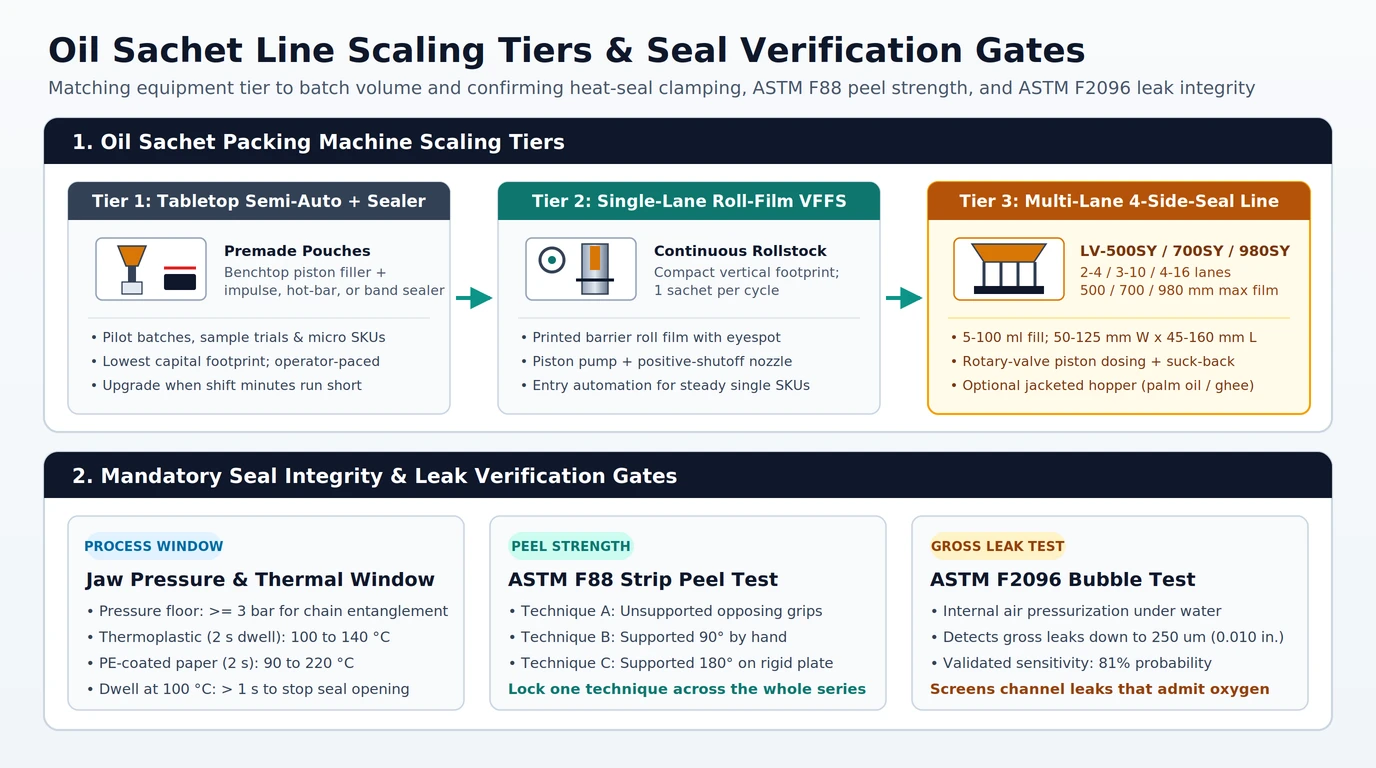
Oil sachet equipment scaling from benchtop premade-pouch runs to multi-lane four-side-seal production alongside standard clamping, ASTM F88 seal strength peel, and ASTM F2096 gross leak verification gates.
Which lane-count, pump, and heating options drive oil sachet packing machine price?
Oil sachet packing machine price is determined by five technical scope choices—the dosing system and wetted contact materials, the sachet-width-capped lane count, heated or jacketed hoppers for high-melting oils, pneumatic suck-back and positive-shutoff nozzle assemblies, and optional nitrogen flushing or trial qualification.
Treat a written equipment quotation as an engineering scope specification rather than a headline number. As detailed on our sachet packaging machine price and quotation scope page, separating base-machine hardware from product-specific options makes supplier comparisons transparent:
- Dosing architecture and product-contact materials: Rotary-valve piston dosing heads, elastomer seals compatible with lipids and cleaning agents, and corrosion-resistant stainless wetted paths compliant with 21 CFR 117.40 drive core wet-path cost.
- Sachet width and lane count: Sachet width (50 to 125 mm across the listed four-side-seal family) caps how many parallel lanes fit within 500, 700, or 980 mm maximum film widths; each additional lane multiplies pumps, valves, shut-off nozzles, and per-lane adjustments.
- Thermal management options: Ambient vegetable oils run without heating hardware, whereas palm oil, palm stearin, and ghee require jacketed hoppers and temperature-monitored manifolds matched to film and seal ratings.
- Anti-drip and oxidation-protection options: Pneumatic suck-back cutoff assemblies, ultrasonic sealing heads where required, and treated nitrogen headspace flushing add dedicated pneumatic and control hardware.
- Pre-purchase sample testing: Running your actual oil and barrier rollstock through our product and film sample testing process confirms clean cutoff, per-lane fill weights, ASTM F88 peel force, and ASTM F2096 leak integrity before freezing the final specification.
Trial and quotation intake checklist for oil sachet lines
| Required buyer input | Specific data to share before quoting | Engineering decision supported |
|---|---|---|
| Oil formulation and state | Edible or cosmetic oil type, solidifying behavior (palm oil, palm stearin, ghee), and filling temperature | Determines ambient vs jacketed hopper and elastomer compatibility |
| Portion and sachet geometry | Target dose in ml (within 5 to 100 ml catalog scope), sachet width (50 to 125 mm), and length (45 to 160 mm) | Sizes piston cylinder stroke and maximum lanes per film width |
| Barrier laminate datasheet | Layer stack (PET, aluminium foil gauge or EVOH, adhesive, PE or ionomer sealant) | Sets heat-sealing window, jaw pressure, and delamination checks |
| Shelf-life and test criteria | Target nitrogen flush, PV or oxidation stability goals, ASTM F88 technique, and ASTM F2096 leak checks | Defines gas-flushing manifold and factory acceptance criteria |
Frequently Asked Questions About Oil Sachet Packing Machines
Why do standard water-liquid filling pipes cause leaks on oil sachet packing machines?
Unlike water, stray edible or cosmetic oil droplets that drip or string onto the top heat-seal band do not evaporate before the jaws close. Oil trapped in the weld zone prevents proper polymer entanglement, causing both product seepage and an oxygen entry passage; positive-shutoff valves paired with pneumatic suck-back keep the top seal band dry before closure.
Do palm oil and ghee sachets always need a heated hopper?
In temperate climates, palm oil's high saturated palmitic acid content and solid palm stearin fraction render it solid at room temperature, and semi-solid ghee also thickens when cool. A jacketed heated hopper helps maintain uniform flow into the piston pump, provided the operating temperature stays within the approved overlap of the recipe, wetted seals, and packaging film.
What film layers prevent olive oil sachets from turning rancid or delaminating?
To stop rapid 400 to 700 nm visible and UV chlorophyll photo-oxidation and oxygen ingress, use an opaque aluminium foil barrier (down to 6 μm laminated with plastic) or a moisture-shielded EVOH barrier, bonded with a fatty-food-compliant adhesive under 21 CFR 175.105 (no visible separation under normal use) and an inner polyethylene or 21 CFR 177.1330 ionomer sealant.
What minimum sealing pressure and laboratory tests verify oil sachet seals?
Flexible packaging heat-sealing trials show that below 3 bars of jaw pressure, the sealant layer lacks enough clamping force for polymer chain entanglement regardless of temperature. Verify finished oil sachets with ASTM F88 peel strength using one consistent holding method (Technique A Unsupported, Technique B Supported 90°, or Technique C Supported 180°) and screen whole packs with the ASTM F2096 bubble test, which detects gross leaks down to 250 μm (0.010 in.) with 81% probability.
How do I choose between a tabletop oil filler, a single-lane VFFS machine, and a multi-lane line?
Use a tabletop semi-automatic filler with a separate impulse, hot-bar, or band sealer for small batches in premade pouches, move to a single-lane vertical roll-film VFFS machine when continuous rollstock automation is needed for one steady SKU, and step up to multi-lane four-side-seal lines such as the LV-500SY (2 to 4 lanes), LV-700SY (3 to 10 lanes), or LV-980SY (4 to 16 lanes) when shift output outgrows single-lane production.
Sources
- PubMed Central (National Library of Medicine), Vegetable oil oxidation: Mechanisms, impacts on quality, and approaches to enhance shelf life (PMC12146556)
- Legal Information Institute, Cornell Law School, 21 CFR § 175.105 — Indirect Food Additives: Adhesives
- Electronic Code of Federal Regulations (eCFR), 21 CFR § 177.1330 — Ionomeric Resins
- Legal Information Institute, Cornell Law School, 21 CFR § 117.40 — Equipment and Utensils (Food cGMP)
- Merabtene, Tanninen, Varis, and Leminen, Heat-Sealing Evaluation and Runnability Issues of Flexible Paper Materials in a Vertical Form Fill Seal Packaging Machine (BioResources, NC State University)
- ASTM International, ASTM F88 Standard Test Method for Seal Strength of Flexible Barrier Materials
- ASTM International, ASTM F2096 Standard Test Method for Detecting Gross Leaks in Packaging by Internal Pressurization (Bubble Test)
- Wikipedia, Heat sealer
- Wikipedia, Filler (packaging)
- Wikipedia, Ethylene vinyl alcohol (EVOH)
- Wikipedia, Aluminium foil
- Wikipedia, Palm oil
- Wikipedia, Olive oil
- Wikipedia, Ghee