

Powder Shampoo vs Liquid Shampoo Sachet Packaging: Dust Control, Dosing & Seal Integrity
Published by the LINEVO sachet equipment team. Technical questions and corrections
Compare powder shampoo sachet packaging machines and liquid shampoo setups across dosing, dust and static control, nozzle cut-off, film and seal checks.
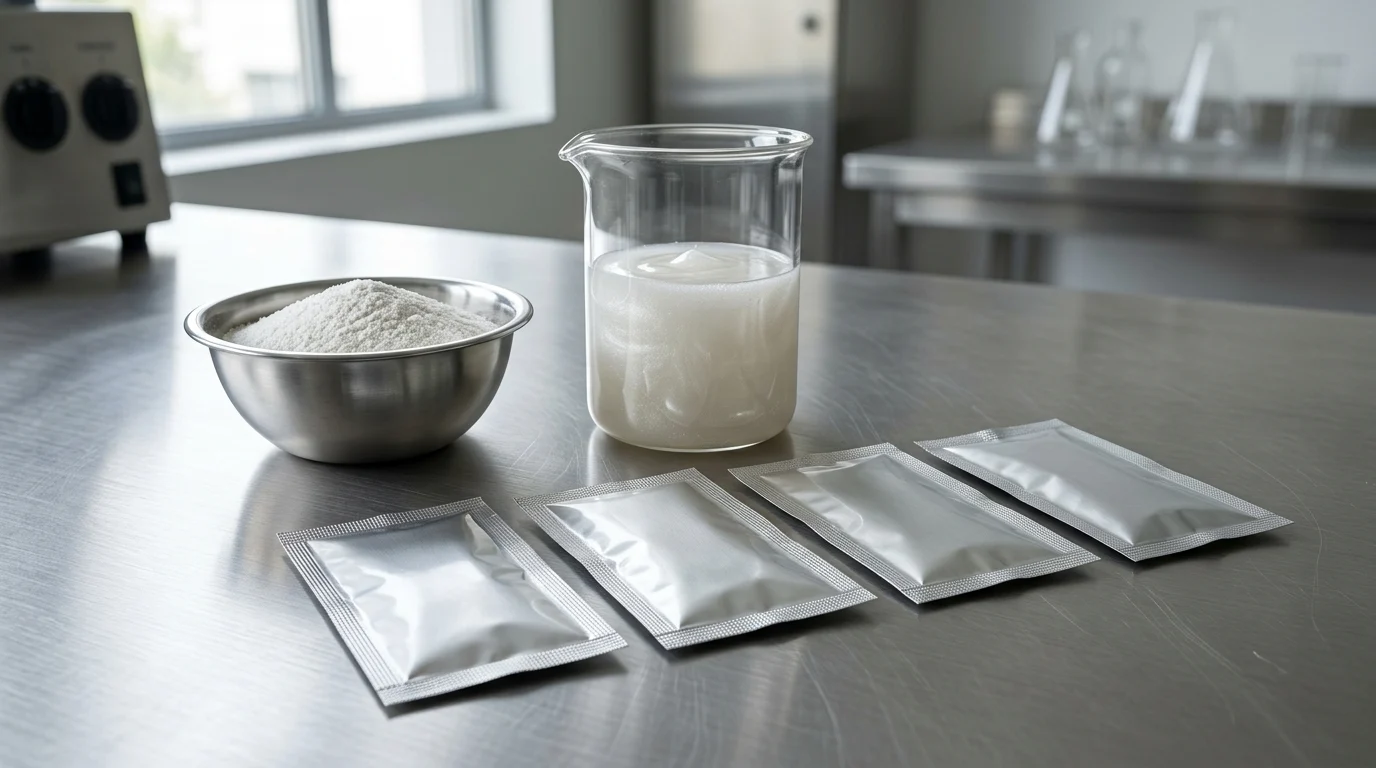
Selecting powder shampoo sachet packaging machines versus liquid shampoo sachet lines starts with separating the dosing head, seal-zone contamination control, and barrier laminate specification for each format. Waterless surfactant powders and viscous liquid shampoos behave differently inside the hopper, at the filling discharge, and between the heated sealing jaws.
When planning a personal-care sachet project, use this engineering comparison alongside our shampoo sachet application overview to scope separate trial records for dry powder blends and liquid formulations.
| Review area | Powder shampoo sachet review | Liquid shampoo sachet review | Decision to record |
|---|---|---|---|
| Dosing hardware | Vertical auger screw configuration, agitation mode, and hopper venting | Piston pump stroke, rotary valve, and nozzle tip shut-off | Which dosing head matches each formulation? |
| Dose stability | Bulk density shifts, aeration during conveying, and shutdown cleanout | Shear-dependent flow, temperature equilibration, and degassing | Which variables must stay locked during trials? |
| Seal contamination | Unwind static charge, airborne dust, and metallised film behavior | Viscous stringing, drip cut-off, and warm bottom-seal load | How will the seal land stay clean before jaw closure? |
| Laminate and checks | Moisture vapor transmission, peel force, hot tack, and gross leak method | Film mark registration, peel force, hot tack, and water quality records | Which package checks govern release? |
Compare powder servo-auger and liquid piston sachet architectures
Waterless powder shampoo and liquid shampoo require distinct metering assemblies on a vertical four-side-seal sachet frame. Compare the powder sachet machine family with the liquid and paste sachet machine family before writing a multi-product equipment brief.
The LINEVO multilane powder sachet packaging machine is a multi-lane four-side seal sachet bagger with an independent servo auger dosing matrix and passive dust-controlled sealing.
In LINEVO Independent Multi-Lane Servo Auger Dosing, each lane uses an independently servo-driven vertical dosing screw to control powder delivery, and dose settings and feeding behavior are validated with your waterless powder shampoo blend during factory sample trials.
For viscous liquid and paste personal-care sachets, review the rotary-valve piston configuration and its catalog parameters.
The LINEVO LV-500SY / LV-700SY / LV-980SY configuration is a multi-lane four-side-seal sachet machine with rotary-valve piston dosing for viscous liquids, gels, and pastes (5–100 ml, 500/700/980 mm web widths).
On the LINEVO SY series product page, Daily Cosmetics & Chemicals applications include shampoo, hair conditioner, body lotion, liquid soap, laundry detergent, and facial cream.
LINEVO Rotary-Valve Piston Dosing uses an anti-drip piston pump to meter thick liquids, and our engineers validate fill settings and nozzle cut-off behavior with your liquid shampoo or conditioner formulation at the target volume.
The LINEVO SY series lists 2–4 / 3–10 / 4–16 lanes for viscous liquid in a 4 sides sealing sachet with a 5–100 ml filling range (can be extended up to 500 ml).
The LINEVO SY series lists bag length 45–160 mm, bag width 50–125 mm, maximum film width 500 / 700 / 980 mm, and packing speed 20–40 cuts/min.
On the LINEVO SY series, packing speed is measured in machine cycles per minute where each cycle cuts one pack in every lane.
The LINEVO SY series lists voltage 220 V, 50/60 Hz, power 4 / 5.5 / 7 kW, machine weight 650 / 850 / 1000 kg, and machine dimensions 1540 × 1375 × 2270 / 1790 × 1445 × 2340 / 1940 × 1600 × 2650 mm.
The LINEVO SY series specifies PLC Control + Touch Screen HMI, Food Grade Stainless Steel SUS304 machine material, and compressed air consumption of 0.6–0.8 MPa, 0.35 m³/min.
The LINEVO SY series includes a Photoelectric Eye Tracing System in which an optical sensor automatically detects and aligns film color marks to secure cutting patterns and uniform sachet dimensions.
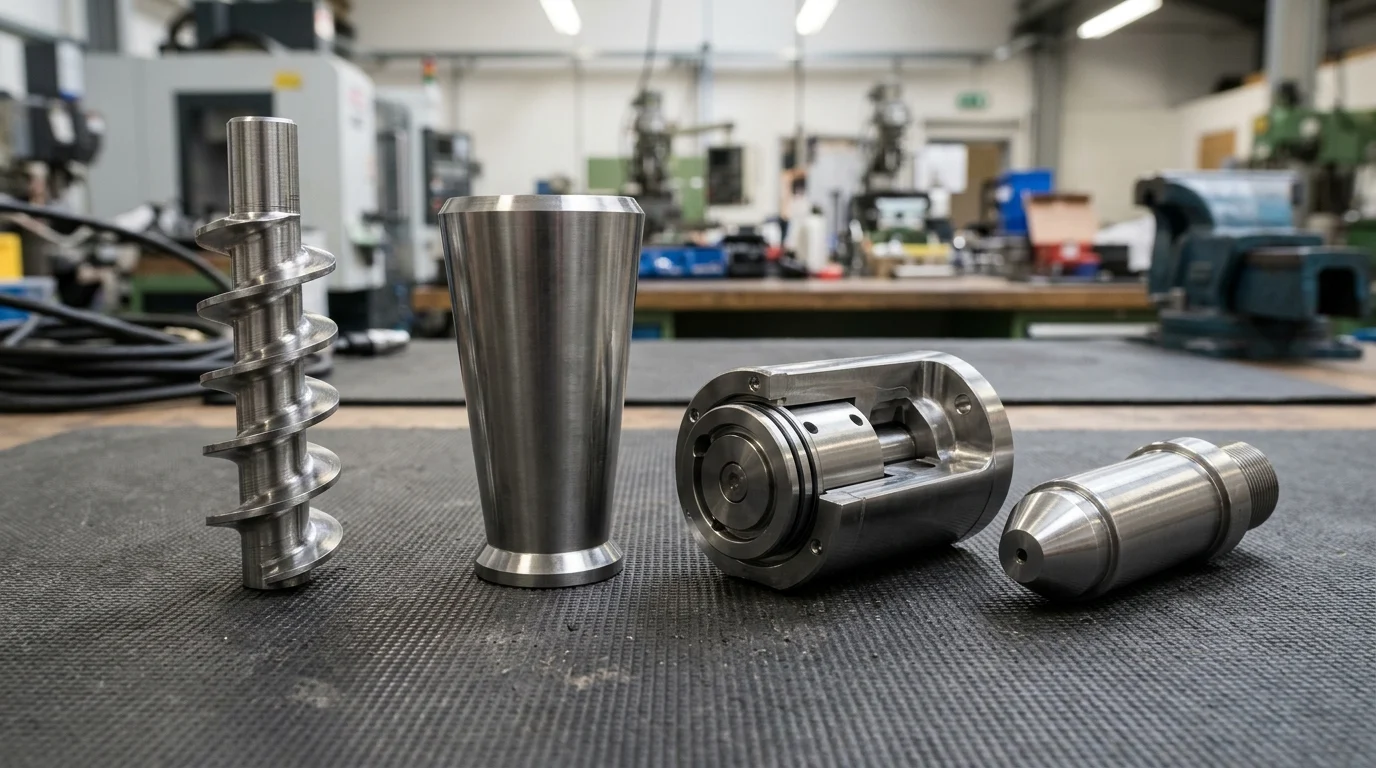
Dosing screw and piston cylinder bench comparison for powder and liquid shampoo sachets.
Control bulk density and select auger tooling for powder shampoo
Review how bulk density, hopper pressure, and auger accessories interact during a dry powder run, and see our auger versus volumetric cup filling comparison if you also pack coarse bath salts or granular personal-care products.
Inherent to its design, an auger dispenses a specific volume of product for each revolution, so if bulk density (mass per physical volume) shifts, the dispensed weight per revolution changes unless head pressure and agitation stay consistent.
Surfactant and botanical powder blends can shift in bulk density due to ambient humidity, aeration during pneumatic or screw conveying, milled particle size distribution, improper agitator blade speed, fluctuating hopper level, or excessive screw RPM.
Equalizing pressure in the hopper by venting it through a dust-filtered breather to atmospheric pressure helps stabilize bulk density, especially when incoming powder has been aerated during conveying.
On our powder sachet machines, we match the auger screw, funnel discharge, and agitation speed to the flow classification of your dry shampoo blend:
- Free-flowing powder blends: Configured with a straight auger screw and funnel, a spinner plate or positive-cutoff collector funnel assembly to prevent dribble between cycles, and slow-speed agitation to avoid aerating the blend.
- Cohesive or non-free-flowing surfactant blends: Configured with a self-feeding auger screw, a lip funnel with a drip washer to hold the powder column cleanly at the nozzle exit, and matched agitation to prevent bridging above the screw intake.
Closed-loop servo auger drives eliminate the coasting and mechanical slippage seen in older clutch-brake fillers, maintaining repeatable revolution counts across every lane.
For free-flowing granular personal-care products such as coarse bath salts or exfoliating beads, a volumetric cup filler can also be selected where product flows from a holding hopper into a rotating telescopic cup that is leveled off before discharge across cup volumes from 4 ml up to multi-liter formats.
Manage non-Newtonian rheology, air bubbles and nozzle cut-off in liquid shampoo
Liquid shampoos, pearlescent washes, and conditioning gels require flow characterization under defined shear and temperature conditions before sizing the pump manifold and filling nozzles.
Viscosity measures a fluid's resistance to flow and governs how the formulation behaves through the hopper manifold, rotary valve, and filling nozzles.
Non-Newtonian fluids such as shampoos, conditioning gels, and cosmetic emulsions exhibit shear-thinning behavior where apparent viscosity changes with shear rate across the pump stroke.
For repeatable viscosity measurement and trial setup, the formulation must be homogeneously mixed, free of entrained air bubbles, and equilibrated to the target filling temperature because surfactant viscosity is strongly temperature-dependent.
Entrained air bubbles in a surfactant gel or shampoo distort both viscometer readings and volumetric piston dosing accuracy, so trial batches should be deaerated or allowed time for micro-bubbles to settle before filling.
On our liquid sachet filling heads, each nozzle is fitted with a positive tip shut-off valve and programmable suck-back stroke so viscous shampoo cuts off cleanly without stringing onto the horizontal seal land.
Prevent static dust attraction and thermal-transfer loss in the seal zone
Use the sachet sealing problems checklist alongside the static and thermal-transfer principles below when inspecting rejected packs.
High static charges generated when packaging film unwinds from the parent roll attract airborne surfactant dust onto the inner sealant surface and into the seal zone, preventing complete polymer fusion.
In vertical form-fill-seal powder applications, an ionizing bar (such as a Meech 314IPS pulsed DC bar) can be mounted ahead of the forming shoulder to neutralize static charges on the inner web surface, paired with dust extraction at the filling tube exit.
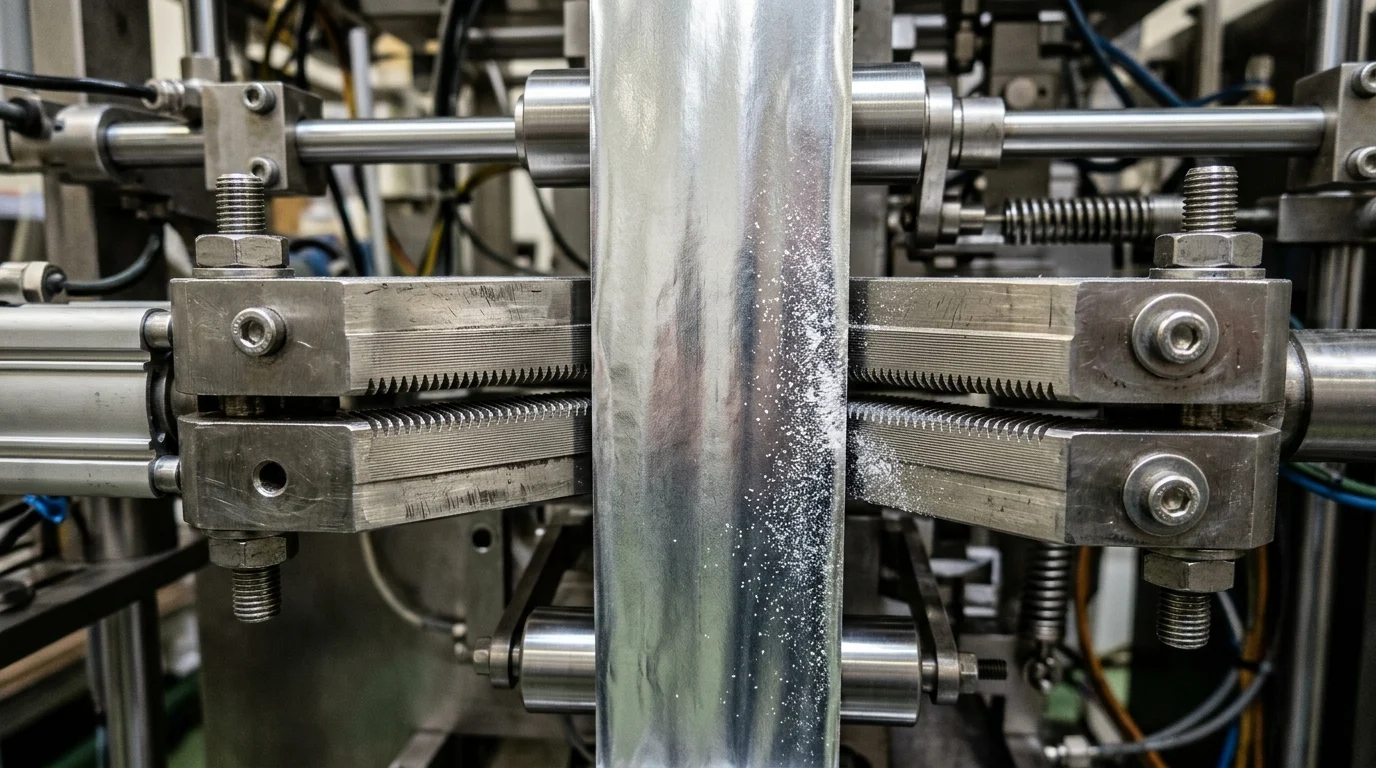
Metallised film web and serrated sealing jaws inspection on a four-side-seal sachet station.
Once the web enters the sealing station, jaw force, contact time, and temperature govern heat transfer into the sealant layer.
Three interdependent parameters control heat sealing—jaw temperature, closing pressure, and dwell time. Higher jaw pressure improves surface contact across multi-lane film webs, while adequate dwell time allows conductive heat to reach the inner sealant interface without scorching the outer print layer.
Across four-side-seal sachet lines, the primary seal checks are seal integrity (absence of micro-channels), cooled peel strength, and hot tack—the immediate strength of the hot bottom seal when supporting the dropped powder or liquid dose before cooling.
As machine cycle speed increases and dwell time shortens, the effective sealing temperature window narrows, so jaw alignment, tooth profile, and PID temperature uniformity must be verified at the target production speed so thermal transfer remains consistent across all lanes.
Qualify barrier laminates, seal strength and cosmetic hygiene
Specify the laboratory barrier and seal methods together with cosmetic hygiene checks before production sign-off.
Moisture barrier and seal evaluation methods
ASTM International standard F1249 is the Standard Test Method for Water Vapor Transmission Rate Through Plastic Film and Sheeting Using a Modulated Infrared Sensor.
The purpose of the WVTR test method is to obtain reliable values for the WVTR of plastic film and sheeting, as WVTR is an important property of packaging materials that can often be directly related to shelf life and packaged product stability.
The water vapor transmission test method covers a procedure for determining the rate of water vapor transmission through flexible barrier materials up to 3 mm (0.1 in.) in thickness, consisting of single or multilayer synthetic or natural polymers and foils, including coated materials.
ASTM International standard F2029 is the Standard Practices for Making Laboratory Heat Seals for Determination of Heat Sealability of Flexible Barrier Materials as Measured by Seal Strength.
In ASTM International standard F88/F88M (Standard Test Method for Seal Strength of Flexible Barrier Materials), seal strength is a quantitative measure for use in process validation, capability, and control.
The seal strength test method measures the force required to separate a test strip of material containing the seal and identifies the mode of specimen failure.
ASTM International standard F1921 is the Standard Test Methods for Hot Seal Strength (Hot Tack) of Thermoplastic Polymers and Blends Comprising the Sealing Surfaces of Flexible Webs.
The hot tack test methods cover laboratory measurement of the strength of heatseals formed between thermoplastic surfaces of flexible webs immediately after a seal has been made and before it cools to ambient temperature (hot tack strength).
ASTM International standard F2096 is the Standard Test Method for Detecting Gross Leaks in Packaging by Internal Pressurization (Bubble Test).
Method sensitivity is down to 250 μm (0.010 in.) with an 81 % probability. This test method may be used for tray and pouch packages. The sensitivity of this test method has not been evaluated for use with porous materials other than spunbonded polyolefin or with nonporous packaging. This test method is destructive in that it requires entry into the package.
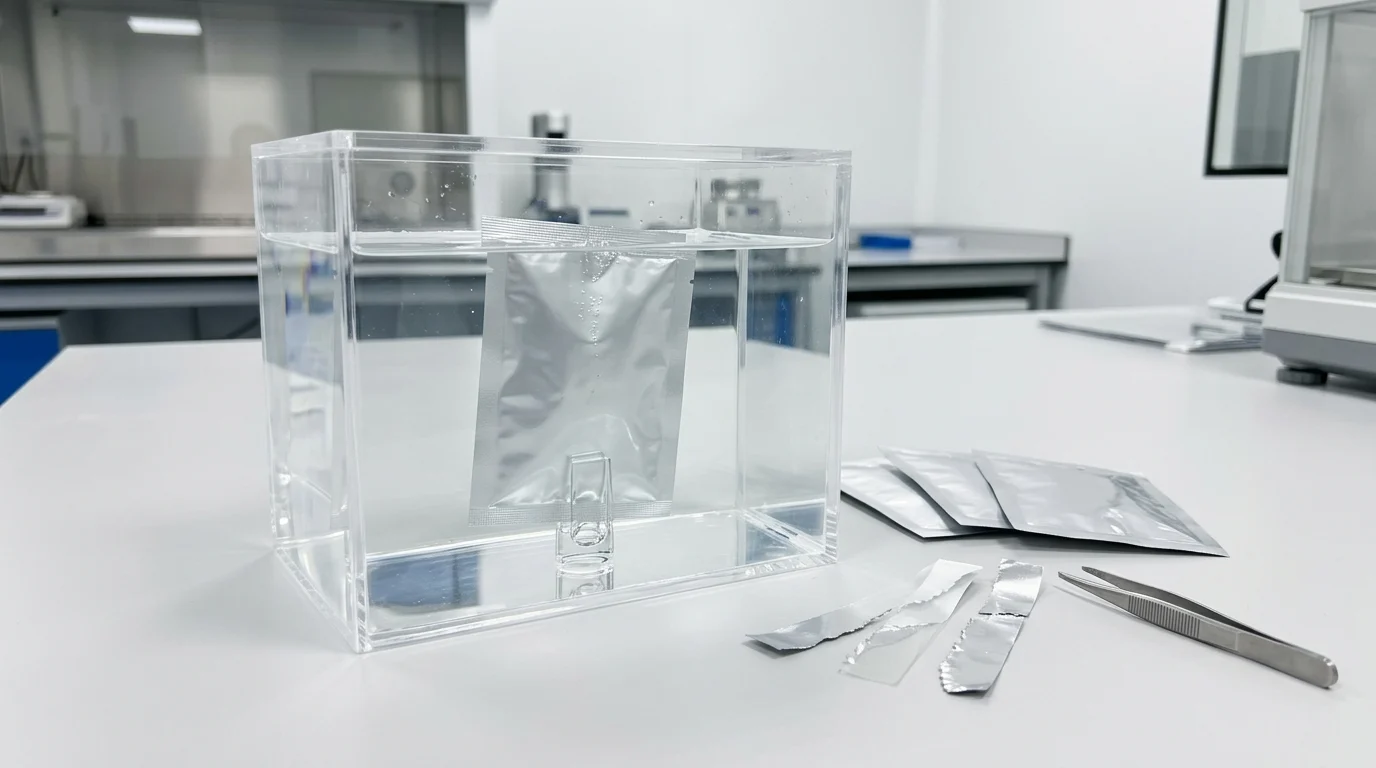
Barrier sachet peel strip and leak check workbench for four-side-seal sachets.
Cosmetic equipment, material storage and water controls
FDA Cosmetic Good Manufacturing Practice inspection guidelines check whether equipment and utensils used in processing, holding, transferring and filling are of appropriate design, material and workmanship to prevent corrosion, buildup of material, or adulteration with lubricants, dirt or sanitizing agent.
FDA Cosmetic Good Manufacturing Practice inspection guidelines check whether cleaned and sanitized portable equipment and utensils are stored and located, and cosmetic contact surfaces of equipment are covered, in a manner that protects them from splash, dust or other contamination.
FDA Cosmetic Good Manufacturing Practice guidelines check whether raw materials and primary packaging materials are stored and handled in a manner which prevents their mix-up, contamination with microorganisms or other chemicals, or decomposition from exposure to excessive heat, cold, sunlight or moisture, with containers of materials closed.
FDA Cosmetic Good Manufacturing Practice laboratory control guidelines check whether the water supply, particularly the water used as a cosmetic ingredient, is tested regularly for conformance with chemical-analytical and microbiological specifications, and whether finished products are tested for adequacy of preservation against microbial contamination.
Prepare a dual-format shampoo sachet quotation and trial packet
When requesting a proposal for powder shampoo sachet packaging machines, liquid shampoo sachet machines, or a plant running both formats, include the following project inputs:
- Product format identity, bulk density range and flow behavior for powders, or shear-dependent viscosity and fill temperature for liquids.
- Target dose per sachet, finished sachet width and length drawing, and four-side-seal layout.
- Candidate barrier laminate structure, inner sealant resin, roll width, and optical eye-mark layout.
- Required auger tooling or anti-drip nozzle configuration, hopper cleanout access, and changeover sequence between formulas.
- Agreed package evaluation methods for water vapor transmission, cooled peel force, hot tack, and gross leak inspection.
Send your powder or liquid shampoo formulation details, sachet drawing, and film specification on WhatsApp to review the machine configuration and trial plan with our engineering team.
Frequently asked questions
How are multi-lane powder shampoo sachet configurations specified and sampled before quotation?
LINEVO engineers develop an application-specific specification covering output, pack-size range, machine dimensions and utilities for the product and packaging format.
LINEVO states that a representative sample test helps resolve material-specific questions before quotation, and buyers should not ship physical samples until the team has confirmed the quantity needed and where to send them.
Use the sample-testing page to coordinate powder and liquid trial materials before dispatch.
Why does an auger filler drift during a powder run or after a line shutdown?
A previously accurate running auger filler may start to drift because changes in the ambient environment can distort the basic flow characteristics of the product.
An accumulation of powder allowed to sit in the hopper during a shutdown can cause an auger filler to act out of control after startup, so orderly cleanout before shutdown is used to eliminate these inaccuracies.
Can ionizing bars above the sealing jaws eliminate static on metallised shampoo sachet films?
Conductive metallised foil laminates shield internal static fields when the web is closed, so ionizing bars must neutralize the inner sealant surface ahead of the forming and slitting assembly before the web folds around the filling tubes.
When troubleshooting heat-seal integrity on powder sachets, we inspect both the inner sealant surface for electrostatic dust contamination and the serrated sealing jaws for build-up or uneven pressure distribution.
Can a laboratory heat-seal curve set production sealing parameters directly?
Care must be taken when applying a laboratory heat seal curve study to manufacturing equipment, as the heat seal curve and corresponding seal strength data are intended to provide a starting point for determination of sealing conditions for full scale manufacturing equipment.
Testing of seal strength of heat seals formed by laboratory practices refers to Test Method F88 for testing heat seal strength, while hot tack testing is covered in Test Methods F1921.
Sources
- LINEVO — Multi-Lane Powder Sachet Packaging Machine with Servo Auger Filler
- LINEVO — Four-Side Seal Viscous Liquid and Cosmetics Sachet Machine Series (LV-500SY / LV-700SY / LV-980SY)
- Meech International — Vertical Form Filling Static Control Application Note
- AMETEK Brookfield — Guide to Accurate Viscosity Measurement
- ASTM F1249 — Standard Test Method for Water Vapor Transmission Rate Through Plastic Film and Sheeting Using a Modulated Infrared Sensor
- ASTM F2029 — Standard Practices for Making Laboratory Heat Seals for Determination of Heat Sealability of Flexible Barrier Materials as Measured by Seal Strength
- ASTM F88/F88M — Standard Test Method for Seal Strength of Flexible Barrier Materials
- ASTM F1921/F1921M — Standard Test Methods for Hot Seal Strength (Hot Tack) of Thermoplastic Polymers and Blends Comprising the Sealing Surfaces of Flexible Webs
- ASTM F2096 — Standard Test Method for Detecting Gross Leaks in Packaging by Internal Pressurization (Bubble Test)
- U.S. FDA — Good Manufacturing Practice Guidelines and Inspection Checklist for Cosmetics