

Granule Sachet Packing Machines
Choose a granule sachet packing machine by particle size, flow and bulk density. Cup filling versus weighing, and what to send us for a quote.
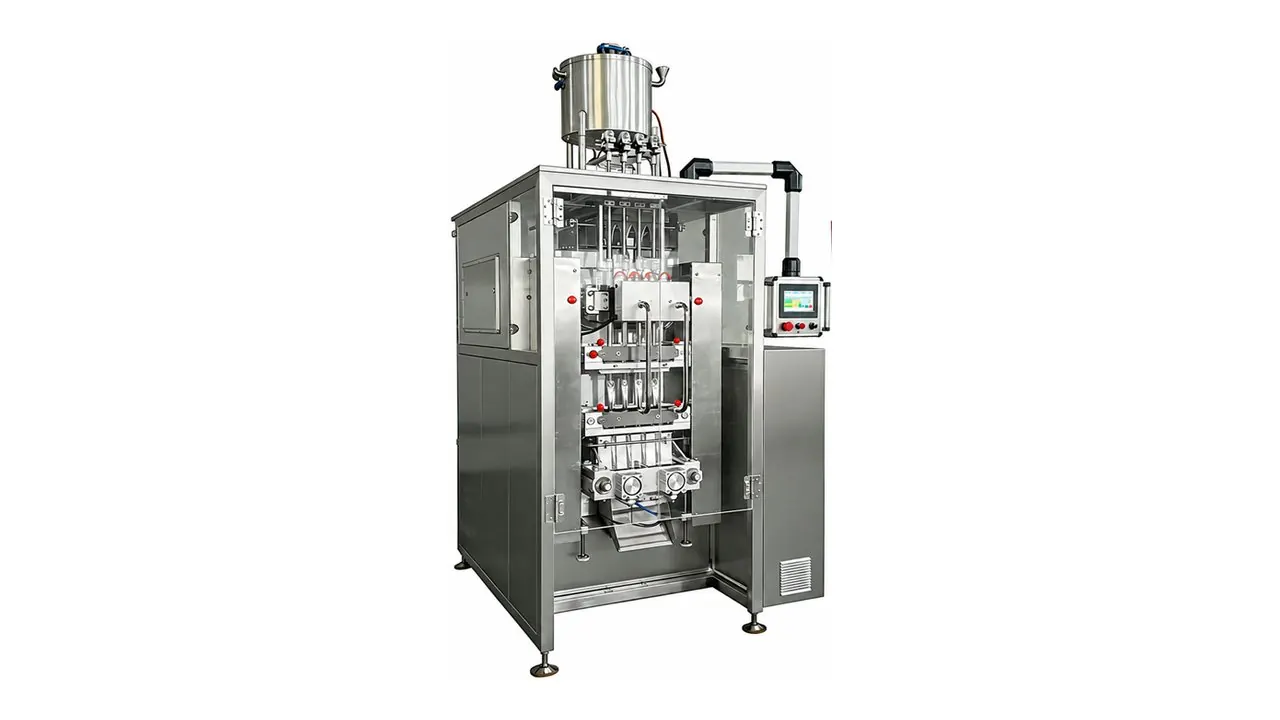
A granule sachet packing machine doses a free-flowing, particulate product into flat sachets and seals them. Granules pour well, which makes them look easy, but they vary in size, shape and density. Those differences decide whether a volumetric cup is accurate enough or whether you need to weigh each dose.
Fill ranges, speeds and accuracy depend on your granules, so we run a sample of your product before we write any dose tolerance down. Bulk density is the number that matters most, and we would rather measure it than guess.
Which granule properties decide the configuration?
Several properties matter more than the product name.
- Particle size sets how fine the cup or feed channel must be, and whether the seal can close around the product. A mix of large and small particles is harder to dose consistently than a uniform one.
- Round granules flow like liquid. Flakes, needles and irregular crystals bridge, interlock and pack unevenly.
- Most granules flow freely, which is why gravity-fed filling suits them. Stickiness from moisture or oil changes that.
- Bulk density is the weight of a given volume. A cup fills by volume, so this is the number that turns a cup size into grams.
- Some granules break when tumbled or dropped. The fines and dust that result change both the dose and the seal.

Illustration: shape and size differences between granule types change how they flow, pack and fill a measuring cup.
Sugar and sweeteners, salt, instant drink granules and seasoning crystals are the usual products. Sugar has its own page, sugar sachet packing. If your product carries a lot of fines or behaves like a powder, powder sachet packing machines cover auger dosing and dust control in more detail.
Volumetric cup filling or weighing?
Volumetric cup filling
A cup filler measures a fixed volume of granules and drops it into the sachet. It is simple, compact and a good match for uniform, free-flowing product. Because it measures volume, the dose in grams moves with bulk density. If density varies between batches, or the granules settle, the weight per sachet moves with it. You can usually adjust the cup size to set the dose.
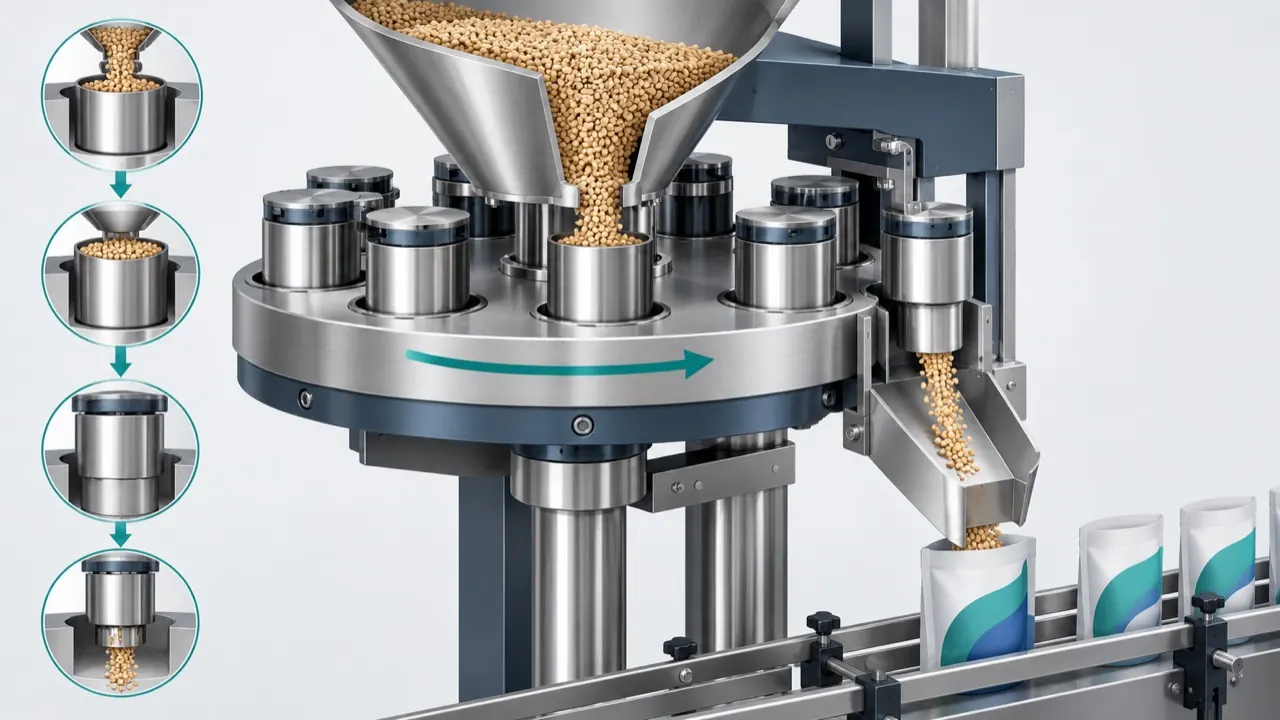
Illustration: a measuring cup fills from the hopper, then empties into the forming tube, so the dose is set by volume.
Weighing
Weighing systems measure by weight, so density changes bother them less. They add mechanical and control complexity, and how well they fit a small sachet depends on the arrangement. Whether the extra complexity pays off depends on how tight your dose tolerance is and how much your product varies.
Comparison
| Factor | Volumetric cup | Weighing |
|---|---|---|
| Basis of dose | Volume | Weight |
| Effect of bulk density change | Dose in grams changes | Largely compensated |
| Best suited to | Uniform, free-flowing granules | Tighter weight tolerance or variable product |
| Complexity | Simpler | More complex |
| Sensitivity to fines and fragility | Fines can pack differently in the cup | Depends on the feeding method |
Neither is better in general. If your density is stable and your tolerance is reasonable, start with a cup and prove it on your granules. Move to weighing only when the numbers show you need it. Any accuracy figure needs its test conditions attached, and we do not promise one without a run on your product.
Product in the seal and dust from fines
A granule can lodge between the sealing surfaces as the sachet closes. One hard particle in the seal can leave a channel for air or moisture to get in. Fines from crushed granules add dust that acts like contamination.
What helps depends on the product and has to be checked on a run:
- how the product falls into the tube, and how long it takes to settle before the seal;
- a seal pattern and film that tolerate some contamination;
- dust extraction near the jaws when fines are present;
- sachet length that leaves enough clean film at the seal.
A 4-side seal sachet has more seal edges. That helps against leaks, but it also gives product more places to interfere.
Sachet formats and lane configuration
Granule sachets are commonly 3-side or 4-side seal flat packs. Cup fillers are compact enough to sit across the film width, so one cycle can make several sachets. Sachet width, film width and the filler layout limit the lane count, and multi-lane sachet machines explains how lanes feed theoretical output. For the wider decision, the sachet machine selection guide ties product, format and output together.
What to send for a quote
- the product name and a description of the granules, including size range and shape;
- bulk density or a rough figure, and variation between batches;
- the target dose per sachet in grams;
- sachet type, approximate size and film, if you have chosen one;
- target output and desired lane count;
- how fragile the product is and whether fines are present;
- any food-contact or hygiene requirements that affect materials and cleaning.
A sample of the real product is the most useful thing you can send, and you can arrange that through product and film trials.
Questions about granule sachet machines
Is a cup filler accurate enough for granules?
It can be, for uniform, free-flowing granules with a stable bulk density. If density varies or the tolerance is tight, weighing may fit better. A trial on your product tells you which case you are in.
Why does my dose change from batch to batch?
A cup fills by volume. When bulk density changes between batches, the same volume weighs a different amount. Check your density range and share it when you ask for a quote.
Can the same machine pack granules and powders?
Sometimes, but the dosing method usually differs, because powders generally need an auger. If you plan to run both, tell us the products and we will see whether one configuration can handle them.
Can granules be packed in 4-side seal sachets?
Yes. Granules are commonly packed in flat sachets with 3-side or 4-side seals. The seal still has to be checked for trapped product on your particular granules.
LINEVO catalog example
Configurations from the LINEVO sachet catalog. Figures are catalog listings, not guaranteed performance: every value is confirmed for your product, film and sachet in the written quotation.
LV-350X
Four-side seal granule sachet machine
Listed products
Instant drink granules, herbal granules, sugar and seasoning packets
Catalog listing
- Fill range
- 1 to 50 g
- Sachet length
- 50 to 180 mm
- Sachet width
- 30 to 80 mm per lane
- Seal format
- Four-side seal
- Lanes
- Four lanes in one cycle (catalog description)
Product photographs: authorized catalog images shared by Dession, LINEVO's sister team in the same company. Original markings may appear.
Not sure which configuration fits your product?
Send your product and pack details, or ask for a trial on your own material before you decide.