

Honey Sachet Packing: Record the Honey, Then Trial the Seal
Published by the LINEVO sachet equipment team. Technical questions and corrections
Planning a sachet packing machine for honey? Record the honey's condition, film and flat bag type, then compare nozzle cutoff and seal in a blank trial record.
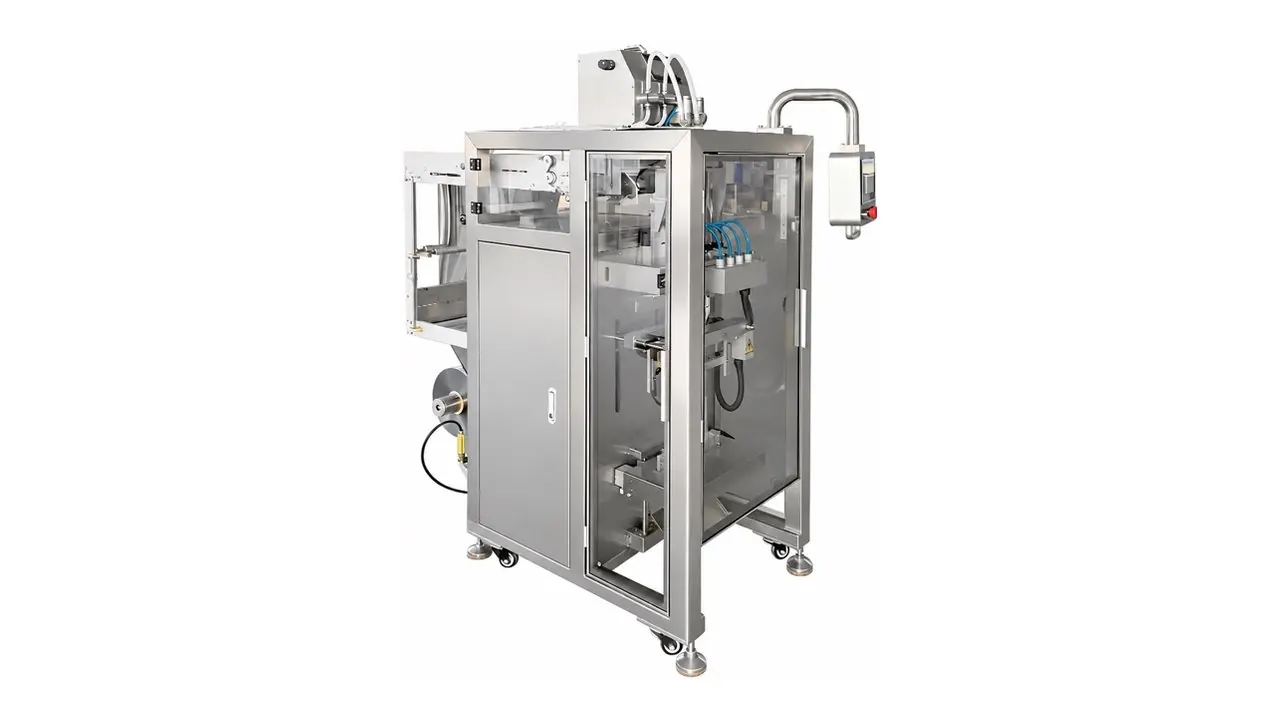
A honey tail left hanging from the nozzle can drop into the seal area, and honey caught in that seal can leave the sachet leaking or rejected. Before you buy a sachet packing machine for honey, write down the honey's actual condition and compare the dose cutoff and the seal on the film you plan to run; this guide covers single-serve flat sachets only.
| Input | What to write | Why it matters |
|---|---|---|
| Honey condition | Ordinary, crystallized, whipped or flavored, in your own words; "unknown" if you do not know | The sample condition affects flow through the hopper, pump, pipe and nozzle |
| Temperature as handled | The temperature with its unit, or "not measured", next to any viscosity value you already have | Cold honey may fill slowly or leave tails, and a viscosity value means little without its temperature |
| Nozzle tail and seal zone | Tail yes or no, where it lands, and whether the seal zone stayed clean | Honey caught in the seal can weaken it |
| Film and flat bag type | The film the trial will use, and 3-side or 4-side flat sachet, or "not chosen" | Cutoff and seal are compared on the film that will actually run |
What condition is this honey sample in?
Honey flow depends on its condition and temperature; honey that is too cold may fill slowly or leave tails at the nozzle, and excessive heating can affect quality. Set any proposed conditioning from the actual honey and its quality requirements.
The sample review distinguishes thick, crystallized, whipped and flavored honey as conditions that can behave differently in a hopper, pump, pipe and nozzle. Describe the sample you would actually run, in your own words: ordinary liquid honey, partly crystallized, whipped, or flavored with a named ingredient. If you do not know which it is, write "unknown". A guessed condition starts the trial from the wrong place.
Next to the condition, write the temperature the honey is at when it is handled, with its unit, or "not measured". If your lab already has a viscosity figure, put it beside the temperature it was measured at, and note whether the honey thins when pumped or stirred, if you know. Our liquid and paste sachet page asks for viscosity the same way, because a number without its temperature does not show how the product will behave. Do not estimate a viscosity nobody has measured.
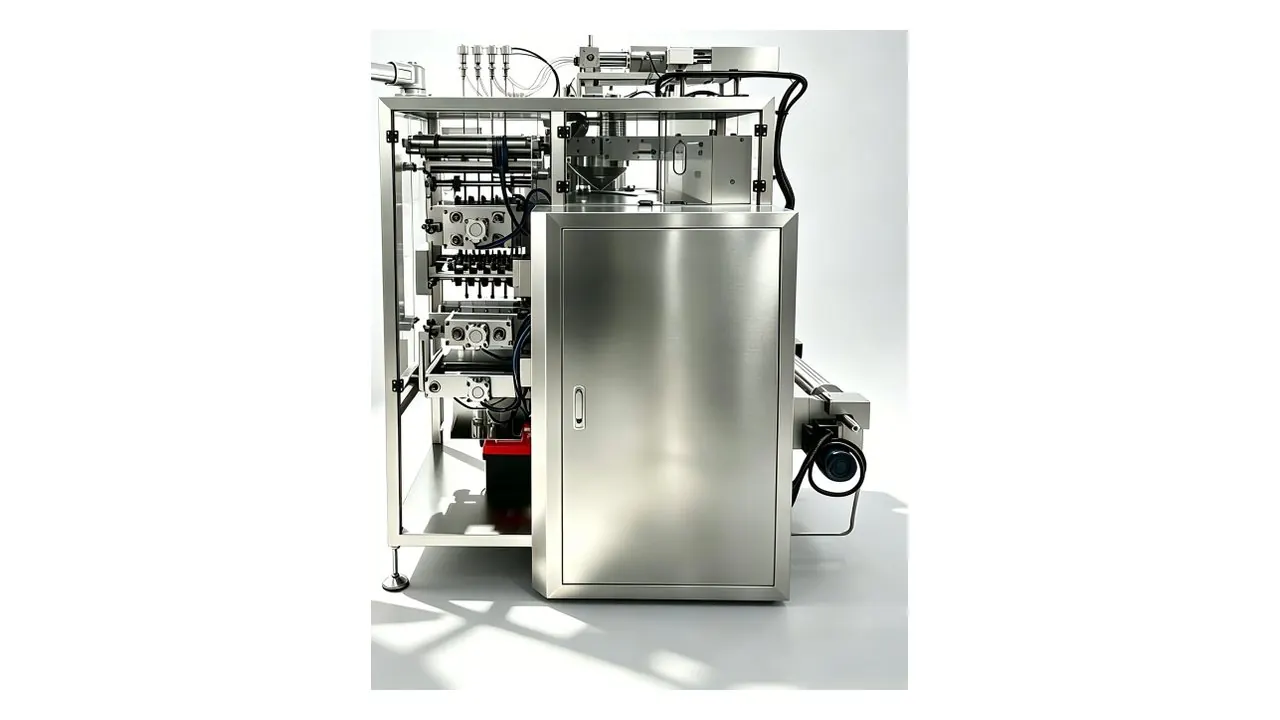
LINEVO catalog photograph. The open front guard exposes the filling and sealing area for configuration and access review. Catalog configuration reference for the trial plan.
Where does the dose end: a clean cutoff or a tail in the seal?
A flat sachet is formed from roll film, filled, sealed and cut. Observe the nozzle when the honey dose ends: a trailing strand or drip can reach the seal area and interfere with closure. Review the cut-off, the time before sealing and the actual production film together, then inspect the resulting pack under the agreed method.
In a honey trial, watch the moment the dose ends. Record whether a tail forms, where it lands (inside the pocket, on the inner film face, or across the future seal band), and whether the closed seal is clean or has honey in it. Make that observation on the film you intend to buy, because the comparison is about that film's seal.
Compare the proposed nozzle and seal arrangements using the same honey and production film, observing both dose cut-off and the finished closure.
Which film and which flat bag will the trial use?
Jars, bottles, flat sachets and narrow stick packs have different forming, filling and handling arrangements. Identify the intended consumer package first, including its opening and filled shape, so our engineering team can review the correct equipment boundary. If you have not yet chosen between the two single-serve formats, settle that first with sachet vs stick pack.
Identify the flat bag as three-side or four-side seal and provide its drawing. Our engineering team reviews the filling path, cut-off and sealing arrangement for that format. Keep a stick-pack or rigid-container proposal separate because its forming and handling sequence differs.
For the film, write the structure and thickness from your film supplier, or "not chosen". The trial compares cutoff and seal on that film, and a result on another film does not carry over.
LINEVO catalog photograph. Supply tubes and filling outlets are visible behind the guard. Review the quoted fluid path and access for cleaning. Catalog configuration reference for the trial plan.
What goes in the honey sample trial record?
Use this record to keep the product, configuration and observations together during the trial. It adds honey columns to the general trial record our sample-testing page uses, which covers product, state and fill, film and pack, machine configuration, run conditions, results and limitations. Fill one row per sample or condition. Leave a cell empty until someone has observed it: an empty cell is not a pass.
| Product and condition the buyer states | Temperature as handled, with unit, or "not measured" | Observed flow in the buyer's words | Nozzle tail: yes/no and where it lands | Dose target, unit, and how it will be checked | Film the trial will use | Bag type: 3-side or 4-side flat sachet, not stick | Seal zone: product in the seal or clean |
|---|---|---|---|---|---|---|---|
Take the dose target and unit from your own fill specification, and name the measurement method you will use. Write flow as you saw it, for example "slow, folds over itself", rather than as a number you did not measure.
What should you send first?
Three items are enough for a first reply. "Not chosen" or "unknown" is an acceptable answer for any of them.
| Item | Why we need it | Example format |
|---|---|---|
| Actual product | The honey's condition changes how it flows and whether it leaves a tail at the nozzle | "crystallized wildflower honey" with its temperature as handled and the unit, or "unknown" |
| Film | Cutoff and seal are compared on the film that will run | Structure and thickness, or "not chosen" |
| Bag type | Flat 3-side and 4-side sachets are a different job from sticks and jars | "4-side flat sachet" or "not chosen" |
Send those three items on WhatsApp. Our engineering team reviews the honey condition, target dose, flat-sachet format and film, then agrees the proposed filling arrangement and the sample inputs needed to assess cut-off and sealing.
Before you ship any honey, follow the sample-testing steps: send details and photos first, then wait for the agreed quantity and address. A trial covers only the product, film, dose, pack and running conditions it records.
Define the honey process and film trial
Agree the allowable handling temperature with the product team from its formulation and quality requirements. Record the actual honey temperature and any viscosity method beside the dosing and cut-off observations. If conditioning is proposed, compare the product before and after that treatment; a hopper setpoint alone does not establish its effect on quality, crystallization or flow. Review the complete contact path, cleaning access and the production laminate with our engineering team.
Keep dose and retraction arithmetic separate from trial outcomes
For a piston of bore D and stroke L, ideal swept volume is V = πD²L/4. Delivered mass is m = ρV_delivered at the recorded material condition; swept volume need not equal delivered volume. For ideal retraction geometry, V_suck = πD_spool²S/4 and L_retract = V_suck/(πd_nozzle²/4). These geometric relations do not prove that a honey thread will break or that the seal will remain clean.
Hypothetical arithmetic only: a 6 mm spool retracting 3.2 mm displaces about 90.5 mm³. In an assumed 4 mm bore that equals 7.2 mm of ideal liquid-column movement. Compressibility, air, valve behavior and actual flow can change the result. Observe the real cut-off. Net mass = gross mass − measured tare; convert to volume only with the density and temperature required by the agreed method.
Viscosity and trial temperature
Brookfield’s viscosity measurement guide explains why temperature belongs with a viscosity reading. Record both when comparing honey feed and cut-off conditions.