

Sachet Sealing Problems and Solutions: Trial Checklist
Published by the LINEVO sachet equipment team. Technical questions and corrections
When a flat sachet leaks or peels open, separate product contamination, jaw contact, peel strength and hot tack with a symptom decision tree and trial log.
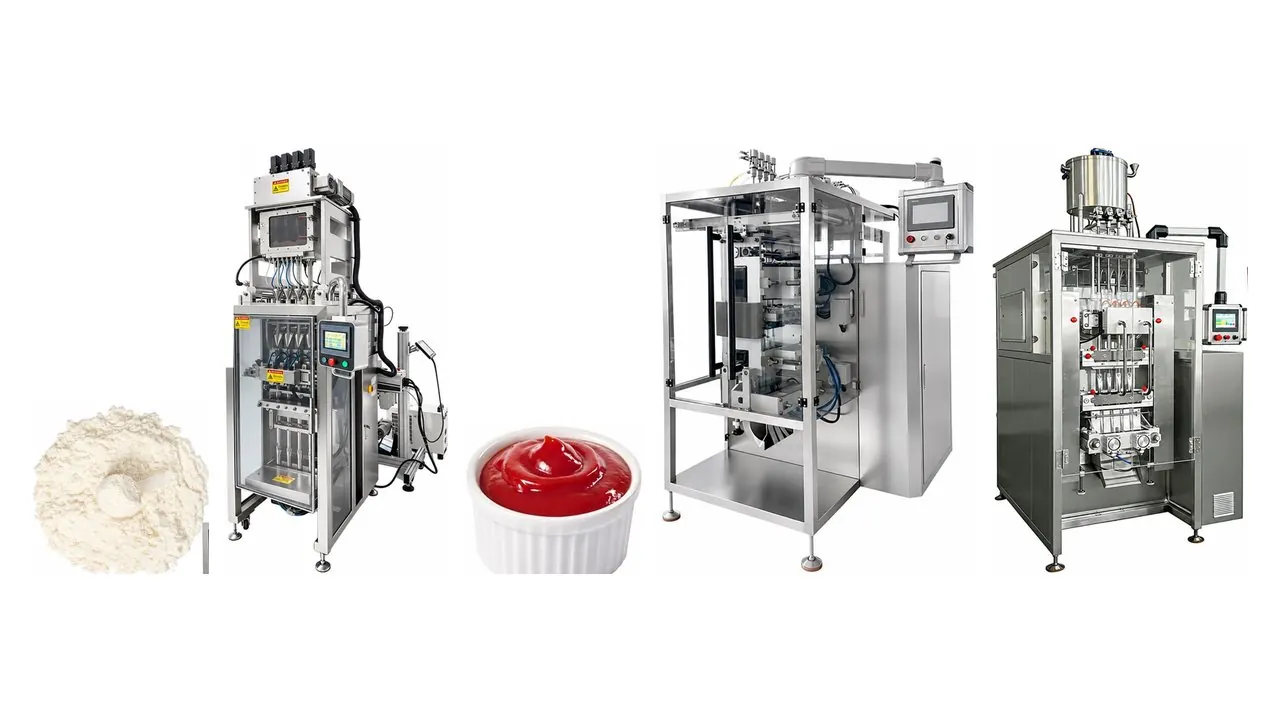
Turning up jaw temperature before locating a sachet leak can scorch the laminate, worsen warm-seal distortion, and bake product residue onto the sealing bars. When a flat sachet leaks or peels open, record the exact seal edge and lane first, then separate product contamination, jaw contact, cooled peel strength, and warm hot-tack handling before changing a single machine setting.
Use the decision table and trial log below to separate contamination, jaw contact, heat-sealing conditions and warm-seal loading. Change one input at a time, then repeat the agreed checks on your actual product and film.
| Input or observation to lock | What to record on the unit | Why it comes before a setting change |
|---|---|---|
| Exact failure location | Top cross-seal, bottom cross-seal, left/right side seal, fold, or corner overlap | Separates dosing contamination at the top seal from web tracking or overlap bridging |
| Lane identity (on multi-lane units) | Specific lane number vs all lanes across the web | One bad lane points to a nozzle, slitter, or local jaw wear; all lanes point to film, timing, or main jaw setup |
| Empty-pouch vs filled-pouch comparison | Whether dry empty film seals cleanly at the same speed and settings | If empty sachets seal tightly but filled sachets leak, investigate dosing cut-off, dust, or product weight first |
| Failure timing | Immediately at jaw opening/discharge (warm) vs after cooling and pressure testing | Distinguishes warm hot-tack separation from cooled seal integrity or peel-strength issues |
| Film roll and splice history | Roll lot ID, laminate structure, and whether failure started at a roll change | Identifies changes to investigate in winding direction, film structure, thickness or surface properties |
| Jaw surface and impression check | Visual cleanliness of serrations and an impression using the paper specified for the jaw type and temperature | Helps identify uneven contact for the machine technician to investigate before altering controller setpoints |
How do seal integrity, peel strength and hot tack differ on a flat sachet?
Separate seal integrity, seal or peel strength, and hot tack when recording a failed pack. They describe leakage paths, separation force and the strength of a still-warm seal, respectively. Select the test and observation timing for the property being assessed. A. Hatzopoulos’ sealing guide discusses these separate checks.
Heat sealing brings compatible sealant surfaces together under heat, pressure and contact time. The suitable settings depend on the converted film and sealing arrangement. Review the material’s sealing range with the film supplier and check temperature, dwell and jaw contact together.
| Seal property | What it measures | How failure looks on a flat sachet | Why raising temperature blindly can backfire |
|---|---|---|---|
| Seal integrity | Whether the fused band forms a continuous, leak-tight barrier with no open channels | Capillary leaks, pinholes, or unsealed paths through product residue, wrinkles, or multi-layer corner transitions | Extra heat bakes trapped powder or liquid into the seal and distorts film around unpressed channels |
| Seal / peel strength | The force required to separate the seal after the sachet has cooled to room temperature | Cooled seal peels open too easily in transit, or welds so hard that the tear notch cannot open the pack cleanly | The usable sealing range depends on the material and running conditions; excessive heat can distort or damage the film |
| Hot tack | The strength of the seal while it is still warm immediately after the sealing jaws open | "Mooning" (crescent-shaped pull-back) or full opening at the cross-seal as the product drops or the knife acts | Too much heat keeps the sealant molten longer after jaw release, reducing its warm holding strength |
Greener Corporation’s sealing guidance describes an effective range between seal initiation and film distortion under the operating conditions. Faster cycling reduces the available heat-transfer time, while slowdowns can increase it. Review jaw contact, dwell and temperature together against the film’s sealing window. If packs open while warm, investigate hot tack and discharge loading, then verify both cooled seal strength and leakage after any adjustment.
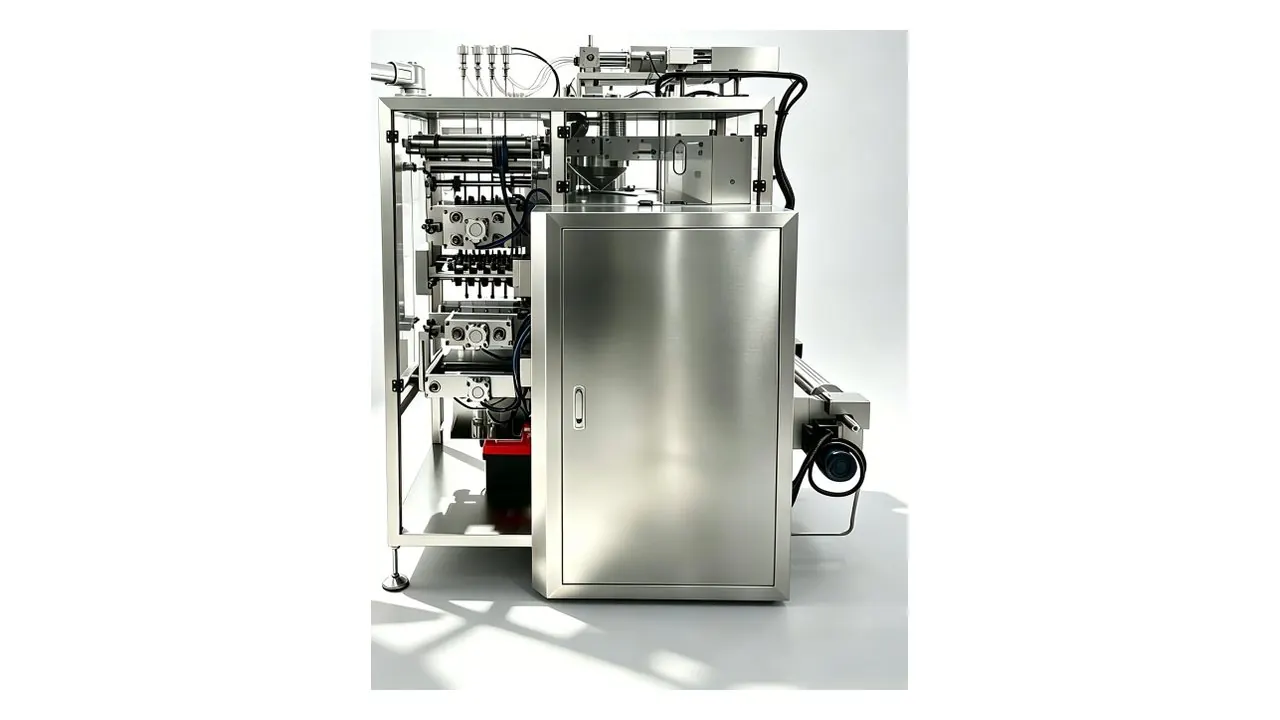
LINEVO catalog photograph. The open front guard exposes the filling and sealing area for configuration and access review.
Which symptom points to contamination, jaw contact or film condition first?
Inspect rejected sachets by edge and by lane before adjusting the machine. A 3-side or 4-side seal sachet has distinct stress zones: the longitudinal side seals, the bottom cross-seal that takes the fill drop, the top cross-seal that closes through the dosing path, and the corner intersections where side and cross seals overlap.
Use this symptom-to-check decision tree to pick the first physical check:
| Observed symptom & location | First physical check (before changing settings) | Primary mechanism to rule in or out | Next controlled action |
|---|---|---|---|
| Leaks at the top cross-seal only on filled sachets (empty film seals cleanly) | Watch nozzle cut-off for liquid tails/splash or check airborne dust settling on the seal band | Product contamination preventing sealant fusion (liquid dosing or powder dosing) | Check fill-to-jaw timing, nozzle shut-off, dust extraction, or wipe jaw faces; do not raise heat to burn through product |
| Seal strong on the left edge/lanes and weak or leaking on the right edge/lanes | Isolate machine per manual, clean jaw faces, and take an impression with the paper specified for the jaw type and temperature | Non-parallel jaws, uneven spring/clamping balance, worn serrations, or local heater/sensor fault | Correct mechanical jaw alignment or replace worn facing/silicone pads before altering controller temperature |
| Pinholes or leaks right where side seals overlap the top or bottom cross-seal | Inspect the multi-layer transition step (where 2 layers become 3 or 4 layers) and check film fold alignment | Insufficient resin flow or pressure bridging at sudden thickness transitions | Verify web forming alignment and jaw serration contact across the overlap; review laminate sealant thickness with the film supplier |
| Cross-seal stretches, "moons," or pops open immediately after jaw release or cut-off | Compare warm sachets at discharge against sachets allowed to cool undisturbed; check cross-seam residue | Hot-tack failure from warm mechanical stress or overheating the sealant past its melt window | Check whether reducing temperature (with verified jaw contact) or adding cooling air stabilizes the warm seal |
| Wrinkles or diagonal creases running through the sealed band | Trace film path from unwind roll through dancer rollers, slitter blades, and forming collar/guides | Uneven web tension, off-center roll core, or misaligned pull rollers (how sachet machines work) | Square the unwind roll and balance web tension upstream before adjusting the sealing station |
| Sudden weak or non-bonding seals across all lanes right after mounting a new film roll | Test which side of the web is the sealant layer and compare roll lot certificates | Incorrect winding or mating seal surfaces, film thickness changes, or changed surface properties | Verify film winding diagram and test a retained reference roll on the same machine settings |
How do you verify jaw contact and clean-seal conditions before touching temperature?
When a flat sachet fails a leak check, verify mechanical contact and seal-zone cleanliness before changing the recipe on the HMI. Converter and tooling troubleshooting guides highlight three checks that do not alter your baseline parameters:
- Inspect and clean the sealing tools. Melted film deposits, carbonized product residue, or damaged PTFE tape and silicone rubber backings create high and low spots along the jaw face. Follow the machine's lockout and safety isolation procedure before cleaning or inspecting any jaw assembly.
- Use the specified impression method. Greener’s carbon-impression guidance distinguishes paper choice by jaw type and temperature. Have a trained technician follow the machine-approved procedure and label the impression with machine, jaw pair, direction and test conditions. Uneven marks call for investigation of contact, alignment, pressure and wear. Plain paper can hide details, as Greener’s diagnostic examples demonstrate.
- Compare controller setpoints with actual jaw surface temperature. Distinguish the controller setpoint from its measured process value. The process value reflects the sensor location; neither value maps the temperature across the entire sealing face. If a heating element is aging or a thermocouple is loose, one section of the bar can run cold while the display looks normal.
Once jaw contact is verified, run a dry-cycle vs. wet/filled-cycle split check:
- Stop the doser and run a short strip of empty sachets on the same film roll at the same cycle speed.
- If the empty sachets pass your seal-integrity and peel checks, the film and jaw settings are capable of sealing at that speed. This directs the next checks toward conditions introduced during filling: powder dusting into the closing jaws, a viscous liquid string hanging from the nozzle, foam rising into the top seal zone, or product weight pulling on a warm bottom seal.
- On multi-lane sachet machines, label each strip by lane number (
Lane 1throughLane N) before cutting or collecting packs. Once loose sachets mix in a discharge chute, you cannot tell whether leaks are scattered across lanes or concentrated in one lane.
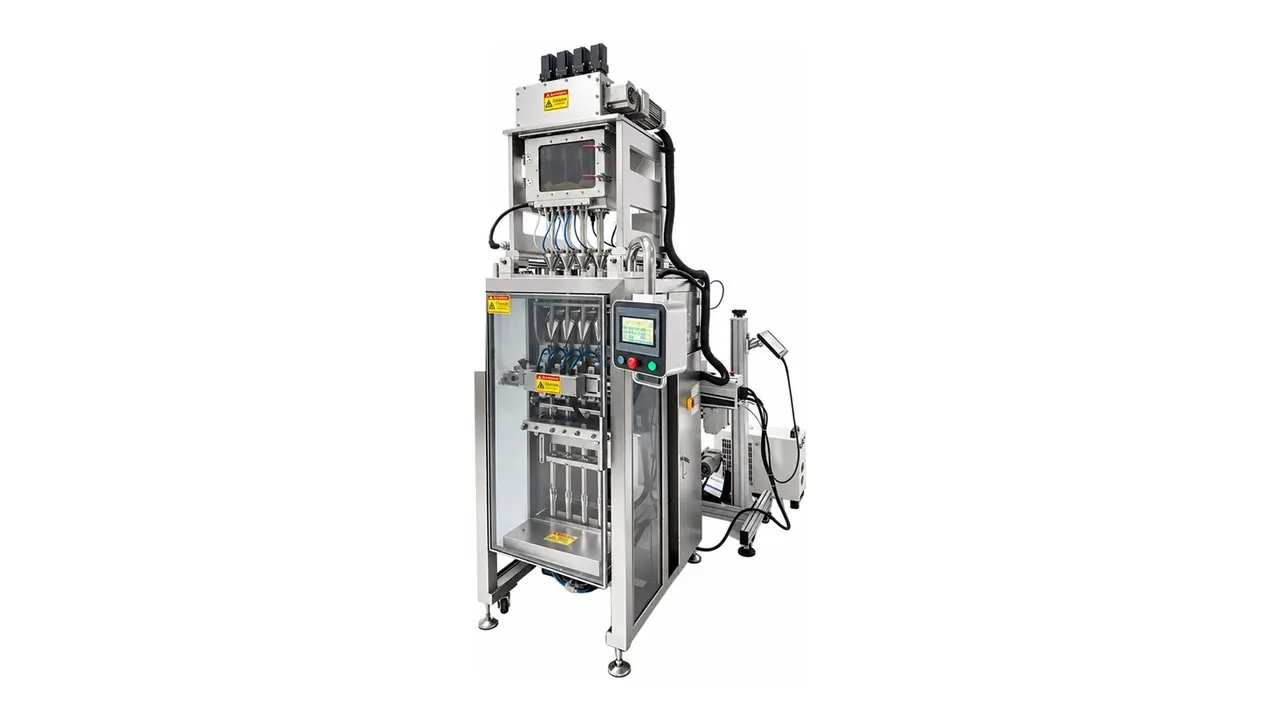
LINEVO catalog photograph. The servo drives and multiple powder outlets show the dosing arrangement above the forming and sealing section.
How do you log single-variable sealing trials by lane and seal edge?
When physical cleanliness and jaw alignment are confirmed and a parameter adjustment is still required, change one variable per run and record the result against a locked baseline. Changing temperature, cycle speed (dwell time), and jaw pressure at the same time makes it impossible to tell which adjustment solved the leak—or which one introduced film shrinkage or delamination.
Copy this blank Single-Variable Sachet Seal Trial Log for shop-floor troubleshooting or pre-shipment product and film sample testing. Leave any unmeasured cell as Unknown / verify on the unit rather than guessing a value.
| Trial record field | Baseline (Run 0) | Trial Run 1 (Change 1 variable) | Trial Run 2 (Change 1 variable) | Recording & verification rule |
|---|---|---|---|---|
| Product identity, batch & fill temperature | Unknown / verify on the unit | Lock to Run 0 | Lock to Run 0 | Keep identical across runs; record temperature with unit |
| Film roll ID, structure & total thickness | Unknown / verify on the unit | Lock to Run 0 | Lock to Run 0 | Same roll and splice state; note sealant layer material if known |
| Sachet format, width × length & seal width | Unknown / verify on the unit | Lock to Run 0 | Lock to Run 0 | Specify 3-side or 4-side seal and nominal seal band width |
| Lane number(s) & exact seal edge inspected | Unknown / verify on the unit | Lock to Run 0 | Lock to Run 0 | Sample and label specific lanes (L1, L2, etc.) and edges (Top, Bottom, Left, Right, Corner) |
| Jaw contact & cleanliness pre-check | Unknown / verify on the unit | Lock to Run 0 | Lock to Run 0 | Confirm clean serrations and even paper/NCR impression before Run 0 |
| Dosing state (empty dry film vs filled dose) | Unknown / verify on the unit | Record state | Record state | Run dry empty film first if contamination is suspected |
| Cycle rate (cycles/min) / effective dwell | Unknown / verify on the unit | Record setting | Record setting | Keep constant unless dwell time is the single variable under test |
| Longitudinal & cross-seal temperature (set vs measured) | Unknown / verify on the unit | Record setting | Record setting | Record both controller setpoint and verified surface reading if available |
| Jaw pressure / mechanical clearance setting | Unknown / verify on the unit | Record setting | Record setting | Record air regulator or mechanical setting with unit |
| Single variable changed in this run | Baseline (none) | Name the 1 change | Name the 1 change | If more than one input changed, mark the run invalid and repeat |
| Hot-tack observation (warm at jaw release/chute) | Unknown / verify on the unit | Record observation | Record observation | Note any mooning, stretching, or opening before the pack cools |
| Cooled seal integrity check (method & result) | Unknown / verify on the unit | Record result | Record result | State the buyer-agreed test method (e.g., vacuum/pressure leak check) and pass/fail count per lane |
| Cooled peel / opening observation | Unknown / verify on the unit | Record result | Record result | Note clean peel, film tear, delamination, or channel gap after full cooling |
| Disposition & quality sign-off | Unknown / verify on the unit | Retain / revise | Retain / revise | Signed by operator or quality owner; retain sample packs with the log |
How to read the completed trial log:
- If Run 1 (empty film) passes integrity checks while Run 0 (filled) fails at the top cross-seal: lock your jaw temperature and pressure back to Run 0 and work on the dosing station—nozzle tip diameter, suck-back or shut-off valve timing, fill drop height, or dust hood extraction.
- If cooled sachets pass peel strength in the center of the seal but leak at the four-layer corner or side-to-cross overlap: LD Pack's seal-failure analysis notes that sudden thickness changes at multi-layer intersections can prevent full resin fusion. Check whether the jaw serration pattern, pressure distribution, or film sealant thickness can caulk the transition step without scorching the two-layer area.
- If lowering cross-seal temperature in Run 1 reduces warm "mooning" at discharge: verify in the cooled integrity row that the lower temperature still achieves full fusion across all lanes and at the lowest-temperature point of the jaw cycle.
What to send when preparing a flat-sachet sealing trial
If you are evaluating a flat sachet packaging machine—or planning a pre-purchase trial for a product that is dusty, oily, stringy, or heat-sensitive—send the inputs below so we can review which dosing cut-off, seal pattern, and trial checks fit your pack.
| What to send us | Why we need it | Example format |
|---|---|---|
| Product form, handling temperature & contamination behavior | Identifies whether fine dust, oil film, liquid tails, or warm product load will reach the seal zone | Text note or spec sheet (e.g., seasoning powder, sauce at fill temperature, or lotion) |
| Sachet format, outer dimensions & seal width | Sets the 3-side or 4-side seal geometry, cavity volume, and multi-layer overlap areas | Dimensioned pack drawing or sample photo (mm × mm, tear notch position) |
| Film laminate structure & roll thickness | Confirms the inner sealant layer and total thickness before planning jaw setup | Film supplier datasheet (e.g., PET/ALU/PE thickness, or "not yet selected") |
| Target dose & lane requirement | Connects cycle rate and lane count to effective dwell time and per-lane inspection | Target g or ml per sachet and target output per minute or shift |
| Observed seal failure location (if troubleshooting an existing pack) | Pinpoints whether the issue is top cross-seal contamination, corner overlap, or hot-tack pull | Marked photo of failed sachets or completed rows from the trial log above |
Send your product details, film structure, sachet drawing, target dose, and any observed seal failure location on WhatsApp to discuss a configuration and trial plan. Marking any open item as "unknown" or "not yet chosen" is completely fine. You can also review our sachet packaging machine buying guides for the broader selection sequence.
Define the seal-test and troubleshooting boundary
Use the agreed seal-strength or leak method for the material and intended package. ASTM F88 addresses seal strength under the chosen technique. ASTM D3078 addresses gross leaks in packages containing headspace gas; test sensitivity depends on the product, material and selected conditions. Test methods and acceptance limits are separate decisions. Record the setup, sampling and observed failure mode instead of applying a universal peel-force, vacuum or jaw-setting target.
Separate heat-sealability and seal-strength checks
ASTM F2029 concerns laboratory heat-seal preparation. ASTM F88/F88M concerns seal-strength measurement. Record the test conditions and use the package-specific acceptance criteria alongside visual and leakage checks.