

Sachet Sizes: Published Ranges and How to Check Yours
Sachet sizes by product and seal type: published width, length and fill ranges for 3-side, 4-side and back-seal sachets, and the arithmetic to size your own.
 Illustration
There is no standard sachet size. The multi-lane machine listings we compiled cover flat sachets from about 17 to 140 mm wide and 45 to 220 mm long, holding from 1 ml (or 1 g) up to about 120 ml. Your portion, the density of your product and the seal layout decide where your sachet falls in that range. The steps below turn your portion into a volume and check a proposed size against the seals, the machine and a filled sample.
What size is a sachet? The right size follows from the portion, not from a chart. In the multi-lane sachet machine listings we compiled, widths run from 17 to 140 mm and lengths from 45 to 220 mm, with listed fills of 1 to 120 ml, or 1 to 50 g for granules. Those are machine envelopes from manufacturers' own listings, not sizes every product can use and not combinations every machine can run. To check a size for your product, convert the portion to a volume, take the seal widths off the outer size, check the result against the lane count and film width of the machine you are considering, and fill a sample.
Key points:
- Size the sachet from the portion: grams divided by density gives the volume the sachet has to hold.
- The outer size you print on a drawing is bigger than the cavity, because the seals take up film on two, three or four edges.
- Listed ranges are envelopes. The widest sachet and the highest lane count on one listing are separate limits, and some combinations do not fit the film.
- Grams and millilitres are not interchangeable until you know the density of your product.
- Confirm the size with a filled sample sachet before you fix the film and artwork.
What sizes do published sachet machine listings cover?
Published multi-lane listings put flat sachets between about 17 and 140 mm wide and 45 and 220 mm long. Listed fills run from 1 to 120 ml, or 1 to 50 g for granules. The table sets our catalog machines next to three public manufacturer listings, each with the seal format and the products it names.
| Listing | Products named | Seal format | Width (mm) | Length (mm) | Fill listed |
|---|---|---|---|---|---|
| Our catalog: LV-400Y | Ketchup, tomato paste, chili sauce, other viscous liquids | 4-side | 30 to 140 | 50 to 180 | 5 to 100 ml |
| Our catalog: LV-350X | Instant drink granules, herbal granules, sugar, seasoning | 4-side | 30 to 80 per lane | 50 to 180 | 1 to 50 g |
| Our catalog: multi-lane powder machine | Protein, collagen and meal-replacement powders | 4-side | Not published | Not published | Not published |
| Public listing A, liquids, pastes and granules | Liquids and pastes; granules | 4-side | 50 to 125 | 45 to 160 | Not listed |
| Public listing A | Liquids and pastes; granules | 3-side | 17 to 100 (liquids), 25 to 100 (granules) | 50 to 180 | Not listed |
| Public listing A | Liquids and pastes; granules | Back seal | 17 to 95 | 50 to 180 | Not listed |
| Public listing B, liquid sachets in three frame sizes | Sauces, ketchup, honey, cream, oil, vinegar, shampoo and similar | 3-side or 4-side | 35 to 60, 35 to 90 or 35 to 120, by film width | 45 to 120 | Not listed |
| Public listing C, 900 mm film | Not product-specific | 4-side | 35 to 80 | 55 to 165 | 1 to 120 ml |
| Public listing C, 1200 mm film | Not product-specific | 4-side | 35 to 80 | 45 to 220 | 1 to 45 ml |
The narrowest widths in these listings come from back-seal and 3-side formats, and the widest from the four-side seal sauce machine. Fill ceilings differ between frames of the same maker, so a listed size range never tells you the fill on its own. Our catalog figures are listings taken from the manufacturer's product pages, not guaranteed performance. The LV-400Y listing is a case in point: it gives widths up to 140 mm, 3 to 10 lanes and film up to 320 mm, but three 140 mm sachets alone would need 420 mm of film, so the widest sachets cannot run at three lanes on that film. Which width and lane combinations a configuration runs is set in the quotation, as is the size range of the multi-lane powder machine, which has none published.
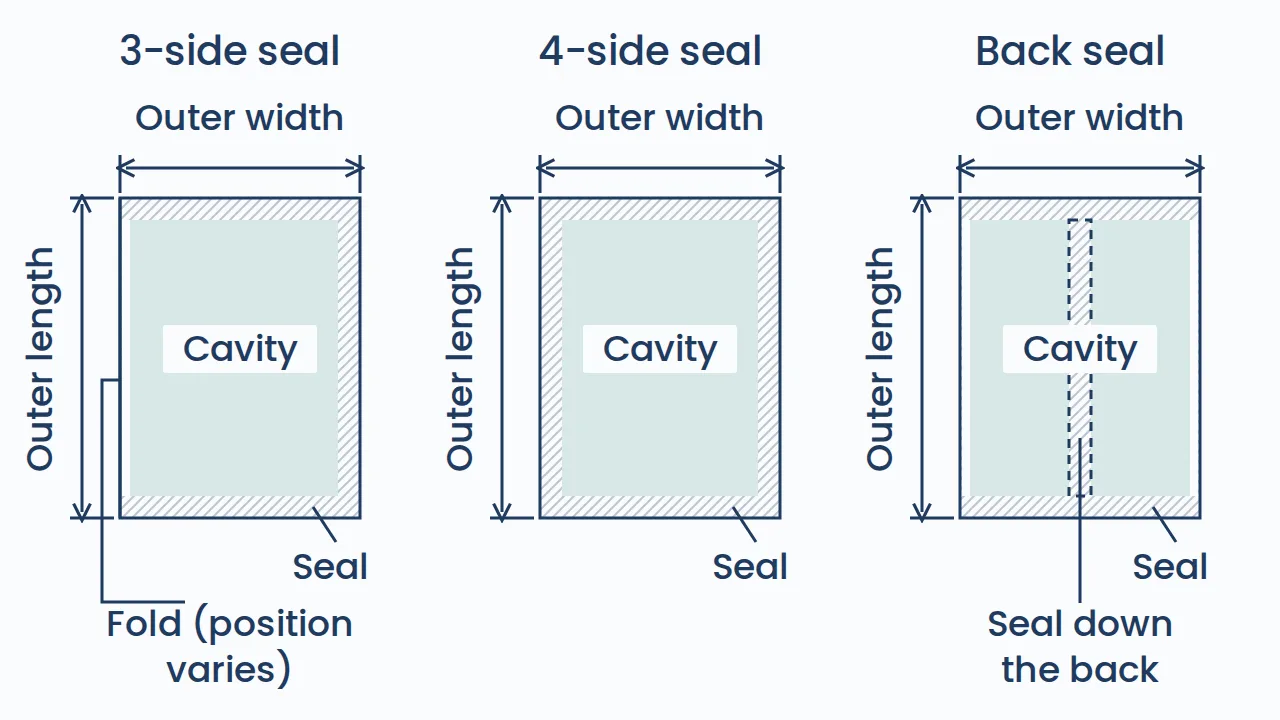
Illustration: the outer size includes the seals, so the cavity that holds the product is smaller on every format.
Which seal format and size suit each product?
Sauces, sugar, powders and shampoo all go into flat 3-side or 4-side seal sachets in the listings above and on our product pages. What changes between them is the unit you set the portion in and what pushes the sachet bigger. The portion itself is your decision. We give no "typical" grams per product, because we have no source that would make one reliable.
| Product | Set the portion in | Seal formats in the listings and on our pages | What pushes the size up | Where to read more |
|---|---|---|---|---|
| Sauce, ketchup, condiments | Grams or ml, checked against the sauce's density | 3-side or 4-side; LV-400Y is 4-side | Particles, or a sauce that strings, both of which need a clean seal area | Sauce sachets |
| Sugar and other granules | Grams; a volumetric cup doses by volume | 3-side or 4-side; LV-350X is 4-side | Lower bulk density, which means more volume per gram | Sugar sachets |
| Instant coffee and other powders | Grams | 3-side or 4-side | Aerated, light powders take more volume per gram | Powder machines, coffee sachets |
| Shampoo and cosmetic liquids | ml or grams | 3-side or 4-side in public listing B | Foam needs room so it stays out of the seal | Shampoo sachets |
If the sachet needs an even look on every edge, the 4-side seal sachet page compares it with 3-side seal. For pumps, viscosity and particles, see liquid and paste machines and granule machines.
How do you check a sachet size for your portion?
Start from the portion and a proposed size, then check the size four ways: volume, cavity, machine and a filled sample. There is no formula that turns a volume straight into a flat sachet size, because a filled sachet bulges. A proposed size can come from the table above or from a sachet you already like. Each step uses a number you can measure or ask a supplier for.
- Convert the portion to a volume. Volume (ml) = portion (g) ÷ density (g/ml). For liquids and pastes, use the measured density. For powders and granules, use the bulk density as the product sits when it is filled, since that is what the sachet has to hold.
- Choose the seal format and seal widths. A 4-side seal sachet has a seal on every edge. A 3-side seal sachet has a fold on one edge instead of a seal, and the sachet drawing shows which edge that is. A back-seal sachet has a seal running down its back and a seal at each end. Take each seal on an edge off the outer size.
- Work out the cavity. Cavity width = outer width − the seals on its two long edges. Cavity length = outer length − the seals at the two ends. A folded edge takes nothing off.
- Check the machine. The fill has to sit inside the listed fill range, and the width and length inside the listed size range. On a multi-lane machine, lanes × lane pitch must fit the film width, where lane pitch is the sachet width plus the gap or cutting allowance between lanes.
- Fill a sample sachet. Put the measured portion of your own product into a sachet of the proposed size and look at the headspace. If the product reaches the seal area, or the sachet bulges hard, the size is too small for the portion.
| Variable | Unit | Where it comes from |
|---|---|---|
| Portion | g or ml | Your label claim or recipe |
| Density or bulk density | g/ml | Your lab, or a measured cup of product |
| Side, top and bottom seal widths | mm | Your sachet drawing or supplier proposal |
| Outer width and length | mm | Your sachet drawing |
| Lane count and film width | lanes, mm | The machine configuration |
| Gap or cutting allowance per lane | mm | The supplier, for the cutting set-up chosen |
Worked examples with assumed inputs
The three examples below show the arithmetic only. Every input marked assumed is a made-up value for illustration, not a property of any real product and not a performance claim for any machine.
Example 1: a sauce portion on a four-side seal sauce machine
Assumed inputs: a 10 g sauce portion and a density of 1.1 g/ml.
- Volume: 10 ÷ 1.1 ≈ 9.1 ml. That sits inside the 5 to 100 ml fill range listed for the LV-400Y.
- Lanes: the LV-400Y lists film up to 320 mm. At 8 lanes, each lane gets at most 320 ÷ 8 = 40 mm, and that has to cover the sachet width plus the allowance between lanes. So an 8-lane layout points to the narrow end of the listed 30 to 140 mm width range. On that film the wide end of the range does not fit three lanes, as noted under the table.
Example 2: a sugar portion with a volumetric cup
Assumed inputs: a 4 g sugar portion and a bulk density of 0.8 g/ml.
- Volume: 4 ÷ 0.8 = 5 ml. The LV-350X lists a fill range of 1 to 50 g, so 4 g sits inside it.
- Density drift: a cup set to 5 ml delivers 4 g only at that density. If a sugar lot packs at an assumed 0.75 g/ml, the same cup gives 5 × 0.75 = 3.75 g. Bulk density belongs on the specification next to the sachet size.
Example 3: seal widths and a listing's maximums
Assumed seal widths: 5 mm on each long edge, 6 mm at each end.
- A 4-side seal sachet 40 mm wide and 60 mm long has a cavity 40 − 5 − 5 = 30 mm wide and 60 − 6 − 6 = 48 mm long.
- On a 3-side seal sachet the fold replaces one of those seals, so one of the two cavity dimensions grows by the width of the seal it replaces. Read which edge is folded from the drawing before you work it out.
- In public listing B, the 720 mm frame lists 4 to 10 lanes and widths of 35 to 90 mm. Ten 90 mm sachets would need 10 × 90 = 900 mm of film before any allowance, more than the 720 mm listed. At 90 mm, 720 ÷ 90 = 8 lanes is the arithmetic ceiling. At 10 lanes, each lane gets 72 mm including allowances.
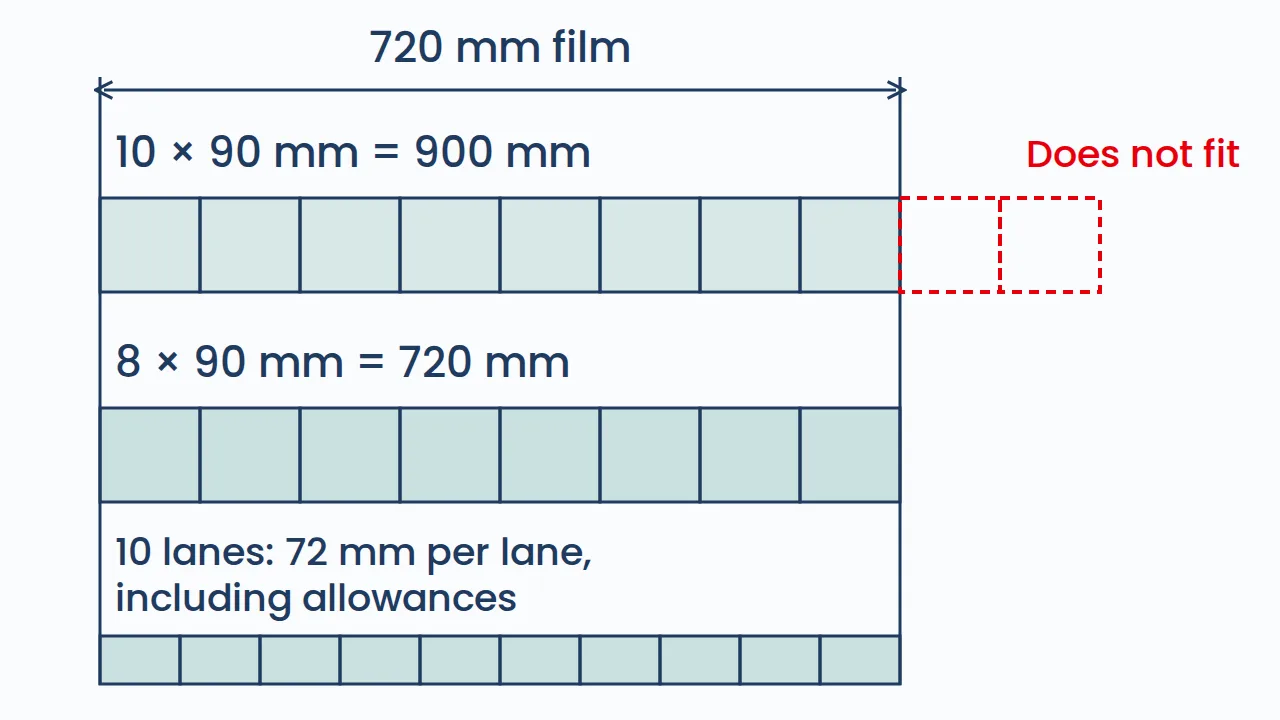
Illustration: on a shared film web, sachet width and lane count trade against each other.
The multi-lane sachet machine page explains why more lanes also make sealing, tracking and dosing balance harder.
What gets misread on a sachet size chart?
A size chart misleads when every number on it is read as if it applied at once. Check for these five misreadings.
- Outer size versus cavity. A chart gives the outer size. The product only gets the cavity, which is smaller by the seals on each edge.
- Width versus length. Our LV-350X listing gives width per lane, across the film, with length running along it. Not every listing says which is which, so check before you compare two quotations.
- Grams versus millilitres. A fill range in ml and a portion in grams only meet through your product's density. A range in grams for one granule does not transfer to a lighter one.
- Maximums that do not combine. The largest width, the highest lane count and the largest fill on one listing are separate limits. Example 3 shows how quickly width and lanes collide.
- Sachets versus stick packs. A stick pack is a narrow tube with a different machine, and its sizes follow other rules. Our sachet vs stick pack guide compares the two formats.
When does a size chart stop helping?
A chart gets you to a first size. It stops being enough once the product or the pack adds a constraint the arithmetic cannot see. Treat these cases as reasons to test before you fix a size.
- Foaming liquids. Shampoo and similar products foam when they are pumped or dropped, and the foam needs room so it does not reach the seal.
- Aerated or variable powders. A light powder takes more volume per gram, and its bulk density can change between batches or as it settles.
- Particles and sticky products. Pieces, seeds or a product that strings at the nozzle need a clean seal area, which can mean a longer sachet than the volume alone suggests.
- Printed film. The sachet length sets the print repeat, so a change in length means new artwork and a new run to check registration.
- Large portions. Above roughly 120 ml or 50 g, a portion is beyond the multi-lane listings we compiled. One public single-lane listing goes up to 180 × 220 mm and 400 ml, where a sachet starts to overlap with a small pouch.
- Several sizes on one machine. A second size can need change parts, which the quotation should list. Our price guide explains what change parts add.
What should you send us to confirm a size?
Send the inputs the method above uses, so a proposed size can be checked against a configuration. Say which items are not decided yet.
- Product name and form: liquid, paste, powder or granule, and whether it foams, strings, dusts or carries particles.
- Target portion per sachet, in grams or millilitres, and the tolerance you need.
- Density or bulk density, if you have it, and how much it varies between batches.
- Seal format (3-side, 4-side or back seal) and the outer size, or a sample sachet or drawing with seal widths and the tear notch.
- Film type and whether it is printed.
- Target output and the lane count you have in mind.
With your product and your film, a product and film trial shows how the portion fills the sachet and whether the seals stay clean. When you are ready for pricing, send a quotation request on WhatsApp with the list above. For the wider selection steps, see the sachet machine buying guide, and the other topics are on the guides hub.
How these ranges were compiled
The table combines two kinds of source. Our catalog rows are listings from the manufacturer's product pages for the configurations we offer. The public listings A, B and C are product pages from three other sachet machine manufacturers, read directly, with only the size, seal format, fill and product fields carried over. All figures are the makers' own listings. We have not measured them, and the ranges describe what each machine family is offered for, not what any one configuration runs at once. Fill was blank in some listings, and we left it blank rather than estimate it. The worked examples use assumed inputs, as labelled.
Questions about sachet sizes
What size is a sachet?
There is no single size. In the multi-lane machine listings we compiled, flat sachets run from about 17 to 140 mm wide and 45 to 220 mm long. Your portion, product density and seal format decide where yours falls, and the checks above show whether a proposed size fits.
What does "1 sachet" mean on a label or recipe?
It means one sealed single portion. The amount inside is whatever the brand fills it with, so one sachet of one product can hold a different amount from another.
What size is a 500 g pack?
That is outside the sachet range covered here. The largest single-lane flat pouch in the listings we compiled is listed up to 400 ml. Unless your product is dense enough to fit 500 g into that volume, it is a pouch or bag question rather than a sachet one.
Can one machine run several sachet sizes?
Within its listed range it may, but a new size can need change parts and a new film width or print repeat. List every size you plan when you ask for a quotation.
Not sure which configuration fits your product?
Send your product and pack details, or ask for a trial on your own material before you decide.