

Salt Sachet Packing Machine: Corrosion-Proof Parts, Dosing & Barrier Films
Published by the LINEVO sachet equipment team. Technical questions and corrections
Specify a salt sachet packing machine with SAE 316L contact parts, PTFE wear liners, dust-tight IEC 60529 enclosures, crystal-matched dosing, and foil laminates.
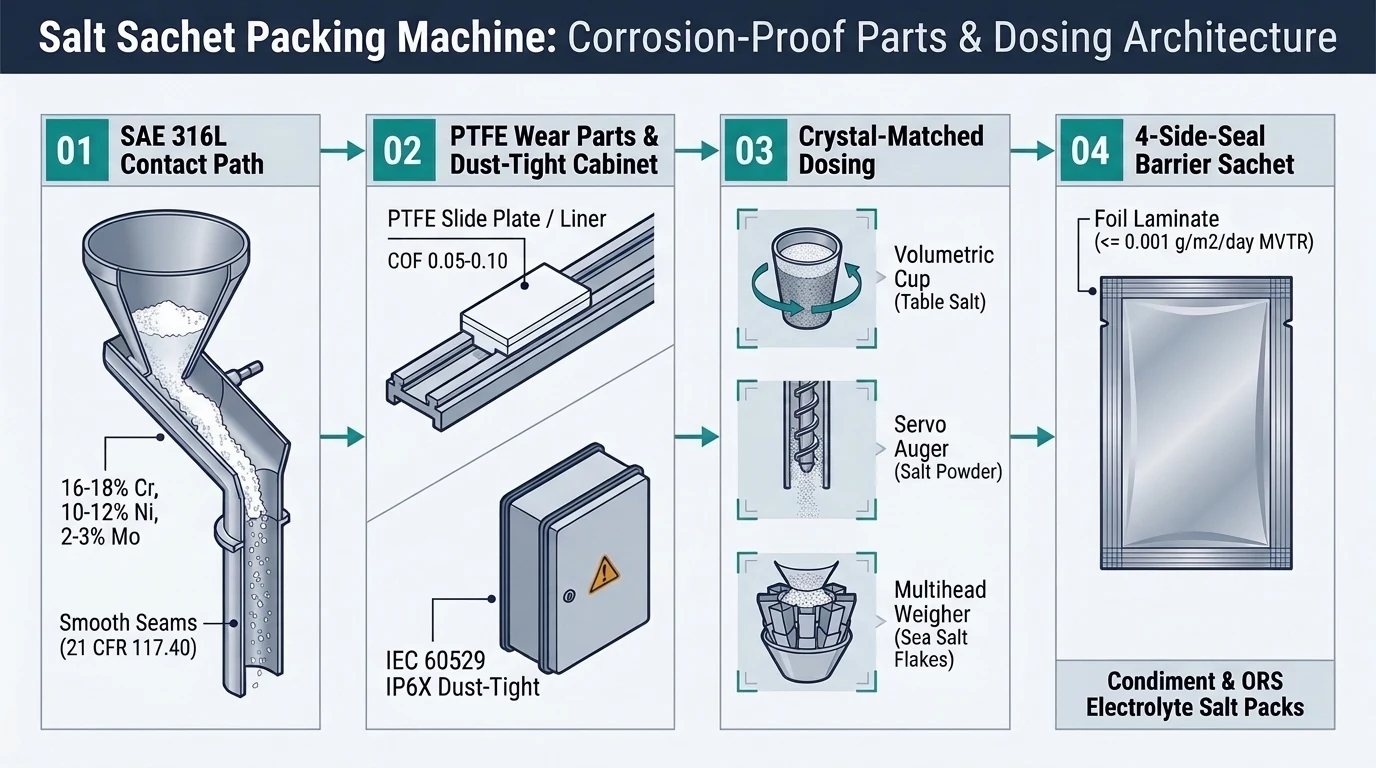
A salt sachet packing machine prevents chloride pitting corrosion and crystal caking by pairing molybdenum-alloyed SAE 316L food-contact hardware, low-friction PTFE wear liners, and dust-tight IEC 60529 electrical enclosures with crystal-matched dosing—volumetric cups for free-flowing refined table salt, independent servo augers for fine seasoning salt powder, and gravimetric multihead weighers for irregular coarse sea salt flakes.
Dry refined salt flows smoothly through a hopper until airborne salt dust absorbs ambient moisture and turns into a conductive chloride electrolyte along weld seams, linear guides, and unsealed control cabinets. Use these corrosion-proofing and dosing specifications alongside our granule sachet packing machines overview, our multi-lane sachet machines guide, our auger filler vs volumetric cup filler worksheet, and—if you are evaluating liquid sodium hypochlorite rather than dry crystalline salt—our bleach sachet packaging machines guide.
What contact alloys and electrical enclosures protect a salt packing machine from chloride corrosion?
Protecting a salt packing machine from chloride corrosion requires SAE 316L stainless steel (16–18% chromium, 10–12% nickel, and 2–3% molybdenum) across hoppers, chutes, and forming tubes, smoothly bonded seams under 21 CFR § 117.40, chemically inert PTFE bearings and slide plates (0.05 to 0.10 friction coefficient), and isolated dust-tight IEC 60529 enclosures.
Under 21 CFR § 117.40, food-contact surfaces must be corrosion-resistant in contact with food, fabricated from nontoxic materials able to withstand food action, cleaning compounds, and sanitizing agents, and constructed with smoothly bonded seams that minimize particle accumulation. Equipment must also prevent food adulteration by lubricants, fuel, metal fragments, or contaminated water.
How hygroscopic salt dust triggers autocatalytic chloride pitting
As documented in the Wikipedia technical overview of pitting corrosion, pitting corrosion is localized attack ranging from microns to millimeters in diameter on passive-oxide alloys such as stainless steels when exposed to aggressive species like chlorides. It progresses in three successive steps: initiation by breakdown of the protective passive film, growth of metastable micron-scale pits, and expansion into larger stable pits.
Once aqueous chloride ions reach steel, they react with iron in the passive film to form iron-chloride complexes that hydrolyze and release fresh chloride and hydrogen ions, sustaining an autocatalytic cycle. Stagnant water with low dissolved oxygen further accelerates pitting, which is why damp salt dust trapped inside rough weld crevices or unsealed rail channels pits standard steel frames rapidly.
Alloy, polymer, and enclosure specification matrix for salt lines
According to the Wikipedia reference on SAE 316L stainless steel, adding 2–3% molybdenum gives 316L stronger resistance than SAE 304 against localized corrosive attack by chlorides, hydrogen embrittlement, and reducing acids, while the low-carbon 316L composition further improves relative corrosion resistance in food, pharmaceutical, and marine environments.
For sliding wear surfaces and release liners, the Wikipedia reference on polytetrafluoroethylene (PTFE) notes that PTFE is hydrophobic, chemically inert, and carries a 0.05 to 0.10 coefficient of friction against polished steel. Industrially, PTFE outperforms acetal and nylon in plain bearings, gears, slide plates, seals, gaskets, and bushings, and serves as a non-stick food-contact coating for hoppers, rollers, and chutes that can be reinforced where grainy abrasion occurs.
For electrical protection, IEC 60529 (the IP code) defines first-digit rating 6 as dust-tight with zero dust ingress under vacuum testing for up to 8 hours. Second-digit rating 5 resists water jets from a 6.3 mm nozzle at 12.5 litres per minute and 30 kPa from 3 meters for at least 3 minutes, while rating 6 resists powerful jets from a 12.5 mm nozzle at 100 liters per minute and 100 kPa from 3 meters for at least 3 minutes. Crucially, standard IP testing uses fresh water—so an IP rating alone does not guarantee protection against salt water and requires dedicated chemical-resistance verification plus physical separation of electrical cabinets from the salt dust zone.
| Machine zone | Material or enclosure standard | Verified engineering property | Failure mode prevented |
|---|---|---|---|
| Hopper, chutes, cups, forming tubes, and fasteners | SAE 316L stainless steel with smooth seams | 16–18% chromium, 10–12% nickel, 2–3% molybdenum; low carbon; 21 CFR § 117.40 compliant | Localized chloride pitting and crevice buildup along contact welds |
| Slide plates, bushings, seals, gaskets, and hopper liners | PTFE (plain or abrasion-reinforced coating) | Chemically inert, hydrophobic, 0.05 to 0.10 coefficient of friction against steel | Metallic galling, salt sticking, and moisture-driven wear |
| Electrical control cabinets and drive housings | IEC 60529 dust-tight (first-digit 6) plus water-jet protection (rating 5 at 6.3 mm nozzle or rating 6 at 12.5 mm nozzle) | Zero dust ingress under 8 hours vacuum test; fresh-water jet ratings verified separately from brine | Conductive salt-dust ingress corroding relays, terminals, and drives |
| Non-contact frame and washdown crevices | Cleanable drained geometry away from trapped brine | Avoids stagnant low-oxygen water pockets that favor pitting | Crevice corrosion beneath unsealed guards and floor mounts |
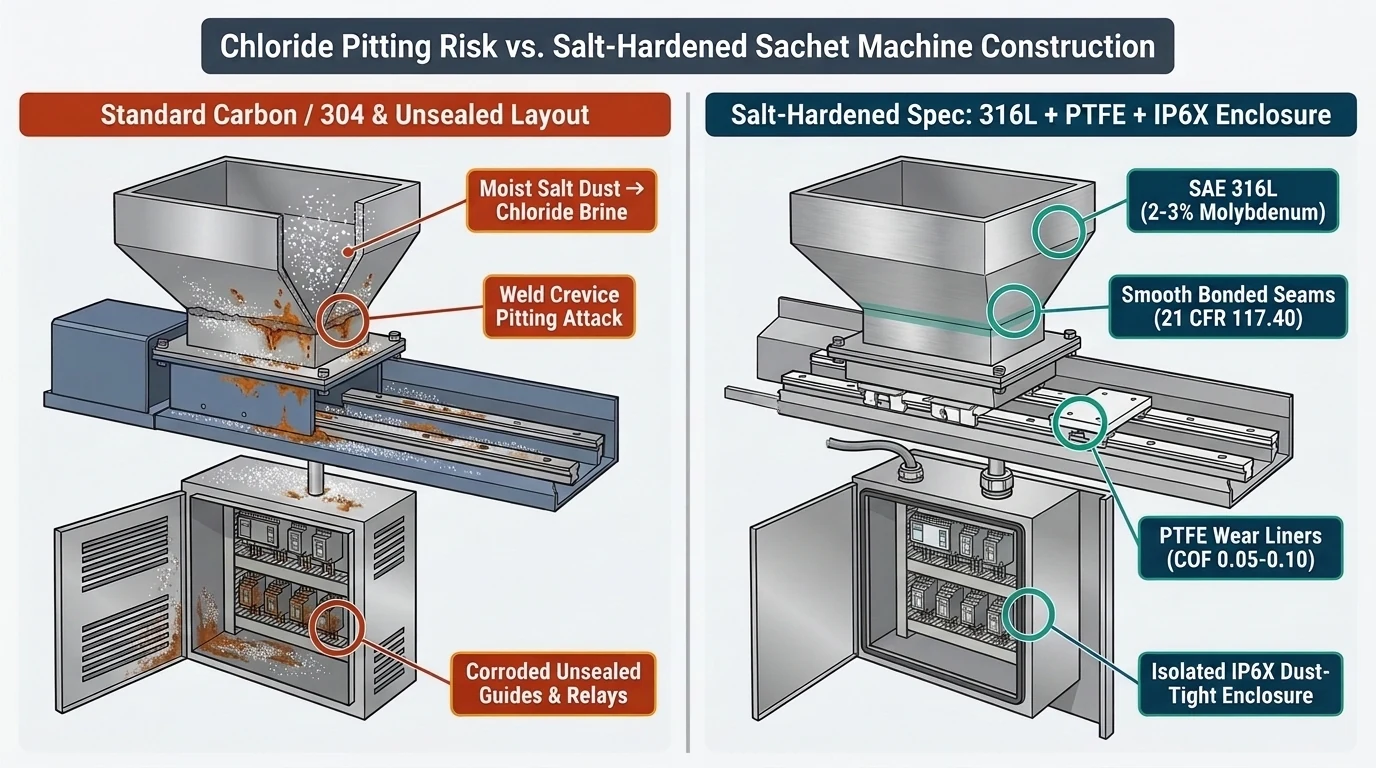
Isolating electrical controls in dust-tight enclosures while upgrading salt-contact paths to molybdenum-alloyed SAE 316L and PTFE wear liners stops damp salt dust from driving autocatalytic chloride pitting.
How do coarse sea salt flakes differ from free-flowing table salt crystals in volumetric dosing?
Free-flowing refined table salt consists of uniform cubic sodium chloride crystals often treated with anticaking agents so it pours evenly into fixed volumetric cups, whereas unrefined sea salt carries hygroscopic magnesium and calcium salts while kosher and Alberger salts have larger grains or flaky shapes that bridge, crush, and shift bulk density.
As summarized in the Wikipedia references on salt and sodium chloride, sodium chloride (NaCl) is a brittle, hygroscopic ionic compound in a 1:1 ratio of sodium and chloride ions forming translucent cubic crystals with a water solubility of 359 grams per litre. To keep refined table salt free-flowing, producers commonly add anticaking agents such as sodium ferrocyanide, magnesium carbonate, tricalcium phosphate, silicon dioxide, calcium silicate, or sodium and calcium aluminosilicates.
Specialty culinary salts behave very differently inside a narrow cup throat:
- Unrefined sea salt: Contains small amounts of magnesium and calcium halides and sulfates that make unrefined sea salt hygroscopic, causing it to absorb moisture from ambient air whenever exposed.
- Kosher and kitchen salt: Features a larger grain size than refined table salt, increasing void spaces inside narrow metering cavities.
- Alberger flake salt: Produced by combining vacuum pan evaporation with cubic-crystal seeding to yield a grainy-type flake that fractures easily under harsh mechanical scraping and packs unevenly by volume.
Matching salt crystal morphology to sachet dosing architecture
| Salt product grade | Crystal morphology and moisture profile | Primary dosing risk | Recommended dosing route to evaluate |
|---|---|---|---|
| Refined table salt (with anticaking agent) | Uniform cubic NaCl crystals; anticaking additives improve gravity flow | Fine dust on heat seals if drop height or dust extraction is poor | Volumetric cup filler on four-side-seal granule line (such as LV-350X) |
| Fine powdered salt and seasoning blends | Fine hygroscopic particles prone to moisture-induced liquid-bridge caking | Hopper arching, uneven gravity fill, and sticky cup walls | Independent servo auger per lane with hopper agitation |
| Unrefined coarse sea salt, kosher, and flake salt | Larger irregular grains or Alberger flakes; Mg and Ca salts raise moisture uptake | Cup-throat bridging, brittle crystal crushing, and bulk-density drift | Quantitative multihead weigher discharging into a vertical form-fill-seal bagmaker |
| Oral rehydration and electrolyte salt blends | Multi-component dry mix (NaCl, citrate, KCl, anhydrous glucose) sensitive to humidity | Rapid humidity caking and ingredient separation across lanes | Servo auger or weighed dosing paired with low-MVTR aluminium foil laminate |
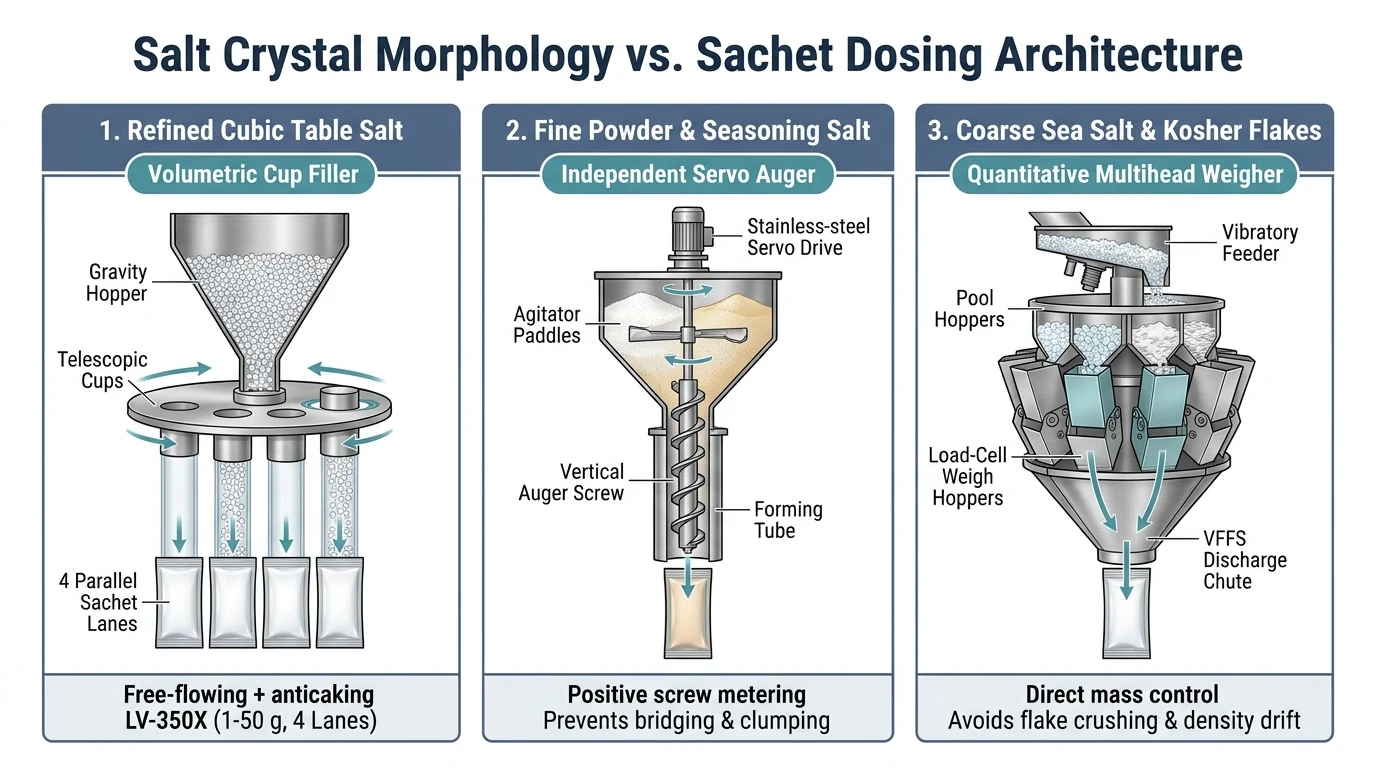
Match the metering principle to crystal geometry and moisture sensitivity: volumetric cups for uniform refined cubes, servo augers for cohesive fine salt powders, and multihead weighing for irregular flakes.
When does fine powdered salt or seasoning salt require auger dosing instead of volumetric cups?
Fine powdered salt and seasoning salt require an independent servo auger per lane instead of volumetric cups whenever hygroscopic moisture uptake or fine particle size causes bridging, clumping, or uneven gravity fill—driving liquid-bridge caking that stalls passive cups and leaves dusty salt fines across the heat-seal zone.
Peer-reviewed powder research archived on PubMed Central (PMC12385211) highlights that inorganic salts possess strong hygroscopic properties and explains how moisture-induced liquid-bridge caking operates across soluble powders: absorbed moisture dissolves soluble material at particle surfaces to form capillary liquid bridges exerting strong cohesive forces, and subsequent moisture evaporation recrystallizes those dissolved solids into permanent solid bridges.
When fine flour salt, iodized salt blends, or spice-salt seasonings begin forming cohesive liquid bridges inside a hopper, gravity can no longer fill a fixed cup uniformly. Moving to our multi-lane powder sachet machine replaces passive gravity drop with an independent servo auger per lane and four-side sealing, using positive screw rotation and hopper agitation to keep cohesive powder moving evenly into each forming tube. Because output, sachet dimensions, and utilities on the multi-lane servo-auger configuration depend on the selected powder, dose, film, and lane layout, validate auger tooling and seal-area dust clearance on your actual salt blend before freezing specifications.
When do irregular crystal sizes call for a granular quantitative packing machine instead of cups?
Irregular coarse sea salt, kosher grains, and fragile flakes call for a granular quantitative packing machine—such as a multihead weigher feeding a vertical form-fill-seal bagmaker—whenever crystal shape variation shifts bulk density enough to break weight tolerance or whenever cup levelers crush brittle crystals into seal-contaminating fines.
On a volumetric cup machine, delivered sachet weight follows a direct density equation: dose mass in grams equals filled cup volume in mL multiplied by bulk density in g/mL. Whenever an irregular sea-salt lot segregates into larger flakes and smaller broken grains, bulk density shifts inside the hopper and cup weight drifts without any mechanical adjustment.
As detailed in the Wikipedia technical summary of multihead weighers, a quantitative multihead weigher disperses granules into pool hoppers and weigh hoppers beneath them, measures the mass in each individual weigh hopper, computes the hopper combination closest to the target weight (such as 100 g in retail pouch runs), and discharges that exact combination through a chute into the bagmaker. Because weighing measures mass directly rather than fixed volume, bulk-density shifts affect accuracy far less, and gentle vibratory feeding protects fragile sea-salt flakes from mechanical scraping.
How do single-serve condiment salt sachets maintain fast throw repeatability across lanes?
Single-serve condiment salt sachets maintain repeatable multi-lane throws by pairing uniform, anticaking-treated table salt with stable hopper bulk density on a four-side-seal granule line such as our LV-350X (1 to 50 g fill range, 50 to 180 mm sachet length, 30 to 80 mm width per lane, four lanes per cycle) and enforcing dry-cleaning shutdown procedures.
Within our published catalog for granule sachet packing machines and four-side-seal sachet lines, the LV-350X handles granules, sugar, and seasoning packets across four parallel lanes in one cycle. Holding tight weight spread across all four lanes depends on three operational controls: keeping batch bulk density steady so cup volume translates consistently into grams, matching drop timing to sachet length so hard cubic crystals clear the closing cross-seal jaws, and preventing damp salt crust from narrowing cup walls between shifts.
Dry-cleaning shutdown discipline and treated compressed air
Hosing down a salt packing machine with water after every shift is one of the fastest ways to ruin stainless steel hardware. Because sodium chloride dissolves readily (359 grams per litre) and stagnant water with low dissolved oxygen favors autocatalytic chloride pitting, residual brine left inside bolt threads, telescopic cup guides, or frame joints attacks passive oxide films overnight.
Follow a dry-first shutdown protocol instead:
- Dry vacuum removal first: Empty hoppers and remove loose salt dust mechanically using dry brushing and vacuuming before any moisture contacts metal surfaces.
- Treated dry air where air purge is used: Under 21 CFR § 117.40, compressed air or other gases used to clean food-contact surfaces must be treated so food is not contaminated with unlawful indirect food additives.
- Complete drying after wet sanitation: Whenever allergen or regulatory sanitation requires wet washdown, rinse thoroughly with clean fresh water to remove all chloride residue and dry every seam and crevice completely rather than leaving stagnant brine behind.
What moisture-barrier laminates do oral rehydration and electrolyte salt sachets require?
Oral rehydration salts and electrolyte salt sachets require low-MVTR aluminium foil barrier laminates—rolled thinner than 0.2 mm with laminated gauges down to 6 μm achieving MVTR as low as 0.001 g/m2/day—paired with uncontaminated four-side heat seals so hygroscopic salt and glucose blends do not clump or degrade in humid distribution channels.
As documented in the Wikipedia reference on oral rehydration therapy, WHO and UNICEF jointly set manufacturing guidelines for ready-to-mix oral rehydration salts powder packets and lowered recommended osmolarity from 311 to 245 mOsm/L. The reduced-osmolarity dry formulation totals 20.5 g per litre (compared to 27.9 g in the original standard) and blends four hygroscopic soluble solids: 2.6 g NaCl, 2.9 g trisodium citrate dihydrate, 1.5 g KCl, and 13.5 g anhydrous glucose. The same reference notes that replacing glucose with sucrose and sodium citrate with sodium bicarbonate produces a mixture that is not shelf stable in high-humidity environments—making moisture-barrier packaging mandatory for electrolyte packets.
Barrier laminate MVTR and heat-seal verification rules
According to the Wikipedia reference on aluminium foil and the Wikipedia reference on moisture vapor transmission rate (MVTR), thin aluminium foil below 0.2 mm (7.9 mils)—with gauges down to 6 μm (0.24 mils) laminated with plastics or paper for strength—forms the standard moisture barrier for dry hygroscopic sachets.
| Barrier and seal checkpoint | Verified engineering benchmark | What to confirm before approving rollstock |
|---|---|---|
| Aluminium foil barrier gauge | Foil thickness under 0.2 mm (7.9 mils); laminated gauges down to 6 μm (0.24 mils) | Confirm laminate integrates plastic or paper support layers to prevent pinholes and foil cracking |
| Flat-sheet MVTR benchmark | Standard international unit is g/m2/day; aluminium foil laminates reach down to 0.001 g/m2/day | Request supplier datasheets reported in g/m2/day for your exact laminate stack |
| Temperature and humidity test conditions | Permeability can rise up to 10% per °C, so 23°C and 37°C results can differ by a factor of 4 | Compare candidate films only at identical temperature, humidity gradient, and sample thickness |
| Seams, creases, and heat seals | Seams, creases, access points, and heat seals are critical to finished-pack moisture performance | Inspect four-side seals for trapped salt crystals or powder fines during production trials |
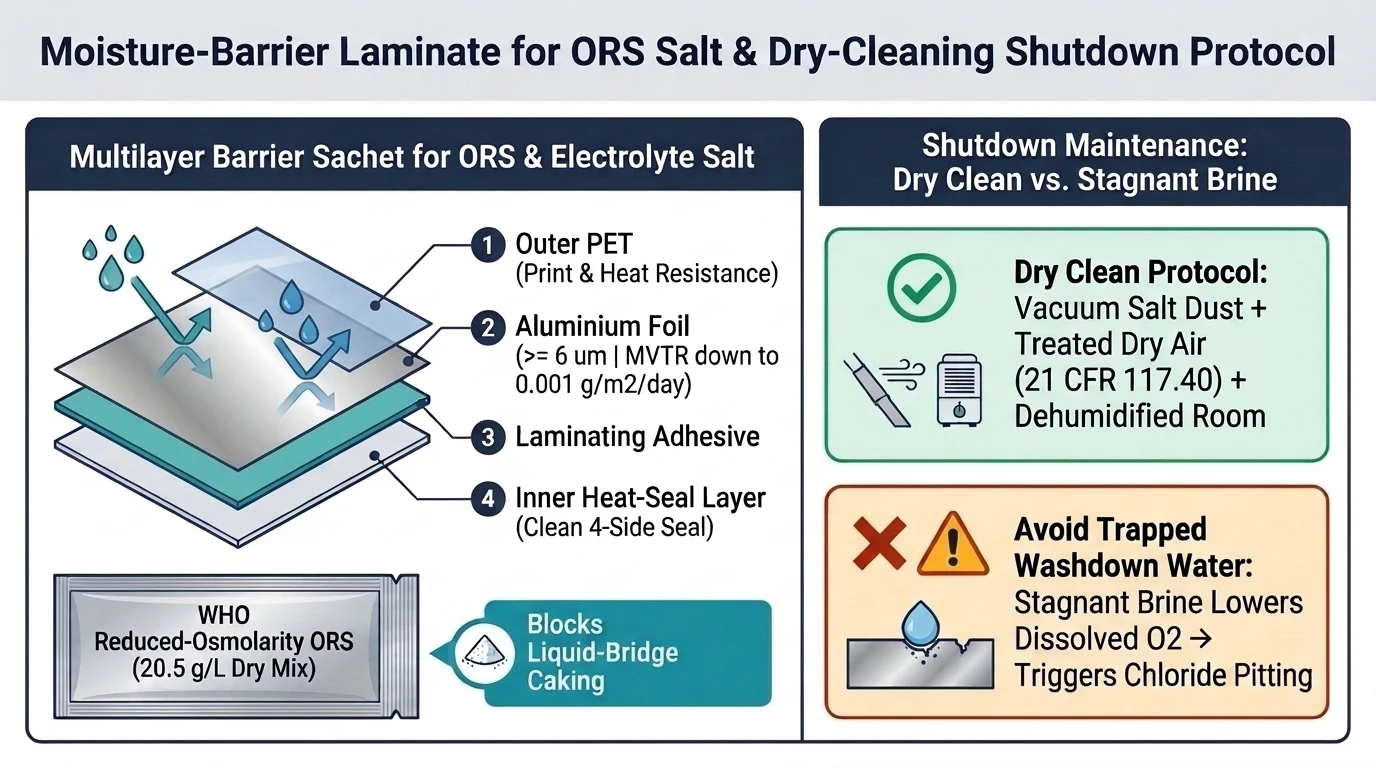
Low-MVTR aluminium foil laminates protect hygroscopic oral rehydration salt blends in humid transit, while dry-cleaning shutdown habits prevent stagnant brine from pitting machine surfaces.
Which alloy upgrades and lane counts drive salt packing machine price?
Salt packing machine price is driven by five documented scope elements—dosing architecture (volumetric cup, independent servo auger per lane, or multihead weigher), four-side-seal lane count and format tooling, SAE 316L contact-part and fastener upgrades, PTFE wear liners and dust-tight IEC 60529 enclosure isolation, and pre-shipment trial verification.
As outlined on our sachet packaging machine price and quotation scope page, every written quotation separates the base machine (dosing system, sealing format, and lane configuration) from product-specific corrosion upgrades and options so buyers compare identical engineering scopes:
- Dosing architecture: Gravity volumetric cups on a four-lane LV-350X (1 to 50 g) have lower mechanical complexity than independent servo augers per lane or a quantitative multihead weigher.
- Corrosion-proof metallurgy and wear parts: Upgrading every salt-contact hopper, chute, forming tube, cup, and fastener to low-carbon SAE 316L austenitic stainless steel (16–18% chromium, 10–12% nickel, 2–3% molybdenum) with smooth 21 CFR § 117.40 seams and PTFE wear components adds material and fabrication scope over standard sugar lines.
- Electrical enclosure isolation and dust control: Specifying dust-tight IEC 60529 first-digit 6 electrical cabinets, remote-mounted panels, and salt-dust extraction near the sealing jaws protects long-term uptime.
- Lane count and sachet dimensions: Sachet width (such as 30 to 80 mm per lane on the LV-350X) and maximum film width govern parallel lanes, multiplying dosing heads, forming tubes, and seal verification points.
- Product and film qualification: Running your actual salt lot and barrier laminate through our product and film sample testing program validates flow, dose weight spread, and clean four-side heat seals before final build.
Salt sachet machine inquiry and dehumidification acceptance checklist
| Required buyer input | Specific data to share before quoting | Engineering decision supported |
|---|---|---|
| Salt crystal grade and formula | Refined table salt (anticaking type), fine powder/seasoning, unrefined sea salt/flake, or WHO reduced-osmolarity electrolyte blend | Selects volumetric cup, independent servo auger per lane, or quantitative multihead weigher |
| Corrosion-protection scope | Required SAE 316L contact parts and fasteners, PTFE wear/non-stick surfaces, and dust-tight IEC 60529 enclosure rating | Locks metallurgy, smooth seam finish under 21 CFR § 117.40, and cabinet isolation |
| Plant humidity and cleaning plan | Packing room temperature/humidity control, dry-vacuum cleaning protocol, and treated compressed air availability | Prevents liquid-bridge caking and stagnant-brine pitting during shift shutdowns |
| Target sachet and barrier film | Target grams per sachet, sachet width and length, foil laminate gauge (down to 6 μm), and MVTR in g/m2/day with test temperature | Confirms lane count, LV-350X vs servo-auger fit, and clean four-side heat sealing |
Frequently Asked Questions About Salt Sachet Packing Machines
Why is SAE 316L preferred over SAE 304 on a salt sachet packing machine?
SAE 316L austenitic stainless steel adds 2–3% molybdenum alongside 16–18% chromium and 10–12% nickel in a low-carbon grade. Molybdenum provides significantly greater resistance than SAE 304 against localized corrosive attack by chlorides, protecting hoppers, chutes, forming tubes, and fasteners when airborne salt dust absorbs ambient moisture.
Does a dust-tight water-jet IP rating guarantee an electrical cabinet is safe from salt brine?
No. Under IEC 60529, first-digit 6 verifies dust-tight protection under vacuum for up to 8 hours, while water-jet rating 5 (6.3 mm nozzle at 30 kPa) and powerful water-jet rating 6 (12.5 mm nozzle at 100 kPa) verify protection against fresh-water jets. Because standard IP testing uses fresh water, protection against corrosive salt water is not guaranteed by the rating alone and requires chemical-resistance verification plus cabinet isolation away from salt dust.
Can coarse sea salt flakes run on the same volumetric cup filler as refined table salt?
Usually not without dose drift or crystal damage. Refined table salt consists of uniform cubic crystals often treated with anticaking agents for gravity cup flow, whereas unrefined sea salt is more hygroscopic and larger kosher grains or Alberger flakes pack unevenly and fracture under mechanical scrapers—making a quantitative multihead weigher the safer option for irregular flakes.
Why should a salt packing machine be dry-cleaned at shift shutdown?
Sodium chloride dissolves readily in water (359 grams per litre), and stagnant water conditions with low dissolved oxygen favor autocatalytic chloride pitting on stainless steel. Vacuuming salt dust dry and using treated compressed air compliant with 21 CFR § 117.40—followed by complete drying whenever wet sanitation is required—keeps brine out of seams, guides, and bolt threads.
What MVTR benchmark and laminate layer protect oral rehydration salt packets?
WHO and UNICEF reduced-osmolarity oral rehydration salts (20.5 g per litre dry mix of NaCl, trisodium citrate dihydrate, KCl, and anhydrous glucose) are highly sensitive to moisture-induced liquid-bridge caking. Laminated aluminium foil (rolled below 0.2 mm, with barrier gauges down to 6 μm) can reach MVTR as low as 0.001 g/m2/day; compare film datasheets at identical temperature, humidity gradient, and thickness because permeability can shift up to 10% per °C (a 4× gap between 23°C and 37°C).
Sources
- Legal Information Institute, Cornell Law School, 21 CFR § 117.40 — Equipment and Utensils (Food cGMP)
- Wikipedia, SAE 316L stainless steel
- Wikipedia, Pitting corrosion
- Wikipedia, IP code (IEC 60529)
- Wikipedia, Polytetrafluoroethylene (PTFE)
- Wikipedia, Salt
- Wikipedia, Sodium chloride
- PubMed Central (National Library of Medicine), A Comprehensive Review of the Rehydration of Instant Powders: Mechanisms, Influencing Factors, and Improvement Strategies (PMC12385211)
- Wikipedia, Oral rehydration therapy
- Wikipedia, Moisture vapor transmission rate (MVTR)
- Wikipedia, Aluminium foil
- Wikipedia, Multihead weigher