

Milk Powder & Creamer Sachet Packing Machine Guide: Anti-Bridging Auger & Nitrogen Flushing
Published by the LINEVO sachet equipment team. Technical questions and corrections
Specify a milk powder sachet packing machine or dairy powder sachet filling machine: anti-bridging auger dosing, static dust extraction, and nitrogen flushing.
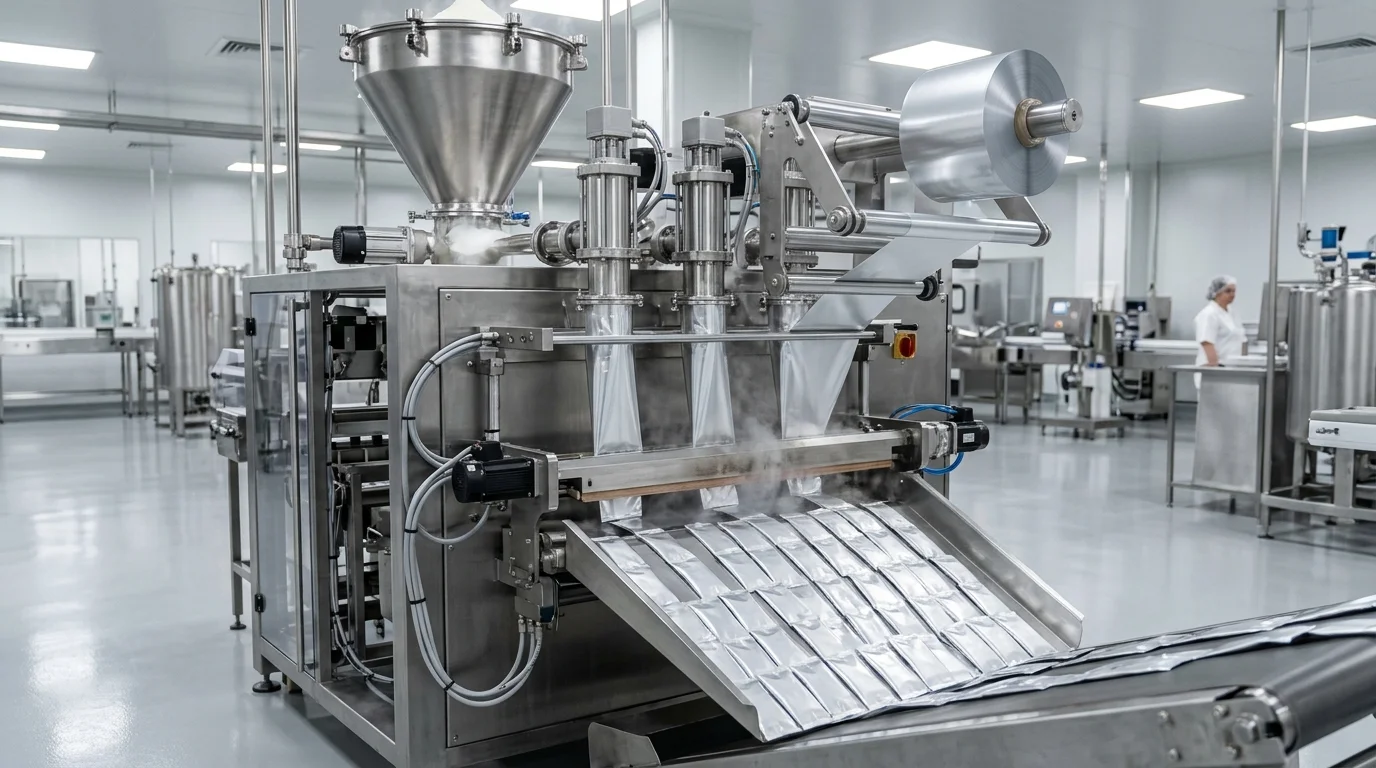
Specifying a milk powder sachet packing machine, comparing milk powder sachet packaging machines, or configuring a dairy powder sachet filling machine requires matching hopper agitation, vertical auger flight geometry, static and dust extraction, and inert gas flushing to the fat content and flow behavior of your powder. Use this dairy and creamer sachet engineering guide alongside our powder sachet packing machines overview, our sachet packaging machine technical guides, and our guide on how to choose a sachet packaging machine to prepare your project specification before a material trial.
| Engineering domain | What to review on the machine | Questions to answer before quotation |
|---|---|---|
| Dairy powder composition and blend stability | Milkfat content, moisture level, particle flowability, and coffee-and-creamer blend uniformity | Does your powder bridge in a cone, hold air when conveyed, or separate between the start and end of a run? |
| Hopper infeed, agitation, and servo auger tooling | Horizontal re-densifying screw, hopper venting, contra-rotating agitator blade, over-flights, and nozzle cutoff | How will the feeder keep bulk density steady at the screw intake without compacting high-fat dairy powder? |
| Static neutralization and narrow-tube dust control | Equipment grounding, static bars, auger drop height into the pouch, and balanced vacuum dust extraction | How will the filling zone prevent static cling and upward dust plumes from contaminating the cross-seal land? |
| Nitrogen flushing, barrier foil, and leak checks | Pre-gassing or bag flushing, residual oxygen target, composite foil thickness, jaw impressions, and bubble tests | What residual oxygen level, barrier film structure, and seal verification methods are required for shelf life? |
Classify dairy fat content, flowability and coffee-creamer blend behavior
Begin the equipment review by documenting the fat fraction, moisture level, bulk density, and blend uniformity of your dairy powder or creamer mix, and cross-reference our coffee and milk tea sachet application page and our sachet sizes and fill volume guide.
Under 21 CFR § 131.147, the U.S. federal standard of identity covers dry whole milk.
Under 21 CFR § 131.147(a), dry whole milk contains not less than 26 percent but less than 40 percent by weight of milkfat on an as-is basis, and not more than 5 percent by weight of moisture on a milk solids not fat basis.
Under 21 CFR § 131.125, the U.S. federal standard of identity covers nonfat dry milk.
Under 21 CFR § 131.125(a), nonfat dry milk contains not more than 5 percent by weight of moisture, and not more than 1 1/2 percent by weight of milkfat unless otherwise indicated.
Under 21 CFR § 131.149, the U.S. federal standard of identity covers dry cream.
Under 21 CFR § 131.149(a), dry cream contains not less than 40 percent but less than 75 percent by weight of milkfat on an as-is basis, and not more than 5 percent by weight of moisture on a milk solids not fat basis.
In coffee-and-creamer blends, differences in particle size and density can allow ingredients to separate during handling, so operators compare the blend at the start and end of a run.
In All-Fill International UK's empirical pencil test for powder flowability, if a perfect impression of the pencil remains, the powder is deemed non-free flowing, whereas partial collapse might indicate a semi-free flowing powder.
In auger dosing, Dose mass (g) = metered volume (ml) × bulk density (g/ml), and changes in density or uneven filling of the screw can change the dose at the same auger setting.
To convert a powder portion into sachet volume, Volume (ml) = portion (g) ÷ density (g/ml).
Specify horizontal infeed re-densification, hopper agitation and servo auger flights
Compare volumetric auger and cup mechanisms using our auger filler versus volumetric cup filler guide, and match the infeed screw, hopper level control, agitator blade, and auger flight profile to your dairy powder.
In All-Fill International UK's technology overview, vertical auger fillers represent a 95% volume of powder filling machines sold, with the remaining 5% comprising vacuum fillers, cup fillers, and gravity fillers.
In All-Fill International UK's volumetric auger filling overview, typically accuracies in the range of ± 0.5% to 2% can be expected.
According to Auger Fabrication, on volumetric cup fillers each cup set has a 40% volume adjustment and consists of three pieces, with dispense rates of up to 120 per minute in continuous motion.
According to All-Fill Inc.'s auger filling accuracy guide, using a small horizontal screw feeder mounted immediately over the filler's hopper from the infeed supply is a method of re-densifying product prior to filling the hopper.
According to All-Fill Inc.'s auger filling accuracy guide, equalizing the pressure in the hopper by venting it to atmospheric pressure is a common method of achieving better density.
In auger filler troubleshooting documentation, auger fillers need careful head pressure control, and a 75% hopper fill cap is recommended to avoid 40% weight variation.
On an anti-static powder packaging line configuration described in manufacturer documentation, a 200L circular stainless steel feed hopper with vibratory-assisted screw conveyance in an anti-bridging design feeds a 50L auger filler hopper with a level sensor for auto start/stop.
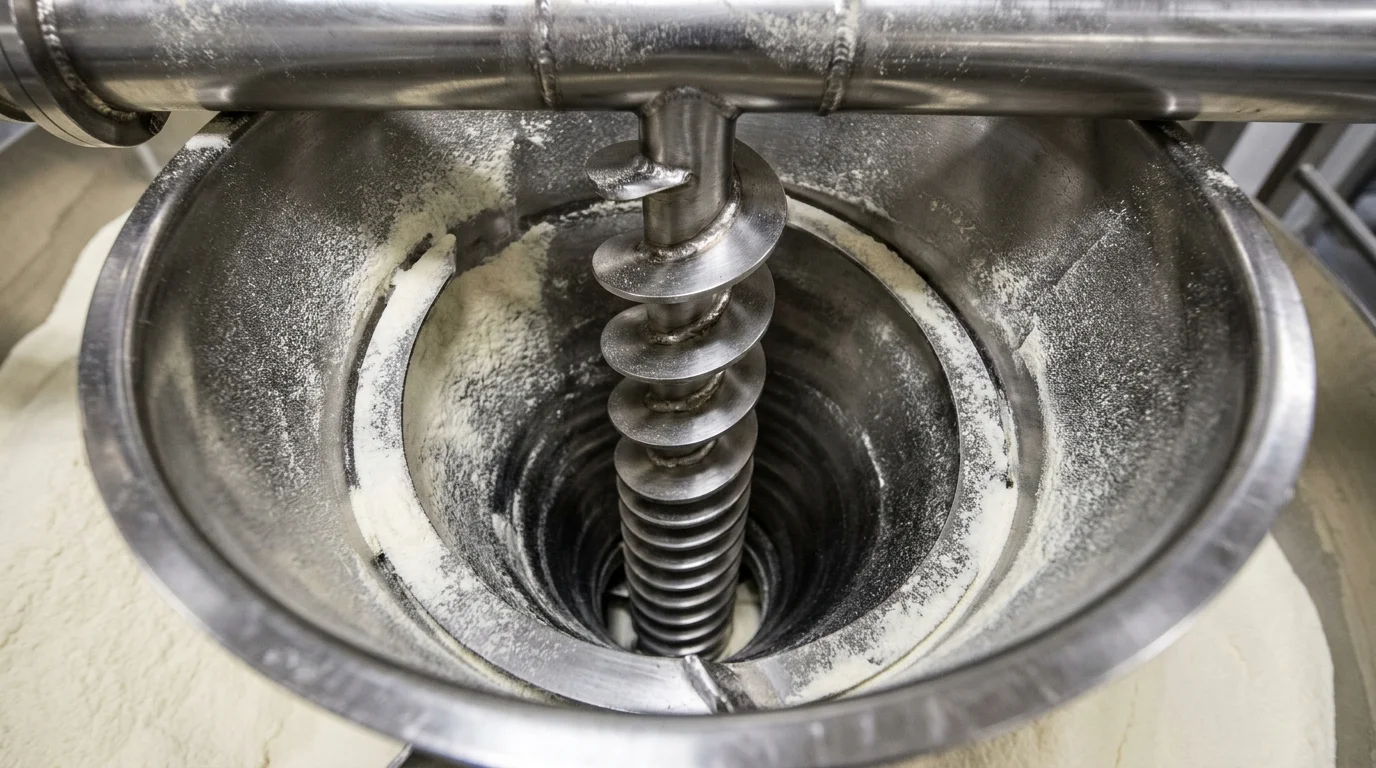
Contra-rotating agitator linkage, auger flight geometry and hygienic cleaning
Review how the agitation blade interacts with the auger funnel throat, how screw cutoff hardware stops dribble between cycles, and how contact parts are cleaned between batches.
In All-Fill International UK's vertical auger filler design, the separately driven and controlled agitation blade rotates in the opposite direction to the auger, de-aerating and homogenising the powder and breaking any product bridge.
In All-Fill International UK's vertical auger filler design, the agitation blade extends down to the throat of the funnel, preventing rat-holing and cavitation and ensuring that the auger flights are consistently filled.
In All-Fill International UK's non-free-flowing powder auger setup, the auger features larger-diameter over-flights in the hopper section that push otherwise reluctant powder downwards to the funnel throat.
In All-Fill International UK's non-free-flowing powder setup, the agitation mode can be controlled so that it stops between fills to avoid overworking and compacting the powder.
In All-Fill International UK's semi-free-flowing powder tooling, it is necessary to create a slight back pressure to retain the powder in the funnel by fixing a drip washer to the bottom of the auger, or adding a lip or anti-drip grid.
In All-Fill International UK's free-flowing product tooling, the usual method to cut off flow is to use a spinner disc, a saucer-shaped disc attached to the end of the protruding auger designed to retain the product flow.
In a dusty-powder auger configuration described in manufacturer documentation, fitting a closed hopper with an integrated vacuum port and a reverse auger suck-back cycle retracts the powder column after each fill, preventing drips between cycles.
On All-Fill's precision powder micro-filler described by Automate UK, every surface that contacts the product is constructed from 316L grade stainless steel, complete with available material and welding certificates for full regulatory compliance.
On All-Fill's precision powder micro-filler described by Automate UK, the system's dustproof stainless-steel enclosure, IP65 rating, and standard tool-free disassembly make cleaning and changeovers fast, safe, and compliant.
According to Pro-Fill Inc.'s auger filler guide, operators should avoid using a cleaning method that leaves moisture where a hygroscopic powder can clump during the next run.
Control triboelectric static cling and the narrow-tube dust chimney effect
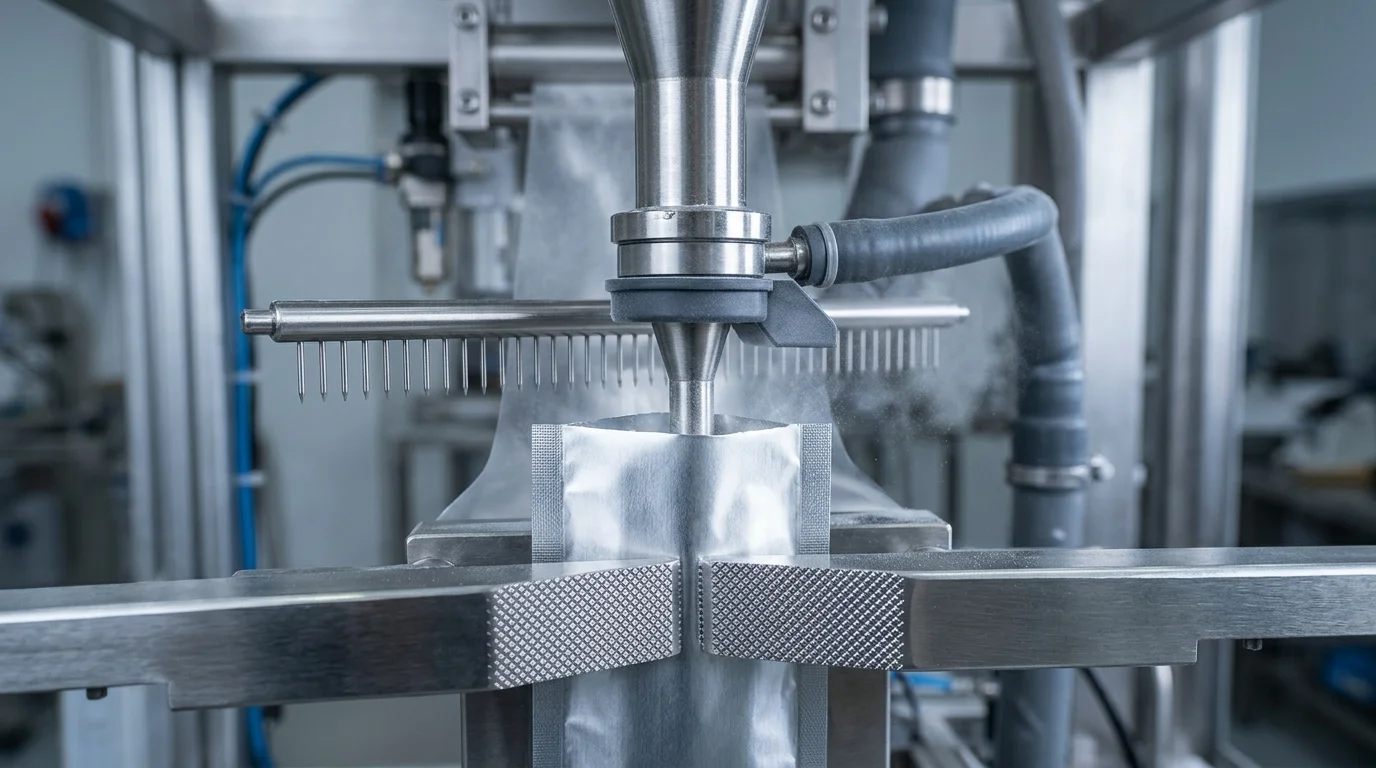
Keep airborne dairy fines out of the heat-seal zone by combining static grounding, active ionization, controlled nozzle drop height, and balanced vacuum extraction, and review our sachet sealing problems troubleshooting guide when diagnosing seal contamination.
In powder auger troubleshooting documentation, when fine tea powders (especially those with low moisture content) flow through an auger and a plastic chute, they generate a static charge that can exceed 10 kV, causing powder to cling to the fill tube, the pouch interior, and the seal jaws, leading to erratic fills and seal failures.
In a static-control configuration described in manufacturer documentation, grounding all stainless steel contact parts with a dedicated earth wire maintains a resistance below 1 ohm to the machine frame.
On an anti-static powder packaging line described in manufacturer documentation, static-control installation points at film unwinding, the forming tube, the filling nozzle exit, and the sealing zone achieve surface charge reduction to < ±50V from a typical > 5kV.
On an anti-static powder packaging line described in manufacturer documentation, the auger filler lists a dosing range of 10g – 2000g per fill cycle, a filling speed of 40 – 120 cycles per minute adjustable via inverter, and a filling accuracy of ±0.5% – 1% with static neutralization active.
In a fine-powder dust-control engineering breakdown, a drop height > 150mm causes high air displacement velocity and severe dust that escapes the pouch entirely (subsurface filling required), 50mm - 150mm causes moderate air displacement and moderate dust coating inner pouch walls (extended filling heads and vacuum hoods), and < 50mm keeps air displacement low and dust minimal.
In an engineering analysis of narrow sachet and stick pack forming tubes, the narrow diameter acts like a chimney that accelerates the dust plume straight up into the sealing jaws, guaranteeing seal contamination if not properly managed.
According to fine-powder dust extraction engineering guidance, vacuum extraction suction power must be balanced carefully because too much suction siphons actual product from the primary dose, causing underweight bags.
Configure nitrogen flushing, barrier laminates and seal verification checks
Define your inert gas purging method, residual oxygen target, barrier laminate structure, and package integrity checks alongside our four-side seal sachet machines overview.
As reported by Packaging Europe on GEA's modified atmosphere milk powder packing technology for sealed 25 kilograms bags, the system gets Residual Oxygen consistently down to under 2%.
In GEA's modified atmosphere milk powder packing process for sealed 25 kilograms bags, the system uses pre-gassing, in which the bag is filled with inert gas to exclude oxygen prior to filling.
On a nitrogen-flushed powder packaging line described in manufacturer documentation, the nitrogen flushing system injects inert nitrogen into each bag before sealing, reducing residual oxygen to < 2% and extending shelf life by 30%–50% for oxidation-sensitive products such as milk powder and protein isolates.
If the product study calls for nitrogen flushing, specify the gas system, residual-oxygen target, and measurement method in the equipment review.
ASTM F1927-20 is the Standard Test Method for Determination of Oxygen Gas Transmission Rate, Permeability and Permeance at Controlled Relative Humidity Through Barrier Materials Using a Coulometric Detector.
According to Hatzopoulos's flexible packaging sealing troubleshooting guide, a doubling of the base film thickness almost doubles the seal strength, however the thicker the material, the narrower the temperature sealing range under normal sealing conditions.
According to Greener Corporation's thermal transfer guide, the effective seal range narrows as machine speed is increased and dwell time is reduced, and machine speed is limited by the need to keep normal temperature cycles within the effective seal range.
In LD PACK's seal failure analysis, assuming a thickness deviation of ±10% with a standard thickness of 80 µm, the composite film thickness ranges from 72 µm to 88 µm, with a maximum deviation of 16 µm.
According to Greener Corporation's sealing jaw maintenance guide, operators use carbonless paper, also known as NCR paper, with heated rotary jaws and with reciprocating jaws at higher temperatures.
ASTM F2029-16(2021) establishes the Standard Practices for Making Laboratory Heat Seals for Determination of Heat Sealability of Flexible Barrier Materials as Measured by Seal Strength.
ASTM F88/F88M-23 is the Standard Test Method for Seal Strength of Flexible Barrier Materials.
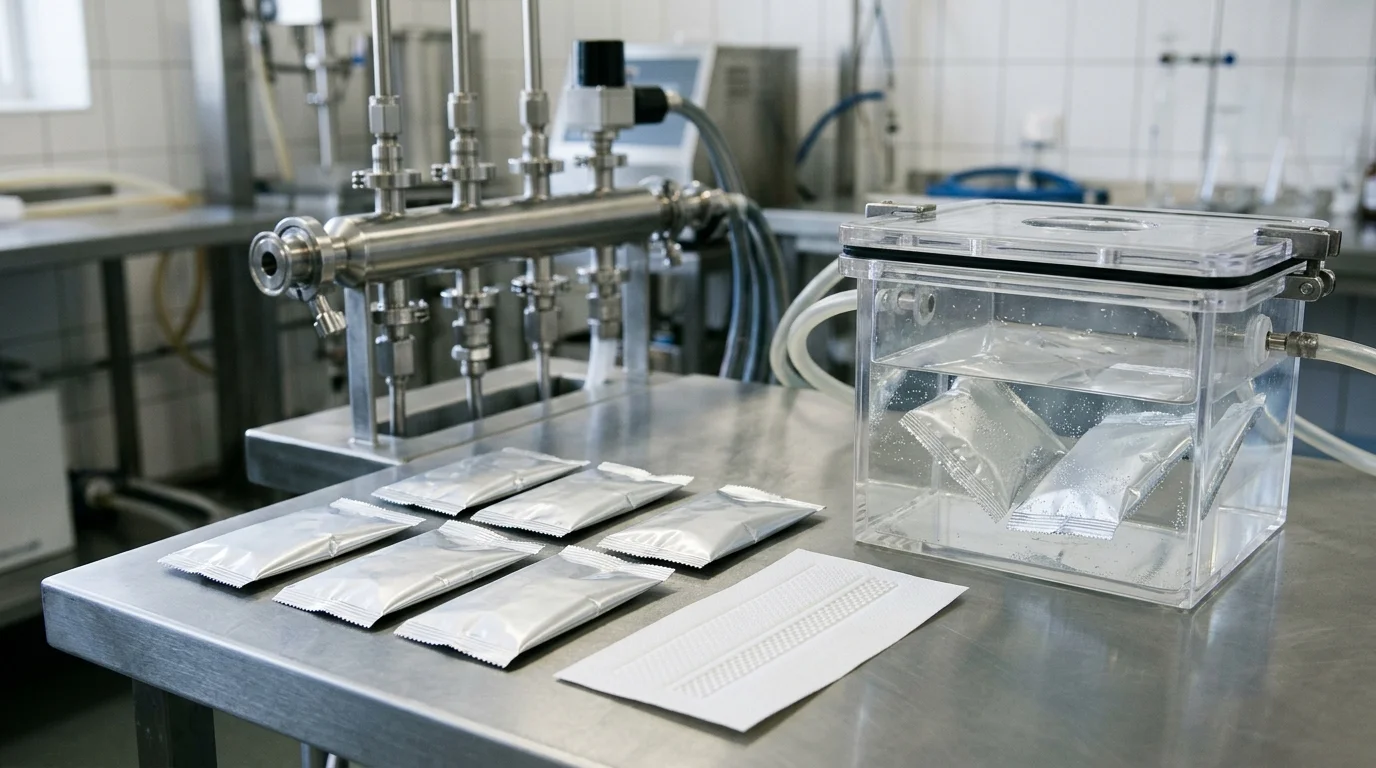
Under ASTM F2096 internal pressurization bubble leak testing, the test method covers the detection of gross leaks in packaging with a method sensitivity down to 250 μm (0.010 in.) with an 81 % probability.
Under ASTM D3078 vacuum bubble emission leak testing of flexible packaging, positive pressure inside the pouch after the vacuum is drawn may force the product to plug small leaks.
Compare our LINEVO powder and granule sachet machine configurations
Evaluate our multi-lane servo auger powder platform and our granule sachet configuration alongside our multi-lane sachet machines overview, our granule sachet machines overview, and our sachet packaging machine price guide.
In our LINEVO catalog, the Multi-lane powder sachet machine is configured with a servo auger filler and a four-side seal format.
Our LINEVO Multi-Lane Powder Sachet Packaging Machine is a high-efficiency multi-lane four-side seal sachet bagger with an independent servo auger dosing matrix and passive dust-controlled sealing.
For our LINEVO Multi-lane powder sachet machine, output, sachet dimensions, and utilities are specified with the selected powder, dose, film, and lane configuration.
On multi-lane machines, the average fill weight across lanes can look fine while one lane runs light and another runs heavy, so operators check lane by lane and sample every lane during a run, outer ones included.
In our LINEVO catalog, the LV-350X is a four-side seal granule sachet machine.
In our LINEVO catalog specification for the LV-350X, the fill range is 1 to 50 g, the sachet length is 50 to 180 mm, and the sachet width is 30 to 80 mm per lane.
According to multi-lane powder packaging engineering documentation, distributing powder evenly across 6 to 12 parallel augers requires specialized manifold designs.
In a powder sachet machine builder's specifications, the BY-JLB160X powder sachet model is optimised for ultra-fine powders — pharmaceuticals, probiotics, and vitamin powder — with a range of 10–100 g.
What to send for a milk powder or creamer sachet machine quotation
Prepare the following project details before scheduling a trial on our product and film sample testing page or requesting a line proposal:
- Dairy powder or creamer formulation type, fat and moisture profile, bulk density range, and whether the blend contains multiple ingredients such as coffee, creamer, and sugar.
- Target fill weight per sachet, sachet outer width and length drawing, and seal format preference.
- Barrier laminate roll structure, nominal film thickness, and any pre-gassing or nitrogen flushing residual-oxygen target and measurement protocol.
- Target shift output, preferred lane layout, and facility electrical, compressed-air, nitrogen, and humidity conditions.
- Cleaning and changeover requirements, contact-surface material documentation needs, and seal or leak verification procedures.
Send your milk powder or creamer details, sachet drawing, barrier film structure, and output target on WhatsApp so our engineering team can review the auger tooling, dust extraction, and nitrogen flushing setup for your project.
Frequently asked questions
How do vertical auger fillers prevent cohesive milk powder from bridging or compacting in the hopper?
In All-Fill International UK's vertical auger filler design, the separately driven and controlled agitation blade rotates in the opposite direction to the auger, de-aerating and homogenising the powder and breaking any product bridge.
In All-Fill International UK's vertical auger filler design, the agitation blade extends down to the throat of the funnel, preventing rat-holing and cavitation and ensuring that the auger flights are consistently filled.
In All-Fill International UK's non-free-flowing powder auger setup, the auger features larger-diameter over-flights in the hopper section that push otherwise reluctant powder downwards to the funnel throat.
In All-Fill International UK's non-free-flowing powder setup, the agitation mode can be controlled so that it stops between fills to avoid overworking and compacting the powder.
Why do narrow sachet forming tubes need static neutralization and drop-height control for dairy powders?
In powder auger troubleshooting documentation, when fine tea powders (especially those with low moisture content) flow through an auger and a plastic chute, they generate a static charge that can exceed 10 kV, causing powder to cling to the fill tube, the pouch interior, and the seal jaws, leading to erratic fills and seal failures.
On an anti-static powder packaging line described in manufacturer documentation, static-control installation points at film unwinding, the forming tube, the filling nozzle exit, and the sealing zone achieve surface charge reduction to < ±50V from a typical > 5kV.
In an engineering analysis of narrow sachet and stick pack forming tubes, the narrow diameter acts like a chimney that accelerates the dust plume straight up into the sealing jaws, guaranteeing seal contamination if not properly managed.
According to fine-powder dust extraction engineering guidance, vacuum extraction suction power must be balanced carefully because too much suction siphons actual product from the primary dose, causing underweight bags.
What residual oxygen targets are reported for nitrogen-flushed milk powder packing (including sealed 25 kilograms bag MAP), and how should a sachet target be specified?
As reported by Packaging Europe on GEA's modified atmosphere milk powder packing technology for sealed 25 kilograms bags, the system gets Residual Oxygen consistently down to under 2%.
On a nitrogen-flushed powder packaging line described in manufacturer documentation, the nitrogen flushing system injects inert nitrogen into each bag before sealing, reducing residual oxygen to < 2% and extending shelf life by 30%–50% for oxidation-sensitive products such as milk powder and protein isolates.
If the product study calls for nitrogen flushing, specify the gas system, residual-oxygen target, and measurement method in the equipment review.
Why can vacuum bubble leak tests miss small seal leaks on filled milk powder sachets?
Under ASTM D3078 vacuum bubble emission leak testing of flexible packaging, positive pressure inside the pouch after the vacuum is drawn may force the product to plug small leaks.
Under ASTM F2096 internal pressurization bubble leak testing, the test method covers the detection of gross leaks in packaging with a method sensitivity down to 250 μm (0.010 in.) with an 81 % probability.
ASTM F88/F88M-23 is the Standard Test Method for Seal Strength of Flexible Barrier Materials.
Sources
- U.S. Food and Drug Administration (Cornell LII) — Dry Whole Milk Standard of Identity
- U.S. Food and Drug Administration (Cornell LII) — Nonfat Dry Milk Standard of Identity
- U.S. Food and Drug Administration (Cornell LII) — Dry Cream Standard of Identity
- Our LINEVO Engineering Library — Coffee and Milk Tea Sachet Packaging Machines
- Our LINEVO Engineering Library — Powder Sachet Packaging Machines
- Our LINEVO Engineering Library — Sachet Sizes and Fill Weight Guide
- Our LINEVO Engineering Library — Multi-Lane Sachet Packaging Machines
- Our LINEVO Official Catalog — Featured Machines Registry and Multi-Lane Powder Sachet Packaging Machine
- All-Fill International UK — Powder Filling Technology Guide
- All-Fill Inc. — Factors That Affect Auger Filling Accuracy
- Automate UK — All-Fill Micro-Filler Precision Powder Filling Release
- Auger Fabrication — Volumetric Cup Fillers Overview
- Pro-Fill Inc. — Choosing an Auger Filler for Powder Packaging
- Packaging Europe — GEA Sealed 25 Kilograms Bag Modified Atmosphere Packing Residual Oxygen Report
- A. Hatzopoulos — Flexible Packaging Sealing Troubleshooting Guide
- Greener Corporation — Thermal Transfer Efficiency and Sealing Jaw Carbon Impressions Guides
- LD PACK — Causes Analysis of Flexible Packaging Seal Failure
- Powder sachet machine manufacturers (product documentation; vendor names withheld) — Hopper Head-Pressure Control, Anti-Static Grounding and Ionization, Narrow-Tube Dust Extraction, Nitrogen Flushing, and Multi-Lane Manifold Design
- ASTM International — Flexible Barrier Seal Strength, Heat Sealability, Leak Detection, and Oxygen Gas Transmission Standards